$1 Million Challenge to World-Class Athletes: MrBeast's Sports Charity Experiment

MrBeast uses disadvantageous rules to pit amateurs against sports superstars, donating all prize money—revealing the format design logic of the creator economy.
MrBeast invited sports superstars including Haaland, Liu Meixian, Caitlin Clark, Gordon Ramsay, Simone Biles, and LeBron James, designing a series of one-on-one challenges with rules disadvantageous to the professionals, with $100,000 at stake. The results were full of suspense: Haaland drew due to psychological warfare, Liu Meixian's team "won" through numerical advantage, and Clark dominated three-pointers yet still donated the prize. Regardless of outcome, all prize money went to charity, including UN Women, Feeding Britain, and the LeBron James Family Foundation. The article points out that this "controlled unfairness" format is a core technique for emotional engagement in content creation, while Shopify's commercial placement was woven into the challenge, showcasing the creator economy's typical model of bundling sports entertainment, charity, and brand marketing.
When YouTube superstar MrBeast announced he was going head-to-head with sports legends like LeBron James, Simone Biles, and Erling Haaland with $100,000 on the line, many assumed it was just another attention-grabbing stunt. But after watching the full challenge, you realize this is actually a carefully designed sports entertainment experiment: winning or losing doesn't matter—where the money ends up is the real point.
A Mismatched Contest That Still Delivered Suspense
The first to appear was Manchester City striker Haaland. The challenge was a target-shooting contest, but to make things "fair," Haaland was forced to shoot from a farther distance. MrBeast's friend Nolan didn't even hit the target, making for an awkward moment.

What's more interesting is the psychological warfare. MrBeast's team yelled at Haaland, "You're a terrible player" and "Messi would've hit the bullseye by now," trying to disrupt the elite striker's rhythm. Haaland was indeed affected somewhat, sending one shot flying over the target. In the end, it was a draw—the subscriber took home $50,000, and Haaland donated the other $50,000 to a charity of his choosing.
This segment reveals a pattern: when professional athletes are placed in unfamiliar rules and high-pressure environments, their advantage is significantly compressed. This isn't to deny their professional ability—it shows that entertainment-oriented formats themselves act as an "equalizer."
A Figure Skating Champion's 100 Spins and a Genuine Team Effort
Next up was Winter Olympic gold medalist Liu Meixian. The challenge involved retrieving bags on ice with obstacles: limbo, jumping to grab bags, and finally completing 100 spins. MrBeast's team admitted they "couldn't even stand steadily," so they pinned their hopes on "strength in numbers."
The result was unexpected. The team grabbed all the bags before Liu Meixian finished her spins, "defeating the professional." But MrBeast emphasized in the video that this result was built on the premise that "we made it extremely difficult." The $50,000 prize was ultimately donated to UN Women, as designated by Liu Meixian.
What's worth noting here isn't "amateurs beat professionals," but how format design gives the weaker side a chance under specific conditions. This "controlled unfairness" is precisely the core technique of content creation.
Limbo is a traditional dance game originating from the Caribbean, where participants must bend backward to pass under a progressively lowering bar without any part of their body touching it. In ice or land obstacle courses, it's often used as a segment to test flexibility and balance. As a figure skater, Liu Meixian's specialized training—including Biellmann spins and layback spins—demands extremely high lower back and spine flexibility, so limbo isn't a completely unfamiliar movement pattern for her. However, center-of-gravity control on a low-friction ice surface still poses an additional challenge.
From Cricket to Basketball: The Absurdity and Authenticity of Cross-Discipline Challenges
Indian cricket star Hardik was brought in to play baseball, with the reasoning being "I'm American, we don't play cricket." The world-class cricketer's first swing wasn't great, but he eventually found his groove through adjustments. The prize was split into two parts, donated respectively to stray dog rescue and programs for underprivileged children.
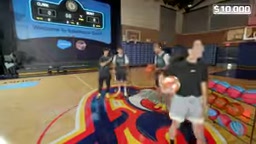
Even more dramatic was the three-point showdown with WNBA star Caitlin Clark. The rule: whoever hits a half-court shot first wins $50,000, and Clark could earn an extra $10,000 for each three-pointer she made. Clark was nearly perfect, while MrBeast's team kept air-balling.

Clark demonstrated the consistency of an elite shooter throughout, while MrBeast's team's "airball show" became the comedic highlight. In the end, Clark's foundation received the donation to support young people pursuing their dreams.
Half-court shot refers to an ultra-long-range shot taken from near the midcourt line, approximately 47 feet (14.3 meters) from the basket on an NBA-standard court. Professional players occasionally practice it in training, but in-game success rates are extremely low, typically regarded as lucky shots. As a top WNBA shooter, Caitlin Clark hit multiple half-court buzzer-beaters during her college career, and such clips are highly shareable on social media. The video's rule of "whoever hits a half-court shot first wins" essentially uses a low-probability event as the criterion for victory, thereby amplifying suspense—Clark's near-perfect shooting versus MrBeast's team's airballs creates a stark contrast, leveraging viewers' intuitive understanding of how difficult long-range shots are.
Gordon Ramsay's Kitchen Domination and Simone Biles at 100 Feet
Gordon Ramsay was brought in for the cooking challenge. Each of MrBeast's three team members made one dish, while Ramsay made three solo—theoretically, the numerical advantage could compensate for the skill gap. But in reality, Ramsay trash-talked while cooking: "This meatball is the same size as your brain," and even recreated the classic "idiot sandwich" meme.

The judges ultimately chose MrBeast's team's burger, but Ramsay's pasta was clearly more popular—the judges went back for more after finishing. This "disconnect between winning and taste" actually made the challenge more talked-about. The $100,000 was donated to Feeding Britain.
The finale featured gymnastics legend Simone Biles. The challenge took place at 100 feet in the air, with four balance beams of decreasing width—each one completed earned more prize money for charity. Biles herself walked the final beam, only 4 inches wide, winning $100,000 for Friends of the Children. She revealed that she was once a foster child, which is why she chose this organization.
"Idiot Sandwich" is an internet meme that originated from Gordon Ramsay's 2015 appearance on The Late Late Show with James Corden. Ramsay sandwiched Corden's face between two slices of bread and called him an "idiot sandwich." The clip has since accumulated tens of millions of views on YouTube, becoming a signature symbol of Ramsay's "harsh judge" persona. Recreating this meme in the MrBeast video essentially taps into the audience's collective memory of Ramsay's variety-show image, trading a low-cost cultural Easter egg for an instant laugh. This also explains why the judges ultimately chose MrBeast's team's burger yet still found Ramsay's pasta more popular—the narrative focus wasn't on cooking skill but on character interaction.
LeBron's One-Minute Three-Point Showdown and the Closing "Lottery Ticket"
The video finally revealed a hidden storyline: MrBeast had previously competed in a one-minute three-point contest against LeBron James at a charity event, with $100,000 on the line. MrBeast joked, "I'm not Curry," but he ultimately won and donated $100,000 to the LeBron James Family Foundation.
LeBron obligingly shouted "Jimmy" on camera, bringing the whole challenge to a close.
What This Experiment Is Really Selling
On the surface, this is an entertainment show of "amateurs challenging professionals." But the logic running through the entire video is clear: each challenge sets rules disadvantageous to the professional athletes, making the outcome full of uncertainty; and regardless of who wins, the prize money ultimately flows to charity.
MrBeast repeatedly emphasized in the video that "the money will be donated," and even integrated sponsor Shopify's placement into a "teach you how to open a store" segment. This approach of packaging commercial content, sports entertainment, and charitable donations together is a typical sample of today's creator economy.
For ordinary viewers, the appeal is watching superstars stumble and amateurs charge in recklessly; for content creators, what's worth studying is the format design, pacing control, and emotional manipulation. And for charities, this is a collaboration where traffic and goodwill arrive simultaneously.
Were the professional athletes really "defeated"? By the score, sometimes yes; but in terms of professional ability, they were just playing by someone else's rules. That's probably the most honest thing about this experiment.
Creator Economy refers to the business model led by independent content creators who monetize directly through platform tools, encompassing ad revenue sharing, brand placements, merchandise, paid subscriptions, and more. MrBeast is a leading example of this model: his video production costs are extremely high (up to a million dollars per episode), but he achieves profitability through YouTube ads, sponsors (like Shopify), and his own brands (Feastables chocolate). This video packages the Shopify placement as a "teach you how to open a store" challenge segment—a "native advertising" strategy where commercial information is embedded in the narrative logic rather than interrupting the content, thereby reducing viewer resistance. This approach of bundling charitable donations, sports entertainment, and brand marketing reflects the evolution of the creator economy from pure traffic monetization to "content as advertising."
Related articles

34 AI Coding Assistants Battle It Out in the Terminal — How to Avoid Picking Wrong
34 AI coding assistants are flooding the terminal, and Orca supports multi-agent parallelism. This article analyzes the consolidation trend behind the gold rush, the cost traps of multi-agent parallelism, and how to maintain an agent-neutral workflow to avoid picking the wrong tool.

Gemini CLI in Practice: An AI Coding Agent in Your Terminal
A deep dive into Gemini CLI: from installation and authentication to building a task management app hands-on, covering plan mode, auto-debugging, GEMINI.md context persistence, and token cost tracking.

Open Design: A Free Open-Source Alternative to Claude Design That Activates Your Coding Agent
Open Design is a free, open-source Claude Design alternative that runs locally with 250+ design skills, auto-detects 16 coding agents, and supports prototypes, slides, and mobile UIs.