10 Years in the Field, Never Built a Model: The Gap Between Expectations and Reality for Data Scientists

A 10-year data scientist reveals the stark gap between job expectations and the reality of daily work.
A data science professional with nearly a decade of experience across four companies reveals he has never built a single regression model at work. This article examines why data science roles often devolve into data cleaning and dashboards, explores the anxiety of skill atrophy, the trap of title inflation, and the difficult choice between staying technical or moving into management — offering practical advice for navigating these challenges.
A Data Scientist's True Confession
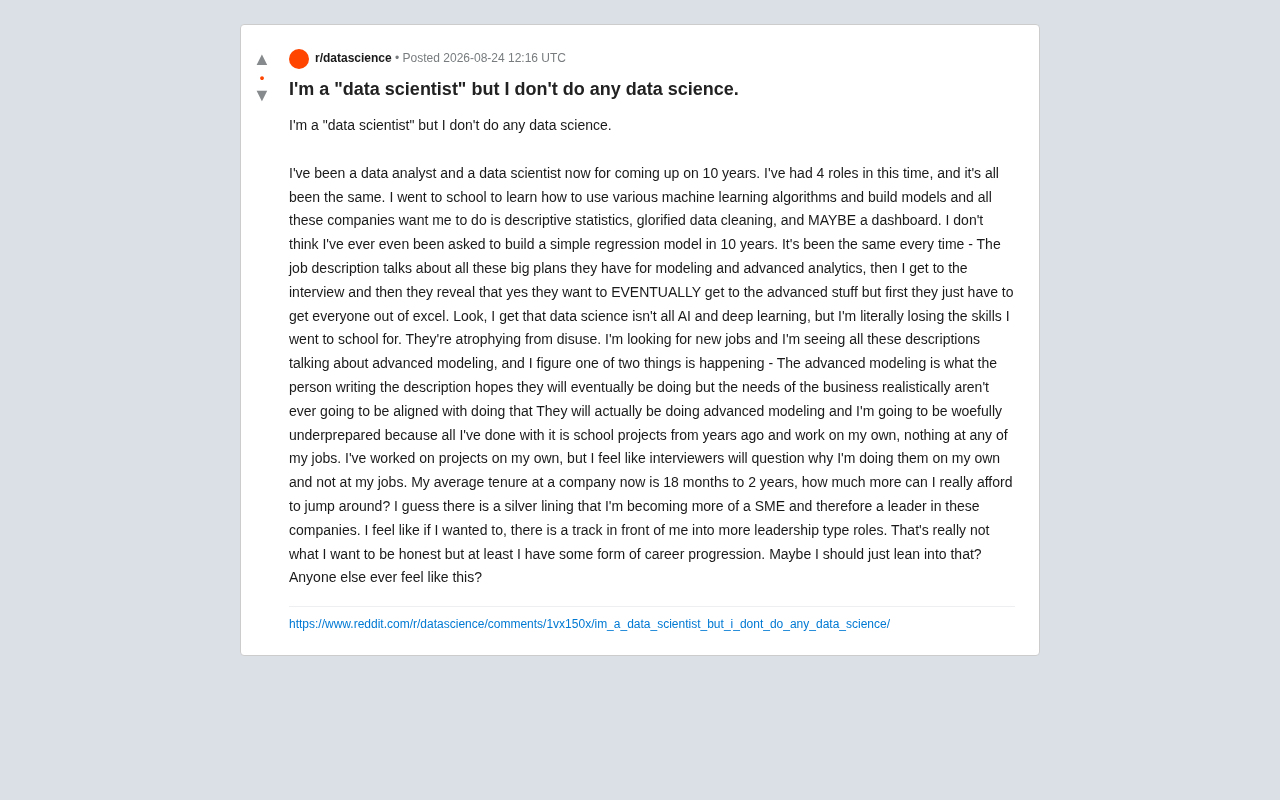
Recently, a data science professional with nearly a decade of experience posted a confession on Reddit that struck a deep chord across the industry. His core frustration cuts right to a major pain point: "I'm a 'data scientist,' but I never do any data science."
This poster has a dual background as both a data analyst and data scientist. Over nearly 10 years across 4 companies, he discovered that every job was strikingly similar — the machine learning algorithms and model-building skills he learned in school were almost never put to use. Instead, his work consisted of descriptive statistics, "glorified" data cleaning, and the occasional dashboard build.
He even admitted: "I can't recall anyone asking me to build even a simple regression model in all these 10 years." Behind this statement lies the massive and long-standing gap between expectations and reality across the entire data science industry.
The Chasm Between Job Descriptions and Actual Work
This practitioner noticed a recurring pattern: job descriptions (JDs) always paint grand visions of modeling and advanced analytics, but once you get to the interview stage, companies come clean — those "advanced capabilities" are something they "eventually" want to do. The most pressing task right now is actually getting everyone off Excel.
This phenomenon isn't an isolated case — it's an honest reflection of insufficient data maturity at many organizations. According to the analytics maturity model proposed by consulting firms like Gartner, enterprise data capabilities typically progress through five stages: descriptive analytics (what happened), diagnostic analytics (why it happened), predictive analytics (what will happen), prescriptive analytics (what should be done), and autonomous analytics (automated decision-making). The vast majority of companies are still stuck in the first two stages, even when their job postings claim to need predictive modeling and machine learning capabilities. This means that many data scientists are hired only to find their actual work corresponds to the bottom of the maturity model — data integration, quality governance, and basic reporting — rather than the advanced analytical work they were trained for. Companies aspire to the halo of AI and deep learning, but their actual data infrastructure, data quality, and business needs are often still at the stage of needing "data governance" and "basic reporting."
Why Does This Gap Exist in Data Science Roles?
From an industry perspective, this gap typically stems from several causes:
- Weak data foundations: Many companies rush to hire "data scientists" before establishing reliable data pipelines and high-quality data, leaving new hires to do data cleaning and basic governance work first. A "reliable data pipeline" refers to the automated process of data collection, cleaning, transformation, and storage (i.e., the ETL/ELT process) — it's the prerequisite for all downstream analysis and modeling. Without this foundation, even the most sophisticated algorithms are useless.
- Business needs mismatch: Business problems that truly require complex modeling to solve are actually quite rare. Most business decisions can be adequately supported by clear descriptive statistics and visualizations. The academic concept of the "No Free Lunch Theorem" offers a similar insight in practice — complex models don't always outperform simple methods. In real-world business scenarios with limited data and noisy features, a well-designed rule engine or simple statistical test is often more reliable and interpretable than a deep learning model.
- Title inflation: The title "data scientist" itself has been overused, with many roles that are essentially data analyst positions given the more glamorous label. This title inflation is directly linked to the 2012 Harvard Business Review article that called data scientist "the sexiest job of the 21st century." After that, the title quickly became a marketing tool for companies to attract talent. LinkedIn data shows that between 2012 and 2022, positions with the title "data scientist" grew by approximately 650%, but a significant proportion of these roles had responsibilities more closely aligned with traditional data analysts or business intelligence (BI) analysts. Similar title dilution is not uncommon in the tech industry — terms like "full-stack engineer" and "growth hacker" have undergone similar watering down. The direct consequence of title inflation is that job seekers can't judge actual job content by the position name, and it also creates misalignment between salary expectations and actual responsibilities.
The Anxiety of Skill Atrophy: A Data Scientist's Career Crisis
The poster's deepest anxiety is this: "The skills I learned in school are deteriorating from prolonged disuse." This is an extremely real career crisis.
This skill deterioration is well-supported in cognitive science research, known as "Skill Decay." Studies show that procedural knowledge (such as writing machine learning code or tuning model hyperparameters) can decline 40% to 60% in proficiency if unused for 6 to 12 months. This is especially pronounced in technical fields requiring continuous practice. What makes it even more daunting is that the technology stack in data science evolves extremely rapidly — from Scikit-learn to PyTorch, from traditional machine learning to large language models (LLMs), from batch processing to real-time inference — even if existing skills don't atrophy, the rapid emergence of new technologies causes a decline in relative competitiveness. This dual pressure of "absolute decay" plus "relative obsolescence" creates a unique career anxiety for technical professionals.
He faces a catch-22. When browsing new job postings, positions mentioning "advanced modeling" leave him torn between two possibilities:
- The description is aspirational: The person who wrote the JD simply listed "goals they hope to achieve," but the actual business needs will never truly align to the point of requiring advanced modeling.
- The requirements are real: If the role genuinely needs advanced modeling, then he would be seriously underprepared — because his entire modeling practice is limited to school projects and personal side projects from years ago, never applied in any professional setting.
This "use it or lose it" skill anxiety is a shared nightmare for many technical professionals. When core skills can't be sharpened through real-world practice over long periods, the "data science" label on a resume gradually becomes hollow.
The Awkward Position of Personal Projects
To keep his skills from completely rusting, this practitioner has been working on personal projects in his spare time. But he immediately runs into a new worry: will interviewers question why he only does this stuff on the side rather than at work?
This concern is equally realistic. The gap between personal projects and commercial projects is far larger than it appears on the surface. In real business environments, data science projects face a series of challenges rarely encountered in personal projects: Data Drift (where the distribution of input data changes after a model goes live, causing performance degradation), model interpretability requirements (especially in regulated industries like finance and healthcare, where model decisions must be auditable), A/B testing and causal inference (rather than merely pursuing prediction accuracy), and MLOps lifecycle management (including model version control, continuous monitoring, automatic retraining, etc.). Additionally, commercial projects typically require repeated communication with product managers, engineers, and business stakeholders to negotiate between model accuracy and business constraints (such as inference latency and computational cost). These soft skills and systems thinking are difficult to cultivate through personal projects.
Without the complexity of real work environments — dirty data, ambiguous requirements, cross-team collaboration, model deployment to production — personal projects can hardly fully substitute for hands-on experience.
To make matters worse, his average tenure at each company is only 18 months to 2 years. Frequent job-hopping already has him worried: "How many more of these jumps can I afford?" In many companies' hiring screening processes, candidates with average tenures below two years are often flagged as "flight risks," making his path of switching jobs to gain hands-on modeling experience even more difficult.
Transitioning to Management: Compromise or Way Out?
Amid this anxiety, the poster does see a silver lining: as his experience accumulates, he's gradually becoming a subject matter expert (SME) within his company, with a faint path toward management and leadership roles emerging.
However, his attitude toward this is conflicted. He admits: "Honestly, this isn't what I really want." But at least it represents some form of career progression. He's even started to convince himself: "Maybe I should just go with the flow and move into management?"
This actually reveals the classic fork in the road of technical career development — the technical expert track vs. the management track. This divergence has been gradually institutionalized at Silicon Valley tech companies, forming what's known as a "dual-track promotion system." Companies like Google and Meta pioneered clear parallel paths: on the technical track, engineers can progress from junior all the way to Distinguished Engineer or even Fellow, with compensation and influence on par with VP-level managers; on the management track, there's the traditional path from Tech Lead Manager to Director to VP. However, in the data science field, this dual-track system is far from mature. Many companies lack clear technical promotion tracks for roles like "Principal Data Scientist" or "Data Science Fellow," meaning that senior data scientists at a certain career stage often find management as the only visible upward path. This institutional gap exacerbates the dilemma of "passive career transitions."
When the path of deep technical expertise is blocked by environmental constraints, transitioning to management often becomes a seemingly natural alternative. But if one's true passion lies in technology itself, this "passive transition" can lead to deeper levels of career burnout. The so-called "Peter Principle" in management theory — the idea that people tend to be promoted to their level of incompetence — applies equally here: an outstanding individual technical contributor doesn't necessarily make an outstanding team manager.
Practical Advice for Data Science Practitioners
This practitioner's dilemma is actually a microcosm of the entire data science industry. For those facing similar situations, the following approaches may offer a way forward:
Redefine "Value" in Your Work
Descriptive statistics, data cleaning, and dashboards may seem "low-level," but if they can truly drive a business from the Excel era toward data-driven decision-making, their value is no less than that of flashy models. The key is whether you can proactively identify opportunities to introduce modeling within this work. In fact, in the data science workflow, data preparation typically consumes 60% to 80% of total project time. True differentiated competitiveness often lies not in knowing the most complex algorithms, but in being able to start from business problems, identify hidden modeling opportunities in the data, and solve them with the simplest effective methods.
Proactively Create Modeling Opportunities
Rather than waiting for the company to assign advanced tasks, proactively propose modeling solutions within your existing work — for example, using predictive models to optimize a business metric such as customer churn prediction, inventory demand forecasting, or marketing attribution analysis. Even if the scope is small, it's real work experience you can put on your resume. An effective strategy is to first build a baseline model using simple methods (such as logistic regression), demonstrate value to management with quantifiable business metrics (e.g., "estimated to reduce customer churn by X%"), and thereby secure more resources and more complex modeling projects.
Choose Your Next Company Carefully
In interviews, rather than passively accepting the JD's description, ask probing questions: How many modeling projects does the team currently have underway? How mature is the data infrastructure? Is there an established MLOps process? Are models already deployed in production? These questions can help assess the true nature of a role and avoid falling into another cycle of "expectation-reality mismatch." Additionally, look at the company's technical blog, open-source contributions, and conference talks — teams that are genuinely doing advanced data science work typically have public technical output.
Plan the Management Track Proactively
If you ultimately choose to move into a leadership role, it shouldn't be a passive compromise but rather an active assessment of whether you're truly suited for and passionate about management work. The technical expert-manager hybrid (such as a technical director or chief data scientist) is also a middle path that preserves technical influence while taking on leadership responsibilities. It's worth noting that excellent data science team leaders need a unique "translation" ability — converting business needs into data problems and translating technical results into business language — which is itself a high-value skill worth cultivating deeply.
Conclusion
"I'm a data scientist, but I don't do data science" — this slightly self-deprecating statement captures the struggle countless technical professionals face between ideals and reality. The gap between the industry's halo and actual demand has always been too significant to ignore.
For every practitioner, what matters most may not be agonizing over whether the title lives up to its name, but rather clearly recognizing what career direction they truly want and proactively creating opportunities for it within real-world constraints. Whether it's doubling down on deep technical expertise or transitioning to management leadership, an active choice is always better than a passive compromise. In this era of surging AI waves, the very definition of a data scientist's role continues to evolve — from traditional modeling expert to a broader "data value creator." Perhaps embracing this evolution itself is the first step toward breaking through.
Related articles

DeepCell: One-Click AI Generation of Documents, Spreadsheets, and Slides
DeepCell tops Product Hunt with one-click generation of documents, spreadsheets, and slides, using the .deepcell format for linked updates, designed for System 2 tasks like modeling and sales reviews.

Doneas: 15-Minute Daily Accountability Calls That Keep Indie Developers From Procrastinating
Doneas is a daily accountability tool for indie developers: plan tasks on Monday, join a 15-minute call with five builders each day, and log deliveries on a public progress page. This article analyzes its core mechanics, effectiveness, and potential issues around retention and matching.

Fastlane 2.0: Fully Automated AI Ad Campaigns, From Creative to Optimization
Fastlane 2.0 is an AI ad automation tool: enter your website and it learns your brand, generates video and image ads, and runs and optimizes them on Meta, TikTok, Instagram, and YouTube.