Tailcat: Tailscale's Official Decentralized Minimalist Networking Solution
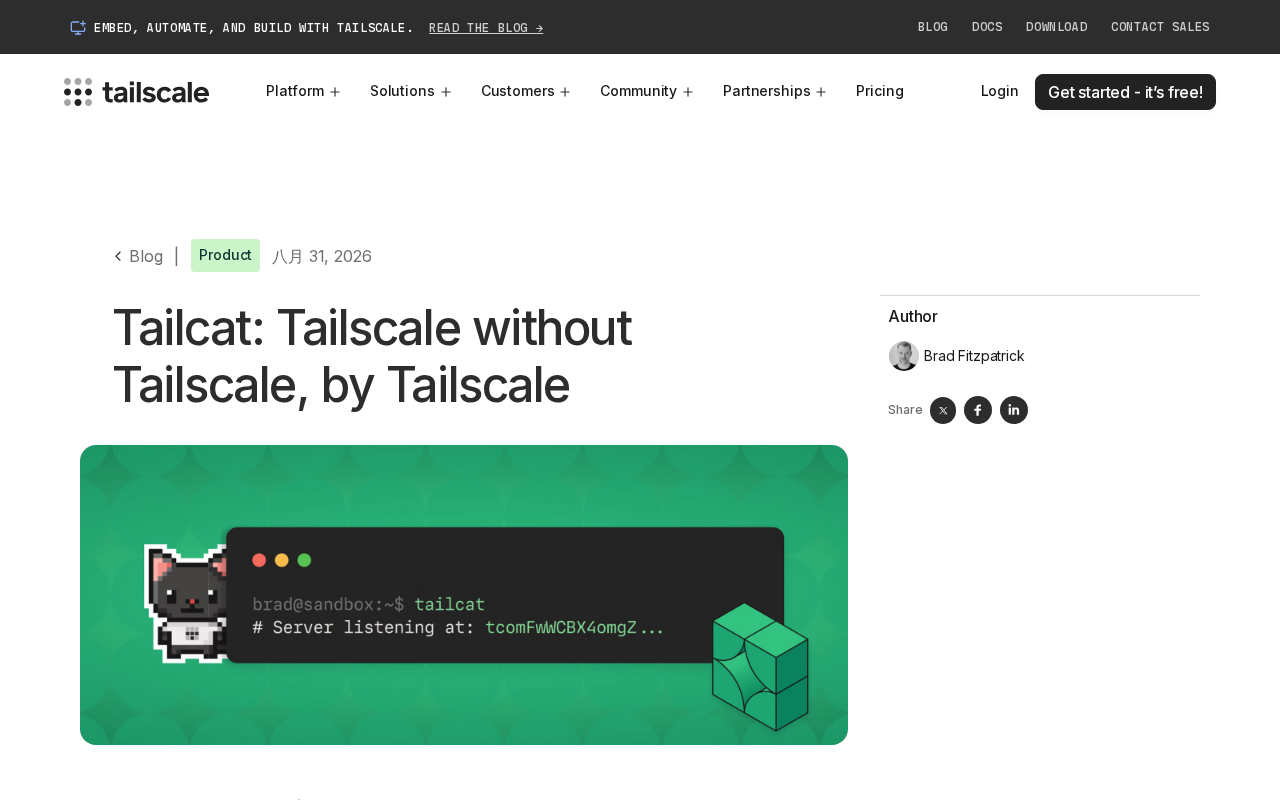
Tailscale launches Tailcat, a decentralized networking tool that removes control plane dependencies.
Tailcat is an official Tailscale project offering decentralized WireGuard networking without relying on Tailscale's central coordination servers. Designed for self-hosting enthusiasts and privacy-conscious users, it provides greater autonomy, better privacy, and lower trust costs. The article explores how Tailcat differs from Headscale, its technical challenges, and what it signals about the industry trend toward SaaS decoupling and open core models.
A Thought-Provoking Project Name
When a company releases a tool called "Without Tailscale, by Tailscale," the naming itself sends a signal worth pondering. Tailscale's recently released Tailcat project debuted with precisely this kind of self-deprecating flair, sparking widespread attention in the tech community on Hacker News.
Behind this naming lies a reflection and exploration by Tailscale of its own product positioning: how to retain core networking capabilities while stripping away the dependencies and control layers that make deployment complex.
What Is Tailscale: Setting the Context
Before diving into Tailcat, it's essential to understand what Tailscale itself does. Tailscale is a zero-configuration VPN (Virtual Private Network) service built on the WireGuard protocol, enabling devices to communicate directly through secure encrypted tunnels regardless of their network environment.
WireGuard itself is a next-generation VPN protocol initially developed by Jason A. Donenfeld starting in 2015, officially merged into the Linux 5.6 kernel mainline in 2020. Compared to traditional IPsec and OpenVPN, WireGuard's codebase is only about 4,000 lines (versus OpenVPN's tens of thousands), making practical security auditing feasible. It uses the Noise protocol framework for key exchange, ChaCha20 for symmetric encryption, Poly1305 for message authentication, Curve25519 for Elliptic Curve Diffie-Hellman key agreement, and BLAKE2s for hashing. WireGuard's design philosophy is "opinionated cryptography" — it offers no algorithm negotiation options, fundamentally preventing protocol downgrade attacks. This minimalist design gives it performance far superior to traditional solutions, with excellent throughput and latency — which is precisely why Tailscale chose it as the underlying transport protocol.
Tailscale's Core Value
Tailscale's success largely stems from its encapsulation of complexity. Traditional VPNs require tedious key exchange, firewall configuration, and NAT traversal handling, while Tailscale automates all of this through a centralized coordination server, allowing users to build a mesh network spanning all their devices simply by logging in.
NAT traversal is one of the trickiest technical challenges in peer-to-peer network communication. Due to IPv4 address exhaustion, the vast majority of home and enterprise devices sit behind NAT devices without publicly reachable IP addresses. Tailscale uses a combination of NAT traversal techniques: first, it uses STUN (Session Traversal Utilities for NAT) servers to discover its public address and port mapping type; then it attempts UDP hole punching for direct connections; for scenarios where direct connections aren't possible (such as symmetric NAT), it falls back to DERP (Designated Encrypted Relay for Packets) relay servers to forward traffic. This mechanism is encapsulated in Tailscale's proprietary netcheck and magicsock components, completely transparent to users.
In Tailscale's architecture, the coordination server plays a crucial but often misunderstood role. It does not forward actual user data traffic — data always travels directly between devices through WireGuard tunnels (end-to-end encrypted). The coordination server's responsibilities include: identity authentication (typically integrating SSO providers like Google, Microsoft, GitHub), distributing and rotating WireGuard public keys, maintaining connection information and ACLs (Access Control Lists) for all nodes in the network, and assisting with endpoint discovery for NAT traversal. This architectural design means that even if Tailscale's servers were compromised, attackers couldn't decrypt user communications — but they could learn the network topology, i.e., which devices are communicating with each other. This is precisely what makes privacy-conscious users uneasy, and what has given rise to alternative solutions.
However, this convenience also introduces a dependency — establishing connections between devices requires reliance on Tailscale's control plane. For users who pursue maximum autonomy and control, this creates both psychological and technical concerns.
What Is Tailcat: A Decentralized Networking Experiment
Tailcat's core philosophy is evident from its tagline: it aims to provide the Tailscale-style networking experience without depending on Tailscale's core infrastructure. This is a "subtraction-first" approach to product design.
What Does Stripping the Control Plane Mean?
For self-hosting enthusiasts and privacy-conscious technical users, removing the dependency on a third-party coordination server is significant. Specifically:
- Greater autonomy: Network establishment is no longer subject to the availability of a centralized service
- Better privacy protection: Device connection metadata no longer passes through external servers
- Lower trust costs: No need to entrust network topology information to a third party
It's worth noting that after stripping the control plane, Tailcat needs to solve a series of technical challenges: without centralized coordination, how do you securely distribute WireGuard public keys? How do you achieve endpoint discovery for NAT traversal? How do you manage devices joining and leaving? The solutions to these problems will largely determine Tailcat's practicality and applicable scenarios.
How Does Tailcat Differ from Headscale?
This approach echoes existing projects in the open-source community, most notably Headscale — an open-source reimplementation of the Tailscale coordination server.
Headscale is an open-source project initiated by Juan Font in 2021, written in Go, aiming to provide a self-hosted alternative to the Tailscale coordination server. It implements the control server API expected by Tailscale clients, allowing official Tailscale clients to connect directly to a Headscale instance instead of Tailscale's cloud servers. As of 2024, Headscale has earned over 20,000 stars on GitHub and boasts an active community. However, since Tailscale's control protocol is not fully documented publicly, Headscale developers need to rely on reverse engineering to maintain compatibility, which occasionally causes compatibility issues during version upgrades.
The key difference is that Tailcat is officially released by Tailscale, making it more of a formal endorsement of the "minimalist" approach, with potential inherent advantages in compatibility and ongoing maintenance. Tailcat's emergence may also fundamentally change the compatibility challenges Headscale faces — it signals that the Tailscale team formally acknowledges and responds to the self-hosting community's needs, rather than viewing them as a competitive threat.
Community Reactions and Discussion
Although discussion of this project on Hacker News is still in its early stages, it touches on a long-standing focal point of technical debate: the trade-off between convenience and control.
The Eternal Tug-of-War Between Centralization and Decentralization
Most modern network services adopt centralized architectures because they significantly lower the barrier to entry. But centralization also entails single points of failure, privacy risks, and vendor lock-in. Tailcat's emergence reflects that even teams behind products known for "ease of use" are seriously addressing user demands for decentralization.
Vendor lock-in is one of the core strategic risks organizations face in the cloud computing era. When an organization's critical infrastructure becomes deeply dependent on a specific vendor's proprietary interfaces and services, migration costs grow exponentially over time. At the network layer, this lock-in is particularly dangerous — if a VPN provider experiences service outages, pricing changes, or policy shifts, the entire organization's internal communications could be affected.
For enterprise users, control plane autonomy also relates to compliance and data sovereignty concerns. Data sovereignty regulations worldwide (such as EU GDPR, China's Data Security Law, and Brazil's LGPD) impose increasingly stringent requirements on the cross-border transfer of network metadata. Network connection metadata — who communicates with whom and when — is considered sensitive information requiring local storage in some jurisdictions. This makes network solutions that can be fully deployed on-premises no longer just a matter of technical preference, but a compliance necessity. When sensitive network connections must be kept entirely within owned infrastructure, solutions like Tailcat have a clear use case.
What Tailcat Means for the Industry
Though Tailcat is a small project, it reflects a noteworthy trend: leading SaaS networking providers are proactively offering "decoupling" options, allowing users to freely choose between managed services and self-hosted deployments.
This "SaaS decoupling" trend is not an isolated case. In recent years, several leading infrastructure providers have begun offering separable versions of their core capabilities: HashiCorp's Terraform has long provided an open-source version alongside commercial cloud services; GitLab offers both SaaS and fully self-hosted options; Supabase, as an open-source alternative to Firebase, allows all components to be self-deployed. This strategy is known as an evolution of the "Open Core" business model — companies build developer trust and ecosystem stickiness by opening up underlying technology, while monetizing through managed services, enterprise support, and premium features.
This product strategy is, in some sense, a sign of market maturity. As core user groups develop deeper understanding of the underlying technology, their demands for transparency and control increase accordingly. Companies confident enough to release products like "ourselves without ourselves" actually demonstrate confidence in their core competitiveness — the real value lies not in locking users in, but in continuously delivering the best experience. For Tailscale, the deeper logic behind launching Tailcat may be: rather than letting third-party solutions like Headscale erode the self-hosting market, proactively embrace this demand, turning potential competition into ecosystem expansion while proving that their technical value stands independent of their commercial services.
Conclusion: Tailcat Is Worth Watching
Tailcat is a fascinating product experiment that responds, with a touch of humor, to the tech community's longstanding call for decentralized networking. Although publicly available information is still limited, the direction it represents — returning control to users while preserving excellent technical capabilities — is undoubtedly worth following.
For developers interested in network privacy, self-hosting, and decentralized technology, Tailcat deserves a spot on the watch list. It may not replace mainstream Tailscale services, but it provides a purer, more autonomous option for specific use cases.
Related articles

Chain of Thought Isn't Just for AI: How Humans Can Use CoT to Improve Thinking Quality
Chain of Thought isn't just a prompt trick for large models. Starting from a Hacker News discussion, this article analyzes why CoT works for human thinking too, breaks down actionable ways to transfer it, and highlights the key differences between human CoT and machine CoT.
Cloudflare Teams Up with OpenAI: Closi…
Cloudflare Teams Up with OpenAI: Closing the Loop from Vulnerability Discovery to Defense with AI
Cloudflare uses OpenAI Daybreak to investigate security vulnerabilities and generate reviewable remediation plans, while developers use Codex to boost coding efficiency and quality.

Orca Multi-Agent Orchestration in Practice: A Guide to Parallel Collaboration with Claude and Codex
Orca is Stable AI's free open-source agent workbench supporting 34 agents like Claude Code and Codex in parallel. Learn its Git worktree isolation, multi-model orchestration, and mobile management.