11-Hour Video Course: Building Reasoning Models from Scratch
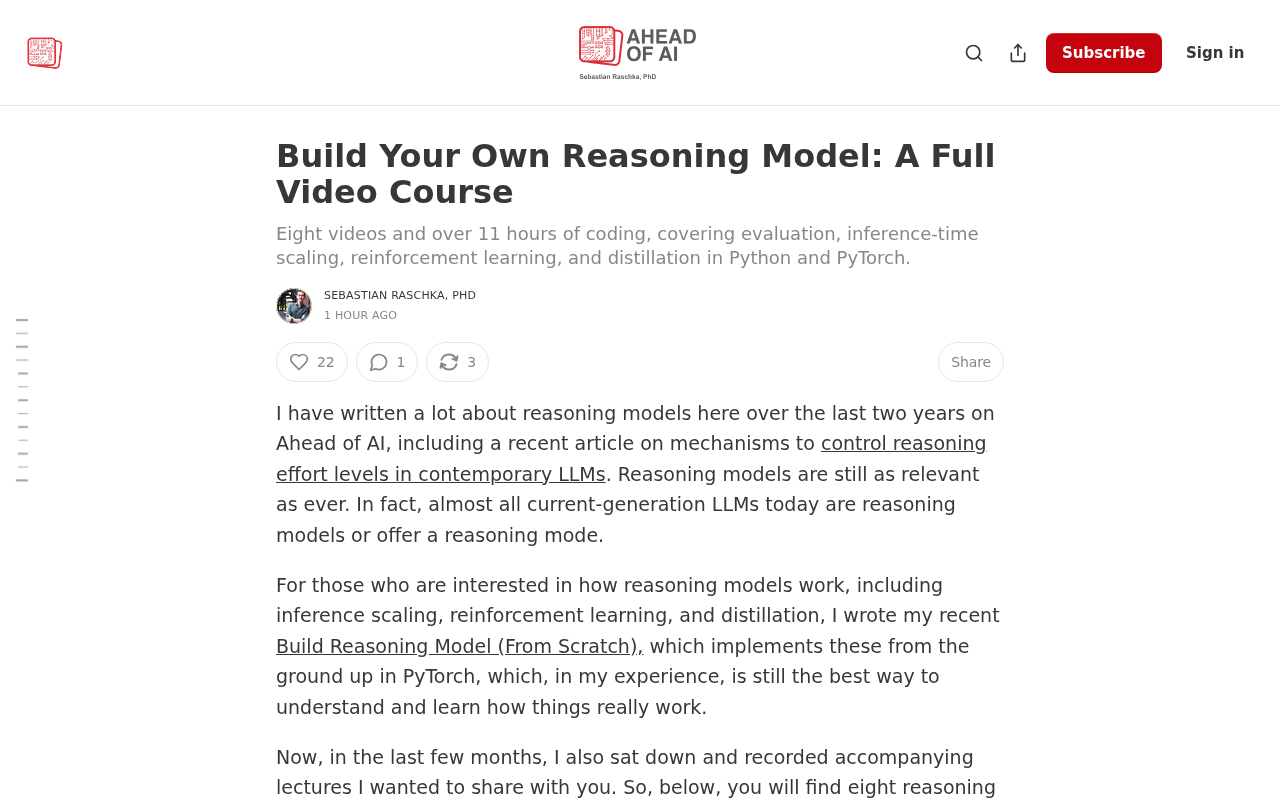
An 11-hour course builds reasoning models from scratch with Python/PyTorch, covering evaluation, inference-time scaling, RL, and distillation.
This 11+ hour video course targets developers with Transformer basics, building reasoning models from scratch in Python and PyTorch across four modules: evaluation, inference-time scaling, reinforcement learning, and distillation. It emphasizes how reasoning ability is trained, not just invoked via API—from defining goals through evaluation, to compute-for-quality scaling and RL reward design, to distillation for cost control.
Why It's Worth Your Attention: A Systematic Learning Path for Reasoning Models
While most AI courses still teach how to call APIs, an 11+ hour video course takes a more hardcore approach—building reasoning models from scratch with Python and PyTorch. The course covers four major modules: evaluation, inference-time scaling, reinforcement learning, and distillation, attempting to answer a core question: how reasoning ability is actually trained rather than merely invoked.
For developers already familiar with Transformer fundamentals who want to dig into the internal mechanisms of reasoning models, systematic content like this remains scarce. Most public materials are scattered across papers, blogs, and fragmented videos, whereas a complete 11-hour course means an end-to-end thread from evaluation metrics to training pipelines.
Course Breakdown: Four Key Modules
Evaluation: How Reasoning Ability Is Measured
The course starts with evaluation, the most easily overlooked yet most critical part of reasoning model development. Evaluating reasoning tasks is far more complex than classification or generation—a correct final answer to a math problem doesn't mean the reasoning process is sound; an incorrect answer might also stem from an incidental deviation in intermediate steps. What the course needs to address is how to design an evaluation system that reflects both final outcomes and the quality of reasoning chains.
The practical value of this module: without reliable evaluation, subsequent reinforcement learning and distillation lack an optimization direction. The difficulty many teams encounter when training reasoning models is precisely the disconnect between evaluation metrics and actual capability.
pass@k is a commonly used metric in reasoning model evaluation, referring to the probability that at least one of k candidate answers generated by the model is correct. The metric was originally used for code generation and later widely applied to tasks such as mathematical reasoning. Unlike traditional accuracy, pass@k measures the model's coverage under multiple samplings and better matches how inference-time scaling is actually used. However, pass@k has limitations: it doesn't penalize redundant or incorrect reasoning paths and is sensitive to the value of k. Therefore, in practice it's often combined with majority voting accuracy, step-level correctness of reasoning chains, and human evaluation to reflect reasoning quality more comprehensively.
Inference-Time Scaling: Letting the Model "Think Longer"
Inference-time scaling is one of the most discussed directions in recent reasoning model research. Its core idea is to invest more compute at inference time—for example, sampling multiple reasoning paths, extending the chain of thought, or performing tree search—to improve the solve rate on complex problems. The course demonstrates the implementation of such strategies in code, helping learners understand the engineering trade-off of "compute for quality."
Compared with training-time scaling, inference-time scaling has the advantage of not requiring model retraining, but the cost is higher inference expense. The course's discussion of this trade-off has direct reference value for teams actually deploying reasoning models.
Chain-of-Thought (CoT) is one of the foundational techniques of inference-time scaling, where the model outputs a series of intermediate reasoning steps before generating the final answer. CoT was initially implemented via few-shot prompting, and later research found that simply adding "let's think step by step" to the prompt can elicit it. In inference-time scaling, the length and structure of CoT become tunable variables: a longer chain of thought usually means more compute investment but may also introduce redundancy or error accumulation. Tree-of-Thought further extends the linear chain of thought into a tree structure, generating multiple candidates at each step and evaluating their prospects, improving the solve rate on complex problems through pruning and backtracking. Together, these techniques constitute concrete implementations of "trading compute for quality."
Reinforcement Learning: The Core Means of Training Reasoning Behavior
Reinforcement learning is currently the mainstream approach for training reasoning models. The course covers the application of RL in reasoning tasks, including key aspects such as reward design and policy optimization. The difficulty here lies not in the RL algorithms themselves but in how to design suitable reward signals for reasoning tasks—the choice between process rewards and outcome rewards, and training stability under sparse rewards, are unavoidable issues in practice.
Implementing the RL training pipeline in PyTorch means learners need to understand the complete chain from sampling and reward computation to gradient updates, rather than staying at the level of calling off-the-shelf libraries.
Process Reward Models (PRM) and Outcome Reward Models (ORM) are the two main designs of reward signals in reinforcement learning for reasoning tasks. ORM gives rewards solely based on the correctness of the final answer—simple to implement but with sparse signals, making it hard for the model to learn correct reasoning steps from incorrect answers; PRM evaluates each step of the reasoning chain at a fine granularity, providing denser reward signals but requiring extensive human annotation or automated step-level verification. In practice, PRM can significantly improve training stability and final performance, but annotation costs are high. In addition, Proximal Policy Optimization (PPO) and Direct Preference Optimization (DPO) are commonly used policy optimization algorithms—the former relies on a reward model and a critic network, while the latter directly optimizes the policy using preference data, simplifying the training pipeline.
Distillation: Transferring Reasoning Ability to Smaller Models
The distillation module focuses on how to transfer the reasoning ability of large models to models with fewer parameters. This is especially important when deploying reasoning models—large models have high inference costs, and distilled models significantly reduce deployment overhead while maintaining a certain level of reasoning quality. The course's coverage of this step extends the entire content from "building it" to "making it affordable."
The core idea of Knowledge Distillation is to have a small model (student) mimic the output distribution or intermediate representations of a large model (teacher). In reasoning model scenarios, distillation focuses not only on matching final answers but also on learning the reasoning process. Common approaches include: using complete reasoning chains generated by the teacher model as supervision signals to train the student model (sequence-level distillation), or aligning the probability distributions of the student and teacher over reasoning steps (token-level distillation). Online distillation further allows the student model to interact with the teacher model in real time during training, dynamically generating training data and avoiding the distribution bias of offline data. Distilled models can typically retain most of the reasoning ability with an order-of-magnitude reduction in parameter count, but performance degradation on complex multi-step reasoning tasks remains a challenge.
Who It's For, and What to Keep in Mind
The course clearly targets developers with some foundation: familiarity with Python, basic knowledge of PyTorch, and awareness of the Transformer architecture. Complete beginners will find the RL and distillation sections quite challenging.
Another point to view rationally is the relationship between course length and depth. 11 hours covering four major modules averages less than 3 hours per module—better suited for building an overall framework and understanding key implementation ideas than for exhaustive coverage of each topic. Reinforcement learning and inference-time scaling could each be a standalone course; the course is more likely a trade-off between breadth and depth.
For engineers who want a systematic introduction to reasoning model development, this course offers a rare complete perspective: from evaluation defining the goal, to inference-time scaling and reinforcement learning as two paths for improvement, to distillation for cost control. This end-to-end structure is more helpful for understanding the complete development lifecycle of reasoning models than learning individual technical points in isolation.
Final Thoughts
The open-source ecosystem for reasoning models is still evolving rapidly, and learners need to judge for themselves whether the course content keeps up with the latest developments. But for the goal of "understanding reasoning models through code," 11 hours of hands-on content plus the Python/PyTorch tech stack constitutes a relatively pragmatic entry path. Learners are advised to proceed in the order of evaluation → inference-time scaling → reinforcement learning → distillation, and to reproduce the core code after each module—this yields far more benefit than simply watching the videos.
One-line Summary
An 11-hour course builds reasoning models from scratch with Python/PyTorch, covering evaluation, inference-time scaling, reinforcement learning, and distillation.
Paragraph Summary
This 11+ hour video course targets developers already familiar with Transformer fundamentals, building reasoning models from scratch with Python and PyTorch and systematically covering four major modules: evaluation, inference-time scaling, reinforcement learning, and distillation. The course emphasizes how reasoning ability is trained rather than merely invoked via API. The evaluation module helps define optimization goals; inference-time scaling improves complex problem solve rates by investing more compute; reinforcement learning focuses on practical challenges such as reward signal design; and distillation transfers reasoning ability to smaller models to reduce deployment costs. The course is positioned to build an overall framework and understand key implementation ideas, suitable for engineers with some foundation to study in order and reproduce the code hands-on.
Related articles

AWS Launches Official Agent Toolkit: Letting AI Agents Directly Build and Manage AWS Applications
AWS launches the official Agent Toolkit, letting AI coding agents directly build and manage AWS apps across CDK, CloudFormation, Serverless, Bedrock Agents, and DevSecOps.

Does Agentic AI Need Its Own "Second Foundation"? A Three-Loop Architecture Explored
Inspired by Asimov's Foundation series, a multi-agent AI architecture hypothesis proposes execute, verify, and adapt control loops to reduce correlated errors and improve trust in AI results.
Rewriting a Commercial Engine in Jai: The Trade-off Between Performance and Productivity
Exploring the engineering practice of rewriting a commercial game engine in Jai: compile-time metaprogramming and data-oriented design advantages, plus ecosystem maturity and learning curve challenges.