Does Agentic AI Need Its Own "Second Foundation"? A Three-Loop Architecture Explored
Multi-agent systems need execute, verify, and adapt control loops to prevent collective misjudgment.
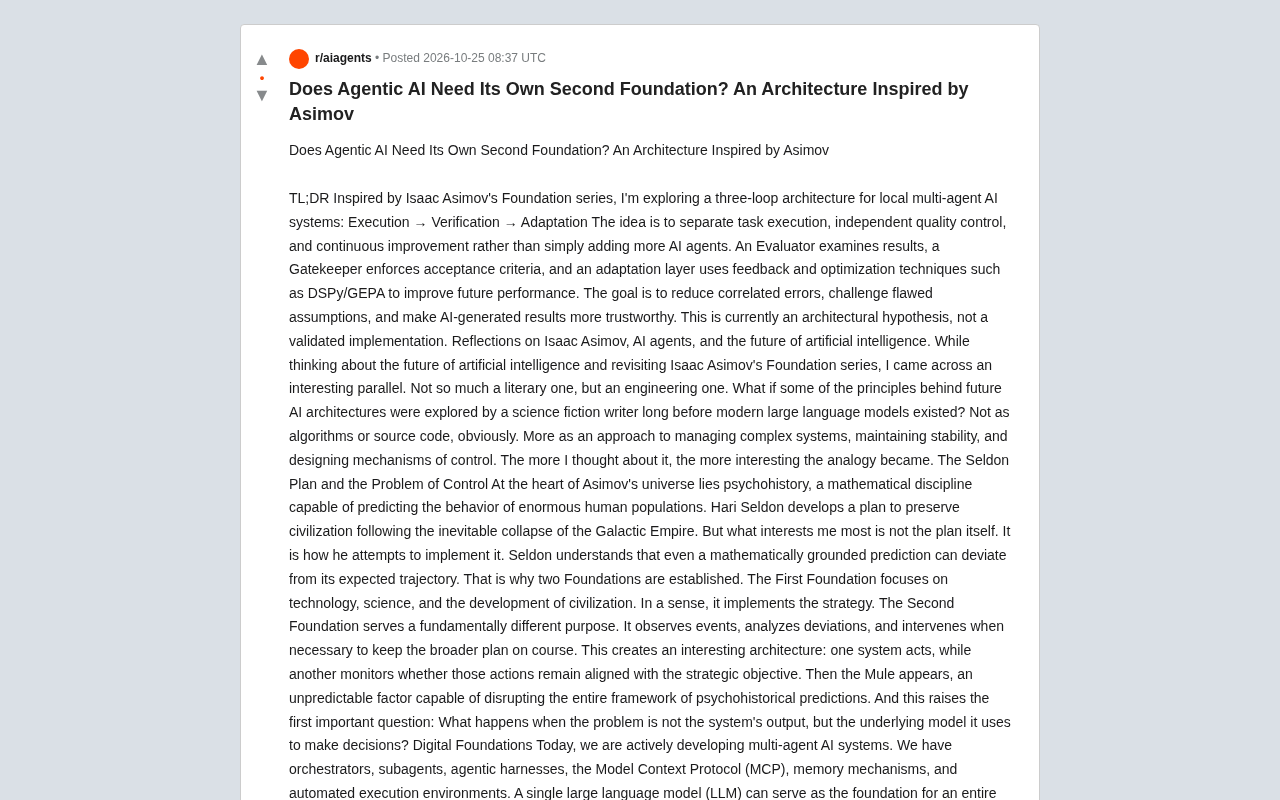
The article introduces an architectural hypothesis proposed by Reddit developer Alexey Chernousov: do multi-agent AI systems need something like Asimov's "Second Foundation"? The author argues the answer is not more agents, but three mutually constraining control loops — execute → verify → adapt. The execution layer has an orchestrator assign tasks and produce results; the verification layer uses evaluators and gatekeepers to perform independent acceptance based on objective evidence (tests, reproducible measurements, constraint compliance) rather than relying solely on another LLM's reasoning; the adaptation layer draws on DSPy's GEPA optimizer to improve system prompts based on execution traces, but changes must be tested and rollback-capable. The article also discusses the "Mule problem" — failures caused by incomplete requirements themselves — and the value of adversarial review, emphasizing that verification depth should adapt to task complexity to avoid over-engineering.
When Asimov Meets Multi-Agent Systems: An Architectural Hypothesis
In the Reddit community, developer Alexey Chernousov proposed an imaginative architectural hypothesis: do today's multi-agent AI systems also need something akin to the "Second Foundation" from Asimov's Foundation series? His answer: it's not about adding more agents, but about building three mutually constraining control loops — execute → verify → adapt.
This hypothesis has yet to be validated in practice, but it touches on a real pain point: when multiple AI agents collaborate, if they share the same underlying model, similar context, and identical erroneous assumptions, they may collectively validate a wrong answer. The original author compares this to "a digital committee that's great at agreeing with itself."
First Foundation: The Execution Layer
In a typical agent architecture, an Orchestrator sits at the center, receiving tasks, analyzing requirements, delegating to specialized sub-agents, and coordinating execution. These agents interact with development environments, databases, search systems, APIs, and MCP servers.
The purpose of this layer is straightforward: produce results. It is the system's "First Foundation," responsible for executing strategy. But the problem is — who ensures these results actually meet the requirements?
Second Foundation: An Independent Verification Layer
The original author's proposal introduces a second control loop. An Evaluator examines generated results, runs tests, identifies errors, and provides structured feedback; a Gatekeeper acts as an independent acceptance mechanism, verifying whether mandatory requirements are met and deciding whether results can pass.
The key insight here is: verification should not rely solely on another language model's reasoning. Objective evidence is needed — automated tests, reproducible measurements, constraint compliance, and traceability back to the original requirements. Otherwise, verification may just be an automated confirmation of a prior error.
Even so, this architecture leaves an open question: who verifies the evaluation criteria themselves? Who catches systemic errors that recur across tasks?
Correlated Error is a core risk concept in multi-agent system reliability analysis, referring to multiple agents systematically making the same type of mistake because they share the same underlying model, training data distribution, or similar context. In statistics, this corresponds to the case where errors are not independent — if two evaluators' judgments are highly correlated, their joint reliability is far lower than that of independent evaluators. For multi-agent verification driven by LLMs from the same source, this means "multiple agents agreeing" does not constitute independent evidence; it may instead amplify a single model's bias. Mitigation approaches include introducing heterogeneous models, external tool verification (tests, formal checks), and explicit adversarial review roles, structurally breaking the homogeneity of judgment.
The Third Force: The Adaptation Layer and GEPA Optimization
Inspired by "Gaia" — the collective intelligence in Asimov's later novels — the original author proposes a third control loop: the adaptation layer. It evaluates not only individual outputs but also the system's own effectiveness.
Here he cites the DSPy framework and its GEPA (Genetic-Pareto) optimizer. GEPA is not another independent language model or additional agent; it is an algorithm that leverages execution traces, quality metrics, and textual feedback to optimize prompts. However, such improvements cannot be applied directly to production systems — changes require testing, comparison with older versions, and rollback capability.
The three loops each serve their own role: the execution layer produces results, the evaluator identifies weaknesses, the gatekeeper enforces acceptance criteria, and the adaptation layer proposes system-level improvements based on accumulated evidence. No component may modify another component's governance rules without authorization and verification.
DSPy is a framework proposed by Stanford University for programming (rather than prompting) language model pipelines. Its core idea is to treat prompts and few-shot examples as learnable parameters, automatically searching for better configurations through declarative module composition and optimizers. GEPA (Genetic-Pareto) is one such optimization strategy: it combines genetic-style search with Pareto-frontier thinking — using execution traces, scoring metrics, and natural-language feedback to iteratively rewrite prompts, while retaining non-dominated solutions across multiple quality dimensions to avoid overfitting to a single metric. Unlike fine-tuning, GEPA does not update model weights; it only optimizes configuration at the prompt level, making it cheaper and more interpretable — though its outputs still require offline evaluation and canary validation before entering production.
The Mule Problem: When the Requirements Themselves Are Flawed
The "Mule" in Asimov's novels is a variable that psychohistory cannot predict. In AI systems, the analogous disruptive factor could be unknown constraints, misstated requirements, or unexpected behavior of external dependencies.
The original author gives an example: an AI agent develops a software module that compiles successfully and passes standard tests, seemingly satisfying all written requirements. But additional review finds that under certain database states, the module violates a critical business rule — the agent correctly implemented the stated requirements, and the problem is that the requirements themselves were incomplete.
This is precisely where the value of Adversarial Review lies: critically examining proposals to identify hidden weaknesses, missing constraints, and conditions under which things may fail. Interestingly, this doesn't necessarily require another permanent agent — introducing an adversarial review mode within the existing evaluation layer may be sufficient.
Adversarial Review draws on red-team testing and adversarial evaluation concepts from software engineering: the reviewer does not aim to "confirm the proposal is correct" but actively constructs counterexamples, boundary conditions, and failure scenarios to expose defects missed by conventional testing. At the requirements level, it focuses on "whether the written requirements are complete and whether there are unstated implicit constraints," rather than merely checking whether the implementation conforms to the requirements. Compared with a permanent verification agent, adversarial review can be embedded in the evaluation layer as an on-demand review mode, introducing critical examination of requirements assumptions while controlling costs.
Not Every Task Needs a "Second Foundation"
The original author also warns of the danger of over-engineering. Running a multi-stage evaluation pipeline for checking the weather forecast, transcribing audio, or answering simple factual questions is pointless. But modifying critical business logic, developing complex algorithms, or evaluating scientific hypotheses is another matter entirely.
Verification depth should be adaptive, depending on task complexity, consequences of failure, quality requirements, and the availability of objective verification methods. Modern agent systems can implement this dynamic routing at the orchestrator level. But baseline security requirements and access controls must always be present, regardless of task complexity.
Balance, Not Endless Stacking of Agents
The most valuable aspect of this hypothesis is that it doesn't require ever-expanding language models and dedicated agent collections. A more effective approach may be to organize existing components into a properly balanced architecture.
The original author readily admits that a literary analogy cannot prove an architecture works. Evaluation frameworks, optimization algorithms, and agent orchestration techniques all already exist. The real question is: when combined into a balanced system, can they deliver measurable improvements in reliability, quality, and operational efficiency? That can only be answered through practical experiments.
His proposed next step is to implement the architecture in a local multi-agent system and evaluate results on real tasks. He also asks the community: has anyone experimented with similar architectures using local LLMs? What are the potential weaknesses of separating execution, independent verification, and adaptation into distinct control loops? How do you measure whether additional verification actually improves reliability?
At a time when model capabilities keep advancing through parameter scaling, tool use, and expanding context windows, this hypothesis reminds us: the next important step may not be about making individual agents smarter, but about designing systems that can catch their own errors and re-examine their decision assumptions. After all, the core question of AI development is not just how intelligent models will become, but who — or what — can prove their decisions are worthy of trust.
One-line Summary
Multi-agent systems need execute, verify, and adapt control loops to prevent collective misjudgment.
Paragraph Summary
The article introduces an architectural hypothesis proposed by Reddit developer Alexey Chernousov: do multi-agent AI systems need something like Asimov's "Second Foundation"? The author argues the answer is not more agents, but three mutually constraining control loops — execute → verify → adapt. The execution layer has an orchestrator assign tasks and produce results; the verification layer uses evaluators and gatekeepers to perform independent acceptance based on objective evidence (tests, reproducible measurements, constraint compliance) rather than relying solely on another LLM's reasoning; the adaptation layer draws on DSPy's GEPA optimizer to improve system prompts based on execution traces, but changes must be tested and rollback-capable. The article also discusses the "Mule problem" — failures caused by incomplete requirements themselves — and the value of adversarial review, emphasizing that verification depth should adapt to task complexity to avoid over-engineering.
Related articles

AWS Launches Official Agent Toolkit: Letting AI Agents Directly Build and Manage AWS Applications
AWS launches the official Agent Toolkit, letting AI coding agents directly build and manage AWS apps across CDK, CloudFormation, Serverless, Bedrock Agents, and DevSecOps.
Rewriting a Commercial Engine in Jai: The Trade-off Between Performance and Productivity
Exploring the engineering practice of rewriting a commercial game engine in Jai: compile-time metaprogramming and data-oriented design advantages, plus ecosystem maturity and learning curve challenges.
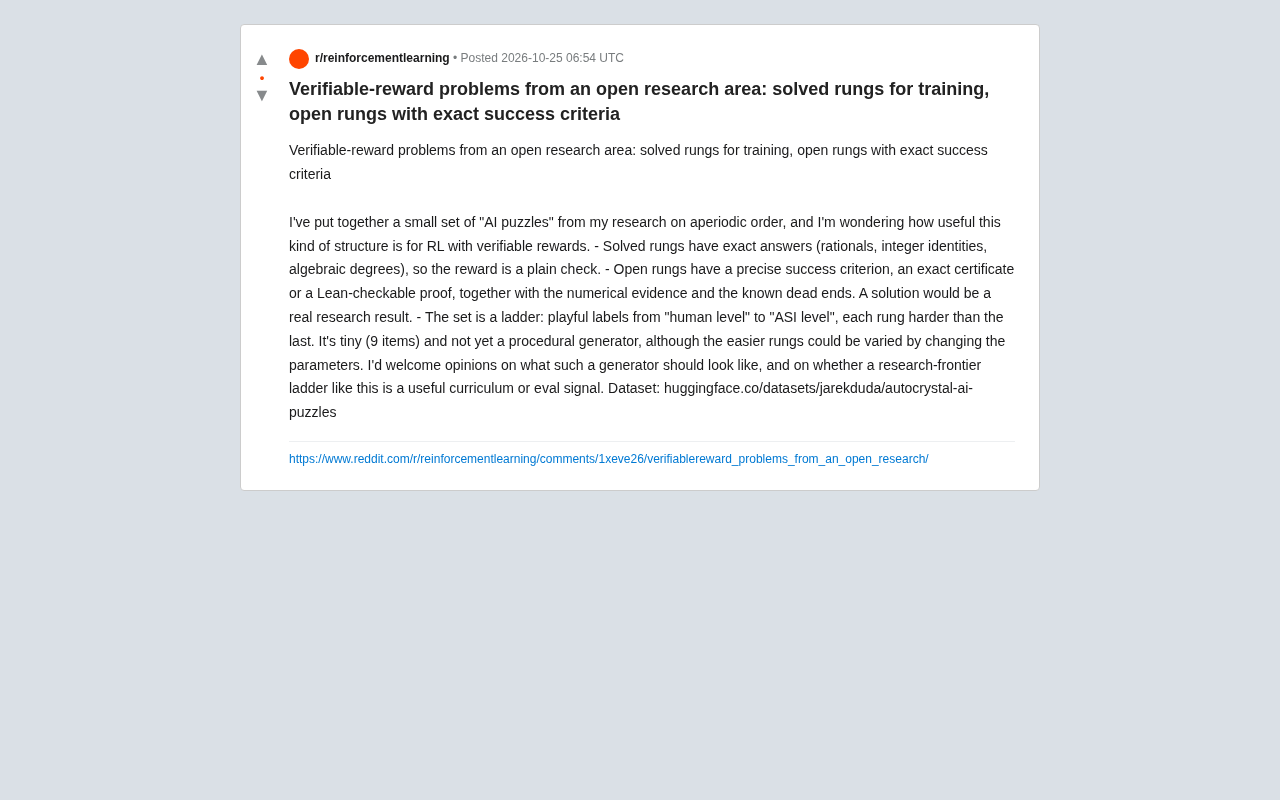
Building an AI Reasoning Ladder with Aperiodic Order Research: An Open Dataset of Verifiable Reward Problems
Researchers release an aperiodic order AI puzzle dataset with solved rungs for RL training and open rungs tied to real math research, exploring verifiable reward RL curricula.