12-Year Veteran Engineer Transitions to Data Science: From Andrew Ng's Course to Real-World Projects

A senior engineer wants to switch to data science, asking about the ML equivalent of a To-Do App practice project and job-hunting path.
A senior software engineer with 12 years of experience posted on Reddit, admitting he no longer enjoys a traditional engineering career and plans to switch to data science. He has completed the first course of Andrew Ng's Machine Learning Specialization and is working through the second. He poses a vivid question: web development has the To-Do App as a CRUD practice project—what is the corresponding "minimal complete project" in machine learning? The article analyzes his motivation—weariness with prompt engineering work and academic interest in statistics—and suggests ML practice project directions: end-to-end classification/regression, building neural networks from scratch, and model interpretability exercises. It then offers job-hunting advice after completing the course: build 2-3 end-to-end portfolio projects, strengthen statistics and SQL, leverage infrastructure experience for ML engineering, and prepare for interviews by component. Finally, it reminds career switchers to face the realities of pay cuts, junior position competition, and "overqualified" concerns.
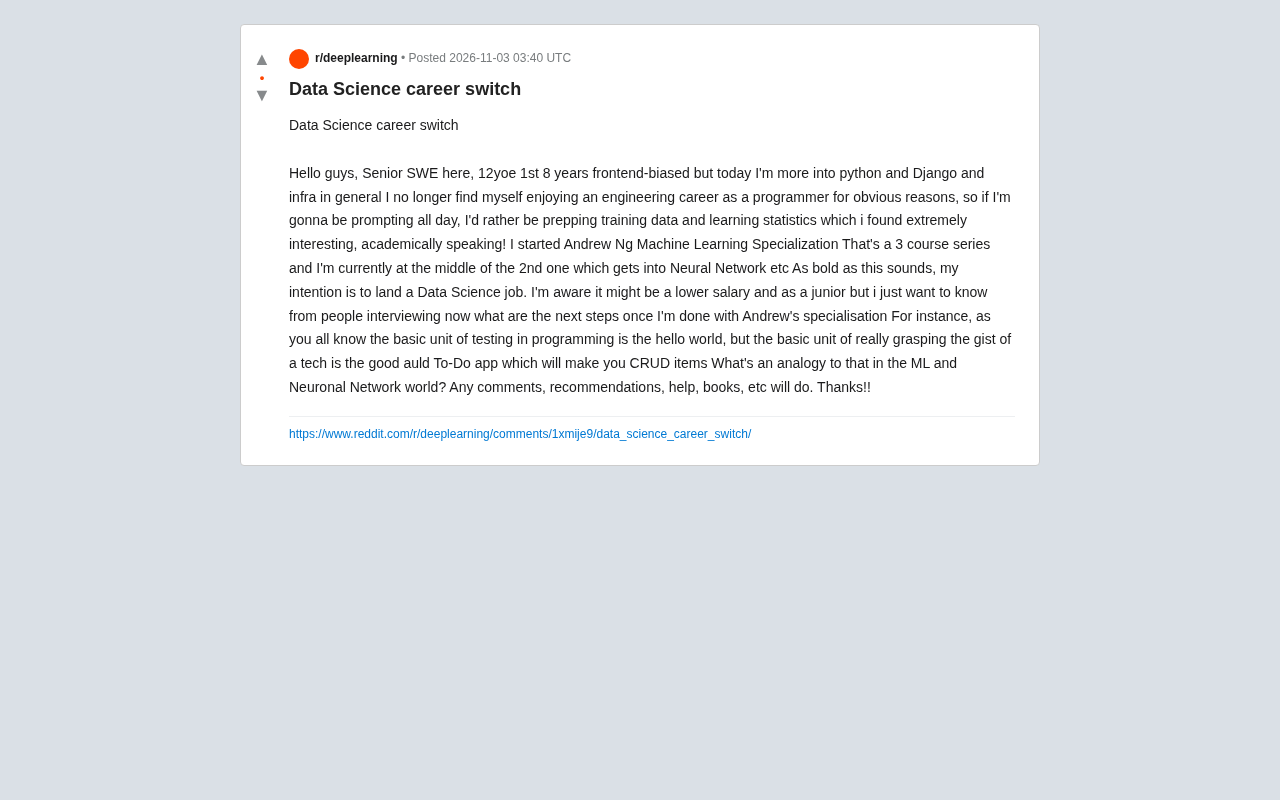
A senior software engineer with 12 years of experience posted on Reddit, sharing his career planning dilemma about transitioning from programming to data science. The engineer spent his first 8 years focused on frontend, and now works more with Python, Django, and infrastructure-related tasks. He candidly admits he no longer enjoys his engineering career as a programmer—rather than writing prompts all day, he'd prefer to prepare training data and study statistics, which he finds academically fascinating. He is currently working through Andrew Ng's Machine Learning Specialization (a three-course series), having completed the first course and being midway through the second, which covers topics like neural networks.
His goal is clear: land a data science job. Although he understands this may mean a pay cut and starting from a junior position, he still wants to hear advice from people currently interviewing—what should the next step be after completing Andrew Ng's specialization? He offers a vivid analogy: in programming, the basic unit of testing is "Hello World," while the signature project that truly demonstrates mastery of a technology is the classic To-Do App (implementing CRUD). So, in the world of machine learning and neural networks, what is the corresponding "benchmark project"?
Why a Senior Engineer Wants to Switch to Data Science
This engineer's motivation isn't a whim. He mentions "no longer enjoying his engineering career as a programmer" and points out a key trend: if future work is mainly about "prompting" AI models, he'd rather invest his energy in preparing training data and learning statistics. This reflects a deeper industry shift—as AI programming tools become widespread, some engineers are starting to rethink their core value. For him, the academic satisfaction from statistics and data processing exceeds the enjoyment of traditional software engineering work.
One detail: he clearly recognizes the cost of transitioning—salary may decrease, and job level may return to junior. This pragmatic attitude shows he has prepared himself mentally rather than being blindly optimistic. For other engineers considering a similar transition, this honest self-assessment is worth referencing.
What Is the "To-Do App" of Machine Learning?
This is the most insightful question in the entire post. In web development, the To-Do App became a classic practice project because it covers the core CRUD (Create, Read, Update, Delete) operations and verifies whether you understand data flow, state management, and user interaction. So, in the ML and neural network space, is there a similar "minimal complete project"?
While there's no standard answer, the community typically recommends several directions:
- End-to-end classification projects: From data cleaning, feature engineering, model training to evaluation and deployment—going through the entire pipeline. For example, using classic datasets (like Iris or Titanic survival prediction) for binary or multi-class classification.
- Regression prediction projects: Such as house price prediction, involving data exploration, feature selection, model tuning, and error analysis.
- Simple neural network implementations: Building a multi-layer perceptron from scratch with NumPy, or using PyTorch/TensorFlow to build a handwritten digit recognition (MNIST) model, understanding backpropagation and gradient descent.
- Interpretability exercises: Performing feature importance analysis or SHAP value explanations on trained models—very common in real-world work.
The common thread among these projects: they force you to confront missing values, outliers, class imbalance, and other issues in real data, rather than just calling an API. For this engineer, his existing programming skills (Python, Django, infrastructure) will be a huge advantage, especially in data pipelines and model deployment.
CRUD (Create, Read, Update, Delete) are the four basic operations of persistent storage applications. The reason the To-Do App became the teaching paradigm for web development is that it covers core concerns like data model design, interface routing, state synchronization, and user input validation with minimal complexity. Correspondingly, the "minimal complete loop" of a machine learning project typically includes: problem definition and business metrics, data acquisition and cleaning, feature engineering, model selection and training, hyperparameter tuning, evaluation (accuracy, precision/recall, AUC, etc.), and deployment or at least a reproducible inference script. The key to judging whether an ML practice project reaches "To-Do App level" is whether it forces you to deal with the messiness of real data (missing values, class imbalance, data leakage), rather than just calling scikit-learn's fit/predict.
From Andrew Ng's Course to Job Hunting: Next-Step Advice
Completing Andrew Ng's specialization is a solid starting point, but it's theory-heavy. To actually land a data science offer, several areas need to be supplemented:
1. Project Portfolio
Complete at least 2-3 end-to-end projects and put them on GitHub. Projects should ideally demonstrate business understanding—such as "predicting customer churn" or "credit risk scoring"—rather than pure toy datasets. Each project should have a clear README explaining the problem context, data sources, methodology choices, and result evaluation.
SHAP (SHapley Additive exPlanations) is a model interpretation method based on Shapley values from cooperative game theory. It outputs contribution values for each feature of each sample, answering "why did the model make this prediction." In data science interviews, being able to explain model decisions is an important marker distinguishing "package callers" from "trustworthy modelers," especially in regulated industries like finance and healthcare. In practice, SHAP values can be used for feature selection, detecting data leakage, and explaining model behavior to business stakeholders. For career switchers, adding a SHAP analysis to a portfolio often demonstrates understanding of model reliability better than piling on another model.
2. Statistics and SQL Skills
Data science job interviews typically test statistical fundamentals (hypothesis testing, confidence intervals, A/B testing) and SQL queries. This engineer mentions an interest in statistics, which is a great signal, but it needs to be transformed from academic interest into interview-demonstrable skills. It's advisable to practice SQL problems and learn how to design experiments.
3. ML Engineering
His existing infrastructure experience is a differentiating advantage. Many data scientists are not good at deploying models, and he can demonstrate how to package models into APIs, containerize with Docker, or set up simple CI/CD pipelines. This will make him stand out among candidates.
4. Interview Preparation
Data science interviews typically include: programming (Python/algorithms), statistics/probability, machine learning theory, case studies (product sense), and behavioral interviews. It's advisable to prepare for each component separately, especially case studies—often a weak spot for engineers transitioning into the field.
Andrew Ng's Machine Learning Specialization, jointly launched by DeepLearning.AI and Stanford Online, consists of three courses: the first covers supervised learning (linear regression, logistic regression, decision trees, etc.), the second focuses on advanced learning algorithms (neural networks, bias-variance, model evaluation), and the third covers unsupervised learning, recommender systems, and reinforcement learning. The course is known for intuitive concepts and programming assignments (using Python/NumPy), but deliberately downplays mathematical derivations and engineering deployment details, so it's often positioned as an "introductory map" rather than a "direct ticket to employment." Many career switchers still need to connect the knowledge points through independent projects into demonstrable skills after completing the course—which is exactly where the portfolio advice below comes from.
Realistic Reminders for Career Switchers
This engineer's post resonated with many, but several realities need to be viewed clearly:
- Fierce competition for junior positions: Entry-level data science positions often receive a flood of resumes, and having 12 years of engineering experience may actually make recruiters worry about "overqualified" or mismatched salary expectations. He needs to be prepared to explain why he's willing to take a pay cut and a demotion.
- "Data Scientist" titles vary greatly: Data scientist responsibilities differ significantly across companies—some lean toward analysis, some toward modeling, some toward engineering. He should clarify which type he prefers and apply accordingly.
- Academic interest ≠ job content: He mentions finding statistics "academically interesting," but in actual work, data cleaning can take up more than 70% of the time. He needs to be mentally prepared.
Overall, this engineer's transition path is feasible, and his programming background and infrastructure experience are pluses. The key is to fill in statistics and project experience, and find a team that appreciates his engineering capabilities. The "To-Do App" of machine learning isn't a fixed project—it's a complete, story-telling data science workflow.
Related articles
 Tech Frontiers
Stylome Bot Slammed as Useless Junk: Why Do AI Detection Tools Keep Failing?
Reddit users test the Stylome AI detection bot: Gemini-rewritten text judged human-written, consistently low confidence. An analysis of AI text detection's technical dilemmas, privacy concerns, and credibility crisis in community governance.
 Tech Frontiers
When AI Becomes a Productivity Divide: Clarity or "AI Psychosis"?
A civil engineer's deep use of agentic AI boosted efficiency but bred contempt for peers who refuse to learn. Is this clarity or AI psychosis? An analysis of the cognitive and psychological challenges behind the AI productivity divide.
 Tech Frontiers
Opus 5.5 Benchmark Scores Climb, Community Says Its "Weights Are Blessed"
Reddit community discusses Opus 5.5's rising scores on the Benchmaxxing Bench, with users describing its performance as "weights are blessed." This article interprets the community reaction and cautions against conflating benchmark scores with real capability.