When AI Becomes a Productivity Divide: Clarity or "AI Psychosis"?

An engineer's efficiency soared with deep agentic AI use, but he felt contempt for peers who refused to learn, prompting reflection on the cognitive divide.
A civil engineer posted on Reddit that after deep use of agentic AI, his efficiency improved dramatically—tasks that took weeks could be done in hours—and company profits and revenue rose significantly. Yet he found himself feeling contempt for peers who refused to learn AI, even doubting their intelligence, and questioned whether this was a sign of "AI psychosis." The post resonated widely, revealing that the productivity gap created by AI tools is producing a cognitive divide: early adopters and latecomers seem to live in two parallel worlds and struggle to understand each other. The article interprets this phenomenon from both objective technological change and subjective psychological bias, suggesting that tech superiority complex and the echo chamber effect may be the roots of contempt, and offers suggestions for coexistence such as distinguishing tool capability from human value, acknowledging resource differences, guarding against echo chambers, and turning superiority into influence.
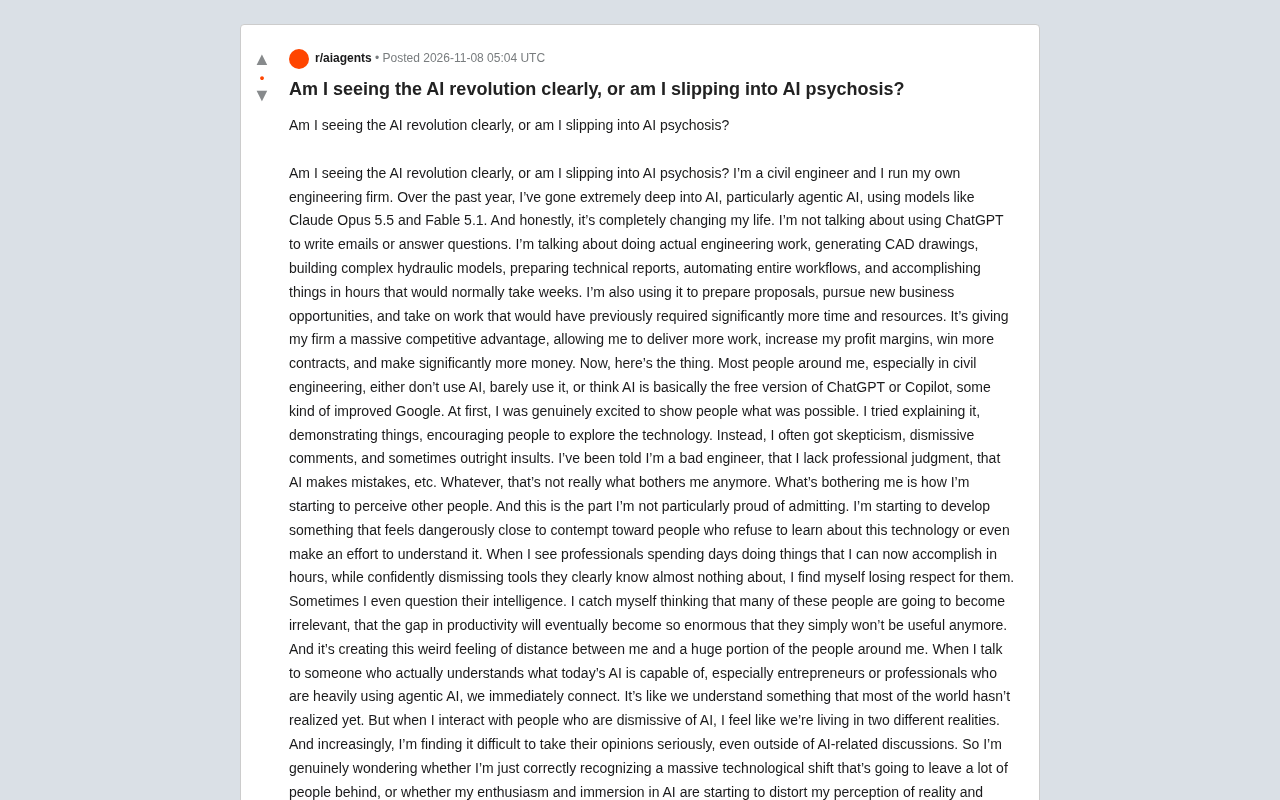
A civil engineer posted on Reddit describing how, after a year of deep use of agentic AI (such as Claude Opus 5.5 and Fable 5.1), his work efficiency soared dramatically—he could even complete work that once took weeks in just a few hours. However, he found himself starting to feel contempt, even disdain, toward peers who refused to learn AI, and he questioned whether this was a sign of "AI psychosis." The post resonated widely and revealed an increasingly acute problem: when AI tools create a massive productivity gap, is the cognitive divide between early adopters and latecomers an objective reality or a subjective distortion?
Productivity Leap: From "Chatbot" to "Engineering Assistant"
The engineer emphasized that the AI use he was describing was not using ChatGPT to write emails or answer questions, but letting AI agents genuinely participate in core engineering work: generating CAD drawings, building complex hydraulic models, preparing technical reports, and automating entire workflows. Tasks that originally took weeks can now be completed in hours. He also used AI to prepare proposals, expand into new business opportunities, and take on projects that previously required more time and resources.
The direct result of this deep use: the company delivers more work, margins improve, more contracts are won, and revenue increases significantly. For him, AI is not a toy but a real competitive advantage.
This experience is not an isolated case. In the Reddit discussion, many entrepreneurs and professionals in other fields shared similar feelings—once they truly embedded agentic AI into their workflows, the efficiency gains were order-of-magnitude rather than linear.
Agentic AI is fundamentally different from traditional conversational AI. Traditional chatbots can only passively answer questions, while agentic AI has the ability to plan autonomously, execute multiple steps, and call external tools (such as CAD software, calculation engines, and APIs). It is like a virtual assistant that can "take over tasks": given a goal, it can break down steps, select tools, and iterate corrections until it delivers results. This is exactly the key to the engineer being able to have AI generate drawings and build hydraulic models—AI is no longer just "answering questions" but "executing engineering tasks." This leap in capability depends on the maturity of large models' reasoning and planning abilities and tool-calling (function calling) mechanisms, and it is also the core driving force behind the shift of AI applications from "chat" to "workflow embedding" since 2024.
The Indifference of Those Around Him: From Excitement to Frustration
The problem lies in interactions with others. His fellow civil engineers either do not use AI at all or treat AI only as a "free version of ChatGPT" or an "upgraded Google." At first he enthusiastically demonstrated, explained, and encouraged exploration, but what he got in return was suspicion, contempt, and even personal attacks—accusations that he was "not a good engineer," "lacked professional judgment," and that "AI will make mistakes."
These responses frustrated him, but what unsettled him more was the change in his own mindset. He began to lose respect for peers who refused to learn yet confidently belittled AI, and he even doubted their intelligence. He realized that he was developing a "dangerous sense of contempt."
Cognitive Divide: Two Parallel Worlds
He described a sense of fragmentation: when talking with people who truly understand current AI capabilities (especially the many entrepreneurs or professionals who use agentic AI heavily), he immediately felt a connection, as if sharing a kind of "cognition that most people have not yet realized." But when interacting with people who belittle AI, it felt like living in two different realities.
More seriously, this sense of fragmentation was spreading—he began to find it difficult to take these people's views seriously even on non-AI topics. This alarmed him: was he correctly identifying a massive technological transformation, or had his enthusiasm and immersion begun to distort his perception of reality and of others?
In the post he admitted: "Maybe both."
Clarity or Distortion? Two Interpretations
From an objective perspective, AI is indeed reshaping the productivity landscape. Agentic AI can execute multi-step tasks, call tools, and plan autonomously, which already goes beyond simple question-and-answer mode. In knowledge-intensive industries such as engineering, law, and consulting, those who master these tools first can indeed gain a significant advantage. Technological change has always created winners and losers; that itself is nothing new.
But from a psychological perspective, when a person invests a great deal of time in a certain technology and gains huge returns from it, it is easy to develop a "sense of technological superiority," then overestimate the universality of one's own judgment and underestimate others' circumstances and choices. The emergence of contempt is often a signal that self-identity has become overly dependent on a single dimension.
What is admirable about this engineer is that he recognized this emotion and actively sought an external perspective. At the end of the post he asked: "Has anyone else also developed similar negative feelings toward people who can't keep up after using advanced AI heavily? Do you also feel this growing divide? Or have I just become an arrogant jerk, slipping into some kind of AI psychosis, and need to get my head checked?"
Tech superiority complex is a common psychological bias: after individuals gain outsized returns from mastering a new technology, they tend to equate technical proficiency with overall intelligence or judgment, and then belittle those who have not mastered it. Its danger lies in substituting "I am ahead on this matter" with "I am superior in all matters," leading to distorted cross-domain judgment. Related to this is the echo chamber effect—when people communicate over the long term only with those who share their views, they continuously reinforce their own opinions and gradually lose tolerance for dissent. The engineer's shift from "enthusiastic demonstration" to "loss of respect" is a typical path of tech superiority complex combined with the echo chamber effect. The key to identifying this bias is to distinguish "efficiency advantages brought by tools" from "inherent cognitive advantages of the individual."
How to Live With the "AI Divide"
For professionals who use AI deeply, the following points may help maintain clarity:
- Distinguish tool capability from human value: AI improves efficiency on specific tasks, but that does not mean the user is smarter or has better judgment in all dimensions.
- Acknowledge differences in learning curves and resources: not everyone has the time, energy, or motivation to explore cutting-edge tools, and this does not necessarily reflect intelligence or professional ability.
- Beware of the echo chamber effect: communicating with like-minded people is pleasant, but deliberately exposing yourself to different views can prevent cognitive narrowing.
- Turn superiority into influence: rather than feeling contempt, use actual results and patient demos to influence others—although this is often thankless.
The value of this discussion is not in providing a "right or wrong" answer, but in revealing a reality that is already unfolding: AI brings not only an efficiency revolution but also a reconstruction of interpersonal relationships and professional identity. He is far from the only one who feels the divide.
(This article is based on public Reddit discussion content; the views represent only the personal positions of the original author and participants.)
Related articles
 Tech Frontiers
Stylome Bot Slammed as Useless Junk: Why Do AI Detection Tools Keep Failing?
Reddit users test the Stylome AI detection bot: Gemini-rewritten text judged human-written, consistently low confidence. An analysis of AI text detection's technical dilemmas, privacy concerns, and credibility crisis in community governance.
 Tech Frontiers
Opus 5.5 Benchmark Scores Climb, Community Says Its "Weights Are Blessed"
Reddit community discusses Opus 5.5's rising scores on the Benchmaxxing Bench, with users describing its performance as "weights are blessed." This article interprets the community reaction and cautions against conflating benchmark scores with real capability.
 Tech Frontiers
Gemini Omni 1.2 Flash: AI Video Moves Toward Draft-Style Editing
Google's Gemini Omni 1.2 Flash update enables conversational, draft-style editing of the same video—swap scenes while keeping products, adjust lighting while keeping characters. Clips up to 15s, 720p costs 30% less than the previous Flash—ideal for e-commerce ads, previs, and short-asset production.