12 Years of Telescope Images: The First Direct Recording of Four Exoplanets Orbiting a Star
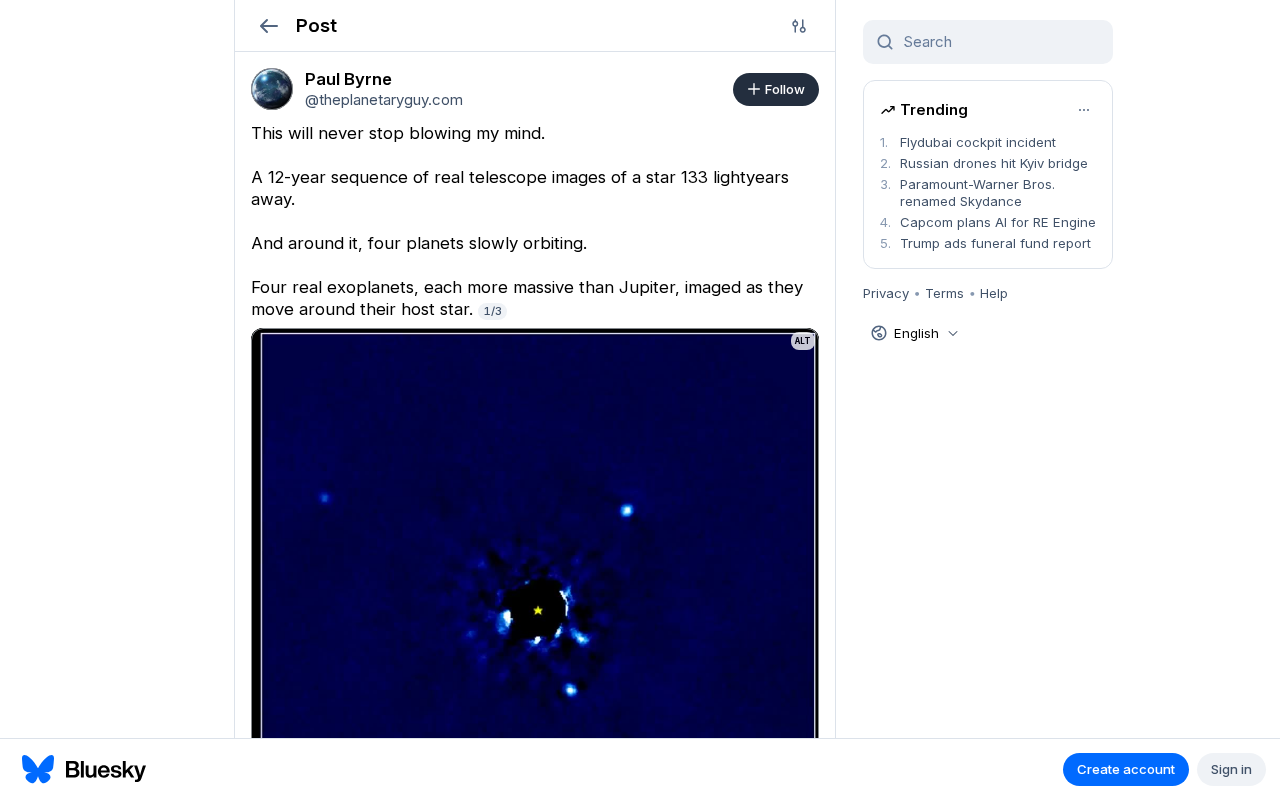
12-year telescope time-lapse directly shows four exoplanets orbiting HR 8799 — a milestone in direct imaging.
A telescope image sequence spanning roughly 12 years went viral on social media, providing a direct visual record of four planets completing their orbits around HR 8799. Such direct imaging is exceptionally rare: a star can be billions of times brighter than its planets, requiring coronagraphs to block the glare and adaptive optics to correct atmospheric distortion. HR 8799 became a landmark direct imaging target because its planets are large, young, hot, and on wide orbits — ideal conditions for separating them from starlight. Twelve years of continuous orbital tracking not only visually rules out background stars and imaging artifacts, but also gives researchers real data to constrain orbital parameters, gravitational interactions, and system stability. For the public, watching planets actually move transforms exoplanets from abstract data into tangible, trackable realities.
A 12-Year Space Time-Lapse
A sequence of telescope images posted on Bluesky — which quickly climbed to the front page of Hacker News (244 points, 53 comments) — has once again brought exoplanet observation into the public spotlight. Spanning roughly 12 years, this series continuously captures the actual orbital motion of four planets revolving around the same star. Astronomy enthusiasts have described it as "planetary motion you can actually see with your own eyes."
Unlike the artist's renderings or simulated animations we're used to, these images are direct observations of real celestial objects. Although the original post contained limited information, community discussion confirms that what's depicted is the famous HR 8799 planetary system — one of the few known stellar systems where multiple planets can be directly photographed.
Why Directly Imaging Exoplanets Is So Difficult
The vast majority of exoplanets are not "seen" — they are inferred. Astronomers typically rely on two indirect methods: the transit method, which detects a planet's existence through the faint dip in a star's brightness as the planet passes in front of it; and the radial velocity method, which measures the spectral shift caused by a star being gravitationally tugged by its planet.
The Overwhelming Glare of Starlight
Direct imaging is rare for one fundamental reason: the contrast in brightness. A star can be billions of times brighter than its planets — like trying to spot a firefly next to a searchlight. To capture the planet itself, a telescope must use a coronagraph to block the star's intense light, combined with an adaptive optics system to correct for atmospheric distortion in real time, allowing the faint planetary signal to emerge from the noise.
Technical note: Adaptive optics (AO) is one of the core technologies in modern large ground-based telescopes. Turbulence in Earth's atmosphere causes starlight to randomly jitter and distort, blurring images — this is precisely why stars appear to twinkle. An AO system uses a wavefront sensor to measure atmospheric disturbances hundreds of times per second, driving a deformable mirror to compensate for these distortions in real time, bringing a ground-based telescope's resolution close to its theoretical diffraction limit. The coronagraph draws on the same concept used to observe the solar corona: a precision occulting mask placed at the focal or pupil plane blocks the star's direct light, while specialized optical designs further suppress diffraction halos. Working in tandem, both systems boost the signal-to-noise ratio enough to detect faint planets. Even so, residual "speckle" noise from Earth's atmosphere and the telescope's own optical imperfections remains, requiring post-processing techniques such as angular differential imaging (ADI) to remove.
The Persuasive Power of Time
A single static photograph can only confirm that a point of light exists. But an image sequence spanning 12 years directly shows those points of light moving along closed orbits around the star. The motion itself is the most compelling evidence — it rules out background stars or imaging artifacts, confirming that these objects are genuinely gravitationally bound to the star. This is why the sequence resonated so strongly with the community.
HR 8799: The Iconic Target for Direct Imaging
Based on community discussion, the stellar system shown in these images hosts several gas giants with masses far exceeding Jupiter's, on orbital scales so vast that their periods span decades or even centuries. It is precisely because of these long periods that continuous tracking over more than a decade is needed to observe any meaningful positional change in the images.
Systems like this are amenable to direct imaging because their planets are large and luminous (young planets still radiate heat left over from their formation, making them especially bright in the infrared), and because they orbit far enough from their host star to be separated from its glare. This makes HR 8799 an ideal natural laboratory for testing direct imaging techniques and studying planetary orbital dynamics and system stability.
Background: HR 8799 is a young A-type star located in the constellation Pegasus, approximately 130 light-years from Earth, estimated to be between 30 and 60 million years old. In 2008, Marois et al. reported in Science the first direct imaging of three planets in the system (HR 8799 b, c, and d); a fourth planet (HR 8799 e) was confirmed in 2010, making it the exoplanetary system with the most directly imaged planets to date. All four planets have masses between approximately 5 and 13 Jupiter masses, with orbital radii ranging from about 15 AU to over 70 AU, corresponding to orbital periods of roughly 40 years to several centuries. As young planets, they still retain heat accumulated during accretion, with surface temperatures around 900–1,200 K, producing relatively bright thermal emission in the near-infrared — a key physical condition enabling their direct imaging. Their wide orbits and intrinsic brightness make HR 8799 the premier natural laboratory for testing theories of planet formation (core accretion vs. gravitational instability) and orbital resonance stability models.
The Scientific and Engineering Significance Behind These Images
The value of this time-lapse extends well beyond its visual impact. Continuous orbital data allows researchers to back-calculate orbital parameters, mutual gravitational interactions, and the long-term stability of the system, providing real-world constraints on theories of planetary system formation and evolution.
For the general public, the significance is equally profound. For a long time, exoplanets existed only in data tables and schematic diagrams — abstract and distant. But when people can watch planets orbit over a timeline, the worlds beyond our solar system are no longer abstract concepts; they become observable, trackable realities. That kind of immediacy can ignite an interest in astronomy more powerfully than any written explanation.
As the next generation of ground- and space-based telescopes continues to push the boundaries of imaging contrast and resolution, we can expect to see more — and clearer — direct images of exoplanets with shorter orbital periods. This 12-year sequence can be regarded as an exciting milestone along that path.
Summary
A telescope image sequence spanning 12 years tells a grand story in the simplest possible way: around a distant star, four planets are quietly and unmistakably tracing their orbits. It is both a testament to the long-term cumulative achievement of direct imaging technology, and a powerful response to the enduring human impulse to look up and wonder.
Related articles

uGAP: An AI Platform Unifying 100+ African Geospatial Datasets
uGAP is an African geospatial AI platform by a University of Cape Town team, unifying 120+ African datasets with a Python SDK for discovery, processing, and model training, already used in cyclone flood mapping.

Cursor Can Now Control Your Computer: AI Agents Can Drive Desktop Apps for Testing
Cursor adds desktop control: AI agents can drive desktop apps like the iOS Simulator to test their own features. We analyze the impact on dev workflows, possible technical approaches, and reliability concerns.

Vibecoding a Custom Inference Engine: High Hopes, Harsh Reality
A Reddit developer shares the real experience of vibecoding a custom inference engine: running GGUF Q4 models in the browser with WebGL2 and GLSL, only to fall into tokenizer debugging hell. This article analyzes the engineering challenges of browser-side LLM inference and why cloning llama.cpp is the more rational choice.