12ft.io Is Dead — Can WallHop Carry the Torch for Paywall Bypassing?

WallHop is an open-source alternative to 12ft.io that uses chained bypass methods and iOS Shortcuts to help users read paywalled articles.
WallHop is an open-source tool created by developer Josh after 12ft.io was taken down by the News Media Alliance. Users simply prepend `wallhop.io/` to an article URL or paste the link to get a reading page stripped of paywall popups and ads — no registration or extensions needed. Technically, it's forked from everywall/ladder and uses a chained fallback strategy: trying multiple bypass methods in sequence, falling back to archive.is when all fail. It supports Medium member articles and offers iOS Shortcuts on mobile, plus a bookmarklet and API endpoints on desktop. The author admits some server-side paywalls can't be broken and openly solicits broken links. The project is GPL-3.0 open source, stores no content, and doesn't profit — but the legal and ethical debates around paywall bypassing remain.
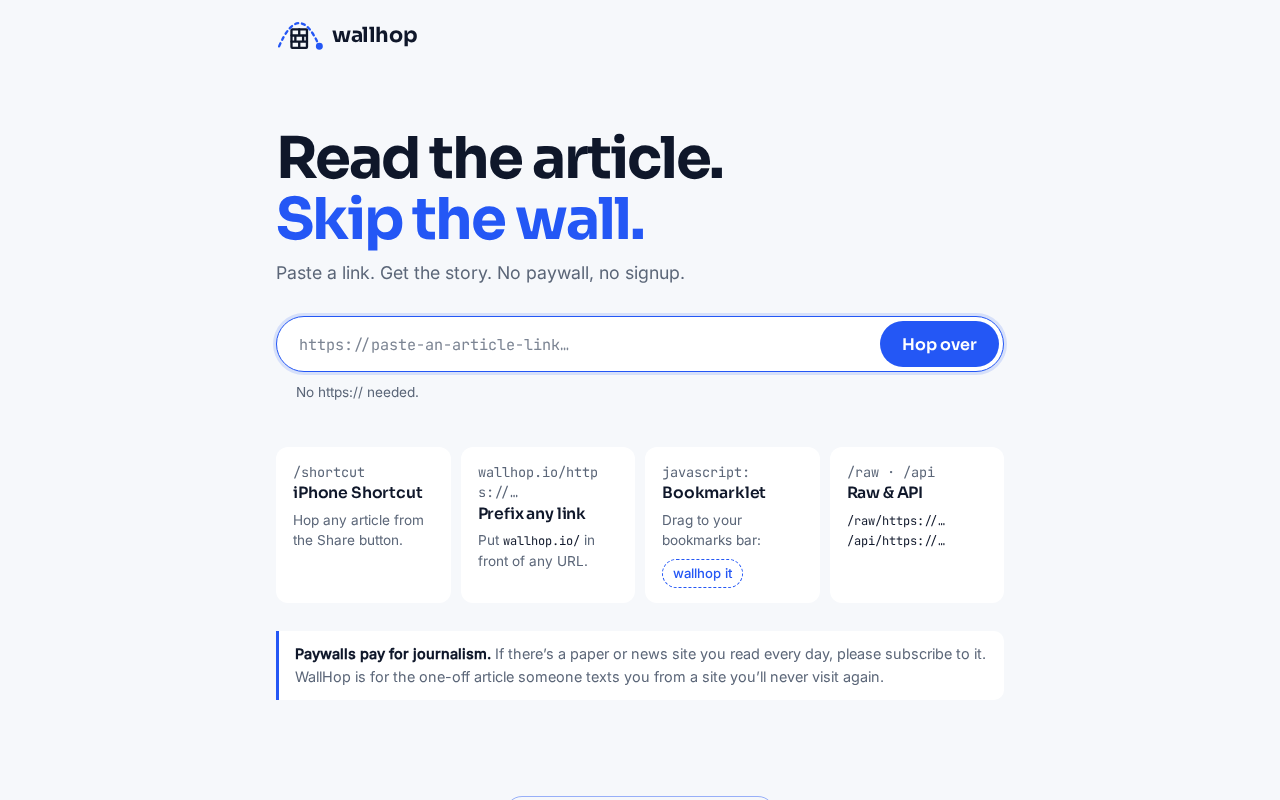
When 12ft.io was officially taken down by the News Media Alliance in July 2025, many users who relied on it to quickly read articles blocked by paywalls felt a sudden void. Developer Josh was one of them. Rather than dwelling in nostalgia, he built a replacement — WallHop — and unveiled it on Hacker News as a "Show HN" post.
One URL Prefix to Solve Information-Access Anxiety
WallHop is dead simple to use: prepend wallhop.io/ to any article URL, or paste the link into the input box on the homepage, and you get a clean reading page stripped of paywall popups, ads, and other distractions.
The author emphasized in the launch post that no registration and no browser extension are required — the whole flow is use-and-go. This is similar to the 12ft.io experience, but WallHop aims to go further in both technical implementation and applicable scenarios.
Technical Approach: Not a Single Trick, but a Chain of Methods
WallHop was initially forked from the open-source project everywall/ladder (GPL-3.0 license), but Josh says he made extensive modifications. The core change is that it no longer relies on any single bypass technique — instead, it chains multiple bypass methods for each request. If one technique is blocked by the target site, the system automatically tries the next; when all methods fail, the request falls back to an archive.is snapshot.
The benefit of this "chained fallback" design is obvious: a single site blocking one technique won't bring down the entire service. Compared to 12ft.io, which mainly relied on limited methods like Googlebot caching, WallHop has a higher fault tolerance when facing different paywall implementations.
everywall/ladder is an open-source project on GitHub focused on restoring web content blocked by paywalls or anti-scraping mechanisms through a variety of methods. It is released under the GPL-3.0 license, allowing anyone to freely use, modify, and distribute it, provided that derivative works are also open-sourced. Ladder's implementation aggregates multiple techniques (such as spoofing crawler User-Agents, leveraging search engine caches, and calling third-party archive services) and adapts them via per-site configuration files. WallHop is forked precisely on this foundation, inheriting the "multi-method attempt" architecture while being substantially refactored by Josh with mobile optimization and a new fallback chain.
Mobile-First: iOS Shortcuts Are the Highlight
Josh mentioned that 95% of his usage is on iPhone, so WallHop has been specifically optimized for mobile. After opening an article in Safari or another app, tap the share button and select the WallHop iOS Shortcut to get the full text before the paywall popup appears.
For desktop users, the project offers a bookmarklet, plus /raw/<url> and /api/<url> endpoints for developers to integrate into automation scripts or third-party tools.
Bookmarklet: a piece of JavaScript code stored in a browser bookmark that executes on the current page when clicked. Users can add the bookmarklet provided by WallHop to their bookmarks bar and click it on any article page to jump to WallHop's clean reading view — no need to manually copy the URL. This approach doesn't rely on browser extensions and works with most desktop browsers, though it may fail in some scenarios due to browser security policies on bookmarklet script execution. iOS Shortcuts is Apple's built-in automation tool; users can create or import shortcuts that pass the current Safari page URL to WallHop and open the result, achieving seamless integration with the share menu.
What It Can and Cannot Bypass
According to the author, WallHop has been tested against most major news outlets and many local newspapers. Medium's member-only articles are also supported — a scenario 12ft.io never handled.
But Josh candidly acknowledges the limitations: some server-side paywall implementations still can't be broken because "some techniques are genuinely out of reach on the client side." He openly invites users to submit URLs that can't be bypassed, promising to try to find a way around them.
This transparent attitude earned 257 upvotes and 112 comments on Hacker News — a notably lively discussion.
archive.is is an independent web archiving service that allows users to save webpage snapshots and generate permanent links, often used to bypass paywalls or preserve content that might disappear. It works by actively crawling the target page and storing a copy; when a user visits the archive link, they actually see a static copy on the archive server rather than the dynamic page returned by the original server. WallHop falling back to archive.is after all chained bypasses fail means users ultimately see content as of the archiving moment — possibly missing the latest comments, dynamically loaded elements, or personalized information — but usually enough to capture the article body.
The Ethical and Legal Shoals of Paywall Bypassing
12ft.io's disappearance wasn't a technical failure but a voluntary shutdown under legal pressure. The News Media Alliance represents the interests of a large number of publishers and has consistently taken a hard line against paywall-bypassing tools. WallHop operates as open source, and the author doesn't profit from it, but that doesn't mean it's completely immune to similar legal risks.
Judging from the tech community's reaction, demand for such tools is real, especially in scenarios like academic research, news aggregation, and fact-checking. But how to strike a balance between freedom of information access and content creators' rights remains an unsolved problem. WallHop's current answer is: don't store content, don't bypass server-side barriers, and fall back to public archives when it fails. Whether this constitutes sufficient legal buffer remains to be seen.
News Media Alliance is an industry organization representing numerous news publishers in the U.S. and globally, with members including major outlets like The New York Times and The Wall Street Journal. The organization has long advocated for copyright protection, opposing unauthorized scraping and paywall bypassing, and has exerted legal pressure on tools like 12ft.io, ultimately leading to its shutdown. Its position is based on the premise that "paywalls are the core of a sustainable business model for journalism," arguing that bypass tools harm content creators' revenue streams. Although WallHop operates as open source and non-profit, if used on a large scale it could still face similar DMCA takedown notices or legal action — especially since its fallback to archive.is may involve redistribution of archived content.
Open Source and the Question of Sustainability
As a derivative of everywall/ladder, WallHop inherits the GPL-3.0 license, meaning its source code can theoretically be audited, forked, and redeployed by anyone. This openness helps build trust, but it also means that if the author stops maintaining it, the community will need to pick up the slack.
Josh showed active maintenance intent at the end of the post, willing to handle user-reported broken links one by one. For a free project with no business model, how long this enthusiasm can last may be the key variable determining WallHop's longevity.
Related articles

5 Practical Ways Real Estate Agents Can Use AI to Boost Efficiency (2026 Edition)
How can real estate agents use AI to boost efficiency? Based on a YouTube walkthrough, this breaks down five methods — ChatGPT for listing descriptions, Canva for marketing materials, forms for open house leads, Zapier for automated follow-up, and seller meeting prep — and flags risk boundaries like fair housing laws, photo authenticity, and price verification.

Grok Bot vs ChatGPT Agent: Which AI Agent Is More Powerful?
How does Grok Bot differ from ChatGPT Agent? This comparison examines how they work: Grok Bot has a cloud computer and runs persistently inside tools to execute multi-step tasks automatically; ChatGPT Agent operates web pages in a browser and is more mature at general tasks. Includes selection advice.

Walmart Agent Gateway: AI Shops for You Automatically—Why Is Amazon Going the Opposite Way?
Walmart's Agent Gateway lets ChatGPT, Gemini and other AI assistants access its product catalog to search, compare and add to cart, with spending limits and per-purchase approval. Amazon blocks external AI agents—two retail giants, opposite paths. Currently US-only, India may follow.