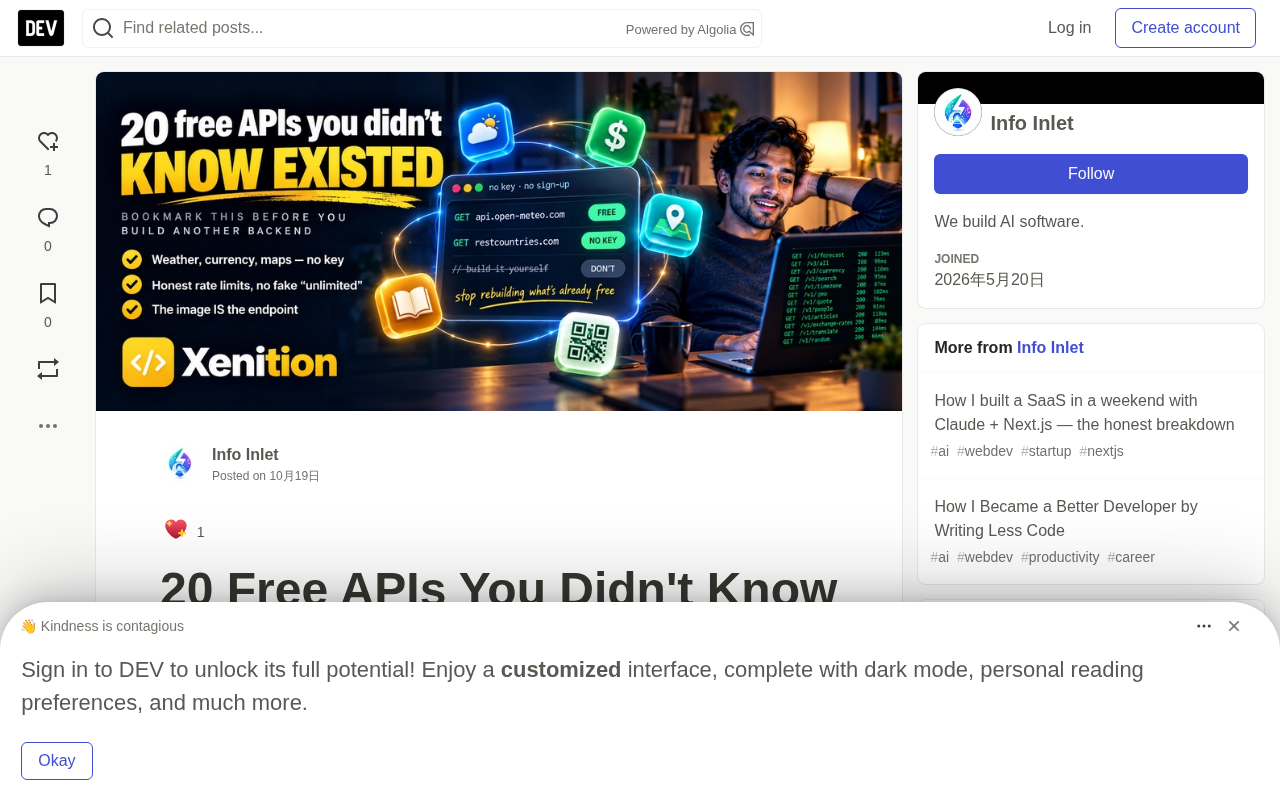
20 Free APIs Every Developer Should Know: A Time-Saving Collection

20 free APIs covering weather, geo, content, and more—and why the integration gap, not API discovery, kills side projects.
The article rounds up 20 genuinely useful free APIs grouped by problem domain, including weather (Open-Meteo), country data (REST Countries), exchange rates (Frankfurter), geocoding (Nominatim), and images (Unsplash/Pexels). Most are keyless but come with their own limits. The author argues that knowing an API exists isn't the bottleneck—the gap from integration to a working feature is what kills side projects—and recommends focusing on describing the outcome and wiring things up fast instead of reinventing the wheel.
Most backend code that gets deleted wasn't deleted because it was badly written—it was deleted because there was already a free API for that feature, and you just didn't know about it.
This is the hidden tax on indie developers: you write a currency conversion endpoint, scrape weather data, maintain a zip-code-to-city service, all without realizing these problems were long ago solved by a public URL and a free tier. A recent popular article rounded up 20 free APIs that people actually use—skipping services like Stripe and OpenWeather that don't need an introduction—grouped by problem domain and honestly flagging the gotchas of each one.
Data You'd Otherwise Pay For, Scrape, or Maintain Forever
Open-Meteo provides full weather forecasts, historical data, and air quality—no registration, no key, free for non-commercial use. Integration is a single GET request: no dashboard, no billing page, no trial countdown. REST Countries returns all country information in one call—flags, capitals, currencies, calling codes, languages, borders, population. Those country dropdowns you've hand-typed could have used this.
Frankfurter is built on official European Central Bank reference rates, open source, and keyless. If you've ever paid for a forex API for a side project, you can stop. Caveat: the ECB publishes once per business day, so these are daily rates, not real-time ticks—fine for 95% of apps, but not for a real trading desk.
Nager.Date gives you public holidays for any country in any year, free and keyless. "Is next Tuesday a holiday in Germany?" is surprisingly annoying to compute, and this API just answers it. Open Library fetches book metadata by ISBN—cover, title, author, publication date—from the Internet Archive, free and keyless.
Location and Identity, Saving You the Geo-SaaS Bill
Nominatim (OpenStreetMap) offers free geocoding in both directions: address to coordinates and coordinates to address. This is the feature every map SDK starts charging for after a few thousand calls. But there's a critical limit: the public server allows a maximum of 1 request per second, requires a real User-Agent, and requires attribution. It's run for the community, not for your batch jobs—either respect it or self-host.
Zippopotam.us supports zip-code-to-location lookup for 60+ countries, returning city, state, and coordinates. ip-api.com provides keyless IP geolocation, returning country, region, city, ISP, latitude, and longitude, at 45 requests per minute for non-commercial use. Note: the free endpoint is HTTP and non-commercial only; HTTPS and commercial use are paid tiers. Sunrise-Sunset gives you sunrise, sunset, dawn, dusk, solar noon, and day length for any coordinates—handy for apps that behave differently based on day and night.
Geocoding is the process of converting an address (like "10 Wangjing Street, Chaoyang District, Beijing") into geographic coordinates (latitude and longitude), or the reverse: turning coordinates into a readable address. It underpins map applications, delivery logistics, location search, and more. Commercial map services (like Google Maps and Mapbox) typically offer a free tier but charge per call beyond it, which can be costly for high-volume apps. Nominatim, as an open-source option built on OpenStreetMap data, provides free geocoding, but its public instance has strict usage limits (e.g., 1 request per second), making it suitable for low-frequency or prototype work; for production, self-hosting or a commercial service is recommended.
IP geolocation is the technique of inferring a user's geographic location (country, city, latitude/longitude) and internet service provider (ISP) from their IP address. It's commonly used for content localization, fraud detection, and access control. Free services like ip-api.com offer keyless HTTP endpoints, but typically restrict non-commercial use and request frequency (e.g., 45 requests per minute), and HTTP is insecure. Commercial use or HTTPS access requires payment. Developers should be mindful of privacy compliance and avoid relying on IP geolocation for high-precision decisions.
Content, Media, and Metadata
The Free Dictionary API (dictionaryapi.dev) provides definitions, parts of speech, example sentences, and even pronunciation audio—no key, no cost. The Wikipedia REST API serves clean article summaries, thumbnails, and extracts. Stop scraping Wikipedia; just use the API and attribute it.
Unsplash and Pexels offer genuinely free stock photo APIs with generous free tiers (Unsplash's demo tier allows 50 requests per hour, Pexels 200 per hour). Both require a free API key and require crediting the photographer; Unsplash's demo tier is for development, and production limits require an application.
goQR (api.qrserver.com) generates QR codes from URLs—no SDK, no npm package, no key. The image itself is the endpoint, so you can drop it straight into an <img src>. Microlink turns any URL into a rich preview: title, description, OG image, logo, even a screenshot—no scraper needed. The keyless free tier allows about 50 requests per day, enough for prototyping; for real use, you'll need to register.
Development Pipeline: Prototypes, Testing, and Demos
JSONPlaceholder is a mock REST API that's always online, serving posts, comments, users, and todos—real-shaped JSON for wiring up a frontend before the backend is ready. The localhost:3001 mock server you keep rebuilding is already hosted for you. The Hacker News API turns the entire site into JSON: stories, comments, users, live updates, served from Firebase, keyless—great for building readers, dashboards, or real text data sources.
Open Food Facts fetches product data by barcode: ingredients, nutrition, allergens, images—a community food database, free, open, and keyless. CoinGecko gives you cryptocurrency prices, market caps, and historical charts without an account; the free demo tier supports basic calls without a key, but the keyless path is rate-limited (about 30 requests per minute), and CoinGecko keeps tightening it, so a free demo key is recommended for real use.
Agify/Genderize/Nationalize are three sibling APIs from the same team that predict age, gender, or nationality from a name—free for 100 names per day, keyless. But let's be clear: these are statistical guesses based on name datasets. They're fun for demos and risky for making decisions about real people—don't build anything important on top of them. Numbers API provides trivia about any number, and Advice Slip gives random advice, both keyless—perfect when your prototype's empty state needs something other than lorem ipsum.
Mock APIs provide fixed or dynamically generated fake data endpoints for frontend development and testing when the backend service isn't ready. JSONPlaceholder is a classic free mock REST API, serving resources like posts, comments, and users as structured JSON, helping frontend teams develop and integrate interfaces independently of backend progress. It's permanently free and keyless, but the data is static, making it unsuitable for scenarios requiring real interaction or persistence.
The Truth the List Doesn't Tell You
Here's the one thing nobody writes in these roundups, and it's the whole ballgame: knowing an API exists is never the bottleneck. You can bookmark all twenty and still ship nothing. Between "oh, a free weather API" and a working feature lie reading the docs, matching the auth, shaping the response into UI, and handling a failed call at 2 a.m.—that gap is where side projects quietly die.
The author says he stopped treating each integration as a project and started treating it as one sentence: "When someone types a city, show the forecast." State the outcome, wire up that one endpoint, and move on. The apps that ship are the ones that refused to rebuild what twenty strangers already gave away for free.
This is exactly the gap Xenition aims to fill—their AI workspace, a Flutter app on iOS and Android. You describe what you want—"an app that turns a zip code into local weather and a map"—and it drafts the app, with free endpoints already wired up, turning integration into a conversation rather than an afternoon. The list above is raw material; the trick is not spending the day on the parts that have already been solved.
Bookmark these twenty, then go build the one feature you actually opened your laptop for.
API integration is far more than calling a URL. It involves reading documentation, understanding authentication (e.g., API keys, OAuth), handling request parameters and response formats, error handling and retry mechanisms, rate-limit handling, data caching strategies, and mapping returned data to UI components. These steps are time-consuming and error-prone, especially for indie developers, who can easily get lost in the details. Choosing simple, well-documented APIs and adopting a "one-sentence outcome" approach can significantly reduce integration complexity and speed up the journey from idea to working feature.
Related articles

Random Pruning of the DPO Computation Graph: 1.4x Training Speedup and Lower Peak Memory
DPO training too slow and memory-hungry? This paper proposes a random pruning framework for the DPO computation graph, sampling independently across position, sequence, and branch dimensions; branch pruning achieves a 1.426x step-time speedup and cuts training time by about 30%, with in-depth attribution of memory and time gains.

Why Does JEPA Underperform MLM in Longitudinal EHR Representation Learning?
New study compares JEPA and MLM for longitudinal EHR representation learning on MIMIC-IV: three JEPA variants train stably without collapse but underperform MLM; target size, not heterogeneity, drives prediction error.

Transfer Learning + Visible Light Communication: A New Approach to Energy-Efficient Indoor Positioning
A study proposes a transfer learning-based visible light communication indoor positioning method, achieving 47% accuracy improvement on the BOSCH factory dataset, 67.5% model efficiency under high noise, and introducing the ME composite metric for energy-efficient positioning in energy-constrained industrial IoT scenarios.