20-Year-Old College Student Earns $1,200/Month with Claude: A Vibe Coding Monetization Breakdown

A college student used Claude to build a niche iOS app for $545 and earns $1,200/month in passive income.
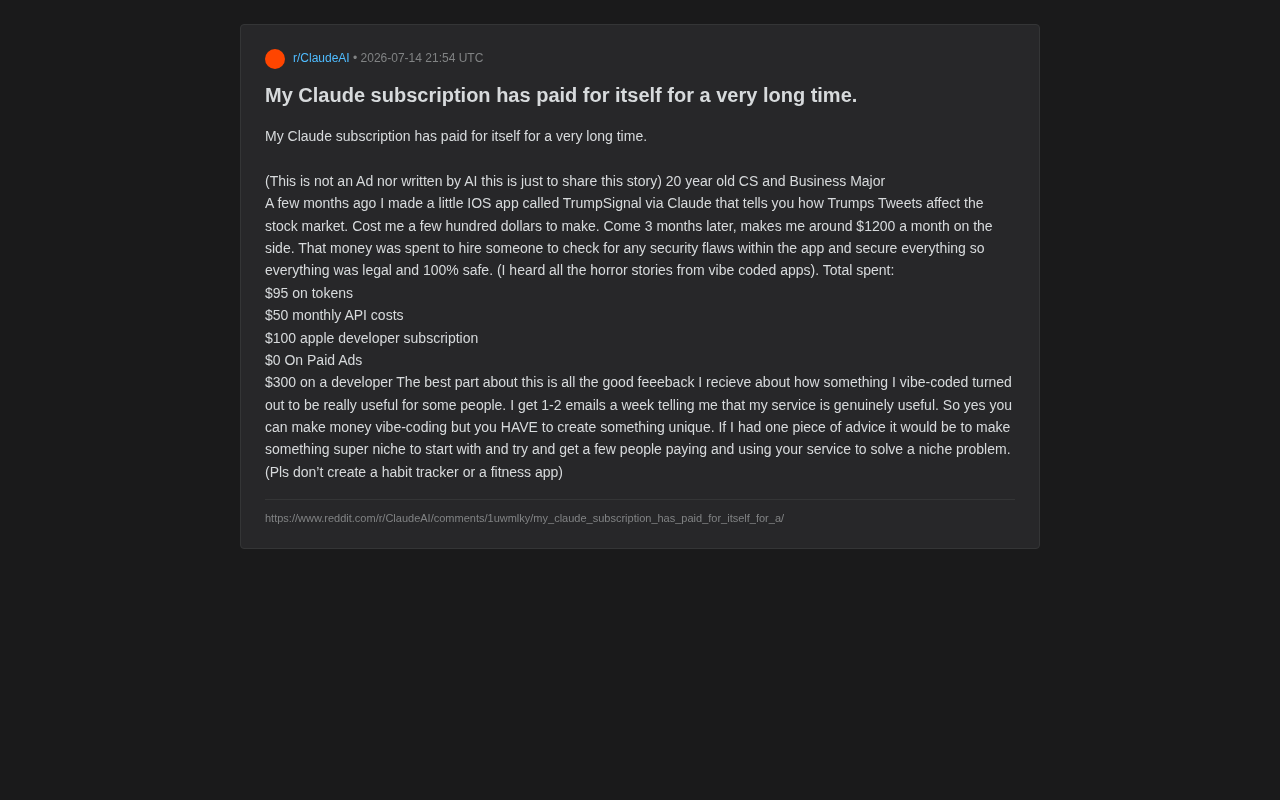
A 20-year-old college student used Claude to build TrumpSignal, an iOS app tracking how Trump's tweets affect stock markets. With an initial investment of $545 — including a $300 security audit — he now earns roughly $1,200/month. The case offers a clear blueprint for Vibe Coding monetization: niche positioning, cost transparency, and human oversight over AI-generated code.
A Validated AI-Powered Income Story
On Reddit, a 20-year-old double major in computer science and business shared his AI coding startup journey — and it quickly went viral. He was upfront about one thing: this wasn't an ad or an AI-generated puff piece, but a real money-making case study backed by actual receipts and data.
A few months ago, he used Claude to build an iOS app called TrumpSignal. The concept was simple but sharp — tracking how Trump's tweets influence stock market movements. Total development costs came in under $600, and within three months, the app was generating around $1,200 per month in passive income.
What makes this story valuable isn't the dollar amount — it's how clearly it maps out the real-world monetization path (and its limits) for what's now known as "Vibe Coding." The term was coined in early 2025 by OpenAI co-founder Andrej Karpathy and quickly caught on: instead of writing code line by line, developers describe what they want in plain language and let an AI model generate fully functional code in real time. The developer shifts into the role of "product manager + QA tester." The biggest shift this paradigm brings is moving the barrier to entry away from syntax fluency and toward product intuition — whoever can ask the right questions and define clear requirements can wield these tools effectively.
Cost Breakdown: A Transparent Startup Receipt
This developer published a complete breakdown of his expenses — an invaluable reference for anyone looking to follow a similar path.
Full Expense List
- Token costs: $95 — Direct usage fees for generating code with Claude
- Monthly API costs: $50 — Interface call fees required to run the app
- Apple Developer subscription: $100 — The mandatory fee to list on the App Store
- Paid advertising: $0 — Zero marketing budget
- Security audit: $300 — Hired a professional to review the code for security vulnerabilities
Total initial investment: approximately $545, generating $1,200/month in steady income — a payback period of less than two weeks. He joked that his Claude subscription had more than paid for itself.
To understand this breakdown, two underlying mechanisms are worth knowing. Claude's token-based pricing: Tokens are the basic unit large language models use to process text — roughly 750 English words equals 1,000 tokens, and both input prompts and output code are billed by volume. The $95 in token costs represents hundreds of thousands to millions of tokens generated, covering iOS frontend UI, data scraping logic, backend API integration, and other complete modules. This pricing model is extremely developer-friendly: you only pay for what you actually use, with none of the fixed labor costs of traditional outsourcing. Apple's developer ecosystem: The $100 annual fee is the gateway to the App Store, and Apple takes a 15–30% commission on subscription revenue — though developers earning under $1 million annually qualify for a reduced 15% rate. Subscription-based monetization has become the dominant model for utility apps, producing steady monthly recurring revenue (MRR). That's the structural logic behind "$1,200/month in passive income."
A Critical Decision That's Easy to Overlook
The $300 security audit deserves its own discussion. The developer admitted he'd seen too many "vibe coded" apps fail — products built entirely on AI-generated code, shipped without human review, often hiding serious security vulnerabilities.
TrumpSignal operates in the financial information space, where compliance risk is especially acute. The U.S. SEC has a clear regulatory definition of "investment advice": any activity aimed at profit that provides specific securities trading recommendations to others may trigger registration requirements under the Investment Advisers Act. The app's legal defensibility likely hinges on positioning itself as an "information aggregation tool" rather than an "investment advisor" — displaying objective data correlations rather than issuing buy or sell instructions. In fintech, legal risk is often more damaging than technical risk, and the $300 audit covered both code security and compliance boundaries.
He proactively paid to have a professional review the code for vulnerabilities, ensuring the app was "compliant and 100% secure." This decision reflects a mature product mindset: AI can help you build a prototype fast, but any product you actually ship to users — especially one involving money and data — still requires human oversight.
The Core of His Success: Hyper-Focused Niche Positioning
If cost discipline is the "how" of this case study, product positioning is the "why it worked."
His core advice is blunt: you have to build something genuinely unique. He emphasizes focusing on "super niche products" — find a small number of people willing to pay, and solve one specific, narrow, real problem.
TrumpSignal is exactly that strategy in action. It's not yet another general-purpose stock analysis tool. It cuts precisely into the very specific scenario of "the relationship between Trump's statements and market volatility." That distinctiveness is what allowed it to naturally stand out in a crowded App Store.
There's solid business logic behind this approach. Chris Anderson's The Long Tail argues that in the internet age, real commercial opportunity often lies not in a handful of blockbuster hits, but in the aggregate of countless niche demands. For indie developers, niche positioning brings an additional advantage: a precise user profile drives acquisition costs close to zero — when the target user's need is specific enough, word-of-mouth in vertical communities (specific subreddits, Discord servers) can handle cold-start growth entirely. TrumpSignal's target users are likely retail investors active in communities like WallStreetBets who follow the intersection of politics and markets — a real, underserved demand with almost no existing supply. That's the ideal shape of a niche market.
A Slightly Amusing Word of Warning
He also added a line that made a lot of people laugh: "Please, for the love of god, stop building habit trackers and fitness apps."
It's a sharp observation about one of the most common traps in the current AI coding wave — legions of newcomers using AI tools to clone the same already-saturated app categories. When everyone is building the same thing, no amount of low development cost translates into commercial value. The real opportunities are hiding in the niche corners no one else has noticed yet.
User Feedback: A More Convincing Signal Than Revenue
For this developer, the income figures aren't even the most rewarding part. He mentioned receiving one or two emails from users every week saying the product is "genuinely useful" to them.
This kind of positive response points to something that often gets overlooked: whether a Vibe Coding product has real value ultimately depends on whether it actually solves a user's problem — not what tools were used to build it or how long it took. Users don't care whether the code was hand-written or AI-assisted. They only care whether it helps them.
Four Takeaways for Indie Developers
1. AI Has Dramatically Lowered the Barrier to Building
A 20-year-old student, with under $600 and a few months of work, completed the entire journey from idea to profitable product. That was nearly unimaginable before AI tools became widely available. Tools like Claude allow people with ideas but limited engineering backgrounds to rapidly validate business hypotheses. The underlying reason: large language models trained on massive code datasets can now understand contextual intent and output structurally complete, logically coherent multi-file project code — compressing what once required months of engineering hours into days or even hours.
2. But AI Cannot Replace Product Judgment
What actually determined success was the "unique and niche" product idea, and the maturity to proactively invest in security. AI handles the "how" — the "what" still requires human insight and judgment.
3. Security and Compliance Are Non-Negotiable
This is especially true for apps involving financial data and user privacy. The $300 security audit may look like an added cost, but it's a necessary investment in avoiding legal liability and reputational damage. In fintech, the cost of a single data breach or regulatory penalty can far exceed the total revenue generated by the entire project.
4. Small and Focused Beats Big and Bloated
Rather than building a feature-heavy, fiercely competitive general-purpose product, dig into a niche need that others overlook. Get a small group of people to pay first, then scale gradually. That's the more pragmatic path.
Closing Thoughts
The reason this Reddit post resonated so widely is precisely because it didn't oversell anything — no "making millions overnight" mythology, just a transparent expense list, a clear strategy, and genuine user feedback.
In an era where AI-powered coding is heavily hyped, a grounded case study like this is far more convincing. It tells us: making money with AI is absolutely possible — but only if you create something that's genuinely unique and genuinely useful.
Related articles
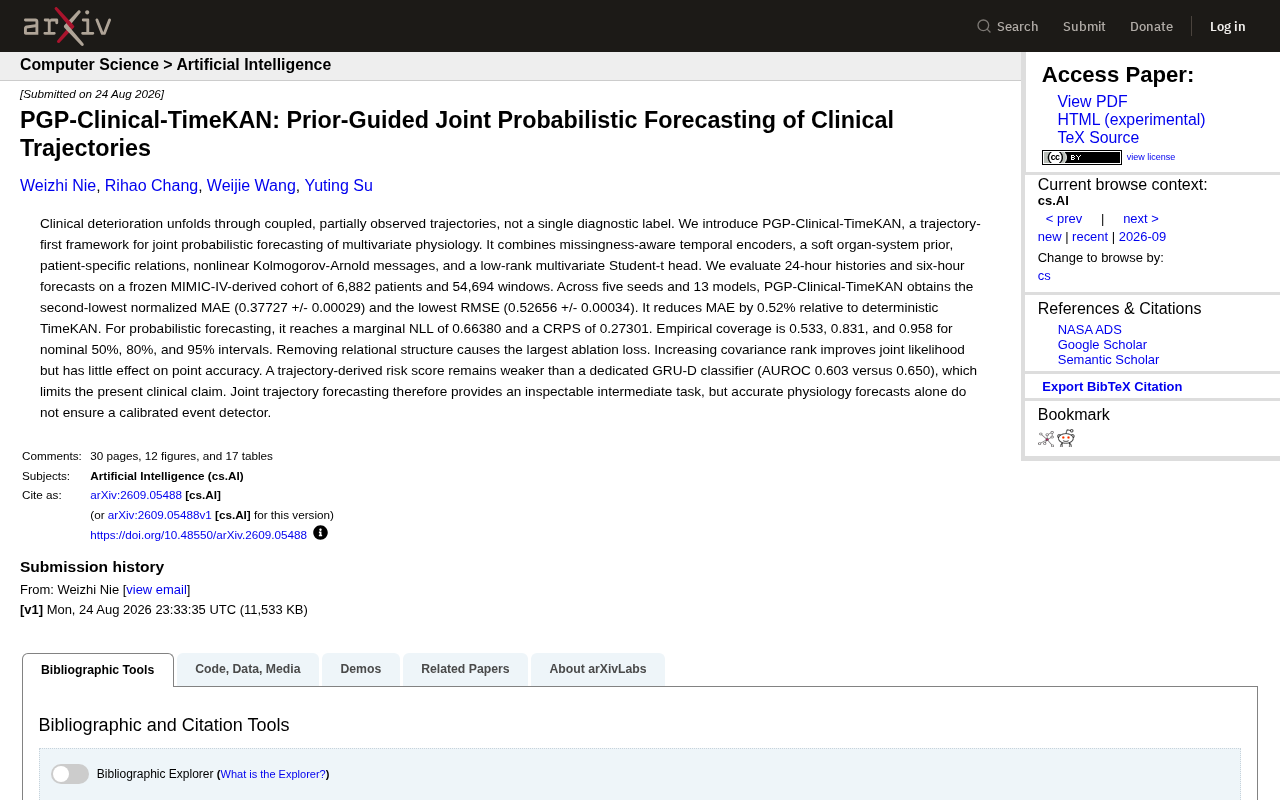
PGP-Clinical-TimeKAN: A Detailed Guide to the Multivariate Physiological Indicator Joint Prediction Framework
An in-depth analysis of the PGP-Clinical-TimeKAN framework for joint probabilistic prediction of multivariate physiological indicators, covering trajectory-first paradigm, KAN message passing, MIMIC-IV validation, and ablation studies.
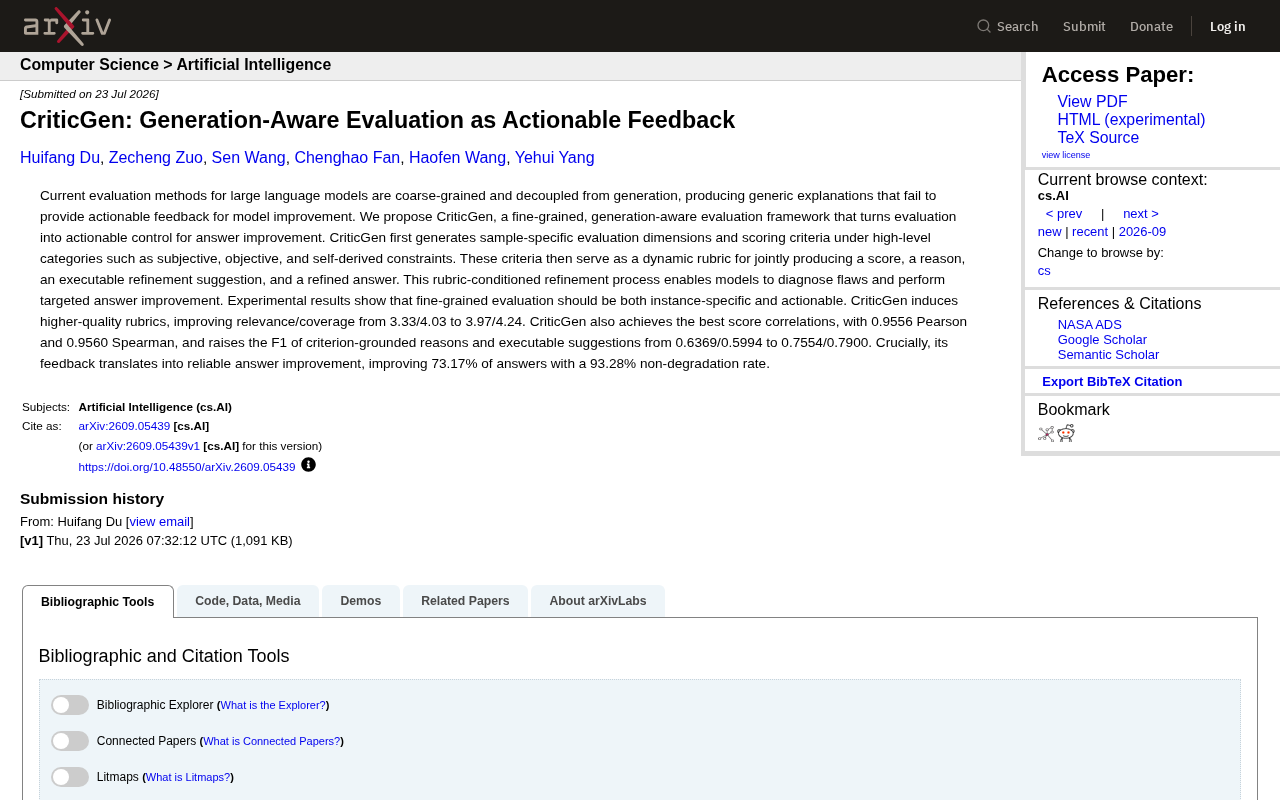
CriticGen: A New Framework That Transforms AI Evaluation into Actionable Improvement Feedback
CriticGen proposes a generation-aware evaluation framework that transforms AI assessment from passive scoring to an active optimization loop, achieving 73.17% answer improvement and 93.28% non-degradation rate.
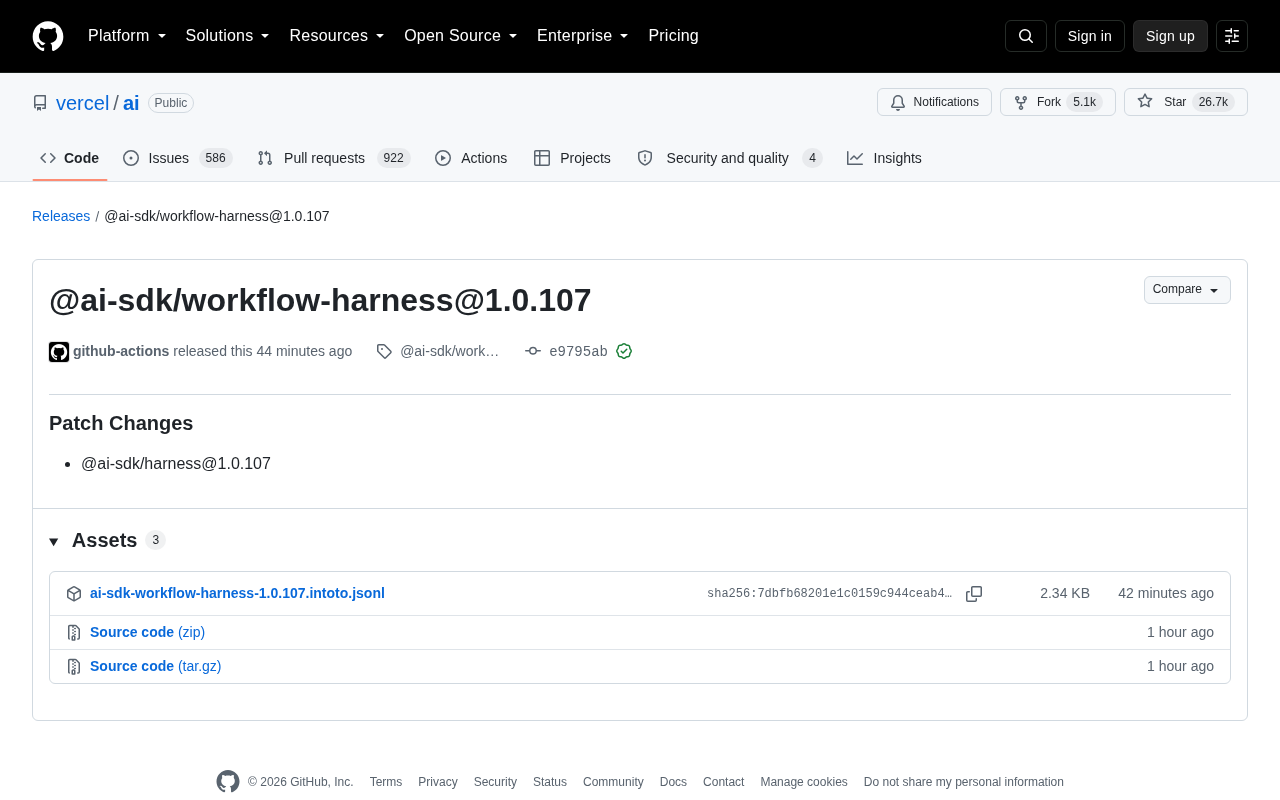
Vercel AI SDK workflow-harness Update Analysis
Deep analysis of Vercel AI SDK workflow-harness 1.0.107 update: architecture design, engineering practices, and developer value for building reliable AI apps.