2026 Embedding Model Selection Guide: Comparing 20+ API and Open-Source Models

A cross-comparison of 20+ embedding models offering a practical selection framework based on price, dimensions, input length, and licensing.
The article notes that embedding models are the highest-volume component in RAG and semantic search systems, yet their cost impact is often underestimated. The comparison covers 20+ API and open-source weight models across four dimensions: price per million tokens, vector dimensions, maximum input length, and licensing. Key points: dimensions directly determine storage scale, and higher dimensions don't necessarily yield better retrieval quality; storage costs must be estimated separately for float32, float16, or quantization; the choice between API and open-source self-hosting depends on data scale, update frequency, and compliance requirements rather than unit price alone. The article ends with a selection checklist emphasizing baseline validation with medium dimensions plus quantization, checking commercial terms of open-source licenses, and evaluating retrieval on real business data.
Choosing the wrong embedding model can cost you on both your bill and your retrieval quality. This cross-comparison covering 20+ API and open-source weight models examines price per million tokens, vector dimensions, maximum input length, and licensing, and includes a storage cost estimation method—providing a practical reference framework for engineering selection.
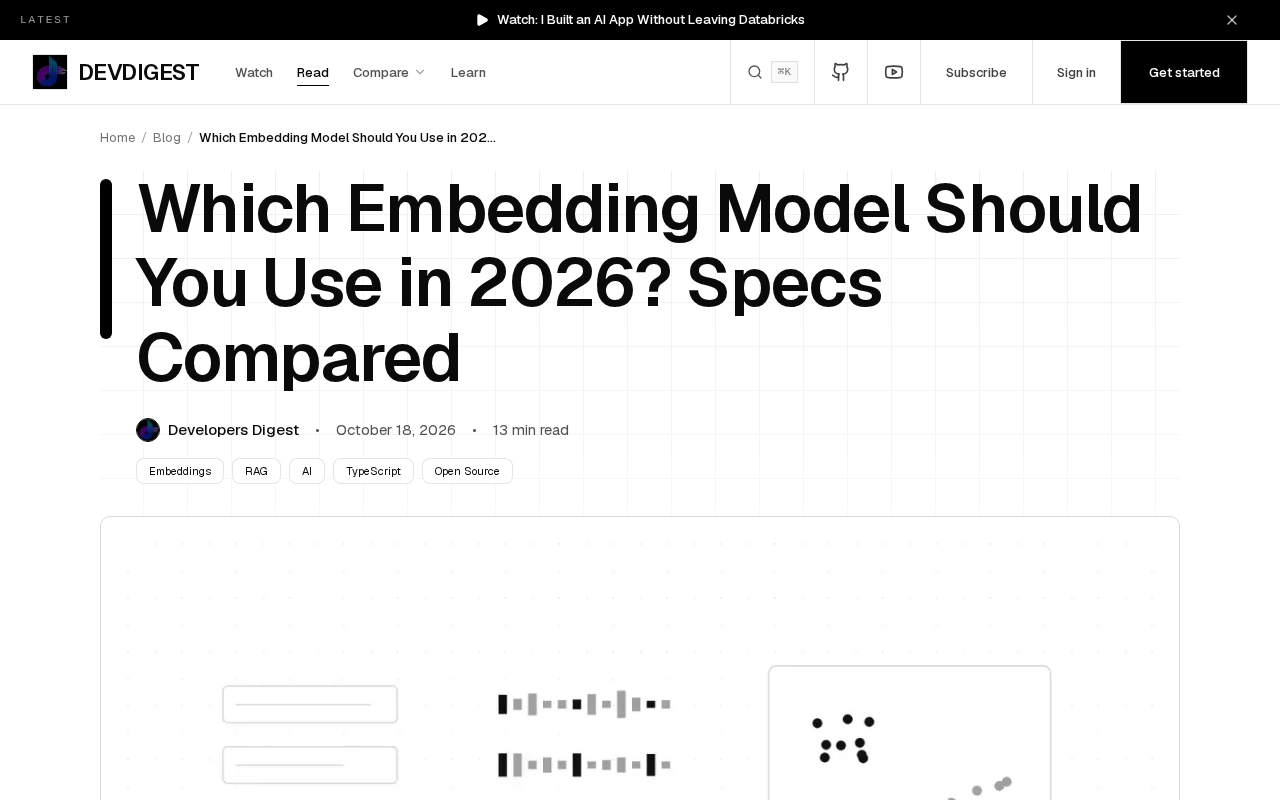
Why embedding selection affects cost more than you'd think
Embedding models don't produce long visible text on every call like generative models do, but in RAG, semantic search, clustering, and recommendation systems they are often the highest-volume component. The core dimension the original comparison focuses on—price per million tokens—directly determines the long-term cost of index building and querying. More critically, vector dimensions determine storage scale: for the same number of documents, the index size gap between 1024 and 3072 dimensions can reach threefold, and storage costs keep accumulating in high-frequency update scenarios.
RAG (Retrieval-Augmented Generation) is an architecture that injects retrieval results from an external knowledge base as context into a generative model: a user's question is first encoded into a vector, the most relevant text chunks are retrieved from the index, and then they are fed into the LLM together with the question to generate an answer. The embedding model handles bidirectional encoding of both documents and queries—called once per document during index building and once per user request during querying—so its call frequency is typically far higher than that of the generative model, and unit price and dimensions directly amplify long-term operating costs.
Price, dimensions, and input length: three parameters you must consider together
The original compares API models and open-source weight models in the same table, which is itself a valuable perspective. Closed-source API pricing is usually more straightforward, but open-source weight models require folding in inference compute and operational costs; conversely, open-source models often offer more cost flexibility for batch offline indexing.
There's a common misconception about dimension choice: higher dimensions don't automatically mean better retrieval quality. The original's comparison shows that many medium-dimension models perform close to high-dimension models on standard retrieval benchmarks while having significantly lower storage and compute overhead. Maximum input length determines how long a text chunk can be encoded in a single pass; for scenarios involving long documents or code files, this parameter directly constrains your chunking strategy.
Licensing also shouldn't be overlooked. Authorization terms vary considerably among open-source weight models—commercial restrictions, attribution requirements, and redistribution conditions all differ—so focusing only on performance metrics during selection can easily lead to compliance pitfalls.
Open-source weight models refer to models whose parameters are released as public weights that you can download and deploy yourself, as opposed to closed-source services accessible only through vendor APIs. Their cost structure isn't billed per token but derived from GPU inference compute, memory footprint, batch throughput, and operational labor: batch offline indexing can fully amortize per-call costs through high concurrency, but under low-load online querying, insufficient GPU utilization actually makes them more expensive. Additionally, weight file size correlates positively with vector dimensions and parameter count, and self-hosting requires reserving extra overhead for memory and concurrency—hidden costs easily overlooked when only comparing API unit prices.
How to calculate storage costs: an easily underestimated expense
The original provides a storage estimation methodology, which is the part many selection articles miss. Actual vector footprint isn't just dimensions multiplied by document count: stored as float32, each dimension takes 4 bytes, so a 1024-dimension vector is 4KB per entry, and a million documents start at 4GB; using float16 or quantization compression can halve the size or more, at the cost of slight precision loss. The reasonable engineering approach is to first validate with medium dimensions plus quantization, then decide whether to upgrade.
float32 / float16 / quantization are three common representations of vector numerical precision. float32 stores one floating-point number in 32 bits (4 bytes), offering the highest precision but largest size; float16 uses 16 bits (2 bytes), halving size with minimal impact on retrieval quality for most embeddings; quantization goes further by using low-bit integers such as int8 along with scaling factors to reconstruct values, compressing size to about a quarter of float32. Retrieval metrics like cosine similarity tolerate these precision losses to some degree, so engineering practice often uses float16 or int8 quantization to reduce storage and memory overhead—at the cost of re-evaluating recall to confirm the precision drop is acceptable.
API or open-source self-hosting: decide by scenario, not preference
If your index is small and you iterate quickly, the zero-ops advantage of API models is obvious; if your data is sensitive, your call volume is huge, or you need offline batch processing, open-source weight models with self-built inference services are more controllable. The original's comparison table covers both routes, effectively hinting at a conclusion: the answer depends on data scale, update frequency, and compliance requirements—not on simply comparing unit prices.
Vector indexes are specialized data structures designed for high-dimensional vectors, with common implementations including HNSW (based on hierarchical navigable small-world graphs—fast queries, high memory usage) and IVF (inverted file plus clustering—suited to very large scale, trading a little recall for memory). Index type and vector dimensions jointly determine memory usage and query latency: the higher the dimensions, the larger each vector, and the higher the cost of maintaining adjacency relationships in graph indexes. So beyond the embedding model's own dimensions, you also need to evaluate the memory budget and recall performance of your target index structure at that dimension—the two must be decided together.
Selection checklist
- First clarify index scale and update frequency, then estimate storage and call costs
- Use medium dimensions plus quantization as a baseline validation to avoid prematurely choosing the highest dimensions
- Confirm that maximum input length covers your chunking strategy
- For open-source weight models, be sure to check the commercial terms of the license
- Run retrieval evaluations on real business data rather than relying only on public benchmarks
The original's comparison data provides a quantitative starting point for these judgments; specific trade-offs still need validation against your own scenario.
Related articles

From Photons to Production: An Open-Source Computer Vision Engineering Reading Path
Reddit user open-sources a computer vision engineering reading path with 16 chapters from image formation to production deployment, emphasizing primary sources, dependency order, and reproducible benchmarks to help engineers understand why models fail and build reliable vision systems.

Prompt Failures? The Truth About Why AI Agents Struggle in Production—and How to Fix It
A Reddit developer built Agents with Copilot and Gemini but faced unstable behavior. This article analyzes three gaps in prompt engineering for Agent scenarios and offers three practical paths to reliable Agent deployment, including structured prompts, workflow-first approaches, and building an evaluation loop.

Tesla Robotaxi to Open Private Vehicle Access Next Year: Promise or Pipe Dream?
At its Q3 earnings call, Tesla said owners can add their cars to the Robotaxi fleet next year. We analyze the technical basis, Musk's missed deadlines, business logic, and competition.