From Photons to Production: An Open-Source Computer Vision Engineering Reading Path

Open-source computer vision engineering reading path from image formation to production deployment, emphasizing primary sources and reproducible benchmarks.
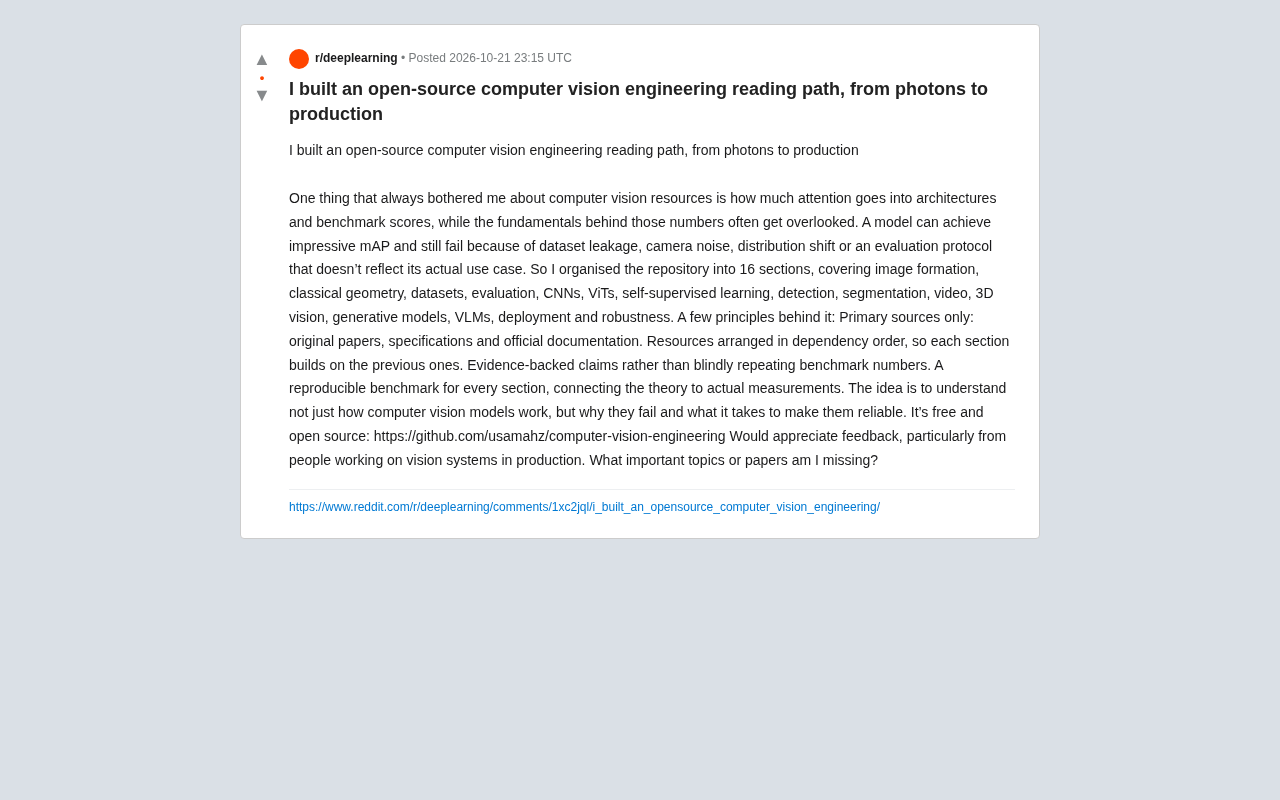
Reddit user usamahz open-sourced the computer-vision-engineering project, aiming to build a complete computer vision engineering reading path from photons (image formation) to production (deployment and robustness). The project has 16 chapters covering image formation, classical geometry, datasets, evaluation, CNN, ViT, self-supervised learning, object detection, segmentation, video, 3D vision, generative models, vision-language models, deployment, and robustness. It follows four principles: use only primary sources, organize by dependency order, evidence-backed conclusions, and reproducible benchmarks. The core motivation is to bridge the gap between model metrics (such as mAP) and production reliability, addressing practical issues like dataset leakage, camera noise, distribution shift, and evaluation protocol mismatch. The author seeks feedback from production engineers to fill in missing important topics or papers.
Why do we need a computer vision engineering reading path?
The field of computer vision has never lacked resources, but most tutorials and courses focus their attention on model architectures and leaderboard scores. A model may achieve an impressive mAP on COCO, yet fail catastrophically in production due to dataset leakage, camera noise, distribution shift, or evaluation protocols that are disconnected from real-world scenarios. The computer-vision-engineering project open-sourced by Reddit user usamahz is precisely aimed at solving this pain point—it attempts to build a complete reading path from photons (image formation) to production (deployment and robustness), helping engineers understand why models work and, more importantly: why they fail.
Project Structure and Design Principles
This repository is organized into 16 chapters, covering the complete chain of computer vision engineering: image formation, classical geometry, datasets, evaluation, CNN, ViT, self-supervised learning, object detection, segmentation, video, 3D vision, generative models, vision-language models (VLM), deployment, and robustness. Each chapter is built around a core question rather than simply listing papers.
The designer follows four principles that are uncommon in open-source learning resources:
- Use only primary sources: original papers, technical specifications, and official documentation, avoiding information distortion from secondhand interpretations.
- Organized by dependency order: each chapter builds on the previous one, forming a followable learning path.
- Evidence-backed conclusions: rather than blindly repeating benchmark numbers, it emphasizes the experimental conditions and constraints behind those numbers.
- Reproducible benchmarks: each chapter comes with a reproducible benchmark that connects theory with actual measurement.
This "theory-measurement" closed-loop design allows readers to not just passively read, but to personally verify the assumptions at each stage. For engineers working on deploying vision systems, this is more valuable than reading a few more SOTA papers.
Distribution shift refers to the phenomenon where the input data distribution encountered during model deployment differs from the training data distribution. In computer vision, this can arise from lighting changes, different camera models, weather conditions, seasonal changes, or user behavior differences. Distribution shift can cause significant performance degradation or even complete failure of the model. Mitigation strategies include: domain adaptation, robust training (such as data augmentation and adversarial training), continual learning, and distribution monitoring during deployment. Understanding the types and impacts of distribution shift helps consider the model's generalization boundaries at the design stage, rather than discovering problems only in the production environment.
From Model Metrics to Production Reliability
The problems identified by the project initiator are very specific: a model can have a beautiful mAP yet perform poorly in real scenarios due to dataset leakage; camera noise and distribution shift can render laboratory evaluation results meaningless; and if the evaluation protocol itself does not match the use case, even the highest scores are just a numbers game. These issues are often glossed over in academic papers, but they are fatal in production systems.
This reading path treats "robustness" and "deployment" as independent chapters rather than supplementary content. This means readers need to recognize from the very beginning that computer vision engineering does not end with training a model—it is a continuous engineering problem from image formation to final deployment. Decisions at every stage—dataset construction, evaluation protocol design, model selection, deployment constraints—affect the reliability of the final system.
mAP (mean Average Precision) is one of the most commonly used evaluation metrics in tasks such as object detection and image retrieval. It is computed by calculating the area under the precision-recall curve (AP) at different recall levels, then averaging across multiple categories or IoU thresholds. A higher mAP generally means better detection accuracy on a given dataset. However, mAP is highly dependent on dataset distribution, annotation quality, and evaluation protocol (such as IoU thresholds and category splits). A model that achieves high mAP on academic benchmarks (such as COCO) may see a significant drop in production performance if there is a distribution gap between training data and real-world scenarios, or if practical factors such as camera noise and occlusion are not considered during evaluation. Therefore, understanding the limitations and applicable conditions of mAP is more important than simply chasing high scores.
Data leakage refers to the accidental inclusion of test set or validation set information in training data, causing the model to appear artificially high during evaluation while having poor generalization in real deployment. Common forms include: different frames of the same scene being split into training and test sets, near-duplicate images not being deduplicated, or global statistics (such as the mean of the entire dataset) being used during preprocessing. In computer vision, data leakage is particularly insidious because image content is highly correlated. Preventive measures include strict data splitting, checking for duplicate samples, and avoiding global normalization before splitting. Identifying and eliminating leakage is the first step in ensuring reliable model evaluation.
Open-Source Community Seeks Production Experience Feedback
The project is released for free as open source on GitHub, and the author explicitly states that he hopes to receive feedback, especially from engineers working on vision systems in production environments. His question is direct: "What important topics or papers did I miss?" This open attitude, combined with the project's commitment to primary sources and reproducibility, gives it the potential to become a solid reference resource in the field of computer vision engineering.
If you are building vision systems or want to fill the knowledge gap from theory to production, this reading path is worth bookmarking. It won't teach you tuning tricks, but it will help you build a thinking framework for judging model reliability—which is precisely the scarcest capability in production environments.
One-line Summary
An open-source computer vision engineering reading path, from image formation to production deployment, emphasizing primary sources and reproducible benchmarks.
Paragraph Summary
Reddit user usamahz has open-sourced the computer-vision-engineering project, aiming to build a complete computer vision engineering reading path from photons (image formation) to production (deployment and robustness). The project is divided into 16 chapters, covering image formation, classical geometry, datasets, evaluation, CNN, ViT, self-supervised learning, object detection, segmentation, video, 3D vision, generative models, vision-language models, deployment, and robustness. The design follows four principles: use only primary sources, organize by dependency order, evidence-backed conclusions, and reproducible benchmarks. The core motivation is to bridge the gap between model metrics (such as mAP) and production reliability, focusing on practical issues such as dataset leakage, camera noise, distribution shift, and evaluation protocol mismatch. The author openly solicits feedback from production engineers, hoping to supplement missing important topics or papers.
Related articles

AI Reverse-Engineers Monitor Firmware in 15 Minutes — Has the Hacking Barrier Been Flattened?
A security researcher used AI to reverse-engineer Dell monitor firmware in 15 minutes—entropy analysis, key extraction, MD5 verification—revealing encryption design flaws.

Mistral Voxtral 3: Real-Time Voice at 4 Cents per Minute, Challenging OpenAI
Mistral Voxtral 3 cuts real-time voice agent costs to 4 cents per minute, bundling three speech recognition models, a speech generation model, and a real-time voice toolkit, supporting 50+ languages and self-hosting. This article analyzes its pricing structure, sub-second response performance, and its strategic divergence from OpenAI and Gemini on data privacy versus out-of-the-box convenience.

WebMCP: Every Website as Its Own MCP Server, So AI Agents No Longer Rely on Screenshots
WebMCP lets websites expose tools via the document.modelcontext API, becoming directly callable MCP servers. This article explains its architecture, the Claude Code remote-debugging demo, Chrome's current support stage, and its impact on the agent ecosystem.