2026 Large Model Benchmark Rankings: Where GPT-6, Claude, and Chinese AI Actually Differ

Eight models re-weighted across four dimensions: GPT-6 Astra leads, DeepSeek rises to third on cost and speed.
The article re-scores eight prominent large models using Artificial Analysis's Intelligence Index, Terminal Bench, per-task cost, and output speed, weighted 60/20/10/10, with all models set to high reasoning tiers. GPT-6 Astra leads at 82.9, Claude Fable 5.1 is second due to its highest cost, and DeepSeek V4.1 Flash jumps to third on cost and speed. Chinese models trail by about 15% on intelligence and 17.2 points on agent tasks, but lead on cost and throughput.
One Leaderboard Doesn't Tell the Whole Story: Why a Composite Ranking Beats Individual Scores
If you look at just one large model leaderboard, it's easy to conclude that the highest score means the best model. But by 2026, that judgment no longer holds. Whether a model is truly good comes down to at least four things at once: how capable it is, whether its agents and coding can actually finish tasks, how much a single task costs, and how fast it runs.
In this video, the Bilibili creator does something more pragmatic: putting the eight most-watched models into the same scoring framework and recalculating, rather than piecing together results from each vendor's launch event. The core data uniformly uses Artificial Analysis's Intelligence Index V4.3.2 as of the end of September 2026, along with Terminal Bench 4.0, per-task cost, and output speed from the same evaluation suite. Vendor model cards are only used to cross-check model versions, context, and release information—self-reported scores are not mixed into the composite.
This choice matters. Vendor self-tests often use different prompts, different toolchains, different reasoning tiers—even the same benchmark isn't run the same way. Comparing these numbers side by side looks rich but easily creates false precision.
Scoring Rules: Four Weights and Two Fairness Principles
This secondary scoring isn't Artificial Analysis's official leaderboard—it's designed to answer the question of "overall strength and real-world value." The four weights are: 60% for composite intelligence, 20% for agent and terminal coding ability, 10% for cost efficiency, and 10% for output speed. For each category, the best-performing of the eight models is set to 100 points, the rest are scaled proportionally, and then weighted and summed.
There are two fairness principles. First, reasoning models use the high or highest tier configuration available on public leaderboards wherever possible: Max for GPT, Max for Claude, High for Grok, Max for DeepSeekAd and Kimi, High for Gemini. This compares the high-capability states each vendor is willing to offer publicly, rather than pitting a budget tier against a full-power tier. Second, context window and open-source status are not given separate bonus points. A 1M context window doesn't mean all 1M can be reliably used, and open weights don't mean higher reasoning quality—these are product features, not something that should quietly become capability points.
You can think of these four items as four gates a real task must pass: Gate 1, can the model understand the requirement; Gate 2, can it call tools to finish code, file, and terminal tasks; Gate 3, how much does completing this job cost; Gate 4, how long does it take to run the same 100 tasks. Passing all four is what we call overall strength.
Artificial Analysis is an independent large-model evaluation organization. Its Intelligence Index isn't a single exam score but a composite index that weights and combines multiple benchmarks—math, science, coding, instruction following, long-context understanding—under a unified methodology. Its value lies in running all models through the same execution framework and prompt templates, avoiding vendors piecing together self-reported scores. Terminal Bench, meanwhile, grew out of software engineering task evaluation in terminal environments: it requires models to read and write files, execute commands, debug code, and pass tests in a real shell. It tests closed-loop multi-step operation ability, not single-turn Q&A accuracy. Understanding how these two metrics are constructed is key to seeing why the same model can rank very differently on the two tables.
Composite Intelligence: GPT and Claude Still Lead the Top Tier
Start with composite intelligence, the core metric. GPT-6 Astra scores 53, and Claude Fable 5.1 also scores 53, tied for first. Next is Grok 4.7 at 46, GLM 5.3 and Qwen 3.8 Max both at 45, Kimi K3 at 44, Gemini 3.8 Flash at 41, and DeepSeek V4.1 Flash at 39.5.
Looking at this alone, the top tier is still GPT and Claude. The highest Chinese models, GLM and Qwen, are at 45—8 points behind 53, roughly a 15% relative gap. That gap isn't small, but it's not uncatchable either.
Agents and Terminal Coding: Where the Gap Gets Magnified
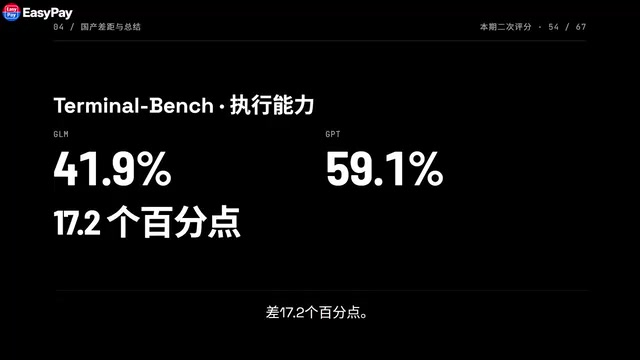
The second chart starts to show changes. Terminal Bench 4.0 tests not whether the model can answer questions, but whether it can continuously complete complex software, machine learning, and operations tasks after entering a terminal. GPT-6 Astra is at 59.1%, Claude Fable 5.1 at 52%, GLM 5.3 at 41.9%, Qwen 3.8 Max at 38.9%, DeepSeek at 26.8%, Grok around 26%, Gemini at 19.7%, and Kimi only 13%.
Here a key fact emerges: strong knowledge and actually completing complex tasks are not the same thing. A concrete example: have the model enter a real code repository, read the error, locate the dependency, fix the code, run the tests, and finally confirm no new issues were introduced. If it answers the first step beautifully but edits the wrong file at step three, the task still fails. This kind of agent leaderboard isn't checking whether the answer sounds like an expert—it's checking whether the entire chain runs through in the end.
Cost and Speed: Chinese Models' Two Aces
The third chart is cost. To complete one standard task on the same Intelligence Index, DeepSeek V4.1 Flash costs about $0.27, Gemini about $1.24, Kimi about $2, GLM about $2.01, GPT-6 Astra $3.26, Grok $3.74, Qwen $5.41, and Claude the most at about $7.63. That's 0.27 versus 7.63—more than a 20x difference.
The fourth chart is even more striking. On output speed, Gemini 3.8 Flash runs about 306 tokens per second, DeepSeek about 235, then a sharp drop to GLM's 74, Claude's 67, GPT's 63, Grok around 45, Qwen around 40, and Kimi around 35.
Per-task cost is typically calculated by multiplying the input and output tokens consumed by one standard evaluation task by the model's official API unit price. The higher the reasoning tier and the longer the chain of thought, the more tokens consumed and the higher the cost. Output speed is measured in tokens generated per second; it directly determines the perceived latency of streaming interaction and also affects total time for batch tasks. Note that both cost and speed are dynamic quantities that fluctuate with reasoning tier, concurrent load, and cache hit rate—the leaderboard gives reference values only under specific configurations. For production environments, these two numbers often drive model selection decisions more than a few points of intelligence difference.
Final Ranking: The Triangular Balance of Capability, Cost, and Speed
Stacking all four charts together, the final ranking is as follows:
- Eighth place: Kimi K3, composite score 56.7. Its composite intelligence of 44 isn't low, and its long context and open weights are attractive, but its Terminal Bench is only 13% and its speed is slow—together these two drag down the total score.
- Seventh place: Grok 4.7, 63.1 points. Its intelligence index of 46 is higher than most Chinese models, but its Terminal Bench is only about 26%, its per-task cost at the high reasoning tier is nearly $3.74, and its output speed isn't fast either.
- Sixth place: Gemini 3.8 Flash, 65.3 points. Its intelligence index is only 41 and its Terminal Bench only 19.7%, but its speed hits 306 tokens per second and its cost is only $1.24. It isn't the strongest heavy-reasoning contender, but it's clearly the highest-throughput one.
- Fifth place: Qwen 3.8 Max, 65.9 points. Composite intelligence 45, Terminal Bench 38.9%—a balanced capability structure, but at about 40 tokens per second and $5.41 per task, its efficiency holds back the composite score.
- Fourth place: GLM 5.3, 68.9 points. Intelligence index 45, Terminal Bench 41.9%, cost $2.01, speed 74. No single category dramatically tops the chart, but there's no obvious weakness across all four dimensions.
- Third place: DeepSeek V4.1 Flash, 71.5 points. This third place is the most easily misunderstood: its intelligence index is only 39.5, so it isn't third in capability. What really lifts it up is its $0.27 per-task cost and 235 tokens per second speed. If you only compare who's stronger on the hardest problems, DeepSeek doesn't make the top three—but factoring cost and throughput into production environments, it suddenly jumps to the top tier.
- Second place: Claude Fable 5.1, 80.1 points. Its composite intelligence of 53 ties GPT for first, and its Terminal Bench of 52% clearly leads most models. It loses first place mainly not on capability, but because its $7.63 cost is the highest of the eight.
- First place: GPT-6 Astra, 82.9 points. Its composite intelligence of 53 ties for first, its Terminal Bench of 59.1% is the highest, and while its $3.26 per-task cost isn't cheap, it's less than half of Claude's, with speed around 63 tokens per second. Under rules that prioritize capability while still accounting for real-world usage cost, it takes first place.
How Far Behind Is Chinese AI Really? Three Questions That Have Shifted
If you look only at composite intelligence, the top Chinese models GLM and Qwen are at 45 versus GPT and Claude at 53—an 8-point gap, roughly 15% relative. Looking at Terminal Bench, which better tests execution ability, GLM is at 41.9% versus GPT's 59.1%—a 17.2 percentage point gap, noticeably larger.
But bringing cost and speed into the picture reverses things again. DeepSeek's composite score is 71.5, only 11.4 points behind GPT's 82.9, while its measured cost for completing the same index tasks is only a fraction of GPT's, and its output speed is several times higher.
Two years ago, when talking about Chinese models, people often asked whether basic capabilities were usable. That question has changed. Today the better questions are: on the hardest tasks, can it stay correct after 10 or 20 consecutive steps; when running 1,000 tasks simultaneously, how much does each completed job cost; and if you want to deploy the weights yourself, can you get them. These three questions correspond to capability ceiling, engineering efficiency, and deployment freedom.
So the real conclusion for 2026 is no longer whether Chinese models can catch up. On many tasks they've already entered the same competitive range. The biggest gap is in success rates on the hardest tasks, long-chain agents, and complex terminal operations; the most obvious advantages are cost, throughput, and the open weights of some models.
Long-chain agent tasks are currently the most discriminating scenario in evaluations: models need to maintain state across multiple rounds of tool calls, handle error returns, dependency conflicts, and intermediate result validation—any deviation in one step gets amplified in subsequent steps. This is why models with similar composite intelligence can differ by more than ten percentage points on Terminal Bench—the error accumulation effect is much faster than single-question accuracy. Open weights means model parameters can be downloaded, locally deployed, or fine-tuned. It matters greatly for data compliance, private deployment, and secondary distillation, but it has no direct causal relationship with the model's own reasoning level, so it shouldn't be mixed into capability scoring.
Ranking Isn't the End Point—Weights Determine Placement
If you're after absolute overall capability, the top tier is still GPT-6 Astra and Claude Fable 5.1. If you're after a balance of capability, cost, and speed, DeepSeek V4.1 Flash and GLM 5.3 are already very close to the top tier. What's really worth watching isn't who's two points up or three points down today, but how fast this gap is still closing.
This ranking isn't an eternal answer either. Remove the cost weight and Claude gets closer to first; increase the speed and price weights further and DeepSeek and Gemini keep pushing forward. So what's valuable isn't just remembering who's number one, but understanding why each model stands where it does.
One-line Summary
Eight models re-weighted across four dimensions: GPT-6 Astra leads, DeepSeek rises to third on cost and speed.
Paragraph Summary
The article re-scores eight prominent large models, uniformly using Artificial Analysis's Intelligence Index, Terminal Bench, per-task cost, and output speed, weighted 60/20/10/10, with all models set to high reasoning-tier configurations to avoid comparing budget tiers against full-power tiers. Results show GPT-6 Astra leads with 82.9 points, Claude Fable 5.1 takes second due to its highest cost, and DeepSeek V4.1 Flash jumps to third on its $0.27 cost and 235 tokens per second. Chinese models trail by about 15% on composite intelligence, with the gap widening to 17.2 percentage points on long-chain agent tasks, but they have clear advantages in cost and throughput. The author emphasizes that weights determine placement, and a single leaderboard can't reflect real-world usability.
Related articles

AI Can Read Neural Network Weights Directly: Do Models Already Exceed Expectations?
A Reddit developer experiment shows language models can directly read neural network weights and infer their function. Astra, Opus 5.5, and Muse Spark 1.3 all passed the test, sparking discussion on model generalization and training sources.

India's Microdrama Market Explodes: EloElo Secures $80M Investment from NBCUniversal
EloElo secures $80M from NBCUniversal to boost StoryTV, its microdrama platform with over 33M monthly active users, as India's microdrama market draws global capital.

Acoustic Detection of Multi-Rotor UAVs: Fusing Handcrafted Features with Pre-Trained Embeddings
Study reveals data leakage from random splits in UAV acoustic detection, proposes source-disjoint protocol with stacked ensemble of handcrafted features and YAMNet embeddings, achieving 95.29% accuracy for low-cost drone detection.