India's Microdrama Market Explodes: EloElo Secures $80M Investment from NBCUniversal

EloElo lands $80M from NBCUniversal to scale StoryTV in India's booming microdrama market.
Indian social entertainment platform EloElo has received an $80 million investment from a division of NBCUniversal to accelerate the expansion of its microdrama platform StoryTV in India. StoryTV currently has over 33 million monthly active users, per Sensor Tower. The article examines the supply-demand dynamics driving India's microdrama boom—falling mobile data costs, smartphone adoption, and low-cost production—while noting that content quality, copyright compliance, user retention, and monetization will be StoryTV's core challenges.
Indian social entertainment platform EloElo has secured an $80 million investment from a division of NBCUniversal to accelerate the expansion of its microdrama business StoryTV in the Indian market. Industry observers view this funding round as another vote of confidence from global capital in India's microdrama sector.
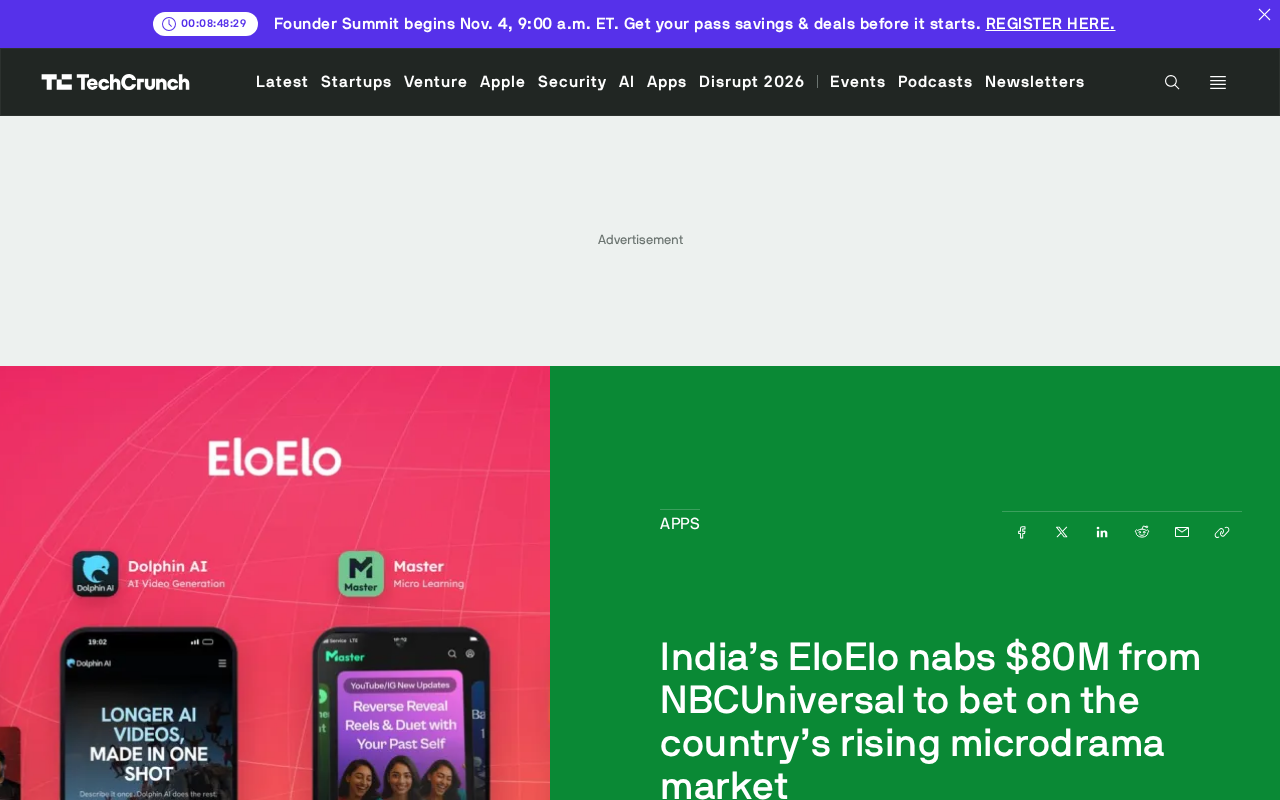
Funding Details and Strategic Intent
According to the original report, the $80 million in funding EloElo received comes from NBCUniversal. While the specific terms of the deal have not been fully disclosed, the use of funds is clearly directed at the microdrama market. EloElo's StoryTV platform currently has over 33 million monthly active users, according to data from Sensor Tower.
As a traditional media giant, NBCUniversal's investment in an Indian microdrama platform reflects a dual bet on emerging content formats and high-growth markets. India has a massive internet user base and rapidly growing demand for mobile content consumption. Microdramas—a content format featuring extremely short episodes and fast-paced storytelling—are quickly gaining traction among local users.
NBCUniversal is a major American media conglomerate owned by Comcast, with operations spanning film and television production, cable networks, and streaming platforms. Its investment in an Indian microdrama platform is a typical move by a traditional media group to make strategic inroads into emerging digital content formats. Such investments are usually not merely financial—they often come with potential for content licensing, co-production, or distribution channel partnerships, which is the context behind the "resource synergies" mentioned in the article.
StoryTV's User Scale and Market Position
According to Sensor Tower data, StoryTV's monthly active users have exceeded 33 million. This figure is highly competitive in India's microdrama market. Compared to traditional long-form video platforms, microdrama platforms can reach users in lower-tier markets more efficiently thanks to lower production costs and faster iteration cycles.
StoryTV's user growth trajectory indicates that Indian users are highly receptive to fragmented, plot-driven content. Microdramas typically run only a few minutes per episode, maintaining user engagement through continuous twists and suspense—a format that works especially well on mobile.
Sensor Tower is a mobile app data analytics firm headquartered in San Francisco that tracks app store data, ad intelligence, and user behavior to provide metrics such as app downloads, monthly active users, and revenue estimates. Media outlets frequently cite Sensor Tower statistics when reporting on mobile app-related data. It should be noted that third-party estimates may differ from actual internal platform data and are generally regarded as reference indicators.
The Growth Logic Behind India's Microdrama Market
The rise of India's microdrama market is not an isolated phenomenon. Globally, the microdrama model has already been proven in the Chinese market and is gradually spreading to Southeast Asia, North America, and other regions. What makes the Indian market unique is its multilingual environment and massive young user base.
On the supply side, India's relatively low domestic content production costs provide favorable conditions for scaled microdrama production. On the demand side, falling mobile data costs and rising smartphone penetration have made short-form video and microdrama consumption an integral part of daily entertainment. NBCUniversal's investment decision is based on its assessment of these market trends.
Microdrama is a vertical-screen series format in which episodes typically run 1 to 3 minutes, with total episode counts reaching dozens or even hundreds. The plots are fast-paced with frequent twists, designed primarily for fragmented mobile viewing scenarios. This model first achieved industrial scale in the Chinese market and is gradually being replicated overseas. India's multilingual environment means content must be produced or localized separately for Hindi, Tamil, Telugu, and other languages—this raises content costs but also creates competitive barriers for local platforms.
Competitive Landscape and Future Challenges
India's microdrama sector is attracting an increasing number of players. Beyond StoryTV, several domestic and regional platforms are also building similar businesses. As capital flows in, content quality, copyright compliance, and user retention will become key competitive variables.
EloElo's strategic investment from NBCUniversal brings not only capital but potentially also resource synergies in content production and global distribution. However, the business model for microdramas is still evolving, and the viability of paths such as paid subscriptions, advertising monetization, and content commerce needs continuous validation. For StoryTV, the core challenge in the next phase will be how to build a sustainable profit model while continuing to grow its user base.
One-line Summary
EloElo secures $80M from NBCUniversal to double down on India's microdrama market through StoryTV.
Paragraph Summary
Indian social entertainment platform EloElo has received an $80 million investment from a division of NBCUniversal, with funds earmarked to accelerate the expansion of its microdrama platform StoryTV in India. StoryTV currently has over 33 million monthly active users, according to Sensor Tower. The article analyzes the supply-demand logic behind the heating up of India's microdrama market: falling mobile data costs, smartphone penetration, and low-cost content production are collectively driving rapid growth of this content format. At the same time, as capital flows in, content quality, copyright compliance, user retention, and monetization paths will become the core challenges facing StoryTV.
Related articles

Qwen 3.8 Beats Opus at Coding—But Can Your Mac Run It?
Open-source Qwen 3.8 beats Opus 4.6 at coding at just 18GB, but how much Mac memory do you need? 24GB crashes; 32GB is the sweet spot. Full config guide inside.

Claude Code + Agent: Building a Fully Automated AI Testing Loop
Bilibili course breakdown: how test developers can use Claude Code terminal-based Agents to build a fully automated AI testing loop. Compares permission boundaries of terminal vs. device Agents, explains why enterprise projects choose Claude Code over Open Claude-type tools, and outlines the Node.js environment setup and DeepSeek model integration path.

Working with AI Agents Requires Nerves of Steel
The more autonomous AI agents become, the heavier the user's psychological burden. Drawing from a Hacker News discussion, this article analyzes black-box anxiety, behavior drift, and monitoring fatigue in agent collaboration, and offers practical approaches like sandbox isolation, permission control, and task granularity management to reduce cognitive load.