2026 Personal AI Agent Comparison: Memory, Security, and Cost Across OpenClaw, Hermes Agent, and More
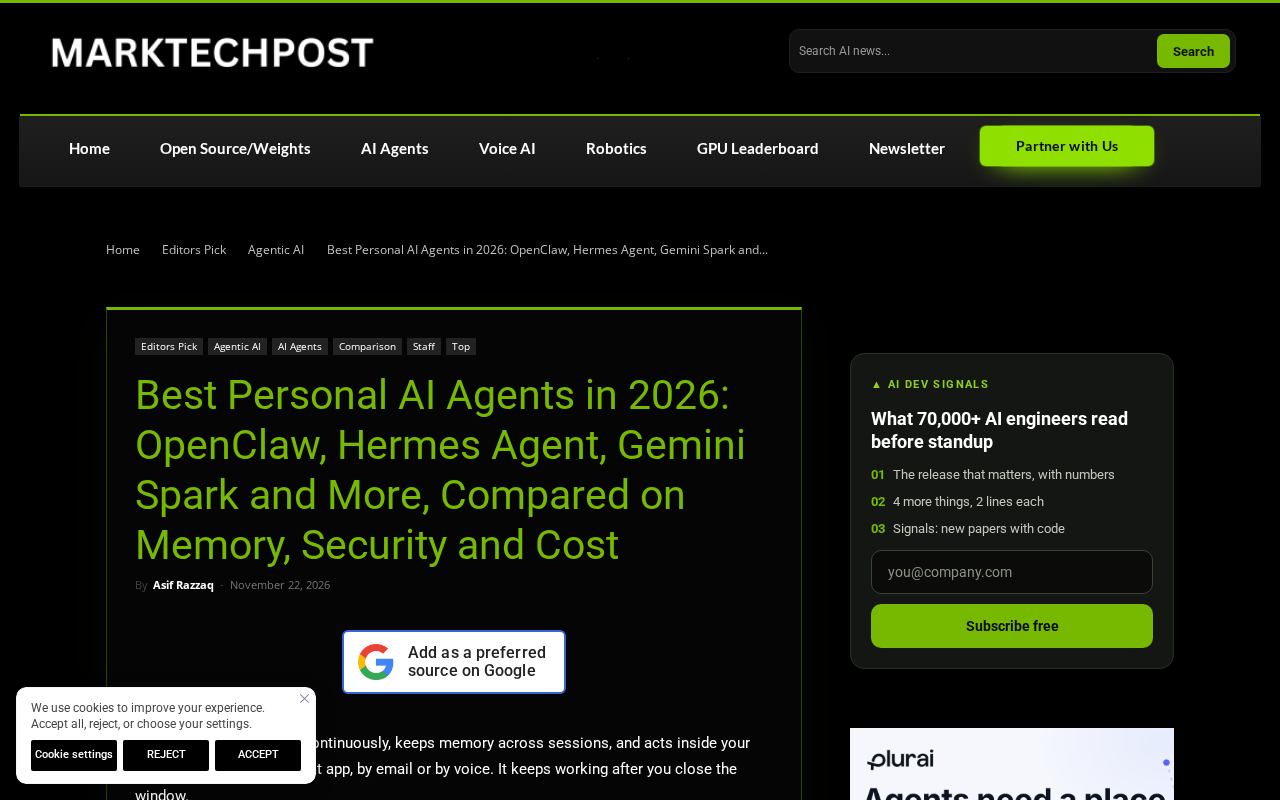
MarkTechPost compares six personal AI agents, highlighting memory, security defaults, and real cost as key selection factors.
MarkTechPost compares Hermes Agent, OpenClaw, Gemini Spark, OpenAI dots, Meta Muse, and Perplexity Personal Computer under one framework across memory, security defaults, and real cost. It argues competition has shifted from features to trust and affordability, with memory shaping the digital-extension feel, defaults reflecting permission trade-offs, and real cost including ongoing model, memory, and tool-call expenses.
Personal AI Agents Enter the Practical Phase, With Memory and Security Becoming Key
In 2026, personal AI agents are no longer just concepts in demo videos. A comparison article published by MarkTechPost places six products—Hermes Agent, OpenClawAd, Gemini Spark, OpenAI dots, Meta Muse, and Perplexity Personal Computer—on the same table, comparing them across three dimensions: memory capability, security defaults, and real cost. These three dimensions happen to be the first walls users hit once they bring an agent into their daily lives.
The article states the scope of the comparison right at the outset but does not elaborate on the detailed specifications of each product. This "list the names, define the dimensions" approach itself sends a signal: competition among personal AI agents has shifted from "can it be done" to "dare you use it, and can you afford it."
Why Memory, Security, and Cost
Memory Determines Whether an Agent Feels "Like Your Own"
The dividing line between a personal agent and a general-purpose chatbot lies in whether it can continuously remember the user's preferences, habits, and context. Hermes Agent and OpenClaw are placed in the same comparison group, indicating that both position themselves as long-term companion assistants. Memory capability affects not only the continuity of experience but also directly determines whether an agent can complete cross-application, cross-session tasks on the user's behalf. The stronger the memory, the more the agent feels like a digital extension of the user; the weaker the memory, the more every conversation feels like meeting for the first time.
In terms of technical implementation, "memory" in personal AI agents is typically divided into two layers: short-term context windows and long-term memory storage. The short-term context window is limited by the token ceiling of the underlying large model and determines how much information can be retained within a single session; long-term memory relies on external vector databases or structured storage to persist user preferences, historical interactions, document content, and more, recalling them when needed through retrieval-augmented generation (RAG). Therefore, the strength of "memory capability" depends not only on the model itself but also on how the agent designs the writing, indexing, retrieval, and forgetting mechanisms of memory.
It is worth noting that long-term memory brings new privacy and compliance issues: which of the user's data is remembered, whether it is stored locally or in the cloud, whether it is used for model training, and whether it can be completely deleted—all of these directly affect whether an agent can be trusted. For open-source/independent products, memory data is often stored in user-controlled environments; for big-tech assistant products, memory may be tied to the account system, with convenience and data-centralization risk coexisting.
Security Defaults Matter More Than Feature Lists
The article deliberately uses "security defaults" rather than "security features"—a wording worth pondering. Once an agent gains access to files, accounts, and calendars, the default settings determine whether users get "out-of-the-box convenience" or "out-of-the-box risk." Gemini Spark, OpenAI dots, Meta Muse, and Perplexity Personal Computer all come from big tech companies, and their trade-offs on security defaults often reflect their product philosophy: whether to prioritize lowering the barrier to use or to prioritize controlling the exposure surface of permissions. MarkTechPost does not provide the specific default policies of each product, but listing this item separately for comparison already shows that it is regarded as a hard indicator in purchasing decisions.
Security defaults refer to the permission and protection policies that take effect when the user has not made any additional configuration—for example, whether the agent can by default read and write local files, whether it can send messages or execute payments on the user's behalf, whether tool calls require secondary confirmation, whether sensitive operations are restricted within a sandbox, and whether logs and telemetry data are uploaded by default. Unlike "security features," defaults do not require users to actively enable them, so they determine the risk baseline that most ordinary users actually face.
In AI agent scenarios, the importance of defaults is further amplified because agents have the ability to plan autonomously and call external tools; a single erroneous default authorization can lead to a chain of operations. Common industry practices include the principle of least privilege, mandatory human confirmation for high-risk tool calls, and restricting network and file access to explicitly declared scopes. When evaluating an agent, reviewing its default permission list and audit records of permission changes often reflects the true security level better than comparing feature lists.
Real Cost Is Not the Subscription Price
"Real cost" is the key phrase in the original title. The cost structure of personal AI agents is far more complex than chat subscriptions: model invocation frequency, memory storage duration, number of tool calls, and background resident overhead all push actual spending away from the sticker price. By placing cost alongside memory and security, the article implies that users need to evaluate an agent as an ongoing operational expense rather than as one-time purchased software.
The Basic Landscape of the Six Products
Judging from the composition of the list, these six products cover three types of players:
- Open-source/independent: OpenClaw and Hermes Agent, which typically emphasize self-hosting and controllability;
- Big-tech assistant: Gemini Spark, OpenAI dots, and Meta Muse, backed by their respective ecosystems with high integration;
- Search/knowledge: Perplexity Personal Computer, continuing its advantage in information retrieval.
MarkTechPost's comparison does not give a final ranking but instead places all six products under the same framework for readers to judge for themselves. This approach is uncommon in comparison reviews, and it also shows that the three groups of products each make trade-offs on different dimensions, making it difficult to determine superiority with a single score.
The division of the three types of players corresponds to different technical approaches and business models. Open-source/independent products typically allow local deployment or self-hosting, giving users greater control over model selection, memory storage location, and tool permissions, at the cost of bearing operational and security configuration burdens themselves. Big-tech assistant products are deeply integrated into existing ecosystems (such as office suites, social platforms, and operating systems), offering a high degree of out-of-the-box usability, but memory and permissions are often tied to the account system, and data flows are relatively opaque. Search/knowledge products enter through information retrieval and knowledge management, with advantages in indexing and recalling massive amounts of information, but their ability to execute cross-application tasks may be weaker than the first two categories.
This three-way division also explains why it is difficult for a comparison review to give a single ranking: different users assign different weights to controllability, integration, and professional depth, and the same product may score very differently across dimensions.
Selection Advice: Check Defaults First, Then Discuss Features
For users considering deploying a personal AI agent, the implicit advice of this article can be summarized in three points:
- Prioritize checking the boundaries of memory: what the agent remembers, how long it remembers, and whether it can be exported and deleted matter more than "how much it can remember";
- Use security defaults as the first filter: the more restrained the default permissions, the less worry later;
- Estimate cost using real usage scenarios: do not look only at the subscription price; factor in high-frequency tool calls and long-term memory storage.
The next stage of competition among personal AI agents will not be about who has a longer feature list, but about who can strike a balance among memory, security, and cost that makes users willing to entrust themselves over the long term. The value of this MarkTechPost comparison review lies in putting these three dimensions clearly on the table.
One-line Summary
MarkTechPost compares six personal AI agents, pointing out that memory, security defaults, and real cost are key to selection.
Paragraph Summary
MarkTechPost places six personal AI agents—Hermes Agent, OpenClaw, Gemini Spark, OpenAI dots, Meta Muse, and Perplexity Personal Computer—under the same framework, comparing them across memory capability, security defaults, and real cost. The article notes that competition among personal agents has shifted from whether features exist to whether they can be trusted and afforded. Memory determines whether an agent feels like a digital extension of the user; security defaults reflect a product's trade-offs on permission exposure; real cost must include the ongoing expenses of model invocation, memory storage, and tool calls. The six products cover three types of players—open-source independent, big-tech assistant, and search/knowledge—each with its own trade-offs and no single ranking. When selecting, users should first check memory boundaries and security defaults, then estimate long-term costs using real scenarios.
Related articles
The Bottleneck of AI Programming Isn't Generation: Why Software Factories Collapse
After AI coding tools went mainstream, PR review quality dropped and incidents rose. The speaker argues the bottleneck isn't code generation but models' inability to sustain maintainability.
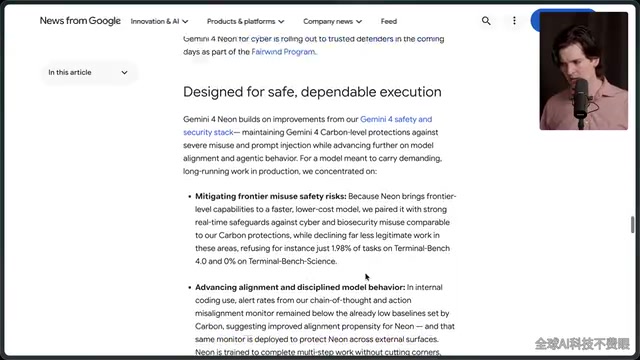
Gemini 4 Neon Hands-On: 10 Hours to Achieve What Opus Couldn't in Days, 20x Faster Warm Start
Google's surprise Gemini 4 Neon release made critic Theo change his tune: 10 hours to finish what Astra couldn't in ten days, 20x faster warm start, coherence beating Opus.

Gemini 4 Neon Hands-On: Which $20 AI Subscription Should You Choose?
Bilibili creator tests Gemini 4 Neon: composite intelligence index 61, beating Claude Opus 5.5, with API 25% cheaper. With a $20 budget, how to choose between Google AI Pro, Claude Pro, and ChatGPT Plus? Includes three must-know pitfalls and recommendations by user type.