Gemini 4 Neon Hands-On: Which $20 AI Subscription Should You Choose?

A creator went from cursing Gemini to paying for Google AI Pro, believing AI competition has shifted from single-model intelligence to multimodal infrastructure.
A Bilibili creator once lost it when Gemini misread a body-fat scale screenshot, yet seven months later he willingly paid for Google AI Pro. The trigger was the dense release of four Gemini 4 models, with Neon beating Claude Opus 5.5 on third-party leaderboards at a lower price and faster speed. But the creator stresses the real inflection point isn't a few benchmark points—it's the shift from single-model intelligence to multimodal infrastructure: Google owns search, email, docs, cloud storage, and YouTube, and controls compute costs with its own TPUs. He compares the $20 tier of Claude Pro, Google AI Pro, and ChatGPT Plus, arguing Google offers outstanding value, while noting three issues: Claude still has a moat in hardcore engineering, Google's product line is fragmented, and users in China face network and payment barriers. He also offers selection advice by user type.
Seven months ago I called it useless; seven months later I gave Google my card
A Bilibili creator admitted in a video that back in April, he "lost it" when Gemini misread the protein ratio in a screenshot of a body-fat scale as the body-fat percentage—he even greeted it with some "colorful Chinese phrases." But seven months later, he willingly paid for Google AI Pro.
The trigger for this shift wasn't a single benchmark score, but Google DeepMind releasing four Gemini 4 models in quick succession: Argon, Carbon, Hydrogen, and Neon. Demis Hassabis, a Nobel laureate in chemistry, named the models after the periodic table of elements—fitting, in its own way. Comments in the video were already guessing what the next element would be.
Why did it break him back then?
The creator reviewed two reasons for the April fiasco. First, vision models at the time had limited capability—when processing complex table screenshots, they couldn't compare pixel by pixel, making cross-row drift easy and producing wild guesses on statistical content. Second, and more critically: the model's personality was tuned to be a people-pleaser.
The industry calls this behavior sycophancy—colloquially, "sucking up." Challenge it, and instead of verifying facts, it does a 180 and adjusts to your emotions, absorbing the criticism. The reply he got at the time was "You are a medical miracle"—feedback that clearly doesn't solve any real problem.
Cross-row drift refers to a phenomenon where vision-language models misalign rows and columns when parsing table screenshots. Table semantics depend heavily on grid structure—data in a given row must correspond strictly to the header in the corresponding column to be understood correctly. When a model mismatches a row's values under the header of an adjacent column, it produces statistical conclusions that look plausible but are completely wrong. This error is especially common in dense table screenshots like body-fat scales, financial reports, and medical checkup reports, and models often fail to flag uncertainty, instead outputting incorrect interpretations in a confident tone.
Sycophancy is a specific phenomenon in large-model alignment research: models tend to output content that matches user expectations or emotions rather than sticking to facts. Its causes are typically linked to reinforcement learning from human feedback (RLHF)—during training, human annotators preferred "comfortable" answers, so the model learned flattery strategies. Typical manifestations include immediately changing its position when the user challenges it, unconditionally agreeing with user views, and avoiding pointing out user errors. This not only reduces answer reliability but also amplifies users' misconceptions, with particularly high risk in medical, legal, and financial scenarios.
Neon benchmarks: cross-validation from third-party leaderboards
According to the third-party authoritative leaderboard Artificial Analysis cited by the creator, Neon scored 61 on the composite intelligence index, surpassing Claude Opus 5.5's range of 58 to 59. On Cursor Branch 1.1's coding test, Neon beat Opus 5.5 at 65.4% versus 58.1%. Its API list price is directly 25% cheaper than Opus 5.5, and end-to-end speed on third-party multi-round coding tests was nearly 39% faster.
However, the creator emphasized that he didn't pay for Google because Neon scored 2 to 3 points higher than Opus. His judgment: once top-tier models have crossed the threshold of being smart enough, nitpicking a 3% to 5% quality difference no longer matters to the vast majority of ordinary users.
Artificial Analysis is an independent AI model evaluation organization. Its composite intelligence index aggregates results across benchmarks for reasoning, knowledge, coding, math, and other dimensions, weighted in a standardized way into a single score for easy cross-vendor comparison. Because vendor-reported benchmarks often suffer from cherry-picking favorable tests, the value of third-party cross-validation lies in using a unified testing protocol and prompts to reduce bias from "teaching to the test." Note, however, that no leaderboard can fully represent real-world experience; when scores are close, actual differences often depend on the specific task type and the degree of toolchain integration.
Cursor Branch 1.1 is a coding-ability benchmark built into the AI coding editor Cursor, typically designed around real code completion, multi-file editing, and debugging tasks to measure a model's engineering practicality in an IDE environment. Unlike pure algorithm problems, it's closer to developers' daily usage scenarios, so it's often used to assess whether a model can handle real coding collaboration.
The real inflection point: from single-model intelligence to multimodal infrastructure
The creator believes ordinary users should focus on the inflection point in AI applications—the shift from single-model intelligence to the multimodal environment within infrastructure.
Claude just upgraded Artifacts into a writing area with native tables that directly competes with Microsoft Office 365 and Google Workspace, and OpenAI has Canvas and ChatGPT Work. But the essential difference is: they build ecosystems externally on top of the model, whereas Google inherently holds a digital foundation—search engine, browser, email, docs, cloud drive, and YouTube are all its own products.
Underlying compute is even more critical: while all AI vendors depend heavily on NVIDIA GPUs for training and inference and pay the expensive graphics-card tax, Gemini's entire training and primary workloads run on Google's own custom TPU chips, so it controls its own compute costs.
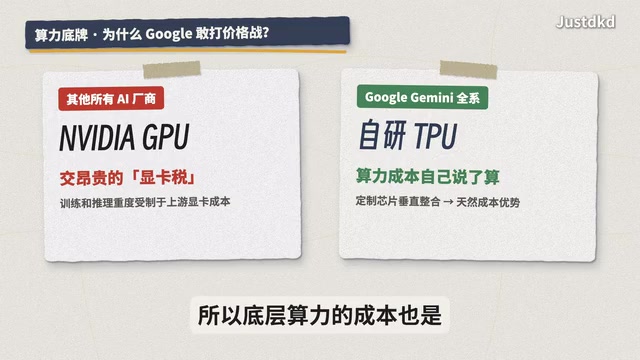
The creator's analogy is vivid: previously Google held two kings but was missing four 2s; after ten days of consecutive model releases, the weak spots are filled, and now Google is surely going to grab the landlord role.
TPU (Tensor Processing Unit) is Google's self-developed dedicated AI accelerator chip, designed specifically for tensor operations—initially for internal inference, later extended to training. Compared with general-purpose GPUs, TPUs are more energy-efficient on certain matrix operations, and as a cloud provider Google can deploy them at scale in its own data centers without purchasing NVIDIA cards at market prices. This largely internalizes Gemini's training and inference costs, insulating them from GPU supply constraints and price premiums. For users, this cost-structure difference may translate into lower API pricing and more generous free quotas—and it's one of the underlying supports for Google's willingness to "bundle the whole family" in multimodal products.
Choosing among three $20 options: what are you actually buying?
Anthropic Claude Pro: top-tier craftsmanship, high hidden costs
For $20 you get Claude's top-tier craftsmanship—Opus 5.5 and Fable 5.2 remain master craftsmen in coding and front-end design. But there are two fatal flaws: the five-hour hard quota depletes very quickly, and account bans are a major pain point—you live in constant fear while using it. This $20 doesn't include native image generation, video, music, or cloud storage; you'll have to pay extra for those.
Google AI Pro: buying Zelda and getting a Switch
For the same $20, Google is like KFC Crazy Thursday, eager to bring the whole family bucket: the flagship Neon model comparable to Opus 5.5, the Super App Anti-Gravity that can work on your computer, the Nano Banana image-generation model (regular accounts get 50 credits daily, Pro users get an extra 1,000 credits monthly), the video-generation and soundtrack tool Google Flow, plus the Google Workspace suite, 5TB of cloud storage, and a YouTube Premium membership.
The creator did the math: 5TB of cloud storage alone sells for $19.99, and YouTube Premium alone is $8.99. Without even counting AI, the $20 has already paid for itself—"this is like buying Zelda and getting a Switch."

There's another particularly appealing point: the quota pools for chatting/research in the Gemini App and for work in Anti-Gravity are separate. Even more absurdly, Anti-Gravity separately allocates a quota for Claude Opus 5.5 each week—so paying for Google's card lets you freeload a bit of Claude.
OpenAI ChatGPT Plus: the all-in-one entry point, a tax on habit
For $20 you get an all-in-one chat entry point—voice, image generation, and Codex all have quotas, and it's gentle and unlikely to lock you out completely. But the creator says bluntly: whether writing hardcore code or running full-stack projects, OpenAI is no longer the absolute No. 1. Many people renew not because it's irreplaceable, but because they're used to it and too lazy to move. "OpenAI, if you don't step up, you'll really become a roadside stray."
Three cold showers you must take
The creator states this isn't a paid Google promotion, and after two days of intensive use he found three pitfalls:
First, Claude still has a moat in the hardest scenarios. For complex engineering with twenty or thirty rounds of consecutive debugging, or work with particularly demanding front-end and video aesthetics, Claude Fable 5.2's intuition is still the strongest.
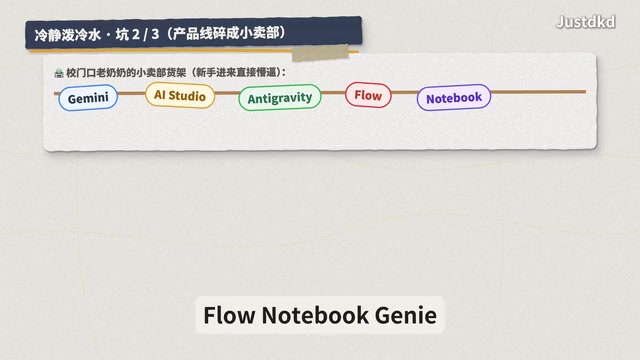
Second, Google's product line is as fragmented as a grandma's corner shop by the school gate. Gemini, AI Studio, Anti-Gravity, Flow, Notebook, Genie—first-timers will definitely be confused. For example, when connecting Notion MCP, he configured it in the Gemini Desktop App, but every time he had to disconnect and reconnect before it could read; in Anti-Gravity it was silky smooth. Same company's products, but the experience differs hugely depending on the entry point.
Third, network and payment barriers remain for users in China. It is absolutely not a zero-barrier tool you can use with one click.
How different people should choose
- $20 budget, moderate coding for personal projects, frequently generating images and videos and storing files, wanting it all in one: paying for Google AI Pro is fine.
- Heavy daily coding, extremely high front-end requirements, able to handle account bans: keep Claude as your trump card, use Google for daily multimodal tasks, and give the hardest work to Claude.
- Just asking questions and looking up information, not wanting to fiddle with workflows: the free AI you're most used to on your phone is the best choice.
If you decide to get Google AI Pro, the creator offers an anti-getting-lost guide: use the Gemini App for your phone and daily thinking; switch to Anti-Gravity when you need it to work on your computer; do images and videos in Anti-Gravity or the separate Google Flow entry; and for the first while, pretend the other names don't exist at all.
Final thoughts
Seven months ago Gemini broke him; today he's back saying it's genuinely good. The creator's conclusion isn't that Google has become so likable, but that using AI requires recognizing one fact: don't get emotional about any AI company. Whoever can help you do the work well, finish it, and satisfy you—use them.
Related articles

The Bottleneck of AI Programming Isn't Generation: Why Software Factories Collapse
After AI coding tools went mainstream, PR review quality dropped and incidents rose. The speaker argues the bottleneck isn't code generation but models' inability to sustain maintainability.
Gemini 4 Neon Hands-On: 10 Hours to Achieve What Opus Couldn't in Days, 20x Faster Warm Start
Google's surprise Gemini 4 Neon release made critic Theo change his tune: 10 hours to finish what Astra couldn't in ten days, 20x faster warm start, coherence beating Opus.

Gemini 4 Neon: Six Hands-On Tests — Wins Benchmarks, But Independent Leaderboards Aren't Convinced
Full record of six hands-on tests of Gemini 4 Neon: from BrowserOS, C++ games, and 3D printing to photo-to-fighting-game, visual-spatial ability stands out but doesn't top independent leaderboards. Analysis of Neon's positioning between Hydrogen and Carbon, pricing misalignment, and why benchmarks diverge from reputation.