Gemini 4 Neon Hands-On: 10 Hours to Achieve What Opus Couldn't in Days, 20x Faster Warm Start
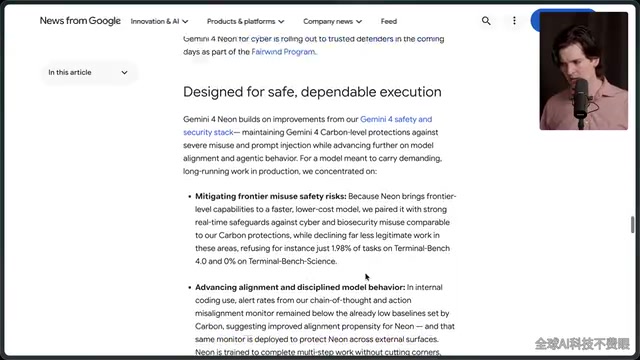
Google's low-key Gemini 4 Neon wins on coherence over benchmarks, making critic Theo call it a generational leap.
Google's surprise medium-sized model Gemini 4 Neon made long-time Gemini critic Theo change his tune. He cites Artificial Analysis data showing Neon scores 61 at the ultra-high thinking tier and ranks high on multiple indices at lower pricing than Opus. He argues benchmarks no longer matter and coherence is the new frontier—Neon achieved in 10 hours what Astra couldn't in ten days, cutting bundle size from 47.44MB to 7.97MB with 20x faster warm start.
Title
Gemini 4 Neon Hands-On: 10 Hours to Achieve What Opus Couldn't in Days, 20x Faster Warm Start
Meta Description
Google's surprise release of Gemini 4 Neon made long-time critic Theo change his tune: 10 hours to complete the optimization task Astra couldn't finish in ten days, 20x faster warm start, coherence surpassing Opus and OpenAI models. This article breaks down the hands-on data and the story behind it.
Article Content
Google's surprise release of Gemini 4 Neon made developer Theo, a long-time critic of the Gemini series, completely change his tune. In a Bilibili video, he documented in detail how this medium-sized model comprehensively outclassed OpenAI's Opus 5.5 and its own predecessors on coding tasks, even calling it "a generational leap forward."
From Skeptic to Convert: A Hater's Transformation
Theo admitted that he had previously rated the Gemini series very low, especially criticizing the Carbon and Astra models. But Neon made him "fire off a tweet on the spot" expressing his shock. His core conclusion: this may be the most comfortable and coherent model for writing code today, even taking priority over all OpenAI products in agentic coding scenarios.
According to him, Google deliberately downplayed it in the official announcement, calling it only a "medium-sized model," but its actual performance far exceeds that positioning. Theo believes Google should have just called it Gemini 5.
Performance Data: Outclassing Competitors Across the Board
According to the Artificial Analysis Intelligence Index cited in the video, Neon scores 61 at the ultra-high thinking tier, ranking third overall among comparable models, right behind larger and slower models. It ranks second on both the VLS Index and the Agentic Arena Index. On pricing, it's $3 per million input tokens and $15 per million output tokens, significantly lower than Opus, with cache discounts also doubled to 15 cents per million.
The Artificial Analysis Intelligence Index is a model capability leaderboard maintained by the independent evaluation firm Artificial Analysis. It scores major language models through a unified test suite and compares them stratified by "thinking tier" (i.e., the compute budget the model is allowed to consume during inference). The VLS Index focuses on vision-language-spatial reasoning, while the Agentic Arena Index simulates multi-step tool calling and task planning scenarios. These indices are not absolute standards, but they can horizontally reflect a model's relative position along specific dimensions, so they are often cited during model selection.
Coherence: The New Competitive Frontier
Theo repeatedly emphasized one point: benchmark scores no longer matter. The real question is coherence—whether a model can stay focused during long tasks, not go off track, and clearly express what it's doing.
He illustrated with a real case: a conversation about WorkTree disk speed issues on a VPS. Other models (including Astra) tangled with it for days without getting to the point, while Neon accurately identified three compounding factors, among which a mechanical hard drive formatting configuration issue accounted for 3.8 seconds of the 6.3-second delay—a configuration error that even Theo himself hadn't discovered.
"It has a natural rhythm, clear language sense, and the density and emphasis are simply good to read."
Theo's conclusion is direct: Neon is more coherent than any Anthropic model or OpenAI model.
In agentic coding, coherence refers to a model's ability to maintain goal consistency, state tracking, and intent expression across multi-turn interactions and tool calls. Unlike single-turn Q&A, long-horizon tasks require the model to repeatedly read files, execute commands, and correct errors over hours or even days. Any single instance of "going off track" or context loss can waste all prior effort. Coherence is difficult to quantify with traditional benchmarks and is usually evaluated through real project trajectories and human review—which is also why Theo believes benchmark scores no longer matter.
Real-World Validation: 10 Hours vs 10 Days
The most convincing case comes from the TS Rust project—a side project to rewrite the TypeScript type checker in Rust. Theo gave Astra a goal: make the bundle size half that of the official build and beat both BondCheck and TSRS in speed.
Astra spent over a week and the result was a 46% smaller size but 56% slower speed. After Theo called it off, Astra spent another four days with no progress. Switching to Opus, it took several days to barely achieve about a 20% speedup.
Then Neon started from the same fork point, using Anti-Gravity's built-in Swarm feature, and delivered results in 10 hours:
- Size reduced from 47.44MB to 7.97MB, about 1/5.95 of the original
- Up to 20x faster in warm-start environments
- 1.5x overall speedup across all benchmark repositories
- 2.3x speedup on the Century repository
- 48.6% reduction in total test suite runtime
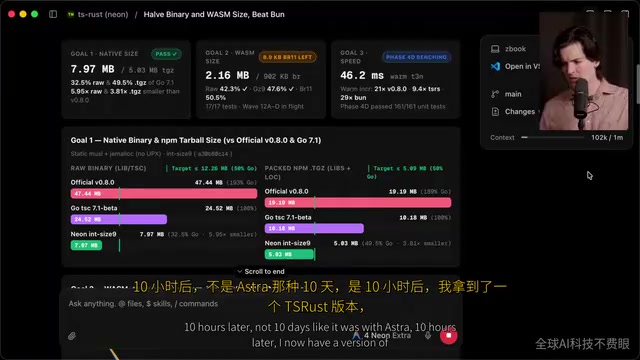
Theo's exact words: "No other model could achieve this kind of speedup in a window where the others burned hundreds of thousands of dollars of tokens over ten-plus days."
Capability in the Details
In another task, Neon needed to create an interactive visualization of PR data for the T3 Code repository. After encountering a bug where the Anti-Gravity renderer couldn't display HTML results, it didn't stop to complain—it rendered the HTML itself, took a screenshot, and output it as an image, while annotating where the problem was. It then proactively used MCP tools to submit a fix PR.
Theo called this a "single-issue" level minor flaw, almost negligible compared to the failure frequency of previous Gemini models.
Anti-Gravity is an agentic coding environment launched by Google, featuring built-in multi-agent collaboration called Swarm, which allows a main model to dispatch multiple sub-agents to execute tasks in parallel. MCP (Model Context Protocol) is an open protocol for letting models safely call external tools, data sources, and repository operations. When Neon encountered the renderer defect, it took screenshots and output them itself and proactively submitted a fix PR—a closed loop completed through this kind of toolchain, demonstrating the agent's autonomy from "discovering the problem" to "fixing it."
Hallucinations and Shortcomings: Imperfect but Acceptable
Neon is not without flaws. In the TS Rust architecture analysis, 10 out of 72 claims were wrong, slightly worse than Fable 5.2 but better than Fable 5.1, with half the hallucinations of Carbon. It performs noticeably worse on 3D generation tasks—Theo said bluntly, "It's not a good 3D model."
But he emphasized that these metrics no longer reflect real experience—what matters is the model's performance in daily development work, especially its ability to self-verify during actual implementation. Neon proactively verifies its own claims when actually implementing, which matters more than accuracy in pure Q&A.

LLM hallucinations refer to the model generating plausible-sounding statements that don't match facts. In the coding domain, this often manifests as fabricated APIs, incorrect configuration explanations, or misjudged dependencies. Hallucination rates are typically assessed through human-annotated claim-level verification—for example, breaking down the model's architecture analysis into individual claims and verifying each one. Notably, hallucination rates in Q&A scenarios are not fully correlated with self-verification ability in implementation scenarios: a model may err in its statements but correct itself before actually modifying code by running tests and reading logs—this is exactly the "self-verification during implementation" that Theo emphasizes.
Why the Sudden Release? Theo's Speculation
Based on conversations with insiders at DeepMind, Theo inferred: Neon was originally a medium-scale experiment to integrate engineering team feedback into training. The research team had previously not paid enough attention to engineering-side input, but this time they listened.
More importantly, Google and DeepMind engineers themselves liked using it so much that they repeatedly begged for an early release—they wanted to know whether the outside world would react the same way. Theo said he is "100% certain" about this part.
At the end of the video, he said: "The new frontier is not the frontier of capability. The new frontier is coherence." He also believes OpenAI has fallen behind some Chinese labs on this dimension.
For developers, Neon's significance lies in this: a medium-sized, lower-priced model that performs stably on real long-horizon tasks may be more practically valuable than a giant model with higher benchmark scores. Theo's advice is direct—go try it, with the Nightly build of Anti-Gravity and T3 Code, and feel the generational gap.
One-line Summary
Google's low-key Gemini 4 Neon release wins on coherence rather than benchmarks, making long-time critic Theo call it a generational leap forward.
Paragraph Summary
Google's surprise medium-sized model Gemini 4 Neon made developer Theo, a long-time critic of the Gemini series, completely change his tune. In the video, he cited Artificial Analysis data showing Neon scores 61 at the ultra-high thinking tier and ranks high on multiple indices, while priced lower than Opus. More importantly, he believes benchmark scores no longer matter—coherence is the new competitive frontier. In the TS Rust project, Neon used 10 hours to compress bundle size from 47.44MB to 7.97MB and achieve 20x faster warm start, accomplishing what Astra couldn't in ten days. Neon still has shortcomings in hallucinations and 3D generation, but its self-verification ability during implementation compensates. Theo speculates the model was originally a medium-scale experiment, released early at the strong request of internal engineers.
Related articles

The Bottleneck of AI Programming Isn't Generation: Why Software Factories Collapse
After AI coding tools went mainstream, PR review quality dropped and incidents rose. The speaker argues the bottleneck isn't code generation but models' inability to sustain maintainability.

Gemini 4 Neon Hands-On: Which $20 AI Subscription Should You Choose?
Bilibili creator tests Gemini 4 Neon: composite intelligence index 61, beating Claude Opus 5.5, with API 25% cheaper. With a $20 budget, how to choose between Google AI Pro, Claude Pro, and ChatGPT Plus? Includes three must-know pitfalls and recommendations by user type.

Gemini 4 Neon: Six Hands-On Tests — Wins Benchmarks, But Independent Leaderboards Aren't Convinced
Full record of six hands-on tests of Gemini 4 Neon: from BrowserOS, C++ games, and 3D printing to photo-to-fighting-game, visual-spatial ability stands out but doesn't top independent leaderboards. Analysis of Neon's positioning between Hydrogen and Carbon, pricing misalignment, and why benchmarks diverge from reputation.