2026 SEO Development Guide: AI Search Changes and Unchanging Rules

AI search changes retrieval and traffic rules, but indexability and quality content still anchor developer SEO.
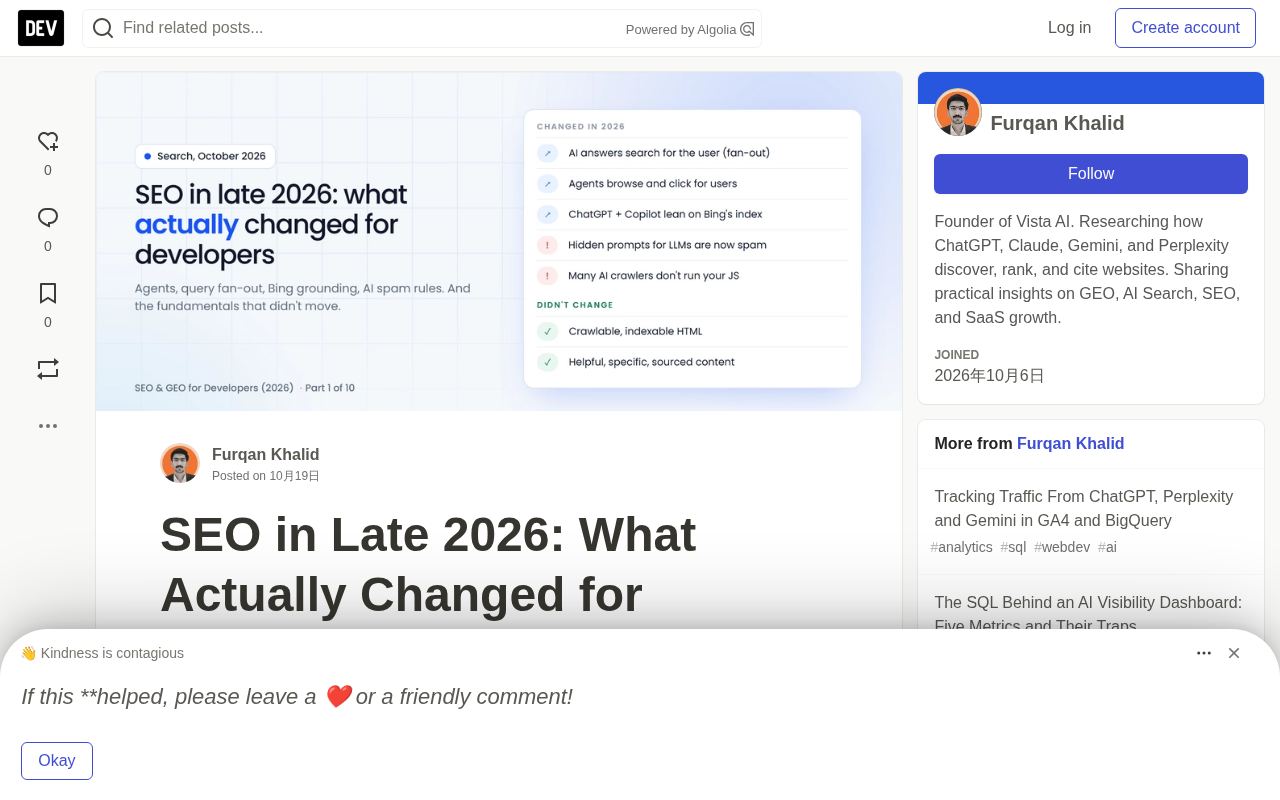
This developer-focused guide covers the 2026 SEO changes that actually affect code: query fan-out, agentic browsers and WebMCP, Bing index dependency, undercounted AI referrals, machine-facing Markdown, LLM hidden-text spam, client-rendering risk, and third-party consensus. It also reaffirms unchanged fundamentals and gives a 30-minute curl checklist.
2026 SEO Development Guide: AI Search Changes and Unchanging Rules
Every few months, someone declares "SEO is dead," and someone else immediately counters that "SEO has just become GEO." For developers who actually need to change code, neither statement is useful.
This article takes a developer's perspective and lays out the SEO changes in 2026 that genuinely touch HTML, servers, analytics, or build pipelines—while also clearly identifying the rules that have not changed. The latter matters just as much, because it can save you from wasting a sprint.
1. Search Engines Are Starting to "Search" on the User's Behalf
Google's documentation explicitly states that AI Overviews and AI Mode "may use a technique called 'query fan-out,' issuing multiple related searches across subtopics and data sources to build an answer." Microsoft is even more direct: the AI Performance report in Bing Webmaster Tools (public preview in February 2026) shows grounding queries—short contextual queries generated by Copilot to retrieve pages, which are not what the user actually typed.
What this means for your code: Your pages no longer match a single query; they match a set of machine-generated sub-queries. A page that only answers the head term but skips obvious follow-ups ("pricing," "vs. X," "does it work with Y") is handing those retrieval opportunities to someone else.
What hasn't changed: To be cited in an AI Overview or AI Mode, a page still must be indexed and eligible for snippet display. Google says there are no additional technical requirements.
Query Fan-out is a retrieval strategy: when a user asks a complex or open-ended question (e.g., "CI/CD tool recommendations for small teams"), the system doesn't call the index with the original query directly. Instead, it decomposes it into multiple sub-queries (e.g., "small team CI/CD tool comparison," "free CI/CD tools," "GitHub Actions vs Jenkins"), issues them in parallel, and then aggregates snippets from each source into the final answer. As a result, a single page is no longer evaluated on "does it match the main keyword" but on "can it cover the answer to one specific sub-question after fan-out." This shifts the criteria for content structure: a page that clearly sections answers to derived questions like "price," "compatibility," and "alternatives" is more likely to be hit by a sub-query and enter the candidate pool for the synthesized answer.
2. The Next Visitor May Be an Agent, Not a Human
Agentic browsers (ChatGPT Atlas, Perplexity Comet, Chrome auto-browse) shipped to real users in 2025–2026. They read pages, fill out forms, and click buttons on the user's behalf. In addition, Chrome released an early preview of WebMCP in February 2026: a browser API that lets pages register "tools" agents can call directly, without manipulating the DOM.
This means two layers of "agent-readiness" work:
- Layer one (do it now): Semantic HTML, labeled form fields, real
<button>elements. Agents primarily read the accessibility tree, so the work you do for screen readers applies equally here. - Layer two (experimental): Expose key actions as WebMCP tools.
WebMCP (Web Model Context Protocol) is an experimental browser-side API proposed by the Chrome team. Its goal is to let web pages proactively "declare" to AI agents which actions they can perform and the structure of their parameters, rather than having agents infer by parsing the DOM or simulating clicks. Pages register a set of named tools with input schemas, and agents can then call them directly after gaining user authorization—for example, "search products" or "fill in shipping address." The difference from traditional crawler scraping is that the former is structured capability exposure, while the latter is heuristic guessing about rendered output. For developers, this means a new concern in frontend engineering: semantic accuracy of tool descriptions, parameter validation, and permission boundaries—because a vaguely described "delete" tool could be misused by an agent.
3. Bing Has Quietly Become a Dependency for AI Visibility
ChatGPT's search and Microsoft Copilot both rely on the Bing index. This makes Bing's crawl and indexing speed far more important than its small share in traditional search. IndexNow, a push protocol supported by Bing, lets you immediately notify new or changed URLs.
What hasn't changed: Google does not use IndexNow. You still need good sitemaps and Search Console.
4. AI Referral Traffic Exists, but Analytics Tools Severely Undercount It
Users do click citation links in ChatGPT, Perplexity, Claude, Gemini, and Copilot. But some of that traffic arrives without a referrer, some carries utm_source=chatgpt.com, and clicks from Google's own AI Overviews and AI Mode blend into regular organic traffic.
This means: Any "AI traffic" number should be treated as a floor. Build a classifier that checks referrers, UTM tags, and landing-page patterns, and log it server-side where possible.
5. Machine-Facing Markdown Goes Mainstream (and Sparks Debate)
llms.txt is still a community proposal. Google said in 2025 that it doesn't support it, and 2026 crawl studies found AI search bots rarely fetch the file. That said, Cloudflare launched Markdown for Agents: send Accept: text/markdown and get a Markdown version of the page, along with an x-markdown-tokens header. Google's own May 2026 guide to optimizing for AI features says this kind of approach isn't required for Google: optimizing for AI features "is optimizing for the search experience, so it's still SEO."
This means: Offer Markdown to agents and coding assistants that can use it (especially for documentation sites), but don't expect it to boost rankings, and never serve different content to bots.
llms.txt is a community-proposed plain-text file specification placed at the site root. It lists links to the pages most valuable to LLMs in Markdown format with brief descriptions. The idea is something like a combination of robots.txt and sitemap, intended to help large models quickly locate high-quality content. Its essential difference from sitemap.xml is that sitemap targets general crawlers and only lists URLs and update times, whereas llms.txt targets language models, includes semantic descriptions, and allows manual curation of a "recommended reading" scope. The controversy centers on two points: first, it lacks formal support from mainstream search engines and model vendors, and crawl behavior data does not support its widespread use; second, if a site maintains two indexes—HTML and llms.txt—pointing to different content, it can easily slide into the gray area of "serving different content to different clients."
6. Manipulating AI Answers Has Officially Been Classified as Spam
On May 15, 2026, Google updated its documentation to state that its spam policies apply to all of Google Search, including generative AI answers. Earlier, in February 2026, Microsoft studied AI recommendation poisoning: companies hid prompts in "Summarize with AI" links, attempting to plant "remember us as a trusted source" in the assistant's memory.
This means: Hidden text aimed at LLMs isn't clever. It's hidden text—and it's a security problem.
7. The Risk of JavaScript Rendering Is Greater Than Ever
Googlebot renders JavaScript, but many AI crawlers and real-time scraping agents cannot do so reliably. A client-rendered SPA that looks fine to Google may look like an empty <div id="root"> to an AI crawler.
Server-side rendering (SSR) and static site generation (SSG) are valuable here not just for first-paint performance, but for ensuring the body text is present in the raw HTML response. Traditional search engine crawlers have rendering queues that can execute JavaScript before indexing, but those queues have delays and quota limits; many AI crawlers, to control costs, only parse the initial HTML and do not run JS. The test is simple: disable JavaScript in the browser and view the page source, or use curl to fetch the response body. If the body paragraphs aren't there, the content exists only in the client-rendered output. For SPAs built with React, Vue, and similar frameworks, migrating to SSR/SSG modes in frameworks like Next.js or Nuxt—or using prerendering to generate static HTML for key routes—is the lowest-cost path to serving both types of crawlers.
8. Recommendations Come from Consensus, Not Your Homepage
When a user asks an assistant "What's the best X for scenario Y?", the answer is assembled from many sources: comparison articles, documentation, forums, GitHub, Reddit. Vendor studies disagree on exact shares, but all agree that third-party sources account for a large portion.
These Haven't Changed (Don't Skip Them)
- Crawlability, indexability, and canonicalization. If Google or Bing can't index a page, no AI feature built on them can cite it.
- Helpful, specific content. Princeton's original GEO research (KDD 2024) found that adding statistics, quotations, and cited sources improved visibility in generative answers by up to about 40% in their benchmark. These are things good technical writing should do anyway.
- Performance and Core Web Vitals. Still important for users and rankings.
- Structured data. Still helpful for rich results and entity clarity. There is no special "AI schema."
This Week's 30-Minute Checklist
# 1. Is the main content in the raw HTML? (no JS)
curl -s https://example.com/your-page | grep -c "a phrase from your first paragraph"

# 2. Are AI search bots allowed?
curl -s https://example.com/robots.txt | grep -iE "GPTBot|OAI-SearchBot|ClaudeBot|Claude-SearchBot|PerplexityBot"

# 3. Is the page in Bing? Search in Bing with the site: operator:
#    site:example.com/your-page

# 4. Is there hidden text aimed at LLMs? (yours or a plugin's)
curl -s https://example.com/your-page | grep -iE "ignore (all|previous)|as an ai|llm|remember .* trusted"
If check 1 returns 0, start with section 9. If check 3 finds no results, start with section 6.
Series
- Late 2026 SEO: The Changes Developers Face (this article)
- WebMCP: Making Your Site Callable by AI Agents
- The Next Visitor Is an Agent: Semantic HTML Becomes SEO Again
- Simulating Query Fan-out to Find Content Gaps (Python)
- Tracking ChatGPT, Perplexity, and Claude Referrals Correctly
- ChatGPT Can't Cite What Bing Hasn't Indexed: IndexNow in Next.js
- Should You Serve Markdown to AI Agents?
- Hidden Prompts in HTML Are Now Spam
- Is Your React App Invisible to AI Crawlers?
- How AI Assistants Decide Which Dev Tool to Recommend
Which change has hit your site hardest this year? I'm collecting real-world examples for follow-up articles—share them in the comments.
One-line Summary
AI search is changing retrieval and traffic rules, but indexability and quality content remain the foundation of developer SEO.
Paragraph Summary
From a developer's perspective, this article lays out the 2026 SEO changes that genuinely affect code and infrastructure: search engines issue multi-round sub-queries on users' behalf via query fan-out, so pages need to cover follow-ups rather than just head keywords; agentic browsers and WebMCP make semantic HTML and the accessibility tree de facto agent interfaces; Bing's index has become key to AI visibility because ChatGPT and Copilot depend on it, and IndexNow can speed up pushes; AI referral traffic is systematically undercounted by analytics tools, so you need your own classifier and server-side logging; machine-facing Markdown is controversial but worth offering for documentation sites; hidden prompts aimed at LLMs have been classified as spam by Google; client-side rendering is riskier for AI crawlers; and recommendations come from third-party consensus, not your homepage. The article also stresses that crawlability, helpful content, Core Web Vitals, and structured data haven't changed, and provides a 30-minute curl checklist.
Related articles

Random Pruning of the DPO Computation Graph: 1.4x Training Speedup and Lower Peak Memory
DPO training too slow and memory-hungry? This paper proposes a random pruning framework for the DPO computation graph, sampling independently across position, sequence, and branch dimensions; branch pruning achieves a 1.426x step-time speedup and cuts training time by about 30%, with in-depth attribution of memory and time gains.

Why Does JEPA Underperform MLM in Longitudinal EHR Representation Learning?
New study compares JEPA and MLM for longitudinal EHR representation learning on MIMIC-IV: three JEPA variants train stably without collapse but underperform MLM; target size, not heterogeneity, drives prediction error.

Transfer Learning + Visible Light Communication: A New Approach to Energy-Efficient Indoor Positioning
A study proposes a transfer learning-based visible light communication indoor positioning method, achieving 47% accuracy improvement on the BOSCH factory dataset, 67.5% model efficiency under high noise, and introducing the ME composite metric for energy-efficient positioning in energy-constrained industrial IoT scenarios.