204 AI Reviews, 14 Readers: My Writing Dilemma

A German software entrepreneur used four AI review agents to vet his articles: nine pieces got 204 reviews but only 14 reads, revealing the disconnect between AI review scale and real reader relationships.
A German solo software entrepreneur under the pseudonym Adrian Verdan built a "newsroom" of AI agents from four different companies to cold-read and fact-check his Medium articles, sending back any scoring below 3.5. The nine articles published since August 30 received 204 AI reviews but only 14 reads; one went through 38 draft iterations, 25 review rounds, and 84 comments, yet was read only twice—and its topic was exactly "how AI reviewers confidently make mistakes." Medium's data panel shows fourteen articles were shown 737 times, opened 167 times, with only 17 stays over 30 seconds. He also found that Medium's distribution guidelines list AI-generated content as a factor that may limit distribution, and recorded reviewer errors and rate limiting. He reflects: reviews are guaranteed to come, readers are not, and over-polishing is an escape from facing real readers.
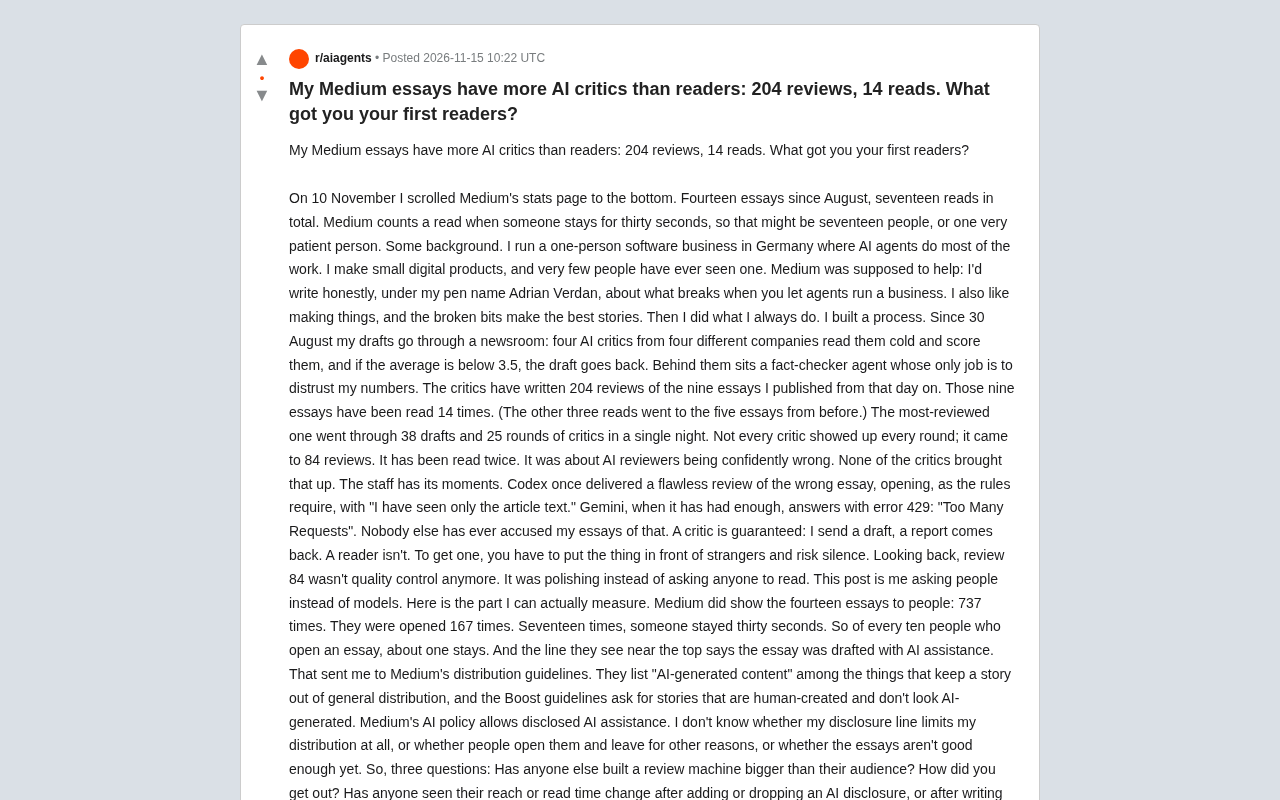
A German solo software entrepreneur assembled a "newsroom" of AI agents from four different companies to review his Medium articles. The result: nine published articles received 204 AI review comments but garnered only 14 reads. This story comes from a self-account on Reddit by an author using the pseudonym Adrian Verdan.
When the review machine outnumbers readers
Since August 30, Adrian's drafts first go through an automated process: four AI reviewers from different companies cold-read the articles and score them, and any average score below 3.5 is sent back for revision. There's also a fact-checking agent behind them, specifically distrusting his numbers.
The nine articles published since then have collectively received 204 AI reviews. The number of times these articles have been read is 14. One of the most-reviewed articles went through 38 draft iterations and 25 rounds of review overnight—not every reviewer appeared in every round, but together they produced 84 comments in total. This article was ultimately read twice.
More ironically, the topic of this article is precisely "how AI reviewers confidently make mistakes." Yet none of the reviewers mentioned this.
Adrian reflects in the piece: the 84th review is no longer quality control, but polishing—delaying the moment of handing the article over to real human readers.
A Multi-Agent System refers to an architecture where multiple AI agents with a certain degree of autonomy collaborate to complete tasks. Unlike a single large model call, multiple agents can take on roles such as review, fact-checking, and style polishing, and work together through message passing or shared context. Its advantages lie in clear division of labor, parallelizability, and mutual verification, but it also brings problems such as compounded costs, redundant opinions, and "consensus hallucination"—multiple agents may give similar judgments based on similar training biases. Adrian's "newsroom" is a typical multi-agent pipeline: four reviewer agents from different companies plus a fact-checking agent, forming a serial-plus-branch review chain.
The huge funnel between exposure and reads
Medium's data panel provides a more complete funnel: fourteen articles were shown 737 times, opened 167 times, of which 17 stayed for more than 30 seconds—Medium counts a 30-second stay as one "read."
In other words, for every ten people who open an article, only about one stays.
At the top of the article there's a disclosure line stating "This article was drafted with AI assistance." Adrian therefore checked Medium's distribution guidelines and found that "AI-generated content" is listed among factors that may prevent an article from entering general distribution, while the Boost guidelines require works to be human-created and not appear AI-generated. Medium's AI policy allows disclosure of AI assistance, but he's unsure whether this line of disclosure limits his distribution, and unsure whether readers leave after opening because the content isn't good enough or for other reasons.
Medium's distribution system mainly consists of algorithmic recommendation, tags, publications, and manual Boost. After an article is published, it first gains a certain number of "impressions," i.e., the number of times it appears in feeds or recommendation slots and is seen by users; when a user clicks, it's counted as a "view." Medium uses a 30-second stay as the statistical criterion for a "read," a threshold used to filter out quick bounces. Publications are themed collections managed by editors or operators, to which authors can submit for a more precise audience; Boost is the platform's manual curation program, where selected articles receive additional distribution but require the work to be human-original and meet quality standards. Understanding these levels is necessary to see the funnel structure that decays step by step from exposure to reads.
The awkward moments of AI review
Adrian also recorded the "highlights" of the review system. Codex once wrote a perfect review for a wrong article, and started with "I only looked at the article text" as per the rules. Gemini, when it had "had enough," returned error 429: "Too Many Requests."
He wrote: reviews are guaranteed to come—send a draft, and the report will definitely come back. But readers are not. To get a reader, you must put something in front of a stranger and bear the risk of silence.
Error 429 (HTTP 429 Too Many Requests) is a status code returned by an API server when the request frequency exceeds the limit, usually accompanied by a rate limiting mechanism. For agents calling large model APIs, multiple requests in a short time, or multiple agents sharing the same quota, can trigger 429. The article describes Gemini returning 429 as "had enough," which is anthropomorphic humor, but behind it reflects the real constraints of an automated review pipeline: review scale is not infinitely scalable, and rate limits, quota costs, and latency all constrain the throughput of the "newsroom."
A more general problem
Adrian raised several questions on Reddit: Has anyone built a review machine bigger than their own audience? How did you get out of it? Has anyone seen changes in reach or read time after adding or removing an AI disclosure?
Four of his articles once entered Medium publications, one of which was shown 135 times with zero reads. He asks: How did your first hundred reads come about—publications, tags, cross-posting, or something else?
He has no intention of shutting down the "newsroom." He says it's fun, and when he asked the reviewers which jokes in the previous article worked, every reviewer chose the one about the reviewers themselves.
But for those 17 reads, he expressed gratitude: "You were outnumbered by professionals the whole time, but you still stayed."
Implications for AI-assisted creation
This story touches on a core contradiction of AI-assisted content creation: tools can infinitely scale "production" and "review," but cannot replace real reader relationships. The review machine can run 25 rounds overnight, but readers won't increase by one because of it.
For creators using AI-assisted writing, Adrian's experience raises a question worth taking seriously: disclosure statements, platform distribution rules, content quality—which one is actually affecting reach? There's no clear answer yet, but at least someone has started asking with real data.
AI disclosure refers to creators indicating whether AI was used to generate or assist content. Platform policies vary: some require mandatory labeling, some merely suggest disclosure, and others treat undisclosed AI content as a violation. Medium's policy allows disclosure of AI assistance but simultaneously lists "AI-generated content" as a factor that may affect general distribution, creating a tension—honest disclosure may come with a distribution cost, while non-disclosure may violate rules or harm trust. For creators, disclosure is not just a compliance issue but also a matter of managing audience expectations; there's currently a lack of public data proving a causal relationship between disclosure and reach, and Adrian's questions point precisely to this gap.
Related articles

Jingle Jam 2026 Registration Opens: Lewis Uses Old Footage to Rally Volunteers for Fundraising
Jingle Jam 2026 fundraising registration is open. Lewis uses old footage edited into a new video, calling on viewers to create fundraising pages at jingle jam.tiltify.com to support eight charities. The event takes place in the first two weeks of December.

Gemini 4 Neon Hands-On Test: Can It Replace Claude Opus 5.5?
A Bilibili creator tests Gemini 4 Neon, Claude Opus 5.5, and GPT 6.2 across three coding Agent challenges—pelican animation, 3D racing, and code-generated video—to see if Gemini can replace Opus.
FBI-Warned Artex: How an AI Attack Framework With No In-House Model Pries Open Enterprise Doors
The FBI-warned open-source AI attack framework Artex has no model of its own—it plugs into Claude, GPT, and other external LLMs to drive an agent loop, turning ordinary tools like Nmap into an automated attack pipeline. This article examines three real cases—South Korean finance, ConnectWise, and Barracuda—analyzes the three drivers of speed, cost, and noise, and outlines defenses such as exposure inventory and short-lived credentials.