Gemini 4 Neon Hands-On Test: Can It Replace Claude Opus 5.5?
Three coding Agents tested head-to-head: Gemini 4 Neon nears Opus 5.5 on creative interactivity, but still lags in detail and stability.
Based on a Bilibili creator's side-by-side test of three AI Agents, this article compares Google Antigravity (Gemini 4 Neon), Codex (GPT 6.2), and Claude Code (Opus 5.5) on a pelican-riding-a-bicycle animation, a 3D racing game, and a purely code-generated promo video. No model wins across the board: Opus 5.5 leads on animation detail and automatic leaning, Gemini 4 Neon shines with sound effects, multiple camera angles, and responsive interactivity but has crude environments and a flickering bug, and GPT 6.2 is more balanced on racing realism. All three fail the video task. The takeaway: Gemini 4 Neon can already compete with Opus 5.5, so the "replacement" claim is partly valid, but detail polish, stability, and toolchain fit remain key variables.
Recently, Google released its new-generation large model Gemini 4 Neon, and the community reception has been surprisingly unanimous in its favor—some even believe it can now replace Claude Opus 5.5. To verify this claim, a Bilibili creator ran a same-prompt side-by-side test using three AI Agent tools—Google Antigravity (powered by Gemini 4 Neon), GPT's Codex (powered by GPT 6.2), and Claude Code (powered by Opus 5.5)—evaluating model capabilities across three dimensions. This article is based on that test video, organizing the key findings and adding analysis.
Test Design: Three Agents, Three Challenges
The creator set up a test workbench to monitor the running status of all three tools in real time. The three challenges were: the classic "pelican riding a bicycle" animation, a 3D racing mini-game, and a promotional video for each model generated purely from code. All outputs were generated through code within the Agent tools, rather than using the web-based video generation features directly.
One variable needs to be stated upfront: the creator acknowledges that GPT 6.2 received its prompt last, so it may have had the opportunity to reference the first two works, and points were deducted accordingly during scoring.
AI Agent (coding agent) is the core vehicle of this test. Unlike chatbots that engage in direct conversation, these tools can autonomously plan steps, read and write files, execute commands, and iterate on debugging—essentially packaging a large model into a "digital employee" capable of independently completing engineering tasks. The "Antigravity," "Codex," and "Claude Code" mentioned in this article all belong to this category: users provide natural-language requirements, and the Agent writes HTML/JavaScript/WebGL code on its own, repeatedly running and correcting it until it produces an interactive web-based work. For this reason, the test evaluates not only the model's language ability but also its long-horizon task planning, code correctness, and self-correction capabilities—which also explains why the same model performs noticeably differently across animation, game, and video tasks.
Pelican Riding a Bicycle: A Contest of Detail and Interactivity
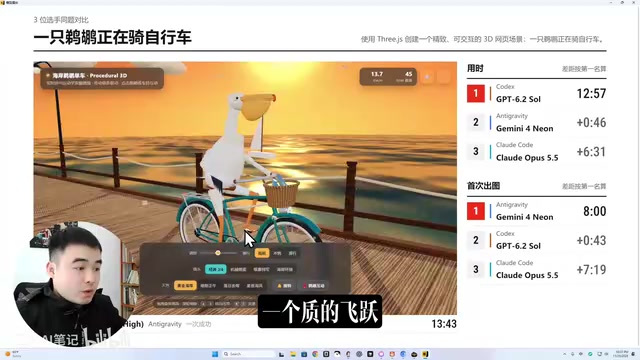
Gemini 4 Neon's work delivers a surprise right out of the gate—it's the only one of the three with sound effects, and the ocean breeze audio is quite realistic. The animation offers four camera angles: classic 4:3, side view, front close-up, and coastal orbit, and it can also switch between multiple lighting conditions such as noon, sunset, and starry night. In terms of interactivity, you can ring the bell, interact with the pelican, and lean into turns using the A/D keys.
But the shortcomings are also obvious: the surrounding buildings and the sailboats on the sea look as crude as "a schoolkid's drawing," which directly drags down the overall level of polish. The creator's subjective score was 8 points, and he stated outright that if the environmental details were more realistic, this work could reach 9.
Claude Opus 5.5's work lacks sound effects, but the animation quality is a notch higher. It can lean into turns automatically—the creator didn't touch the keyboard or mouse, and the vehicle completes the leaning motion on its own. The pelican's beak keeps moving, the eyes of the two little fish in the basket blink, and in night mode there are headlights and taillights. These details earned it a 9 from the creator.
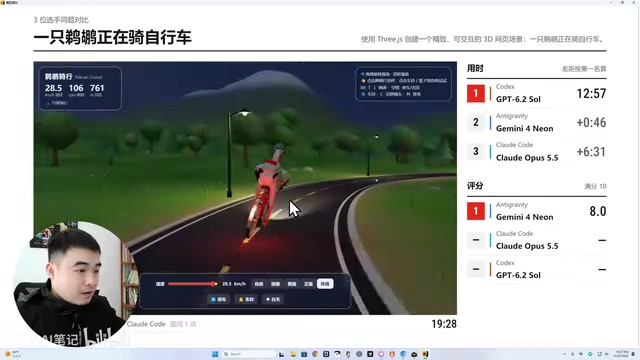
GPT 6.2's work has noticeably fewer actions and camera positions: only pedaling and gliding, and only three camera angles—three-quarter, side, and pedal close-up. It can't wave hello, only ring the bell, and there's no day/night switching. Combined with the suspicion of "copying," the creator gave it only 7 points.
"Pelican riding a bicycle" is a long-circulating benchmark meme in the AI community, originating as a joke about image generation models' composition and physical plausibility: there are complex spatial relationships between the pelican's beak, webbed feet, and bicycle pedals, making structural errors easy to draw. When transplanted into the coding Agent context, the evaluation points expand to whether the model can correctly model character skeletons, wheel rotation, camera following, and keyboard/mouse interaction in code. So this prompt wasn't chosen at random—it's a comprehensive stress test that simultaneously exposes flaws in geometric understanding, animation state machines, and interaction logic, which is why the three works diverge on "environmental detail" and "action richness."
3D Racing: A Clear Gap in Environmental Realism
The second challenge asked for a 3D racing mini-game. Gemini 4 Neon's version has responsive controls and supports switching between rear and in-car views, but the steering wheel in the in-car view isn't realistic enough, and the upper half of the screen flickers continuously—a suspected bug.
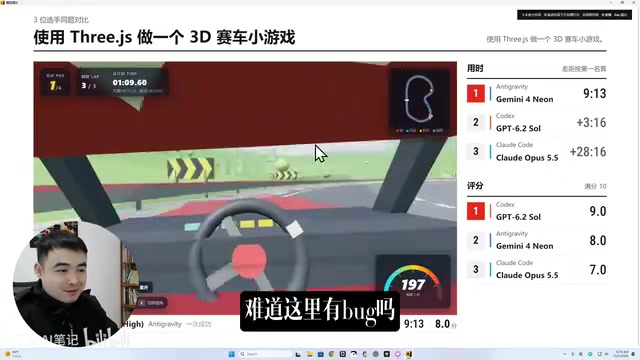
Opus 5.5's racer doesn't look as good from the rear view as Gemini's version, and the vegetation and blue sky with white clouds are similarly crude; after switching to the in-car view, the creator remarked bluntly that "it feels less like racing and more like driving a three-wheeler."
GPT 6.2's version actually performs more evenly on this challenge: no sound, but the surrounding environment, the crowd in the grandstands, the buildings, and the blue sky with white clouds are more realistic than the other two, closer to a real 3D scene. The in-car view is also crude, but at least it feels like "driving a race car." The creator believes that with further prompt optimization, Gemini 4 Neon may have even greater potential on this type of task.
Code-Generated Video: All Three Fail
The third challenge asked for a promotional video for each model generated purely from code. The creator's judgment was direct: none of the three met client standards. Gemini 4 Neon's result was "pretty mediocre"—an immediate pass; GPT 6.2 used the wrong logo—also a pass; Opus 5.5's result was relatively the strongest, but it also used the wrong logo in the end.
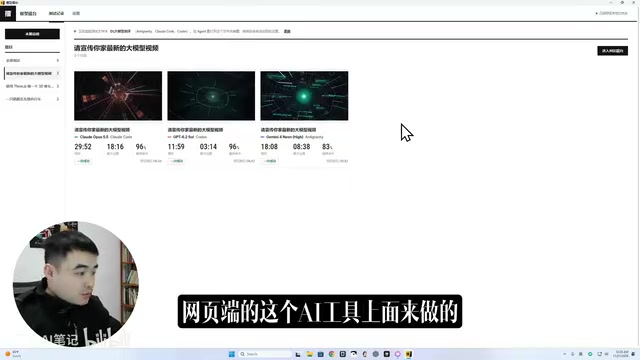
What's exposed here is a limitation at the tool level: generating video with a coding Agent is inherently a weak spot—no matter how strong the model, it's hard to produce polished video. The creator suggests that if you need to generate video, you should prioritize the web-based versions of Gemini or Claude rather than forcing it within a coding Agent.
Generating video purely from code typically refers to using graphics libraries such as WebGL, Canvas, or Three.js, with the model writing rendering and animation code to composite frames one by one, rather than calling a diffusion model to generate pixels. The former is essentially "procedural animation," where visual fidelity is limited by the complexity of hand-written geometry and shaders and struggles to match the texture of live-action footage or AI video models; the latter relies on large video generation models, which excel at lighting and texture but are usually unavailable within coding Agents. This explains why all three failed collectively on the third challenge: there's a structural mismatch between task requirements and tool capabilities, and the wrong logos further reflect the models' unstable control over key visual elements in long code.
Overall Performance and Selection Advice
Across the three challenges, no model emerged as a comprehensive winner. Opus 5.5 had richer detail and more natural interactivity on the pelican animation; GPT 6.2 had better environmental realism in the racing game; and video generation was unusable across all three. Gemini 4 Neon's strengths lie in sound effects, multiple camera angles, and responsive interactivity, while its weaknesses are crude environmental detail and a suspected rendering bug.
For developer selection, the signal from this test is: Gemini 4 Neon is already capable of competing head-to-head with Opus 5.5 on creative interactive tasks, but still lags in detail polish and stability. The "replacement" claim has some basis, but it's far from a comprehensive surpass. Beyond model capability, the influence of the toolchain and task type on final output is equally impossible to ignore.
One-line Summary
Same-prompt test of three coding Agents: Gemini 4 Neon approaches Opus 5.5 on creative interactivity, but still lags in detail and stability.
Paragraph Summary
Based on a Bilibili creator's side-by-side test of three AI Agents, this article compares Google Antigravity (Gemini 4 Neon), Codex (GPT 6.2), and Claude Code (Opus 5.5) on three challenges: a pelican-riding-a-bicycle animation, a 3D racing game, and a purely code-generated promotional video. Results show no model wins across the board: Opus 5.5 is best on animation detail and automatic leaning, Gemini 4 Neon stands out with sound effects, multiple camera angles, and responsive interactivity but has crude environments and a flickering bug, and GPT 6.2 is more balanced on racing environmental realism. All three fall short on the video task. The conclusion: Gemini 4 Neon can already compete with Opus 5.5, so the "replacement" claim is partially valid, but detail polish, stability, and toolchain fit remain key variables.
Related articles

Jingle Jam 2026 Registration Opens: Lewis Uses Old Footage to Rally Volunteers for Fundraising
Jingle Jam 2026 fundraising registration is open. Lewis uses old footage edited into a new video, calling on viewers to create fundraising pages at jingle jam.tiltify.com to support eight charities. The event takes place in the first two weeks of December.
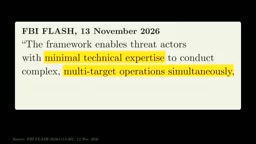
FBI-Warned Artex: How an AI Attack Framework With No In-House Model Pries Open Enterprise Doors
The FBI-warned open-source AI attack framework Artex has no model of its own—it plugs into Claude, GPT, and other external LLMs to drive an agent loop, turning ordinary tools like Nmap into an automated attack pipeline. This article examines three real cases—South Korean finance, ConnectWise, and Barracuda—analyzes the three drivers of speed, cost, and noise, and outlines defenses such as exposure inventory and short-lived credentials.
How Does ARTEX AI Automate Hacking with Agents?
ARTEX AI is an agentic automated hacking framework. This article analyzes its dual-layer planner-executor structure, the shared blackboard-driven adaptive attack loop, and what this agentic hacking model means for defenders.