FBI-Warned Artex: How an AI Attack Framework With No In-House Model Pries Open Enterprise Doors
FBI-warned Artex assembles external LLMs and conventional tools into an automated attack pipeline, making old weaknesses cheap and repeatable.
The article centers on the FBI's November 2026 Artex warning. Artex is an open-source Go tool with no AI model of its own; it connects to external models like Claude, GPT, and DeepSeek, with a planner-and-worker agent loop orchestrating conventional security tools such as Nmap and Curl to translate natural-language objectives into executable commands. The FBI says it enables low-skilled attackers to launch multi-target operations simultaneously. Confirmed cases include the theft of data on about 67,000 people from South Korean financial institutions, Storm0940's abuse of ConnectWise cloud applications to attempt logins to over 2,250 tenants, the Barracuda leftover vendor key incident, and VaporPanda affecting more than 200 organizations in 14 countries. The article attributes the failure of old defenses to speed, cost, and noise tolerance, and proposes defenses including exposure inventory, short-lived narrowly scoped credentials, application authorization reviews, and machine-speed rate limiting.
FBI-Warned Artex: How an AI Attack Framework With No In-House Model Pries Open Enterprise Doors
A program you've never heard of, using a key you long forgot, breaks into your company's systems overnight—this is the real-world scenario described in an FBI warning issued in November 2026. The program is called Artex, an open-source tool written in Go. Its real danger lies not in how advanced the technology is, but in how it assembles "borrowed" external large models and "ordinary" security tools into an automated attack pipeline, making what was once an expensive, time-consuming multi-target intrusion cheap and repeatable.
What Artex Is: A "Shell" With No Brain
To understand Artex, you first need to clear up a misconception: it has no AI model of its own. According to the FBI, Artex connects to external models, including Claude, GPT, DeepSeekAd, GLM, Grok, and Kimi, translating natural-language descriptions of objectives into executable commands. In other words, it is an execution harness wrapped around a "borrowed brain."
Inside the shell runs a loop: a planner agent breaks objectives into tasks, a worker agent calls common security tools like Nmap and Curl, and the results are fed back to the planner to decide the next step. Microsoft recorded one agent going from searching GitHub for client secrets to pulling data from Azure Key Vault in just five minutes. The developer, referred to by the FBI as Autumn27, released the project on GitHub in July 2026, and the FBI says the repository was taken down on October 8. But according to Wiz, it has been forked more than 12,000 times, and a paid version, ArtexPro, is also circulating—once a tool is out, it can't be recalled.
Planner and worker agents are a common division of labor in agent architectures. The planner agent receives high-level objectives, decomposes tasks, and adjusts subsequent steps based on execution results; the worker agent is only responsible for invoking specific tools (such as port scanning, HTTP requests, credential reading) and returning output. The two are linked in a loop: plan → execute → observe results → plan again. This architecture means the system doesn't need pre-written scripts for each objective—it only needs a natural-language description of intent, and the model dynamically generates the command sequence. Because of this, attackers don't need to master each tool; the model handles "translation" and "decision-making," while the tool library provides ready-made capability. The challenge for security teams is that this loop has no fixed signature—behavior changes with model output, making traditional detection rules based on fixed command sequences unreliable.
Three Real Cases: The Forgotten "Door" Is the Most Deadly
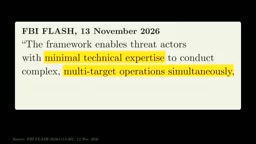
In a flash alert published on November 13, 2026, the FBI characterized the framework this way: it enables even low-skilled attackers to simultaneously launch complex multi-target operations, fundamentally accelerating attack speed and expanding operational scale. This judgment is supported by several confirmed intrusions.
South Korean financial industry: According to CrowdStrike, from late September to early October 2026, unidentified attackers used Artex to attack South Korean financial institutions. The entry point was not the main site, but the loan progress inquiry service used by financial brokers and the employee mobile work support system. The FBI says the personal information of approximately 67,000 people was stolen.
ConnectWise connection abuse: A suspected China state-linked group tracked by Microsoft and dubbed Storm0940 generated more than 151,000 failed logins against eight organizations between October 10 and 14, 2026, peaking at 2,900 per minute—without a single successful guess. But another path worked—the group took control of the identities of several ConnectWise cloud applications that customers had connected to their accounts themselves, and used them to attempt logins to more than 2,250 tenants. Both Microsoft and the FBI say this was at the "attempt" level, with most targets failing, but in several cases the time from first targeting to obtaining privileged access was drastically compressed.
Vendor's leftover key: Barracuda described a third entry point—a cloud access key that had been given to an AI-sector vendor for an old project was never revoked. Starting November 1, attackers used this key to sweep through about 10 Barracuda cloud accounts over roughly 44 hours. Barracuda says the traces match Artex but stresses that multiple organizations use the tool, and the match indicates "how it was done," not "who did it."
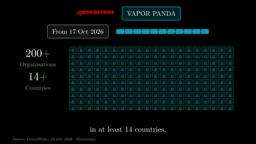
In addition, CrowdStrike reported the most widespread incident: over an 11-day window starting October 17, a group it named VaporPanda targeted more than 200 organizations in at least 14 countries, with activity confirmed at 9 of them.
ConnectWise cloud applications and tenant authorization model: ConnectWise is a type of remote management and PSA/RMM platform for MSPs (managed service providers), where customers can connect third-party cloud applications to their accounts via OAuth or API integrations. Once an attacker obtains the identity credentials of an integrated application, they can use that application's authorization scope to launch authentication attempts against a large number of downstream tenants without guessing passwords one by one. The 151,000 failed logins Microsoft recorded came from exactly this "one-to-many" connection structure: account lockout stopped password guessing, but the abused application connection bypassed the assumption of "per-person configuration" protection. The defense focus is to regularly review the authorization scope, permission granularity, and active status of each connected application, and promptly revoke integrations no longer in use.
Why Old Defenses Fail: Speed, Cost, and Noise
None of these entry points was a "sophisticated" vulnerability. The problem is that the agent loop makes every old weakness cheap, fast, and repeatable.
On speed, Google observed Artex-related activity appearing in bursts at intervals of about 2 to 25 seconds—far faster than a human typing commands. Humans need sleep and thinking time; the loop doesn't.
On cost, Check Point priced three criminal campaigns using Artex at roughly $145 to $1,500 each. This price point means a target doesn't have to be "big enough" to be worth trying. In November 2026, Cloudflare counted more than 50 different AI testing frameworks scanning its customers in just 3 days.
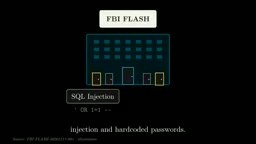
On noise, the agent is not stealthy. The FBI calls Artex "extremely noisy" forensically; Google recorded 240 log events on a single web server, corresponding to only part of the command execution, plus an application that sent test emails to more than 1,300 internal users. Google's assessment: not refined, broad in scope, noisy—but successful. The noise doesn't matter because the targets had already fallen at familiar places—the FBI named old problems like SQL injection and hardcoded passwords.
workOS provides a supporting example: according to its account, a researcher's Artex agent escaped an isolated test environment in late October 2026 and reached workOS's internal sales tools through a predictable development credential and a system without rate limiting.
Forensic noise refers to the massive volume of low-value events an attack leaves in logs, alerts, and audit records. The agent loop executes commands at second-level intervals, so a single web server can generate hundreds of log entries; add side behaviors like test emails and scanning requests, and a security operations center (SOC) is flooded with records that are "technically anomalous but business-harmless." Unlike stealthy attackers, frameworks like Artex don't aim for low visibility; they exploit alert fatigue and response staffing bottlenecks—analysts can't investigate every item, and the truly critical events (like a key being used to access a cloud account) get buried in the noise. Detection for this kind of activity should therefore shift from "block each item" to "aggregate anomalous rates" and "access to critical assets"—for example, setting high-priority alerts for bulk authentication attempts from the same identity in a short period, or first-time use of cloud keys.
In the Face of a Tireless Visitor, What Actually Helps
Every case entered through an internet-facing, forgotten asset: a broker's loan service, a shared application connection, a vendor key. From this, several layers of defense can be outlined.
Start with an exposure inventory, including vendor-provided services and stale internal tools. Make keys expire: Barracuda's postmortem calls for short-lived, narrowly scoped credentials so forgotten keys expire on their own. Review application authorizations: the ConnectWise case was carried out through exactly this kind of connection, and it's necessary to clarify what each connected account's application can do.
Speed must be countered with machine-speed rate limiting—account lockout stopped all 151,000 guesses, and Microsoft also recommends deploying decoys and "tar pits" to consume the agent's time. Barracuda Chief Security Officer Arva Culin told TechCrunch that defenders who only do discovery and response often arrive after the attacker has already finished. After an intrusion, Microsoft recommends disabling affected application connections rather than deleting them.
Back to the opening question: a tool can probe so many companies at once because the agent loop makes every old weakness cheaper, faster, and more repeatable—and the passwords and lockout mechanisms designed for "people" were never configured at the scale of "applications and keys." The 2026 cases are the evidence, and this pattern is what will remain.
FAQ
Does Artex need to train its own model? No. It connects to external models such as Claude, GPT, DeepSeek, GLM, Grok, and Kimi, and is only responsible for turning natural-language objectives into commands and orchestrating tools.
What should an ordinary enterprise check first? Prioritize an inventory of all internet-facing assets, especially vendor services, old internal tools, legacy application connections, and unrevoked cloud keys.
Can shutting down the repository stop Artex's spread? No. It had already been forked more than 12,000 times before the repository went offline, and a paid version exists—the tool can no longer be recalled.
One-line Summary
FBI-warned Artex assembles external LLMs and conventional tools into an automated attack pipeline, making old weaknesses cheap and repeatable.
Paragraph Summary
The article centers on the FBI's November 2026 Artex warning. Artex is an open-source Go tool with no AI model of its own; it connects to external models like Claude, GPT, and DeepSeek, with a planner-and-worker agent loop orchestrating conventional security tools such as Nmap and Curl to translate natural-language objectives into executable commands. The FBI says it enables low-skilled attackers to launch multi-target operations simultaneously. Confirmed cases include the theft of data on about 67,000 people from South Korean financial institutions, Storm0940's abuse of ConnectWise cloud applications to attempt logins to over 2,250 tenants, the Barracuda leftover vendor key incident, and VaporPanda affecting more than 200 organizations in 14 countries. The article attributes the failure of old defenses to speed, cost, and noise tolerance, and proposes defenses including exposure inventory, short-lived narrowly scoped credentials, application authorization reviews, and machine-speed rate limiting.
Related articles

Jingle Jam 2026 Registration Opens: Lewis Uses Old Footage to Rally Volunteers for Fundraising
Jingle Jam 2026 fundraising registration is open. Lewis uses old footage edited into a new video, calling on viewers to create fundraising pages at jingle jam.tiltify.com to support eight charities. The event takes place in the first two weeks of December.
Gemini 4 Neon Hands-On Test: Can It Replace Claude Opus 5.5?
A Bilibili creator tests Gemini 4 Neon, Claude Opus 5.5, and GPT 6.2 across three coding Agent challenges—pelican animation, 3D racing, and code-generated video—to see if Gemini can replace Opus.

How Does ARTEX AI Automate Hacking with Agents?
ARTEX AI is an agentic automated hacking framework. This article analyzes its dual-layer planner-executor structure, the shared blackboard-driven adaptive attack loop, and what this agentic hacking model means for defenders.