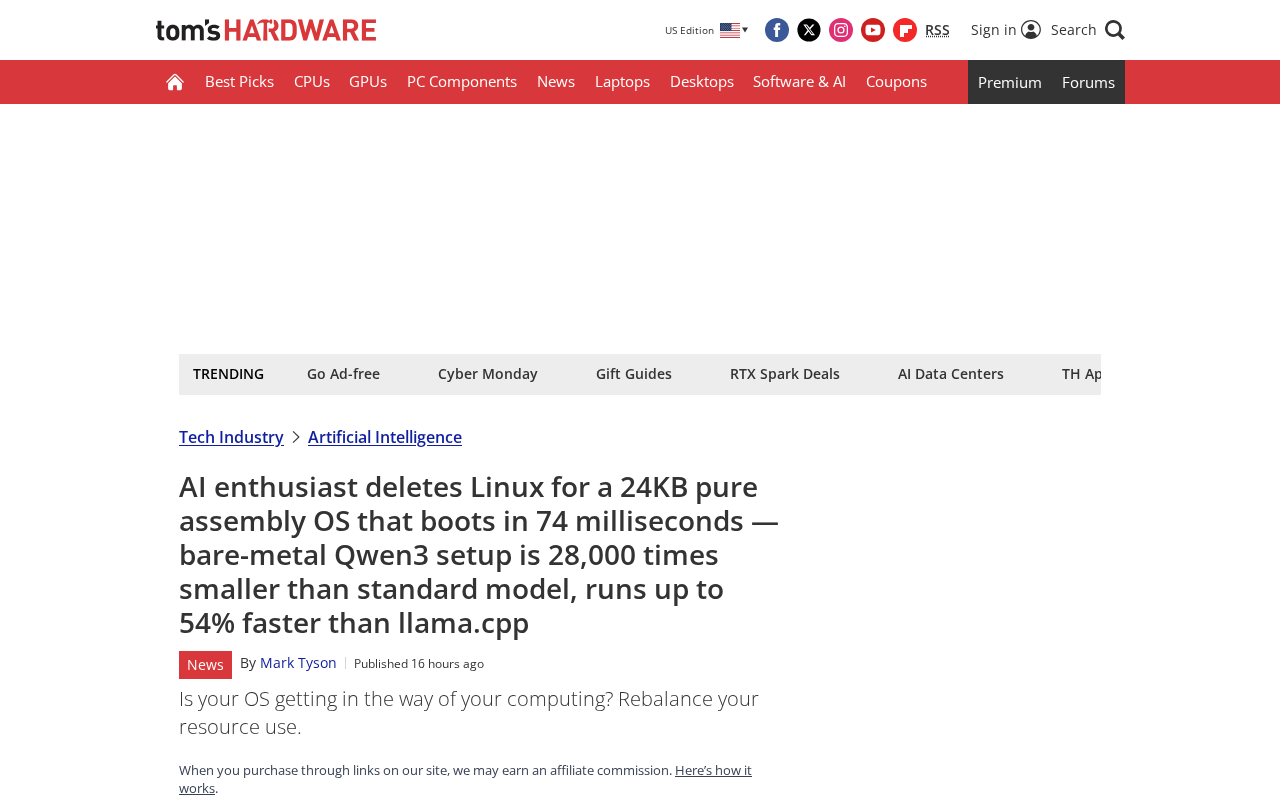
24KB Microkernel OS Boots in 74 Milliseconds, Sparking Debate on Lightweight Systems

AI enthusiast replaces Linux with a minimal 24KB system that boots in 74ms, sparking reflection on system bloat.
The article discusses a Hacker News share: an AI enthusiast deleted Linux and switched to a minimal OS only 24KB in size that boots in 74ms. Such systems typically contain just a tiny bootloader and minimal kernel, cannot host modern app runtimes, and are closer to geek experiments than daily-use solutions. The topic matters for edge computing and serverless cold-start optimization, and for reflecting on bloated multi-GB Linux distributions. The event has a single source and lacks cross-verification, so it should be treated as a technical curiosity; the real takeaway is to examine the necessity of each abstraction layer and apply lightweight thinking to containerization and CI/CD.
A 24KB Operating System That Boots in Just 74 Milliseconds
On Hacker News, a discussion about "an AI enthusiast deleting Linux and switching to an operating system that is only 24KB and boots in just 74 milliseconds" attracted modest attention. Although the original post received only 6 upvotes and has no comments yet, this extreme case touches on a long-standing question in systems software: are modern operating systems too bloated? Can lightweight solutions be the better choice in specific scenarios?
The Core of the Story: An Extreme Migration from Linux to 24KB
According to the share on Hacker News, a developer interested in AI completely wiped their existing Linux installation and switched to an operating system that is only 24KB in size. The system's boot time is just 74 milliseconds, far below the several seconds typical of regular Linux distributions. The post did not disclose the operating system's specific name, implementation details, or use case, but the two numbers—"24KB" and "74 milliseconds"—are enough to pique the curiosity of the technical community.
From an engineering perspective, a 24KB footprint is roughly the size of a tiny bootloader plus a minimal kernel. Such systems typically do not include a full network stack, graphical interface, or multitasking scheduler, but are instead aimed at single-task or embedded control scenarios. The author's choice to use it as a primary system is very likely a geeky experiment rather than a pursuit of everyday usability.
Size Reference for Microkernels and Bootloaders
In operating system engineering, a 24KB image size roughly corresponds to a boot sector (512 bytes) plus an uncompressed single-address-space kernel, or an extremely stripped-down real-time kernel. For reference, a compressed Linux kernel image is typically in the range of several MB, while a full distribution can easily be several GB. Historically, systems that have reached this size range include MenuetOS (floppy image of about 1.4MB), KolibriOS (about 1.4MB), and various teaching-oriented microkernel prototypes. Squeezing a system down to 24KB usually means giving up virtual memory paging, the network protocol stack, file system caching, and most of preemptive multitasking, retaining only interrupt handling, memory allocation, and the most basic I/O drivers. Therefore, the "74 millisecond boot" of such systems reflects an extremely short initialization path rather than superior scheduling or I/O performance.
Why Lightweight Systems Are Back in the Spotlight
The Pursuit of Extreme Resource Efficiency
In cloud-native and edge computing scenarios, system image size and boot speed directly affect deployment density and cold-start latency. A system that boots in just 74 milliseconds means a large number of instances can be spun up in an extremely short time, which is theoretically attractive for serverless computing, function-as-a-service, and similar scenarios. Although a 24KB system can hardly host modern application runtimes, it demonstrates the possibility of stripping away redundancy to the limit.
Cold-Start Latency and Serverless Computing
In serverless computing, cold start refers to the entire process of spinning up a function instance from zero, loading the runtime, and responding to the first request, typically taking hundreds of milliseconds to several seconds, with OS boot, runtime initialization, and code loading each accounting for a portion. Industry approaches to reducing cold start include pre-warmed instance pools, snapshot restore (such as Firecracker microVMs), and streamlined guest kernels. In this context, a 74-millisecond boot time means the operating system layer is almost no longer a bottleneck, and the remaining latency will mainly come from the application runtime itself. It is important to distinguish, however, that microVM solutions (such as AWS Firecracker), although also pursuing millisecond-level startup, still have guest kernels in the hundreds of KB to several MB range because they need to be compatible with the standard Linux ABI; a 24KB system does not have the ability to run general-purpose binaries, so the two have different goals.
Reflection on Modern Software Bloat
Modern Linux distributions often measure in GB and contain thousands of packages and complex init systems. This bloat brings convenience but also sacrifices understandability and auditability. The share on Hacker News is essentially a tribute to the idea of a "minimal usable system"—just as the early Unix philosophy advocated "do one thing and do it well."
Unix Philosophy and Minimal Usable Systems
"Do one thing and do it well" comes from Doug McIlroy's summary of Unix tool design principles, emphasizing that programs should have a single responsibility and accomplish complex tasks through composition. This idea was later summarized as "small is beautiful" and has influenced lightweight practices such as BusyBox, the suckless suite of tools, and Alpine Linux (based on musl libc and BusyBox). In contrast stands the "big and comprehensive" approach represented by integrated init systems such as systemd, which has long been a focus of community debate. Understanding this context helps clarify the nature of the 24KB system story: it is not a new technological breakthrough but another expression of the minimization tradition in an extreme direction, and its value lies in providing a contrast that reminds developers that abstraction layers are not free—each layer brings size, attack surface, and cognitive cost.
A Rational Look from Multiple Perspectives
At present, this topic has only appeared on Hacker News, and no other technical community or media outlet has independently verified it. Therefore, there is a lack of cross-source corroboration regarding the system's actual name, architecture, and purpose. Readers should treat it as a technical curiosity rather than a directly reproducible solution.
If such a system does exist, its real value may not lie in replacing the Linux desktop, but in providing a minimal option for specific domains (such as embedded devices, teaching demonstrations, and security-isolated environments). For AI enthusiasts, such manual experiments also remind us that tool choices should serve the goal rather than blindly follow the mainstream.
Takeaways for Developers
The inspiration from this share is not to encourage everyone to delete Linux, but to prompt us to re-examine whether every layer of abstraction in a system is necessary. Today, with containerization and micro-virtualization technologies maturing, reducing system attack surface and boot overhead has become a practical need. Whether building custom firmware or optimizing test environments in CI/CD, lightweight thinking is worth borrowing.
Without more details, we cannot judge the reliability or security of this 24KB system. But as a signal, it shows that the technical community's exploration of efficiency has never stopped.
One-line Summary
An AI enthusiast replaced Linux with a minimal 24KB system that boots in 74 milliseconds, sparking reflection on system bloat.
Paragraph Summary
The article centers on a Hacker News share: an AI enthusiast deleted Linux and switched to a minimal operating system that is only 24KB in size and boots in just 74 milliseconds. The article notes that such systems typically contain only a tiny bootloader and a minimal kernel, cannot host modern application runtimes, and are closer to geek experiments than everyday usable solutions. The topic's value lies in two aspects: first, the extreme pursuit of image size and cold-start latency in scenarios such as edge computing and serverless; second, reflection on modern Linux distributions that easily run to several GB and have too many abstraction layers. The article also emphasizes that the event has only a single source and lacks cross-verification, so it should be treated as a technical curiosity; the real takeaway for developers is to examine the necessity of each abstraction layer and borrow lightweight thinking in containerization and CI/CD optimization.
Related articles

AI Product Manager Systematic Course for Beginners: Three Modules Explained with Pitfall Avoidance Guide
Breakdown of Bilibili's 100-episode AI product manager course: Foundation builds large model and Prompt cognition, Advanced tackles Agent workflows and RAG knowledge bases, Practice completes projects like personal knowledge bases and intelligent customer service. Includes learning roadmap and pitfall avoidance tips.
YOLO Object Detection for Absolute Beginners: Environment Setup and Core Concepts
Learn YOLO object detection from scratch: Python basics, VS Code, Miniconda environment setup. A Bilibili tutorial guides you step by step, with a desktop icon recognition project as your hands-on goal.

2026 Desktop Speaker Buying Guide: 24-Model Roundup and Pitfalls to Avoid
How to choose 2026 desktop speakers? Based on a Bilibili roundup of 23 products, this guide analyzes budget, interfaces, and placement by tier—under 100 yuan, 200–300, 300–600, and above 1,000—and reviews standouts like Huazai Pixelbar AI, Colorful X9 Pro, and Edifier G1500 MAX.