250 Developers, 24 Hours: An Inside Look at AI Entrepreneurship at Hong Kong's Hackathon

Hong Kong's SeaHack hackathon shows how AI tools let non-coders build a working MVP in just six hours.
Hong Kong's SeaHack hackathon drew 250 participants from over ten countries — a 500% jump from its first edition. The standout trend: AI coding tools have shifted the entry bar from "can you code?" to "do you have a good idea?" Participants with no coding background shipped working products in six hours. Projects spanned Cantonese pronunciation learning, privacy-first local CRM, and fintech lending — though fintech showed clear signs of homogenization. Judges flagged a key AI-assisted development pitfall: interfaces cluttered with redundant explanatory text were immediately flagged as "too Claude." Organizers positioned Hong Kong as a natural bridge between Eastern and Western AI ecosystems, while the hackathon itself proved that constraints fuel creativity — and that the process matters more than finishing.
A hackathon in Hong Kong called SeaHack (C-Hack) drew more than 250 developers and creators from over ten countries, who had 24 hours to form teams, build, and submit projects. Free Code Camp founder Quincy served as a judge and documented the entire event. Compared to the inaugural edition a year ago, which had only 50 participants, this edition achieved 500% growth — and the most remarkable aspect was how AI tools are reshaping the path from idea to working product for everyday people.
A Non-Technical Founder's "Six-Hour MVP"
The most striking detail of this hackathon came from a team made up of Connor from South Africa and Cindy from Hong Kong. They were building a platform to help NGOs identify and recruit volunteers — the core insight being that many nonprofits spend a large portion of their budget on marketing agencies to recruit volunteers and sponsors, when that money should be flowing to people who actually deserve it.
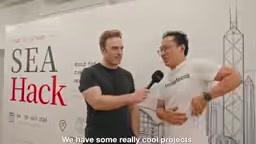
What made it truly interesting was their background: Cindy came from marketing, Connor from finance, and neither had ever written a line of code — they hadn't even downloaded Visual Studio Code. "But with AI, anything is possible," Connor said. "Turning an idea into an MVP in six hours is genuinely exciting."
This wasn't an isolated case. Another participant at the event admitted they arrived late, yet "learned to code and can now build things" — using Claude Code and the token credits provided by the organizers, they created a map overlay that marks natural resources and fertile land. AI coding tools are shifting the hackathon entry bar from "can you code?" to "do you have an idea worth building?"
MVP (Minimum Viable Product) is a core concept in lean startup methodology — it refers to the most resource-efficient product version that can validate a core hypothesis, with the goal of gathering real user feedback quickly rather than pursuing feature completeness. Traditionally, building an MVP in six hours was nearly impossible for non-technical founders — they'd need to find a technical co-founder or spend weeks learning basic programming. The emergence of AI coding assistants like Claude Code and Cursor changed that premise: users describe what they need in natural language, and the AI generates code scaffolding, debugs errors, and deploys applications. Platforms like Vercel further compressed the time from "code" to "accessible webpage," making the entire pipeline completable by non-technical people in a matter of hours. The "token credits" at the hackathon refer to pre-purchased AI API call quotas provided by the organizers, allowing participants to use the tools freely without incurring AI service costs.
Localization and Privacy: From Cantonese to Local AI
Regional identity came through vividly in the projects. Hong Kong locals Jenny and Coco built an app for learning Cantonese pronunciation — users record themselves, the app detects whether their pronunciation is accurate and offers corrections, with plans to add visualization of Cantonese's six tones and a feature for scoring users as they sing along to Canto-pop lyrics, blending language learning with popular music.
Another direction was more thought-provoking. Local Hong Kong developer Michael built a CRM tool called REFT, whose core proposition is: "Our conversations shouldn't become training data for the next generation of AI." The tool integrates directly with WhatsApp and Telegram — the most common communication channels for Hong Kong small business owners — and uses a fully locally-run AI model to review chat logs, suggest replies, and extract customer relationship summaries, with all data stored locally and never uploaded to the cloud.
He emphasized that it runs efficiently on "any computer made in recent years" without consuming too many resources, targeting the growing privacy anxiety of the AI era. This represents a clear product thesis: when big tech treats data as fuel for training, "local-first" becomes a genuine differentiator.
The "locally-run AI model" approach used by REFT typically relies on open-source frameworks like Ollama or LM Studio to deploy smaller open-source models (usually 7B to 13B parameters, such as Llama or Mistral) on the user's own CPU or GPU, without sending data to cloud servers from OpenAI, Anthropic, or others. The trade-off is slower inference and lower capability ceilings compared to cloud-based large models, but for structured tasks like summarization, classification, and drafting replies, they are generally sufficient. Both WhatsApp and Telegram offer local data export or API access capabilities, allowing third-party tools to read chat logs without routing through their servers. For Hong Kong small business owners, WhatsApp is the dominant customer communication channel, making it highly valuable to embed AI capabilities there — and "data localization" also carries compliance appeal in the context of Hong Kong's Personal Data (Privacy) Ordinance.
When Everyone Is Building "Tinder for Loans"
Fintech became the most crowded category. One team built a literal "Tinder for Loans" — borrowers submit a YC-style application video (complete with an AI-generated repayment plan and requested amount), and lenders browse through them like a dating app: swipe right to accept, swipe left to pass, with a blockchain-based audit log available to verify borrower history.
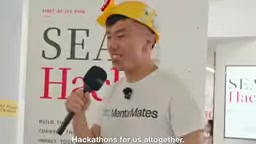
Another team, Terry, built an AI loan system that lets users complete what would normally be a tedious checklist-based application through simple conversation — the AI evaluates the application and feeds results to an administrator, eliminating manual back-and-forth. Another team built a "compliant debt-collection voice agent" — after a customer leaves their name and phone number, a voice agent built on local regulatory rules immediately follows up, quickly collecting information and handing it off to an existing decision-making agent.
Toy recommendations also emerged as a popular theme. At least two teams built recommendation systems around a toy company called Apple Park, targeting the pain point of "not knowing what to buy for someone else's kid," using a conversational LLM to gather information about the child, generate a story, and match an appropriate toy. The heavy overlap in themes also reflects the homogenization risk of "wrapper innovation" in the AI era.
The Judges' Perspective: AI-Generated Telltale Signs Are a Liability
The documentary offered a rare look at the actual judging process — arguably the most informative section. Judges scored across three tracks — startup, industry, and community — first reviewing two-minute pitch videos, selecting the top three in each track for a live presentation, and ultimately choosing one winner per track.

Several evaluation criteria came up repeatedly during deliberations: feasibility ("nothing is stopping this from becoming a real product"), market size, retention ("you figure it out after a few uses and never come back"), and whether the problem was genuine ("this is an imaginary problem I can't relate to").
The sharpest comment was aimed at an AI-generated interface: "This is very Claude. What Claude is particularly bad at is piling on too much explanatory text." The judge pointed out that a landing page had three headlines instead of one — "it's these small details that drive me crazy." This is a warning for all developers using AI to rapidly generate products: AI can get you 80% of the way there, but the details that expose the tool's fingerprints are exactly what judges and users notice first.
The "this is very Claude" phenomenon the judges described refers to the tendency of large language models like Claude to produce UI copy or landing page content that is overly complete in structure and heavy on explanatory language — multiple parallel headings, abundant bullet points, and repeated restatements of the same feature in different words. This style stems from the high proportion of documentation and instructional text in model training data, which leads the model to default toward "informational completeness" rather than "visual restraint." Mature product design typically follows the opposite principle: one core message per page, headlines that create tension rather than describe functionality. This judging feedback reveals a classic blind spot in AI-assisted development — AI tools can quickly scaffold structure and logic, but struggle to internalize the aesthetic judgment and user psychology specific to a given context, which is precisely what distinguishes a "product" from an "AI-generated artifact." Developers who ship the AI's first-pass output without manual refinement risk exposing those tool fingerprints at the most visible layer: the interface itself.
Hong Kong as a Bridge Between East and West
Organizer Chynette is a native Hong Konger, founder of MentorMates, and the driving force behind this hackathon. She has a clear read on Hong Kong's tech ecosystem: the debate over "whether the future of AI belongs to China or the US" is heating up, and her answer is "both are driving it together."

"There's no better place than Hong Kong to discover this," she said — Hong Kong sits adjacent to Shenzhen and the Greater Bay Area while maintaining an international outlook, with access to overseas AI models, talent, and infrastructure. It's a natural bridge where East meets West.
Stanford lecturer and serial entrepreneur John Whaley articulated the value of hackathons at a methodological level: "Constraints breed creativity. When you have an urgent deadline, everything non-essential gets stripped away, forcing you to come up with creative solutions — that's where real value gets created."
Closing Thought: Finishing Isn't the Point
The documentary ends with a poignant detail. Many teams were scrambling right up to the 3:30 deadline — deploying to Vercel, uploading localhost screen recordings, even struggling to select the right submission track. Some didn't submit in time; some projects simply weren't finished.
But when asked to rate their satisfaction with the weekend, the participant who didn't finish said: "Even though the project wasn't really done, I learned a lot — there were so many experts here. I'm very satisfied."
Quincy shared that he too had been through hackathons where he couldn't finish in time and had nothing to turn in.
"If you're feeling intimidated, don't be. Just go out there and build something." That might be the most important message to carry forward — now that AI has lowered the bar for creation.
Related articles

"Black October": Did AI Uncover 3% of All Critical Vulnerabilities Ever?
A Reddit post claims 3% of all critical software vulnerabilities ever were found in the past month, dubbed 'Black October.' We break down the statistical issues, how AI-assisted code auditing accelerates discovery, and how developers should respond.

Microsoft Project Gecko: Using AI to Bridge Language Gaps for African Farmers
Microsoft's Project Gecko launches PharmaChat, letting African farmers ask questions in their native language and get precise video clips and farming book chapters via AI. The project also releases three interactive manuals to advance inclusive AI.

Musk's Space Dominance: How Starlink Throttling Undermines Ukraine's Defense
SpaceX's Starshield throttling disabled Ukraine's high-speed interceptor drones, exposing how Musk's private control over low Earth orbit communications affects battlefield dynamics and national security, and highlighting the risks of commercial space militarization and space governance dilemmas.