27-Model Code-to-Video Test: Claude Opus 5.5 Takes the Crown, But the Real Value King Is Someone Else
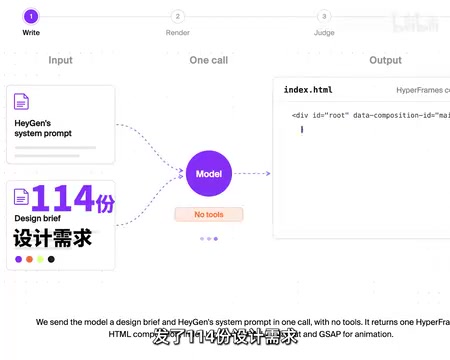
27 models generate video from single-file HTML; top models lead on aesthetics but cost 100x more, while mid-tier models win on value.
Artificial Analysis' Code2Video Benchmark had 27 mainstream models each write single-file HTML to create videos without external tools and with only one submission, rendered uniformly by Hyperframe. All models exceeded 96% rendering success rate, so the gap shifted to aesthetics. Claude Opus 5.5 ranked first with 1536 points at $3.08 per task; last-place Nimotron 3 Ultra costs 3 cents but trails by 1232 points. GPT 6.1 ranked fourth at ~$0.31, and Mimo tenth at $1.
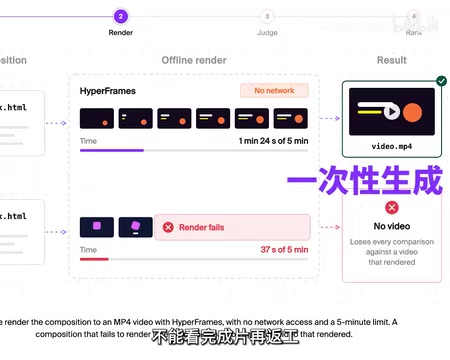
Letting AI generate video with code can produce a 100x cost difference—one costs $3, another just 3 cents. How much does the final output actually differ? The Code2Video Benchmark released by Artificial Analysis offers a fairly useful answer: they sent 114 design briefs to 27 mainstream models worldwide, requiring each model to independently write an HTML file to create a video without any external tools—for example, making chat bubbles cycle through colors, or completing a product interface demo. The model handles layout and animation logic, and Hyperframe renders the final video. Each task gets only one submission, with no rework after seeing the result.
Rendering Success Rate Is No Longer the Barrier—Aesthetics Are
The results of this round first make one thing clear: basic code generation capability is no longer the main dimension separating models. Every model's rendering success rate exceeds 96%, and the code basically runs. In other words, the real test has shifted from "can it be made" to "does it look good"—animation pacing, visual appeal, typography details, and other dimensions closer to design aesthetics have become the key differentiators. This also means that when all models can deliver a runnable HTML file, the evaluation system's focus naturally migrates toward output quality.
Scoring is handled by Gemini 4 Argon through pairwise comparisons across five dimensions: interactivity, requirement compliance, composition, temporal consistency, and production technique. This pairwise approach reflects relative performance between models better than absolute scoring.
Pairwise comparison is a common model evaluation method: the evaluator sees only two models' outputs for the same requirement at a time and judges which is better, rather than assigning absolute scores to all results. Compared with absolute scoring, pairwise comparison reduces noise from evaluator subjective scale drift and is better suited to comparing generated content with obvious stylistic differences that are hard to measure on a unified scale. In LLM and generative AI benchmarks, pairwise results are usually aggregated into a global ranking using the Bradley-Terry model or Elo rating system. The "total score of 1536" in this article is such an aggregated relative score, not a percentage score.
Ranking Landscape: Opus 5.5 Leads, Tail Gap Is Huge
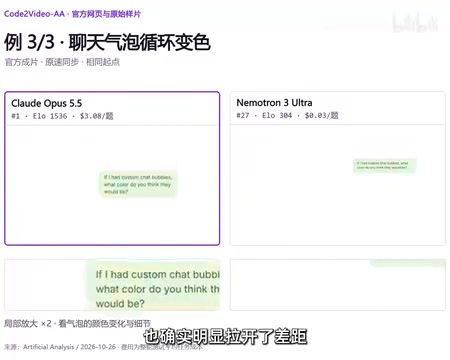
In the final ranking, Claude Opus 5.5 takes first place with a total score of 1536 and an average task cost of $3.08. The last-place Nimotron 3 Ultra trails the leader by 1232 points, yet costs only 3 cents—roughly a 100x price difference from Opus. Comparing the two outputs, the quality gap is indeed visible to the naked eye—which directly answers the question at the beginning: cheap does come at a cost, and on the pure aesthetics dimension, low-cost models struggle to compete with top models.
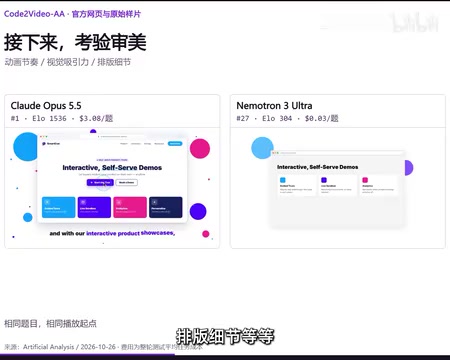
However, the top models' lead is not without cost. Opus 5.5's $3.08 per task is not cheap for scenarios requiring batch video generation.
Hyperframe plays the role of a "deterministic renderer" in this kind of test: the model outputs only HTML/CSS/JavaScript code, and an external rendering engine captures and encodes it frame by frame at a fixed viewport and fixed frame rate into video. The benefit is decoupling "code generation quality" from "video encoding quality," avoiding incomparable results caused by different models calling different video generation backends. Standardizing the rendering step also ensures the "one submission, no rework" rule is strictly enforced—the evaluator receives exactly the code the model finally delivers, and the rendering result is the final score.
Value Perspective: Another Answer from GPT 6.1 and Mimo
If we switch to a different evaluation dimension, the conclusion is completely different. GPT 6.1 ranks fourth overall and costs only $0.31 per task on average, about one-tenth of Opus. Mimo, ranked tenth with a total score of 1052, costs just $1—far more than Nimotron's 3 cents, but far less than the top models. This shows that in "good enough" scenarios, mid-tier models offer outstanding value: spending one-tenth the money for a near-top ranking may be a more pragmatic choice for cost-sensitive teams.
This stratification actually reveals the cost structure of Code2Video-style tasks—high-priced models buy you the aesthetic ceiling, while mid-tier models buy you acceptable completion. Which to choose depends on whether your video is for brand-level materials or rapid idea validation.
The single-file HTML constraint may seem like just an engineering detail, but it actually imposes several implicit requirements on model capability: the model must organize structure (HTML), styling (CSS), and animation timing (JavaScript or CSS animations) all within one file, without relying on external libraries, CDNs, or asset resources. This means it must handle layout systems, animation loops, timeline coordination, and other problems usually handled by frameworks. The stricter the constraint, the more it exposes the model's depth of understanding of front-end rendering mechanisms, and it also makes outputs from different models comparable under the same rendering environment.
What This Benchmark Really Tells Us
The value of Code2Video Benchmark goes beyond a ranking table. It breaks "writing video with code" into quantifiable engineering problems: single-file HTML, one submission, no external tools—these are almost the harshest constraints possible, and therefore best expose models' true level in layout understanding and animation timing.
From the results, competition among models has entered a dual game of aesthetics and cost. Top-ranked models lead in visual quality, but cost an order of magnitude more; mid-tier models provide usable output at extremely low cost. For practical users, rather than obsessing over who is first, it is better to first clarify which balance your scenario needs. If your project does not demand high visual detail but requires large-volume output, a low-cost mid-tier model is clearly a more rational starting point; conversely, when pursuing brand-level visual expression, the premium of top models is meaningful.
One-line Summary
27 models generate video with single-file HTML; top models lead on aesthetics but cost 100x more, while mid-tier models stand out on value.
Paragraph Summary
Artificial Analysis' Code2Video Benchmark had 27 mainstream models worldwide each write single-file HTML to create videos under constraints of no external tools and only one submission, with Hyperframe handling unified rendering. Results show all models exceeded 96% rendering success rate, meaning code capability is no longer the differentiator—the gap has shifted to aesthetic dimensions such as animation pacing, typography, and visual appeal. Scoring was done by Gemini 4 Argon via pairwise comparisons across interactivity, requirement compliance, composition, temporal consistency, and production technique. Claude Opus 5.5 topped the list with 1536 points at an average cost of $3.08 per task; last-place Nimotron 3 Ultra costs only 3 cents and trails by 1232 points. GPT 6.1 ranks fourth at about $0.31, and Mimo ranks tenth at $1, revealing a cost stratification between "aesthetic ceiling" and "good-enough completion."
Related articles

Apple Unveils First Touchscreen MacBook Pro: OLED Display and Glowing Logo Return
Apple unveils its first touchscreen MacBook Pro with an OLED display, starting at $2,899, plus the return of the glowing Apple Logo. Amazon updates its Echo lineup, and Virgin Galactic reveals its commercial spacecraft Aperon. This article reviews the three hardware stories and the product signals behind them.

Android Studio Opens Up to Any Coding Agent: The BYOA Era Begins
Android Studio launches Bring Your Own Agent, letting developers connect Cloud Agent, Codex, Anti-Gravity, or any coding agent in the IDE and access the emulator, build system, and Compose preview.
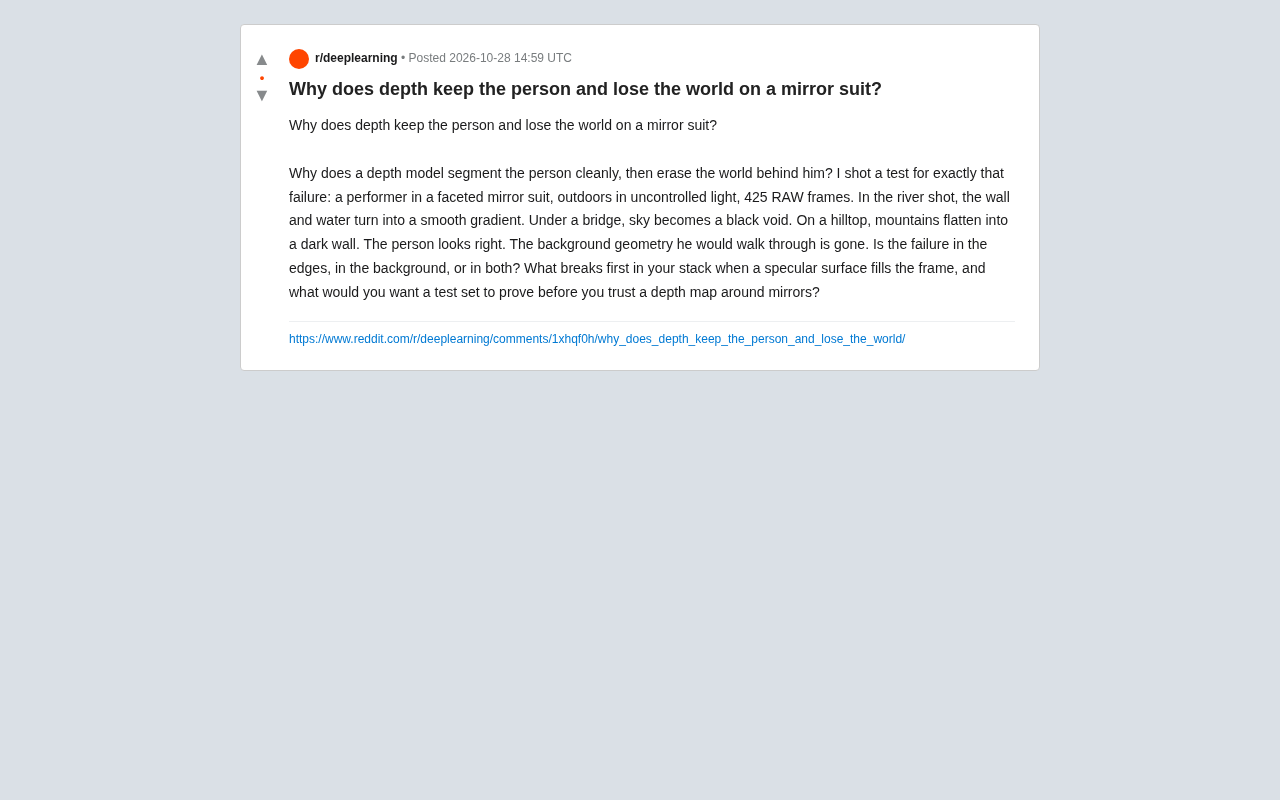
Depth Estimation Under Mirrored Clothing: Subject Stays Sharp, But Why Does the Background Disappear?
Reddit user tests depth estimation on mirrored clothing: person segmentation stays sharp but background geometry is lost. Analysis traces failure to specular reflections destroying background cues, explores edge-background interplay, and suggests data and model improvements.