3-Month LLM Learning Roadmap: From Zero to Agent Development, Fully Broken Down
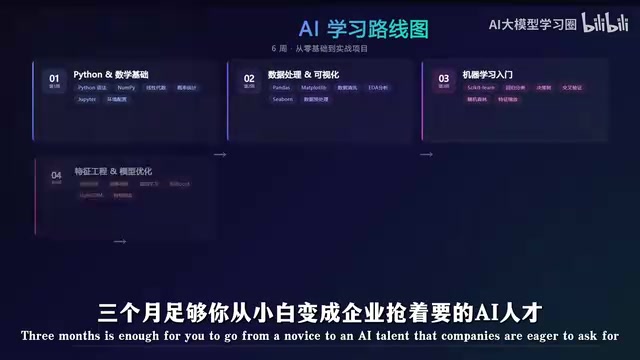
A Prompts → RAG → Agent roadmap for LLM beginners, with a real deliverable at every stage.
This article outlines a three-stage LLM learning roadmap for beginners: start with prompt engineering and API calls to build a copywriting generator; progress to RAG and vector databases to create a knowledge base Q&A assistant; then master the ReAct framework and multi-agent collaboration to build production-ready Agents. Each stage has a concrete, monetizable deliverable, making it a practical skills map for aspiring AI application developers.
A Clear Roadmap for Leveling Up with LLMs
Starting from scratch with large language models, the biggest obstacle usually isn't difficulty — it's not knowing where to begin. A learning guide shared on Bilibili breaks the LLM journey into three progressively building stages: laying the foundation, learning to build, and hands-on practice. What makes this roadmap valuable is how it transforms the abstract goal of "learning AI" into concrete, executable tasks with real deliverables.
This article organizes and expands on that roadmap to help anyone looking to transition into AI development understand what to study at each stage — and what they'll be able to build.
Step 1: Build the Foundation — Get Comfortable with Prompts and APIs
Many beginners jump straight into model training, only to be discouraged by the math and compute requirements. The original guide offers practical advice: don't rush into model training. For now, it's enough to learn how to write effective prompts and understand the basics of API calls.
Prompt engineering is one of the core skills for working with LLMs today. Writing good prompts is fundamentally about learning to precisely describe tasks to the model, constrain its output format, and provide the right context. Understanding how APIs work lets you integrate model capabilities into your own programs or products.
The hands-on deliverable for this stage is a viral copywriting generator. The barrier to entry is low, but it can immediately generate income — you can use it to take on freelance copywriting gigs. Validating your learning through a small, working tool is far more satisfying than passively consuming theory.

Step 2: Make AI "Work" for You — Master RAG and Knowledge Bases
Once you have the basics down, move into more practical application-layer work. The core concept here is RAG (Retrieval-Augmented Generation) — enabling an LLM to answer questions based on external knowledge, rather than relying solely on what it learned during training.
To get RAG working end-to-end, you'll need to understand a few things:
- Data cleaning: Raw documents are often messy and need to be cleaned and split into appropriately sized chunks
- Vector databases: Converting text into vectors and storing them to enable semantic search
- Agents and knowledge graphs: Getting familiar with the concepts of intelligent agents and structured knowledge
The project for this stage is building a knowledge base Q&A assistant. Feed it industry reports, company manuals, or other documents, and you can then ask questions and get accurate answers grounded in that material. This type of application has enormous real-world demand within enterprises — it's a critical step from personal toy project to genuine commercial value.
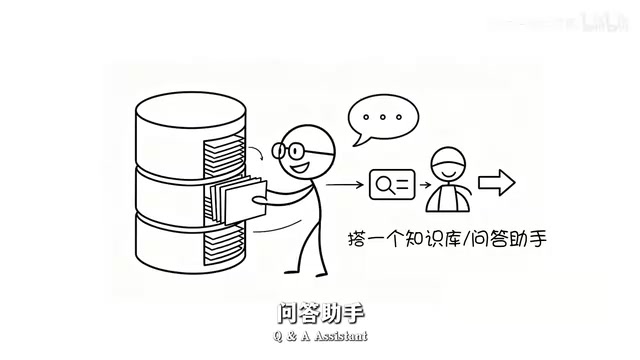
RAG (Retrieval-Augmented Generation) is currently one of the most widely adopted technical approaches for deploying LLMs in enterprise settings. LLMs have a training knowledge cutoff and cannot "remember" a company's private internal documents. RAG solves this: when a user asks a question, the system first retrieves the most relevant text chunks from an external knowledge base, then passes those chunks along with the question to the LLM, which generates an answer grounded in that context. This approach preserves the model's language understanding and generation capabilities while addressing the problems of outdated knowledge and private information.
Vector databases are the key infrastructure behind RAG. Text is converted into high-dimensional vectors by an embedding model and stored in the database. At query time, the question is similarly converted to a vector, and the most semantically similar passages are retrieved using metrics like cosine similarity — this "semantic search" is far more accurate than keyword matching. Popular vector databases include Chroma, Milvus, Weaviate, and Pinecone. For beginners, a local Chroma deployment is the quickest way to get started.
Step 3: Build Agents — Understand ReAct and Multi-Agent Collaboration
The third stage is where engineering ability really shines — building an Agent from scratch.
The core concept here is the ReAct pattern (Reasoning + Acting). It enables AI to do more than passively answer questions; it can run a "think–act" loop: analyze a problem, decide which tool to call, receive the result, and continue reasoning. With ReAct under your belt, AI evolves from a chatbot into an autonomous task executor.
Taking it further is multi-agent collaboration. When a single agent's capabilities are limited, multiple agents with specialized roles can work together to handle more complex workflows. This is one of the hottest directions in AI application development right now.
After completing this stage, building a conversational bot or drafting an AI implementation plan for a company should both be well within reach. It means you've developed a reasonably complete set of engineering skills in practice.
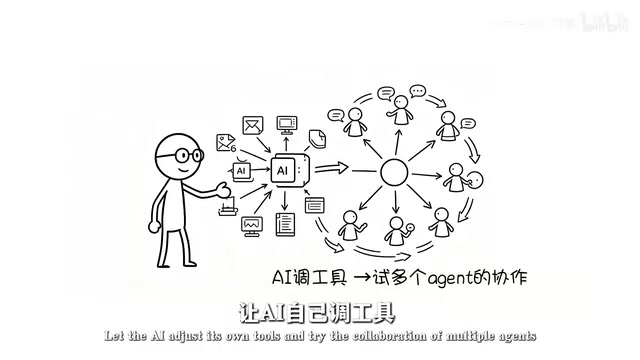
ReAct (Reasoning + Acting) is an agent reasoning framework proposed by a Google research team in 2022. Its core idea is to have the LLM alternate between outputting "Thought" steps and "Action" steps during its response: first reason about what should be done, then call an external tool (such as a search engine, code interpreter, or database query) to get a result, then continue reasoning based on that result — repeating until a final answer is reached. This "think–act–observe" loop enables models to handle complex tasks requiring multiple steps and multiple tools. It serves as an important design foundation for major agent frameworks today, including LangChain, LlamaIndex, and AutoGen.
Multi-Agent collaboration takes this further by distributing tasks across multiple specialized agents — for example, one agent handles research, another writes code, and a third reviews the output, all orchestrated by a coordinator agent. This architecture is more efficient than a single agent for long-horizon, cross-domain tasks, and is the core capability offered by frameworks like AutoGen and CrewAI.
Why This Roadmap Is Worth Following
The greatest strength of this learning path is that it's outcome-oriented, with deliverables at every step. It sidesteps the trap beginners most commonly fall into — diving headfirst into the deep theoretical waters of model training — and instead builds progressively from prompt engineering to RAG to Agents, with a shippable, monetizable project at each stage.
One caveat worth noting: phrases like "get job-ready in three months" and "companies will compete for you" carry obvious motivational flair. Actual learning pace varies from person to person, and whether you're ready for a role also depends on project depth and hands-on experience. Treating this as a clear skills map rather than a guarantee of success is the more grounded approach.
For anyone looking to break into AI application development, rather than agonizing over where to start, just follow this "Prompts → RAG → Agent" thread and start building. Making your first working tool is almost always worth more than reading ten tutorials.
One-line Summary
A three-stage LLM learning roadmap — Prompts → RAG → Agent — with a monetizable hands-on project at every step.
Paragraph Summary
This article outlines a three-stage LLM application learning roadmap designed for complete beginners. Stage one covers prompt engineering and API calls, culminating in a viral copywriting generator. Stage two introduces RAG (Retrieval-Augmented Generation), vector databases, and Agent fundamentals, with the goal of building a knowledge base Q&A assistant. Stage three goes deep into Agent development — covering the ReAct reasoning framework and multi-agent collaboration — enabling you to independently build intelligent agents or draft enterprise AI implementation plans. The roadmap's key strength is its outcome-driven structure, with a deliverable at each stage, effectively steering beginners away from the common pitfall of diving straight into model training theory. The article also cautions that "three-month fast-track" messaging is motivational in tone; this is best viewed as a clear skills map, not a guarantee of success.
Related articles
Three Stages of AI LLM Testing: A Practical Guide from Core Concepts to API Calls
A learning path for testers covering LLM fundamentals, prompt engineering, OpenAI SDK calls, API Key vs Token differences, streaming output, RAG, and Agent systems.
Vercel's Chief of Software Looks Back: The Evolution of Agent Building — From Multi-Agent Chains to File System Agents
Vercel's Chief of Software Andrew recaps the agent-building journey at AI Engineer: from giant prompts to multi-agent chains, monolithic memory, file system agents, and the open-source EVE framework.
Tencent's Open-Source BSK in Action: Letting AI Take Over Your Already-Logged-In Browser
Tencent's open-source BSK (Browser Skill Kit) lets AI take over your real, logged-in Chrome via WebSocket. We break down the architecture, setup, and three key pitfalls from real-world testing.