3AM Super Intelligence: How an AI On-Call Engineer Tackles Production Incidents

3AM launches a locally deployable AI on-call engineer focused on root cause investigation and fix rehearsal.
3AM Super Intelligence launched an AI on-call engineer on Product Hunt covering root cause investigation, fix rehearsal, and one-click Slack resolution, running entirely inside the user's network. Targeting systems "you can't rewrite," it advances AI suggestions into validated actions while leaving final decisions to humans. Limitations include an unspecified permission model and early community validation.
Production goes down, and getting woken up at 3 AM is a nightmare for many engineers. 3AM Super Intelligence launched an AI on-call engineer on Product Hunt, touted to investigate root causes, rehearse fixes, and resolve incidents with one click in Slack — all while running entirely inside your own network. The product received 76 upvotes and ranked 7th, landing at the intersection of developer tools and AI. What it aims to solve are the systems "you can't rewrite" — legacy systems, monoliths, and core paths where one change affects everything.
From Alert to Closure: What 3AM Solves
In a traditional on-call workflow, after being woken up, a person has to do three things: locate the problem, validate the fix approach, and execute the change. 3AM breaks this workflow into steps where AI can intervene. According to the official description, it first conducts root cause investigation, then rehearses the fix in a safe environment, and finally completes incident resolution through a one-click action in Slack. This means the on-call engineer doesn't have to log into a bastion host, dig through logs, and manually run commands while half asleep — instead, they first review the AI's investigation conclusions and rehearsal results, then decide whether to hit confirm.
The key to this design is the word "proven." It doesn't promise that AI will automatically fix every incident, but emphasizes that the fix has been validated through rehearsal. For production systems, this distinction matters: an unvalidated fix action is as dangerous as an untested database migration.
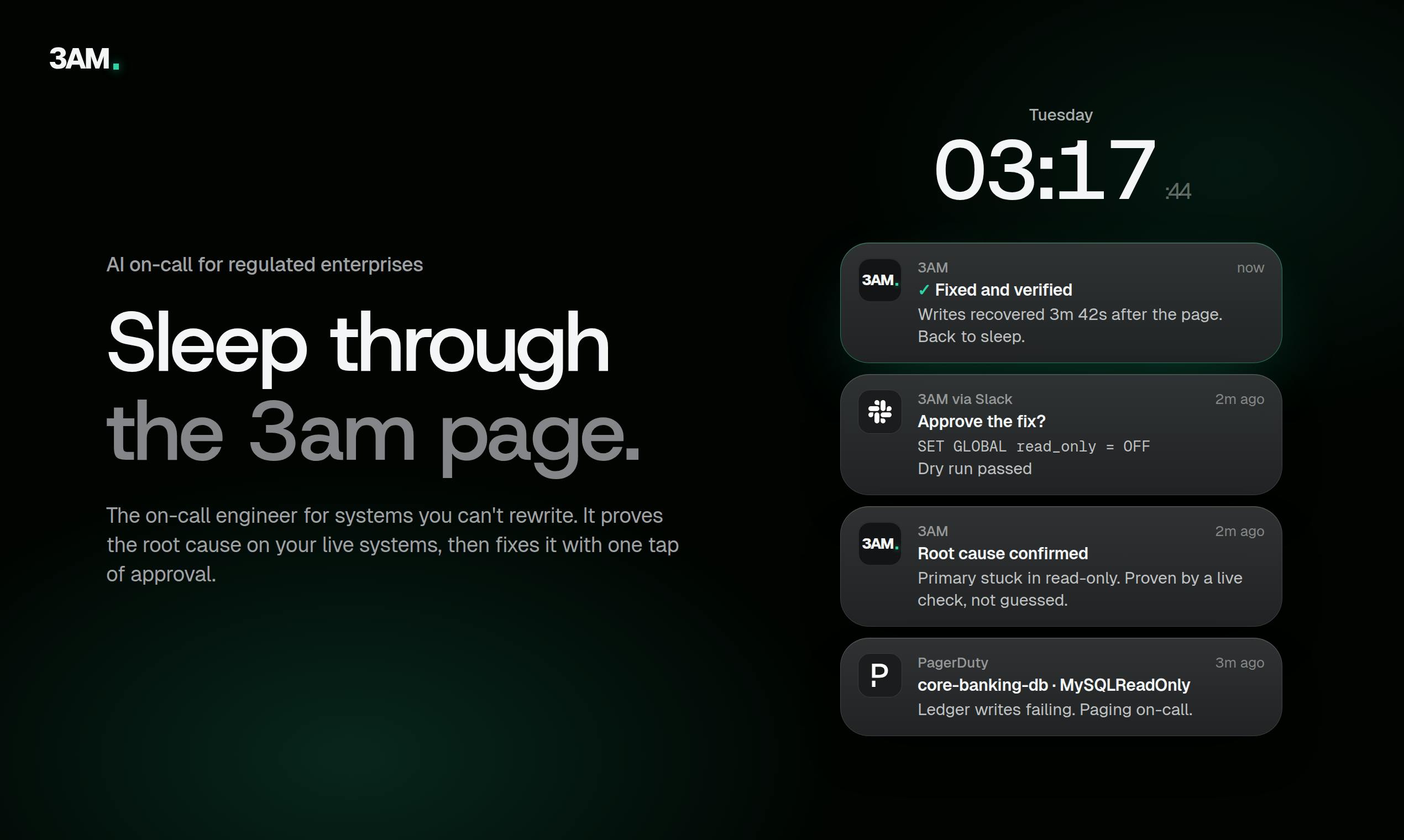
Root Cause investigation (root cause analysis) refers to the technical process of working backward from alert symptoms along metrics, logs, distributed tracing, and change records to identify the source of the failure. Traditionally it relies on human experience and predefined rules, and often consumes the majority of incident handling time; tools like 3AM instead use large models to perform correlational reasoning across multiple signal sources, producing candidate root cause hypotheses with evidence chains. Because model outputs are uncertain, engineering practice typically requires cross-validation with observability data and fallback through canary or rollback mechanisms, avoiding treating probabilistic inferences as deterministic conclusions directly applied to production changes.
Why "Not Rewriting the System" Is a Real Need
The product positioning includes a very blunt line: for systems you can't rewrite. This hits the current reality of many teams. Not every system can be torn down and rebuilt; a large amount of enterprise core logic runs in services accumulated over years, where rewriting is costly, risky, and the business can't wait. Such systems often also have incomplete observability — messy log formats, missing metrics, broken call chains — making them precisely the scenarios that most need someone on duty and are hardest to automate.
3AM chooses to enter from here rather than building an observability platform for new systems, which is a pragmatic differentiation. New products can natively integrate OpenTelemetry, but old systems can only rely on AI to understand existing signals. This also explains why it emphasizes running "from inside your own network" — for legacy systems that cannot go to the cloud, data egress itself is a red line.
Legacy system generally refers to a system that has run for many years and still supports core business but has an outdated tech stack, missing documentation, and original developers who have largely left. Such systems are characterized by changes that affect the whole system and are difficult to replace directly. In contrast, OpenTelemetry is an open observability standard promoted by the Cloud Native Computing Foundation, unifying data collection protocols for metrics, logs, and distributed tracing, so new systems can obtain structured telemetry data upon integration. Legacy systems were often built before the standard existed, with varying log formats and incomplete instrumentation, so AI is needed to reconstruct runtime state from unstructured signals — exactly the technical gap 3AM targets.
The Pros and Cons of One-Click Slack Actions
Converging incident handling into Slack makes the interaction very smooth and saves the cost of switching back and forth between multiple consoles. But one-click actions also raise approval boundary questions: who has permission to click this button? Does a rehearsal-approved plan mean it can be executed unconditionally? The official materials do not elaborate on the permission model and rollback mechanism, which will be unavoidable details in actual deployment.
For high-risk changes, a reasonable expectation is that AI handles investigation and rehearsal while humans make the final decision. 3AM places the confirmation action in Slack, effectively leaving decision authority with humans — this design direction is correct. But if teams want unattended nighttime operations where AI directly handles low-risk incidents, a clearer automation tiering strategy is needed.
Fix rehearsal (rehearse the fix) refers to drilling the fix steps in an isolated environment according to the actual execution steps, observing their impact on system state, dependent services, and data, so as to discover side effects before changing production. It differs from traditional change approval in that approval evaluates the change plan submitted by humans, while rehearsal tests the actual effects produced by the actions. Configuration drift between the rehearsal environment and production directly affects the credibility of conclusions, so rehearsal results only reduce rather than eliminate risk and still require rollback plans and execution window controls.
Its Position in the AI On-Call Race
AI on-call is becoming an independent category, and players share a common approach: use large models to read alerts, logs, and change records and produce root cause hypotheses. 3AM's differentiators concentrate in two places: first, fix rehearsal, advancing from "suggestion" to "validated action"; second, in-network deployment, catering to teams sensitive to data boundaries. Whether these two points constitute a sufficiently deep moat depends on the reliability of the rehearsal mechanism and the breadth of integration with heterogeneous systems.
From Product Hunt feedback, 76 upvotes, 4 comments, and 7th place indicate it has attracted some attention but is far from large-scale discussion. With relatively few comments, community validation is still early. For teams focused on AI operations, it is worth putting on a watchlist, with particular attention to how it demonstrates consistency between rehearsal results and actual execution.
AIOps (intelligent operations) is an operations practice that introduces machine learning and automation into alert aggregation, anomaly detection, and root cause localization, initially dominated by rules and statistical models. After the rise of large models, a new generation of AI on-call tools layers natural language understanding and reasoning on top, able to directly read alert text, log snippets, and change tickets. A common difficulty in this category is evaluation: incident samples are scarce and scenarios heterogeneous, making it hard to establish a unified benchmark, so vendors mostly use demo cases and rehearsal mechanisms to prove reliability, while real effectiveness still needs long-term production data validation.
Who Should Pay Attention
Teams with legacy systems, heavy on-call pressure, and no ability to rebuild from scratch are 3AM's most direct target users. Organizations already using Slack as their operations collaboration entry point will have lower integration costs. Conversely, if the system is already fully containerized, has mature observability, and changes go through standard pipelines, existing toolchains may already cover most needs.
The question 3AM raises is very specific: when an incident happens at 3 AM, can AI first conduct investigation and validation for humans and leave the decision to them? The answer to this question will determine whether AI on-call engineers are a real need or just another tool with a cool demo and light real-world adoption.
One-line Summary
3AM launches a locally deployable AI on-call engineer focused on root cause investigation and fix rehearsal.
Paragraph Summary
3AM Super Intelligence launched an AI on-call engineer on Product Hunt, covering three stages: root cause investigation, fix rehearsal, and one-click Slack resolution, while emphasizing that it runs entirely inside the user's own network. The product targets systems "you can't rewrite" — legacy systems, monoliths, and core paths — which often have incomplete observability and are precisely the ones that most need someone on duty. Fix rehearsal is its core differentiator, advancing AI suggestions into validated actions while leaving final decision authority to humans. The article also notes its limitations: the permission model and rollback mechanism are not detailed in official materials, and with only 76 upvotes and 4 comments on Product Hunt, community validation is still early. Whether it constitutes a moat depends on rehearsal reliability and the breadth of integration with heterogeneous systems.
Related articles

Amphibious Transforming Drone: Beyond 100x Power Savings, What Are the Real Needs?
Is the amphibious transforming drone just a gimmick? Starting from the 100x power difference of the M4 Morphobot, explore real application scenarios and thesis topic ideas, analyzing boundary conditions where pure drones and pure ground robots both fail.

Warhound Raises $200 Million: Genetically Engineered "War Dogs" Paired with Anduril Gear
Warhound raises $200M, backed by Ben Lamm and Palmer Luckey, to genetically engineer dogs for military and law enforcement use and equip them with Anduril gear. This article analyzes its technology direction, funding logic, and ethical controversy.

Claude API Comes to Google Cloud: IAM Integration and SDK Access Guide
Anthropic hosts the full Claude API on Google Cloud with IAM-controlled permissions and unified billing. This guide covers the Vertex AI and Anthropic-hosted entry points, IAM role configuration, and SDK access.