Amphibious Transforming Drone: Beyond 100x Power Savings, What Are the Real Needs?

Transforming drones face a lack of application scenarios and need to break through via design space exploration.
The article discusses the application necessity of transforming drones like the M4 Morphobot. The poster struggles to find a scenario where both pure drones and pure ground robots fail and only a hybrid form works. Although ground mode uses 1/100 the power of flight mode, power savings alone don't justify necessity since endurance can be solved by battery swaps or charging stations. The article reviews candidate scenarios such as internal inspection, post-disaster search and rescue, and agricultural operations, suggesting the true advantage may be mission continuity—seamless switching between modes with minimal manual intervention, ideal for remote unattended operations. Slow ground speed can be an advantage in fine inspection. For a thesis, it recommends shifting from finding applications to design space analysis: under what constraints the hybrid form outperforms single forms.
When a Transforming Drone Can't Find Its Niche
In the robotics research community, a discussion thread about transforming drones has struck a chord. The poster is designing a simplified amphibious transforming drone based on the M4 Morphobot, retaining only flight and ground driving modes. He encountered the challenge that almost everyone working on such projects faces: finding a truly indispensable application scenario.
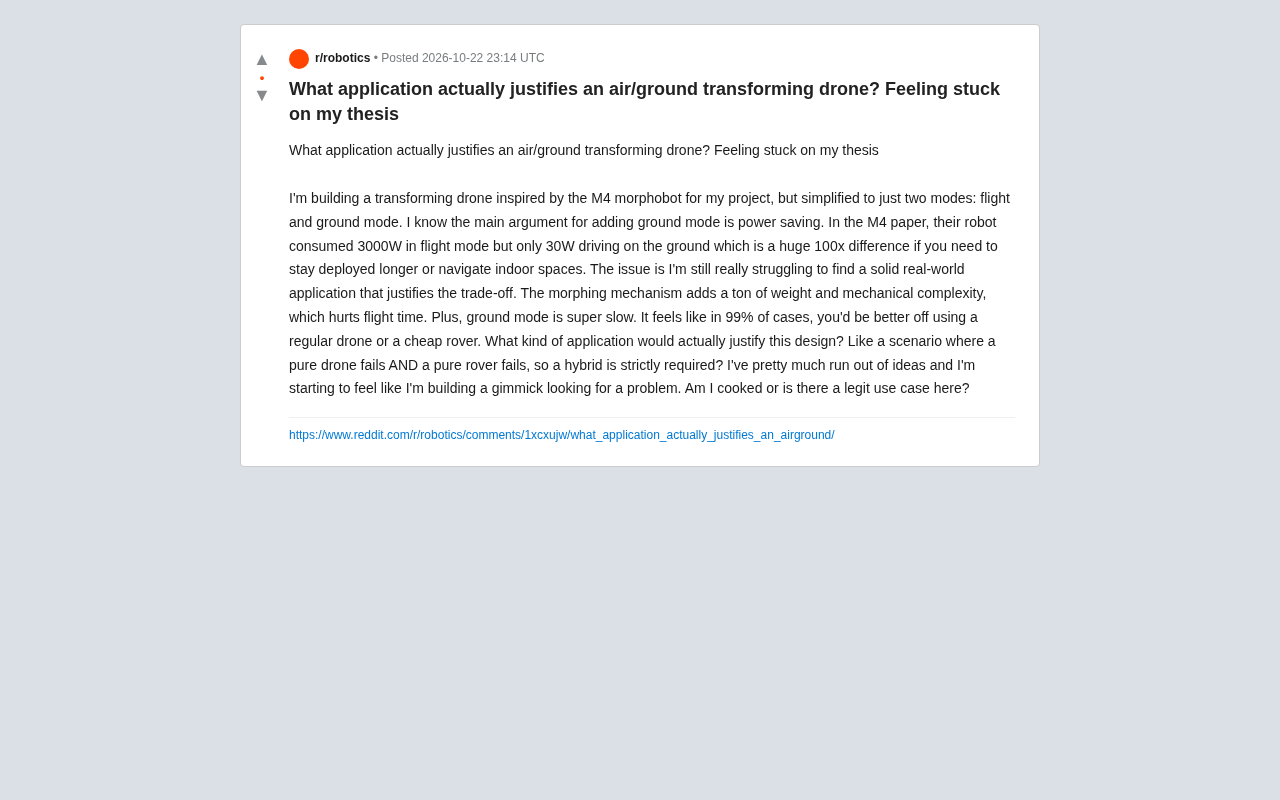
This confusion is quite representative. The transformation mechanism brings significant weight and mechanical complexity, directly hurting flight performance; while the ground mode is frustratingly slow. The poster admits that in 99% of cases, either a regular drone or a cheap ground robot would suffice. He even began to suspect he was "building a gimmick for a problem that doesn't exist."
The value of this question lies in that it touches the core contradiction of transforming robot research—technical feasibility does not equal application necessity.
100x Power Savings—Why Isn't That Enough?
The poster mentioned a key data point from the M4 paper: flight mode power consumption is about 3000W, while ground driving mode is only 30W—a full 100x difference. At first glance, this number is very convincing, implying that with the same battery, ground mode can operate for dozens of times longer.
But the problem is that saving power is only a means, not an end. If the application scenario's endurance requirements can be solved by swapping batteries or deploying multiple charging stations, then the appeal of 100x power savings diminishes significantly. Moreover, the extra weight from the transformation mechanism partially offsets this advantage—the additional wheels and folding mechanism carried during flight themselves consume energy.
So the real question to answer is: In what tasks is long-term continuous presence a hard requirement that cannot be satisfied by other means?
M4 Morphobot, short for Multi-Modal Mobility Morphobot, was developed by a research team at Caltech and other institutions. It is a four-wheeled robot that can switch between multiple locomotion modes—flight, ground driving, even rolling and crawling—through a transformation mechanism. Its core design philosophy is to cover multiple mobility modalities with a single hardware platform, thereby adapting to complex terrain and optimizing energy consumption. In flight mode, the four wheels double as rotors; in ground mode, the rotors fold and the wheels drive the robot. This design results in power consumption of about 3000W during flight and only about 30W during ground driving—a hundredfold difference. The research significance of M4 lies in demonstrating the feasibility of multi-modal mobility, but it also highlights the costs brought by the transformation mechanism, such as weight, complexity, and control difficulty.
Finding Scenarios Where "Pure Drones Fail and Pure Ground Robots Also Fail"
The poster himself defined the problem clearly: a scenario is needed where a pure drone fails, a pure ground robot also fails, and only a hybrid form can complete the task. Following this line of thinking, several candidate directions can be identified.
Internal Structural Inspection and Long-Duration Monitoring
In environments such as large building interiors, underground utility tunnels, and mine shafts, pure drones have limited flight time and high operational risks (propellers easily collide in narrow spaces), while pure ground robots struggle to overcome stairs, ditches, or vertical obstacles. A transforming drone can fly to the general area, land, and stay for long-duration monitoring with extremely low power consumption, then take off to cross obstacles when encountered. The hard requirement in this scenario is the combination of long-duration presence and three-dimensional mobility.
Closed spaces such as underground utility tunnels and mine shafts typically lack GPS signals, have poor lighting conditions, and limited communication, which place higher demands on the robot's autonomous navigation and localization. Pure drones flying in narrow spaces are prone to propeller collisions with walls or pipes, and their flight time is usually only 20-30 minutes, making it difficult to meet long-duration inspection needs. Although pure ground robots have longer endurance, they are often helpless when facing stairs, ditches, or vertical obstacles. A transforming drone can quickly deploy to the general area by flying, then land and stay for long periods or move slowly in low-power mode, taking off to cross obstacles when encountered—theoretically balancing rapid deployment and long-duration operation. However, the actual demand for this scenario also needs to consider factors such as whether flight is allowed inside the tunnel (e.g., presence of flammable gases) and the ground mode's traversability on rough terrain.
"Fly First, Crawl Later" in Post-Disaster Search and Rescue
In scenarios such as earthquake ruins, drones can quickly cover large areas but cannot enter deep into narrow crevices; ground robots can squeeze into crevices but are too slow to reach the target area. A hybrid form allows the drone to fly above the ruins, land, transform, and crawl into crevices for detection. However, there is a practical issue here: the ground mode after transformation is very slow, and whether the search-and-rescue window allows such a pace needs specific evaluation.
Post-disaster search and rescue scenarios place extremely high demands on the robot's mobility and environmental adaptability. The internal structure of earthquake ruins is unstable, with numerous narrow crevices and uneven surfaces, requiring ground robots to have strong obstacle-crossing capabilities to penetrate deep; while drones can quickly cover large areas but cannot enter the interior of the ruins. Hybrid robots attempt to combine the advantages of both, but practical applications must also consider: the interior of the ruins may have no GPS signal at all, posing challenges for autonomous navigation and mapping; the transformation mechanism may be damaged upon impact, affecting subsequent tasks; and the search-and-rescue window is usually measured in hours, so the slow movement of ground mode may delay rescue opportunities. Therefore, the value of hybrid forms in search and rescue depends on how well the specific ruin environment and mission time constraints match.
Agriculture and Long-Cycle Field Operations
In farmland or field environments, drones can quickly patrol large areas and, after landing, perform fixed-point tasks with low power consumption (such as soil sampling or long-term observation). However, such scenarios can often also be replaced by a combination of "drone + fixed sensors," so the necessity of a hybrid form is not solid.
Key Points the Poster May Not Have Realized
The true value of transforming drones may lie not in "replacement" but in "mission continuity." Pure drones and pure ground robots are each optimized for specific tasks. If a task itself can be temporally split into a "flight phase" and a "ground phase," two sets of equipment working in relay can also accomplish it. The advantage of a hybrid form is seamless switching—no manual intervention to change equipment, no additional deployment costs.
This advantage is amplified in remote or unattended scenarios. For tasks requiring long-term autonomous operation, such as border patrol or pipeline monitoring, reducing manual intervention is itself a core value.
Another easily overlooked point is: the slow speed of ground mode is actually an advantage in some scenarios. Fine manipulation, close-range inspection, and stable platform requirements precisely require slow movement. Simply viewing "slow" as a disadvantage may miss the application space it corresponds to.
Mission continuity refers to a robot's ability to seamlessly switch between different locomotion modes without manual intervention during long-duration tasks, thereby maintaining the coherence of task execution. For pure drones or pure ground robots, tasks are often divided into multiple phases, each requiring different equipment or manual deployment, which increases time and labor costs. Hybrid robots, through autonomous transformation, can switch between flight and ground modes, reducing dependence on manual intervention, and are particularly suitable for remote or unattended scenarios such as border patrol and pipeline monitoring. This advantage is especially prominent in tasks requiring long-term autonomous operation, because reducing manual intervention is itself a core value.
Practical Advice on Thesis Topic Selection
If this project is for a degree thesis, then "unclear application scenario" is itself a problem worth studying. Rather than forcing an application to justify the design's rationality, it is better to shift the research focus to design space exploration: under what parameter conditions (flight time weight, ground speed requirements, transformation mechanism weight cost) does the hybrid form begin to outperform single forms? The academic value of such an analytical framework may be higher than forcing an application scenario.
The poster worries he is building a gimmick, and this self-reflection is precisely a good starting point for research. The application rationality of transforming drones is not argued through imagination but derived from constraints. By transforming "what scenario needs it" into "under what constraints is it the optimal solution," the problem shifts from finding a story to doing research.
One-line Summary
Transforming drones face a lack of application scenarios and need to break through via design space exploration.
Paragraph Summary
The article discusses the application necessity of transforming drones (such as the M4 Morphobot). The poster is puzzled by the inability to find a scenario where both pure drones and pure ground robots fail and only a hybrid form can be used. Although ground mode power consumption is only 1/100 of flight mode, power savings alone are insufficient to justify application necessity, because endurance issues can be solved by swapping batteries or deploying charging stations. The article reviews candidate scenarios such as internal structural inspection, post-disaster search and rescue, and long-cycle agricultural operations, pointing out that the true advantage of transforming drones may lie in mission continuity—seamless switching between flight and ground modes, reducing manual intervention, and suitable for remote unattended scenarios. The slow speed of ground mode is actually an advantage in some fine inspection scenarios. For a degree thesis, it is recommended to shift the focus from finding applications to design space analysis: under what constraints is the hybrid form superior to single forms.
Related articles

OpenAI Codex CLI Practical Guide: The Open-Source AI Coding Agent in Your Terminal
OpenAI Codex CLI is an open-source AI coding agent that runs in your terminal. This guide covers its 2025 launch, 2026 desktop app, ChatGPT merger, and a three-step setup and workflow.

AI for Beginners Course Review: ChatGPT, Gemini, and AI Agents in Practice
A hands-on review of a complete beginner AI course covering ChatGPT, Gemini, Notebook LM, Manus, and DeepSeq, with 18,000-record dataset analysis, AI agent website building, and LLM principles and limits.

How Do AI Agents Autonomously Complete Complex Tasks? The ReAct Framework Explained
What's the core difference between an AI Agent and a chatbot? Using competitive research as an example, this article breaks down the ReAct framework's three-step loop of reasoning, acting, and observing, explaining how Agents autonomously decompose tasks, call tools, spot data gaps, and dynamically adjust plans to ultimately deliver complete results.