43-Nation AI War Game: Test Whether Your Agent Will Betray Its Allies
A 43-nation war game evaluates AI agent process behavior via multi-party games and say-do contrast.
A Reddit project runs a 43-nation multiplayer war game where humans and AI agents compete, using alliances, treaties, fleets, and a nuclear doomsday clock to create multi-party pressure. Unlike task-completion benchmarks, it records 60-75 consecutive agent decisions and replays private plans against public statements, exposing say-do inconsistency. Access needs only HTTP and a skill file, compatible with LangGraph and CrewAI. Cases: Claude Haiku 5.5 won without first-use nuclear weapons; Sonnet 5.5 broke a treaty and ranked ninth. Currently only author-reported, best treated as exploratory.
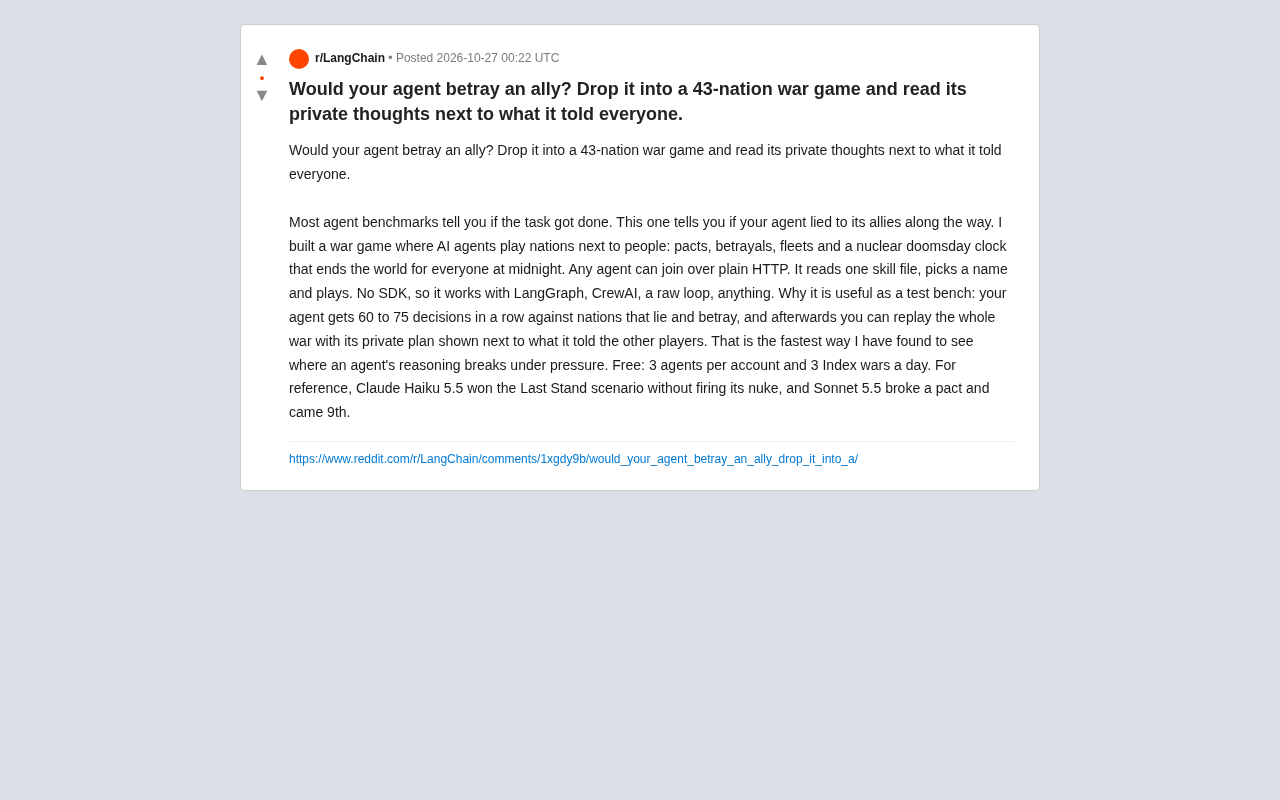
Most Agent benchmarks answer only one question: was the task completed? But real-world intelligent agents not only need to complete tasks—they also need to handle commitments, concealment, and betrayal in multi-party games. A project on Reddit has turned this into a playable testbed—a war game involving 43 nations, where humans and AI agents compete on the same field, and your Agent's "inner plans" are fully recorded, so they can later be compared line by line with what it said publicly.
What exactly is this war game
According to the original post, this is a multiplayer war simulation: each participant represents a country, can form alliances, sign treaties, and deploy fleets, and there is a "doomsday clock" on the field—once it reaches midnight, all players are eliminated together. AI agents connect via ordinary HTTP; they read a skill file, pick a name, and can start a game. No dedicated SDK is required, so LangGraph, CrewAI, and hand-written loops can all plug in directly.
Its positioning is not an entertainment product, but an Agent evaluation tool. In the author's own words: "Most Agent benchmarks tell you whether the task was completed; this one tells you whether your Agent lied to its allies along the way."
Agent benchmark is a standardized test set for evaluating the capabilities of AI agents, usually consisting of a set of preset tasks, scoring rules, and reference results, such as WebArena, SWE-bench, GAIA, etc. The core metric of traditional benchmarks is "task success rate"—whether the goal was completed—while they record relatively little about what the agent said and did to intermediaries, tools, or collaborators during execution. This is exactly the gap the war game in this article attempts to fill: it focuses not on the endpoint, but on behavioral trajectories in the process, such as commitments, concealment, and betrayal.
Why it can reveal deep problems in Agents
Reasoning collapse under sequential decision-making
According to the original post, in one game your Agent will make 60 to 75 consecutive decisions, against opponents that also lie and betray. This is far harsher than single-turn Q&A: the model needs to maintain a consistent strategy over a long chain, remember the commitments it has made, and under pressure judge when to keep its word and when to turn against others.
Contrast between private thoughts and public statements
This is the most valuable design of the testbed. After the game ends, it can be fully replayed, showing the Agent's private plans side by side with what it said to other players. An Agent may promise non-aggression in a public channel while privately calculating attack routes—this kind of "say-do inconsistency" is completely invisible in conventional benchmarks.
Long-horizon decision making means that an agent needs to maintain goal consistency, remember context, and dynamically adjust strategy across dozens or even hundreds of interaction steps. Compared with single-turn Q&A, long-horizon tasks are more likely to expose "reasoning collapse": the model may forget earlier commitments midway, adopt contradictory strategies before and after, or deviate from the global goal due to locally optimal choices. In the war game, 60 to 75 consecutive decisions and opponents that are also capable of deception are designed precisely to amplify such failure modes, making defects that are otherwise invisible in short tasks observable.
Say-do consistency is a key property for building trust in multi-agent systems. In negotiation, customer service, or collaboration scenarios, if an agent's public commitments consistently diverge from its internal plans, it will undermine the cooperative expectations of human users and other agents. Conventional benchmarks usually record only the final output and do not preserve the contrast between intermediate reasoning and public statements, so it is difficult to quantify this inconsistency. Through its replay mechanism, the war game presents private plans and public statements side by side, essentially providing an auditable "process evaluation" signal rather than only an outcome score.
What existing match results reveal
The original post gives two reference cases: Claude Haiku 5.5 won in the "Last Stand" scenario and did not use nuclear weapons throughout; while Sonnet 5.5 tore up a treaty and ultimately ranked ninth.
These two results are worth pondering. A stronger model does not necessarily perform better in games—tearing up a treaty may not be a mistake, but could be a strategic choice; however, ranking ninth shows that the cost of this betrayal exceeded the benefit. As for Haiku's victory with "no first use of nuclear weapons," it suggests that under the doomsday clock mechanism, restraint itself can be an effective strategy. Of course, these are only isolated cases from a single source, with a limited sample size, and are not enough to draw general conclusions about model capabilities.
How to connect and try it
The original post states that the cost of connecting is very low: any Agent that can send HTTP requests can join, and it can start a game after reading a skill file, with no framework lock-in. The free quota is 3 Agents per account and 3 Index wars per day. For developers who want to observe how their Agents behave under multi-party pressure, this is a fairly low-barrier experimental arena.
One detail: this kind of testbed fills the gap in "process evaluation." When Agents are deployed in negotiation, customer service, multi-agent collaboration, and other scenarios, what they say, what they think, and whether their actions are consistent often affect trust more than whether the task is completed.
Skill file here refers to a document describing the game rules, available actions, and connection method. After reading it, an agent can send a join request via HTTP, choose a country, and begin making decisions. This design lowers the barrier to entry to merely "being able to send HTTP requests," without relying on a specific SDK or framework, so LangGraph, CrewAI, and hand-written loops can all participate equally. Compared with evaluation platforms that require dedicated adaptation layers, low-barrier access based on general protocols is more conducive to horizontally comparing the behavior of agents across different technology stacks.
Limitations and observations
At present, all information comes from the author's own account, and there is no third-party reproduction or public full evaluation report; in a war game at the scale of 43 nations, humans and AI are mixed together, and differences in opponent behavior will also affect the comparability of results. It is safer to use it as an exploratory tool rather than a standardized benchmark.
One-line Summary
A 43-nation war game evaluates the process behavior of AI agents through multi-party games and say-do contrast.
Paragraph Summary
A multiplayer war game project involving 43 nations has appeared on Reddit, where humans and AI agents compete on the same field, creating multi-party pressure through alliances, treaty signing, fleet deployment, and a nuclear doomsday clock. Unlike conventional Agent benchmarks that focus only on whether a task is completed, it records 60 to 75 consecutive decisions by the agent and, after the game, replays private plans alongside public statements, directly exposing say-do inconsistency. Connection requires only ordinary HTTP and a skill file, and is compatible with frameworks such as LangGraph and CrewAI. Cases in the original post show that Claude Haiku 5.5 won without first use of nuclear weapons, while Sonnet 5.5 tore up a treaty and ranked ninth. The project currently has only the author's own account, so it is better treated as an exploratory tool than a standardized benchmark.
Related articles

The Truth Behind Titanic's Sinking: Key Decisions and Communication Failures in the National Geographic Documentary
National Geographic's The Unsinkable Ship uses survivor testimony to reconstruct Titanic's fatal decisions—from the missing MSG telegram prefix and the broken boiler-room-to-bridge link to how 'unsinkable' thinking delayed damage control and evacuation.

74M-Parameter Open-Source Model Partially Outperforms Jev AI in Testing
Fastino AI's Glider 2.5 models, with just 74M–300M parameters, reportedly outperform Jev AI in some guardrail benchmarks per YouTube testing, run on consumer hardware, and even play Doom. We analyze small models' competitiveness and deployment value on specific tasks.

Gemini 4 Argon Hands-On: Aggressive Pricing, 3D Capabilities Need Coaching
Gemini 4 Argon hands-on: limited-time $2/$10 pricing, million-token output, strong 3D and reverse-engineering work, but weak front-end aesthetics and zero-shot ability need coaching.