48GB MacBook Local Benchmark: A Complete Look at 11 Categories of Cutting-Edge Open-Source AI Models

A 48GB M5 Max MacBook runs 11 AI model categories locally — Q&A and image gen ready, video and robotics still lagging.
This article systematically benchmarks 11 categories of frontier open-source AI models on a MacBook Pro with an M5 Max chip and 48GB unified memory, covering LLMs, Agents, generative models, visual perception, 3D reconstruction, video/world models, robot policies, medical AI, cybersecurity, and domain foundation models. Key findings: Q&A, Chinese image generation, TTS, object detection, and 3D reconstruction are local-ready within 20GB RAM; MoE models are significantly faster and leaner than dense models; Agents excel at bug fixing but struggle with multi-step web research; video generation is slow and world models only retain 5–10 seconds of context; robotics simulation closes the loop but needs fine-tuning for real hardware; medical models can assist but not replace clinicians.
Running a full suite of cutting-edge open-source AI models on a single laptop — that's the core challenge of this benchmark. The test machine is a MacBook Pro with an M5 Max chip and 48GB of unified memory, running sustained full-load workloads while recording throughput and latency throughout. Data never leaves the machine and works offline, which makes it a genuine privacy guarantee for sensitive use cases like internal documents, meeting recordings, and medical imaging.
This article covers real-world findings across 11 directions using a consistent framework: what the task is, where it's used, what performs well, a real-world example, and a one-line takeaway. Bottom line up front — Q&A/writing, image generation/TTS, detection, and 3D reconstruction are already local-ready; web research, video, and world models are still slow or unreliable; robotics and healthcare still have a ways to go before real-world deployment.
Large Language & Multimodal Models: The Brain of a Local Assistant
Large language models combined with multimodal models that can see and hear handle core tasks like Q&A, writing, and reasoning — ideal for scenarios where data must stay on-device, such as internal document Q&A, meeting transcription, and converting scanned documents to editable text.
30B-class MoE models are fast and memory-efficient on Mac. The Nemotron series delivers at least 150 tokens/second with around 18GB of memory usage — dense models of the same nominal size (e.g., Qwen3) are 4–5× slower. Long-context handling is also solid: all five questions were answered correctly in a 128K-token "needle in a haystack" test.
A concrete example: a scanned page of a research paper is converted to full-page Markdown by a vision-based OCR model in under 2.2 seconds. When the same image is passed to a segmentation model with the prompt "cat and remote control," it correctly segments two cats and two remotes in under 0.63 seconds. On speech recognition, the proper noun "Yunfan" in a meeting recording was correctly transcribed by a dedicated ASR model, while Whisper rendered it as a phonetically similar but wrong string of characters. Takeaway: Q&A, document reading, and speech recognition are already local-ready with memory usage under 20GB.
MoE Explained: MoE (Mixture of Experts) architecture is key to understanding why 30B-class models can run efficiently on local hardware. Unlike traditional dense models that activate all parameters on every inference pass, MoE splits the model into multiple "expert" sub-networks and only routes each forward pass through a small subset — typically 2 to 4 experts. This means a nominally 30B-parameter MoE model actually only does the computational work of a few billion parameters per inference, dramatically reducing memory bandwidth and compute requirements. The Nemotron series achieving 150+ tokens/second at just 18GB of memory is a direct result of this architecture. Apple's M-series unified memory — where CPU and GPU share the same physical memory pool — amplifies this advantage further: weights don't need to be shuffled between VRAM and RAM, resulting in higher bandwidth utilization. This is the fundamental reason why Macs are surprisingly competitive against discrete GPU machines for small-batch inference workloads.
Agent Models: Tool Calling and Automated Bug Fixing
Agent models don't just answer questions — they decide which tools to call, review the results, and determine the next step. Typical use cases include local web research, fixing bugs locally like Claude Code, and automated web navigation — all with code and screenshots staying on-device.
On the BFCL tool-calling benchmark, Qwen3 scored 83% and another model scored 81%, with output format being the biggest failure mode. Web research is a clear weak point — the same model improved from 1/15 correct to 7/15, while cloud-based models get full marks. Bug-fixing performance is impressive: across 14 problems, DevStral and Qwen3 each fixed 12, averaging under 97 seconds per problem.
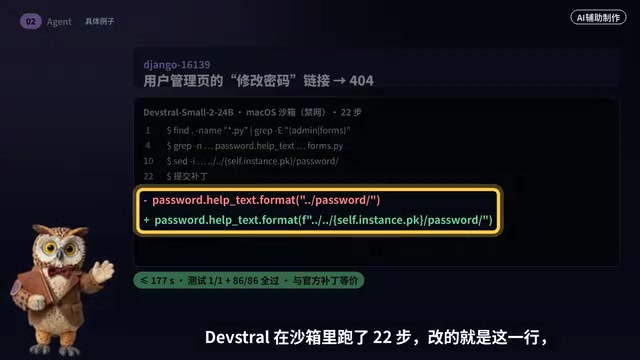
A Django bug causing a password reset link to return 404 was resolved by the model running 22 steps inside a sandbox. The final fix came down to a single critical line of code — done in under three minutes, with all tests passing. In a GUI Agent scenario, the model was given only screenshots and tasked with replying to an email. It independently executed 7 steps: scroll, open, click reply, type, and send. It succeeded on 9 out of 10 web tasks, with each step taking under 3 seconds. Takeaway: tool calling and bug fixing are already usable; multi-step web research is not yet reliable.
BFCL Explained: BFCL (Berkeley Function-Calling Leaderboard), published by UC Berkeley, is the most widely cited benchmark for tool-calling ability. It tests whether a model can correctly select a function, fill in parameters, and output a call instruction in the specified JSON format given a set of function definitions — this is the foundational "decide-then-execute" capability in any Agent pipeline. The "output format" failures mentioned in the test refer to cases where the model's logic is correct but the output contains issues like misspelled parameter names, wrong data types, or unnecessary nesting. These errors are nearly harmless in plain-text Q&A but cause entire steps to fail in Agent contexts that require machine-parsed call instructions. Web research tasks show such a large performance gap because they require the model to maintain contextual judgment across multiple rounds of search-read-re-search loops. Local models accumulate errors rapidly across steps due to inference speed and context window management constraints.
Generative Models: Images, Edits, TTS, and Singing
This category covers text-to-image, instruction-based image editing, speech synthesis, and even singing — useful for posters, signage, product imagery, voiceovers, and background music.
Chinese text rendering in generated images was a key test. ERNIE Image Turbo scored perfectly on 80 Chinese signage test cases, each taking under 23.2 seconds. FLUX 2 client was the fastest at under 5 seconds per image, but frequently produced garbled Chinese text. In the editing tests, changing a sign reading "山间茶舍" (Mountain Tea House) to "云上书店" (Cloud Bookstore), Qwen Image Edit got it right while another model produced garbled characters.
On TTS, Qwen TTS achieved a voice cloning similarity score of 0.96 with a first-packet latency under 0.1 seconds, and correctly handled polyphone words like "银行行长" and "长期." MiniMax Music can even sing Chinese lyrics. Takeaway: Chinese image generation, image editing, and TTS are already usable; editing is somewhat slow; real-time voice conversation is currently English-only.
Visual Perception & 3D Reconstruction: Detection, Mapping, and Driving
This category covers three tasks: bounding-box object detection in images, 3D scene reconstruction from a set of photos, and road scene understanding for autonomous driving. Applications include quality control/retail, AR/security, robotics, and long-tail autonomous driving analysis.
Detection model YOLO26X achieves a mAP of 0.622 at 40+ frames per second — real-time capable. A single street scene image yielded 11 detected objects, including a clock on a wall. For 3D reconstruction, DA3 processed 24 viewpoints in under 1.8 seconds; given 32 frames of footage captured while walking through a room, a single forward pass reconstructed a point cloud and camera trajectory with 6.5 cm error.
The driving model correctly inferred "slow down for red light" in a nighttime red-light scenario. Average trajectory error across 6 scenes was 4.93 meters — half the long-range extrapolation baseline. Takeaway: detection and 3D reconstruction are already local-ready; driving models run but still exhibit "correct reasoning, wrong trajectory" failures.
mAP and Real-Time Detection Explained: mAP (mean Average Precision) is the standard evaluation metric for object detection, measuring a model's precision and recall across all categories at different IoU thresholds. Simply put: the closer to 1, the fewer misses and false positives. A mAP of 0.622 on a general detection benchmark is a strong result, indicating the model reliably detects most common objects with accurate bounding boxes. A throughput of 40 FPS meets the engineering threshold for real-time video stream processing, making it suitable for direct integration with surveillance cameras or industrial cameras for online quality inspection without cloud offloading. DA3's single-pass reconstruction (no iterative optimization — results come directly from one forward pass) represents a major recent advance in 3D vision. Traditional NeRF-based methods require minutes to hours of gradient optimization per scene, while feed-forward networks reframe reconstruction as a single neural network inference — a speed difference of hundreds of times, at the cost of slightly lower accuracy on unseen scenes.
Single-Image to 3D: E-Commerce and AR Asset Generation
Generating a 3D model from a single photo is hard because the photo doesn't show what's behind the object. Applications include e-commerce product visualization, game and AR assets, and pre-modeling for robotic grasping.

Triple S2 produces a rough mesh in as little as 2.2 seconds but mirrors the front face onto the back. SAM3D produces the best silhouette quality. Another model takes about a minute to output a result with basic PBR textures using under 7GB of memory. When rotating a cat model to view the back, some models convincingly wrap the fur pattern around. Thin, symmetrical objects remain a challenge — vases are often flattened, with only SAM3D producing upright, symmetrical results. Takeaway: rotatable 3D previews are already good enough; thin, symmetrical objects are still a weak spot.
Video & World Models: Short Clip Generation and Interactive Simulation
Video generation takes an image and a text prompt and predicts the next 2–3 seconds of footage. Use cases include short video content, storyboard previsualization, and robot training data. LTX has 22 billion parameters but only uses 14GB — generating roughly one second of video every 13 seconds. Of five models tested on the prompt "two cats stretching and yawning," only Cosmos Predict produced an actual yawn — though the slowest model took nearly ten minutes for a three-second clip.
World models emphasize interactivity: press a key and the model imagines the next frame step by step. DIAMOND runs at 31.7+ FPS — twice real-time — but the image degrades to a blur after a few seconds. VPoint originally required CUDA but was successfully ported to Mac, running at 23+ FPS. Press W to move forward, click the left mouse button and a fireball appears. Takeaway: short clips can be generated locally but slowly; world models are playable but only remember 5–10 seconds — not enough for long-horizon simulation.
Robot Policy Models: From Perception to Action in a Closed Loop
Robot policy models watch a camera feed, understand instructions, and directly output robot arm actions. More advanced models like WAM simultaneously imagine future frames and actions, making it easier to debug failures.
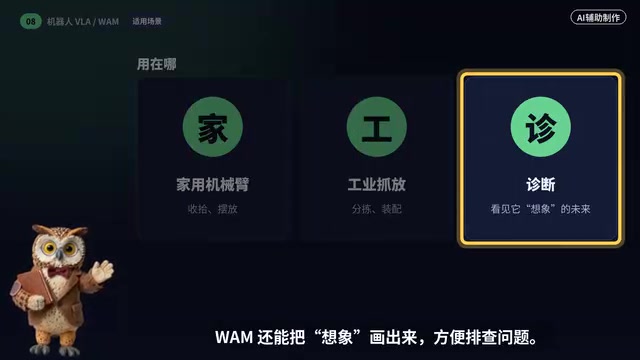
The LIBERO simulation benchmark ran successfully on Mac for the first time with long-horizon tasks: GR00T achieved 100%, WAM achieved 98%, and even a 2.8B-parameter VLA small model reached 96%, with each action taking under 195 milliseconds. In a task requiring placing two moka pots on a stove, the best-performing model placed both correctly in 362 steps, while another hovered above the second pot until timeout. WAM's "imagine first, then act" approach comes at a cost — it generates actions while imagining, with each block taking up to ~63 seconds. Takeaway: pick-and-place in simulation is already closed-loop; second-grasp tasks are still a weak point; moving to real hardware requires fine-tuning.
Medical Models: Capability Demonstration, Not Diagnosis
Important disclaimer upfront: all data used is publicly available — this is a capability demonstration, not clinical diagnosis. Four areas were tested: diagnosis, Q&A, segmentation, and clinical documentation.
For diagnosis, on fundus image referral classification, MedSigLIP with a probe reached AUC 0.94 — suitable only as a second reader. For Q&A, general-purpose Qwen3 answered 189 out of 200 Chinese and English medical multiple-choice questions, clearly outperforming smaller medical-specialized models. For segmentation, MedSAM propagated an entire kidney lesion on a CT scan from a single drawn bounding box, with the longest diameter of 58.6 mm matching the physician's measurement — each lesion processed in under 0.3 seconds. For clinical documentation, a doctor-patient dialogue was converted directly into a SOAP note with all 6 elements correct and zero fabrications. The word error rate for physician dictation transcription was just 2.3%. Takeaway: segmentation, transcription, and note generation are approaching usable quality; imaging diagnosis can only serve as a second reader.
AUC and SOAP Explained: AUC (Area Under the ROC Curve) is the standard evaluation metric for binary medical diagnostic tasks, ranging from 0 to 1, where 0.5 is random guessing and 1.0 is perfect classification. An AUC of 0.94 means that if you randomly sample one truly ill patient and one healthy person, the model will assign a higher risk score to the ill patient 94% of the time — a high bar for medical imaging screening, though still systematically short of the stability, interpretability, and regulatory certification required for clinical deployment, hence the "second reader" positioning. SOAP is the standard structure for clinical documentation: Subjective (patient complaint), Objective (physical examination findings), Assessment (diagnostic judgment), and Plan (treatment plan) — the most universal clinical record format in hospital information systems. A model that can generate zero-fabrication SOAP notes directly from a doctor-patient dialogue has real potential to reduce physician documentation burden, though validating "zero fabrication" still requires manual item-by-item review.
Cybersecurity Models: Defense Only
The security direction covers only defense: detection, triage, and classification. No attack code generation, no URL access.
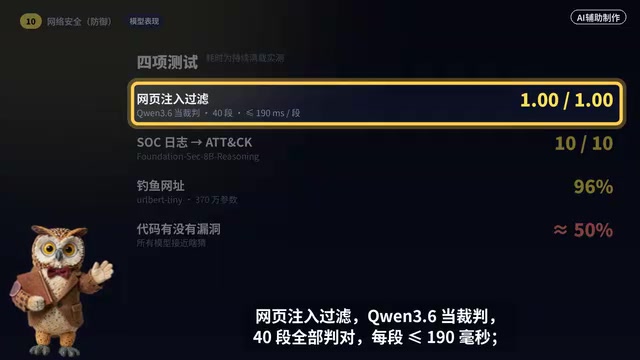
For web injection filtering, Qwen3 acting as a judge correctly classified all 40 samples in under 190 milliseconds each. A 3.7M-parameter model achieved 96% accuracy on phishing URL detection. However, all models performed near random chance when asked to judge whether code contains vulnerabilities. FoundationSec's reasoning variant correctly identified a sequence in Windows logs — "delete volume shadow copies, then delete the backup directory 4 seconds later" — as a ransomware precursor. Takeaway: triage, injection filtering, and phishing detection are usable; vulnerability judgment can only serve as a hint.
Domain Foundation Models: Weather, Proteins, and Materials
The final category covers domain foundation models — trained at scale like large language models, but on domain-specific data: weather, time series, proteins, materials, and satellite imagery.
The time series model Chronos reduced forecasting error from 22% to ~13% with 20 training samples. The protein model ESM predicted structure from sequence alone with a TM-score of 0.987. The DNA model achieved AUC ~0.93 on promoter recognition. The materials model achieved an energy error of 5.3 meV per atom. The tabular model TabPFN outperformed tuned baselines on 5 out of 6 datasets with no hyperparameter tuning. Satellite imagery land cover classification across 10 classes achieved 0.947 accuracy. Starting from global atmospheric conditions on January 1, 2023, AURORA computed a three-day weather forecast in under 94 seconds, with a 72-hour temperature error of 1.25°C — about one-third of the baseline. Takeaway: all 7 domains produced verifiable results, but note that several models carry non-commercial licenses.
Summary: The Capability Boundaries of a 48GB MacBook
What can a 48GB MacBook do today? Q&A and writing, image generation and TTS, detection, and 3D reconstruction are already local-ready. Web research, video generation, and world models are still slow or unreliable. Robotics and healthcare still have significant distance to close before real-world deployment.
Most models run directly on Mac via MLX or PyTorch MPS. Models labeled "CUDA only" often just need a few additional packages. The true blockers are weights that exceed 48GB or dependency on proprietary CUDA kernels. For developers and organizations who prioritize keeping data on-device, local deployment of cutting-edge open-source models is already a genuinely viable option.
Related articles

WorkBuddy Full Tutorial: Build an AI Office Automation Agent from Scratch
A complete WorkBuddy tutorial: installation, three working modes, multimodal picture book video practice, expert team agent building, and workflow configuration for low-cost AI office automation.

WorkBuddy Agent Complete Guide: From Beginner to Automation in 7 Days
Based on Bilibili's 256-episode WorkBuddy masterclass, this systematically breaks down Tencent's AI office workbench core capabilities: Agent principles, Skill encapsulation, cross-platform connectors, scheduled automation, knowledge bases, and zero-code development, with learning path recommendations.

8 AI Accounts, 7 Failed: An Honest Review of Using AI to Get Work Done
Only 1 of 8 AI-run Bilibili accounts succeeded. We break down the real difference between "performing AI" and "using AI to get work done."