4B Mini Model GLB-3D-Coder: Generate Godot 3D Assets from a Single Sentence

4B-parameter model GLB-3D-Coder generates GLB 3D assets importable into game engines from a single sentence.
GLB-3D-Coder is a miniature code model trained on Qwen3.5-4B that generates Three.js scene code with GLB export from short English prompts, directly producing 3D assets importable into game engines like Godot. It uses Three.js as an intermediate representation and GLB as the exchange format, transforming 3D modeling into a code generation task, with 4B parameters runnable on consumer hardware. In testing, most generations succeed on the first try, but some still require retries or modifications. The current release is the first functional checkpoint; once training completes, the author will publicly release the Safetensors weights and training dataset, which is expected to lower the barrier for indie developers to create prototype assets and encourage community secondary development.
Title
4B Mini Model GLB-3D-Coder: Generate Godot 3D Assets from a Single Sentence
Meta Description
GLB-3D-Coder is a tiny 4B-parameter code model that generates Three.js scenes and exports GLB assets, which can be imported directly into game engines like Godot. This article breaks down its technical approach, real-world performance, and open-source plans.
Article Content
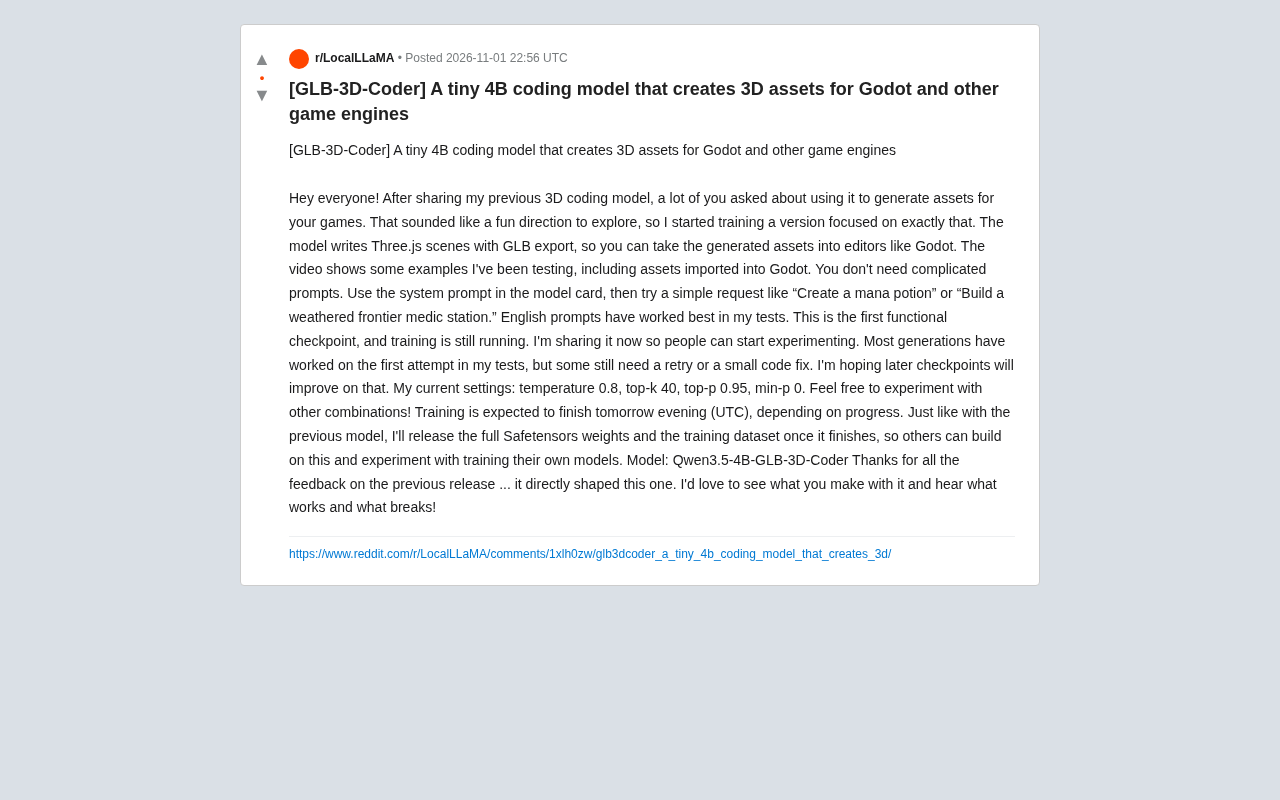
A developer has released a miniature code model on Reddit called GLB-3D-Coder. With only 4B parameters, it can write Three.js scenes and export them directly as GLB-format 3D assets that can be imported into game engines such as Godot. The model continues the author's earlier work on 3D code models, but shifts the focus from "generating code" to "generating game assets that can be put to use directly."
What the Model Can Do: From a Single Sentence to an Importable Asset
According to the author, GLB-3D-Coder is trained on Qwen3.5-4B and outputs Three.js scene code with GLB export. Users don't need to write complex prompts—just use the system prompt provided in the model card and give a simple request, such as "Create a mana potion" or "Build a weathered frontier medic station."
The author's demo video shows several generation examples, including assets that have already been imported into Godot. This indicates that the model's output doesn't stop at browser preview—it can complete the full pipeline of "generate → export → engine import." For indie developers and small teams, this practical value is quite direct.
Simpler Prompts Work Best
One noteworthy detail: the author explicitly states that English prompts work best in his testing. This aligns with the experience of many code generation models—the instruction distribution the model encountered during training determines its sensitivity to language and expression. The author recommends starting with the system prompt from the model card, then describing the target object in one natural-language sentence, without piling on lengthy modifiers.
Technical Approach: Why Three.js + GLB
The model's technical choices are quite clever. Three.js is the most mainstream 3D rendering library on the web, with a mature ecosystem and stable API, making it easier for the model to learn reliable structures during training. GLB (the glTF binary format) is an asset exchange format widely supported by game engines—Godot, Unity, Unreal, and others can read it directly.
Using "generating Three.js code" as an intermediate step and then exporting via GLB essentially transforms 3D modeling—a task requiring artistic skill—into a code generation task that the model excels at. The 4B parameter count means the model can run on consumer-grade hardware, a stark contrast to large models with tens of billions of parameters, and it lowers the barrier for individual developers to experiment.
glTF/GLB Format Overview
glTF (GL Transmission Format), developed by the Khronos Group, is known in the industry as "the JPEG of 3D" and aims to be the unified standard for 3D asset exchange. It uses JSON to describe scene structure (node hierarchy, materials, animations, cameras, etc.) and stores large data blocks like meshes and textures as external files or embedded data. GLB is the binary packaging of glTF: it packs the JSON and all resources into a single .glb file, making distribution and loading easy, which is why it has become the most commonly used delivery format for game engines and web 3D applications. Godot, Unity, Unreal, Babylon.js, and others all natively support importing GLB.
Three.js and Procedural Modeling
Three.js is a JavaScript 3D library that runs in the browser, building scene graphs through code: assembling models with geometries like BoxGeometry and SphereGeometry, defining materials with MeshStandardMaterial, and then serializing the entire scene to GLB via GLTFExporter. This "describing geometry with code" approach is naturally suited to language models—the model only needs to generate well-structured JS code, without directly manipulating a user interface or learning the commands of specialized modeling software. In other words, Three.js provides a semantically clear, API-stable intermediate representation, making it an ideal bridge for code generation models to output 3D assets.
Real-World Performance: Good First-Try Success Rate, But Not Universal
The author admits that in current testing, "most generations succeed on the first try," but some still require retries or minor code modifications. This indicates the model is at a usable but not yet stable stage. For objects with relatively simple structure and clear semantics (like common game props such as potion bottles), the model's performance should be more reliable; for scenes with complex descriptions and unique structures, the probability of rework increases.
The author's recommended inference parameters are: temperature 0.8, top-k 40, top-p 0.95, min-p 0. This combination leans toward preserving some creativity while using top-k and top-p constraints to prevent the output from becoming too divergent. He also encourages users to try other parameter combinations, since the diversity needs for 3D asset generation are not entirely the same as for ordinary text generation.
This Is the First Usable Checkpoint
It's important to note that the current release is only the first functional checkpoint, and training is still ongoing. The author expects training to complete by the next evening (UTC), at which point he will publicly release the full Safetensors weights and training dataset, just as with the previous model.
The Role of Sampling Parameters
temperature controls the randomness of output: higher values flatten the distribution and produce more divergent generation; 0.8 is a medium-high temperature that encourages the model to try different shapes. top-k samples only from the k tokens with the highest probability, while top-p (nucleus sampling) samples from the smallest set of tokens whose cumulative probability reaches p—together they limit the candidate range and prevent absurd code. min-p is a newer strategy that sets a threshold based on the proportion of the highest-probability token, dynamically filtering low-probability candidates to reduce obvious errors while maintaining diversity. For code output, too high a temperature easily leads to syntax or API call errors, so such parameter combinations need to balance creativity and structural correctness. The author's suggestions can serve as a starting point, to be fine-tuned according to task complexity.
Open-Source Strategy: Weights and Dataset Fully Public
Perhaps more noteworthy than the model itself is the author's openness. He promises to release the full weights and training dataset after training completes, allowing others to continue training their own models on this foundation. For a vertical-domain miniature model, the dataset is often more valuable than the weights—instruction-code paired data for 3D asset generation is quite scarce in the public domain, and opening this dataset will directly lower the starting cost for newcomers.
The author also mentions that the direction of this version was heavily influenced by community feedback after the previous model's release. This "release—feedback—iterate" cycle is exactly why small open-source models can quickly find their positioning.
What This Means for Game Development Workflows
The value of such models isn't in replacing 3D artists, but in filling the gap between "idea" and "runnable prototype." When indie developers validate gameplay, they often get stuck on the lack of basic assets: a potion bottle, a medic station, a few scene props—outsourcing individually isn't cost-effective, and modeling them yourself is time-consuming. If a single sentence can generate placeholder assets that can be imported into an engine, prototype iteration speed will increase noticeably.
Of course, at this stage the output is better suited as prototype material or a base for further processing, rather than final art resources. The model occasionally requires retries and code fixes, which also means users should ideally have some ability to read Three.js. But considering it has only 4B parameters and the weights will soon be open-sourced, this starting point is already enough to make people look forward to future checkpoints.
If you're prototyping with Godot or another engine, you might want to give it a try once the weights are released, and you're welcome to feed back both successes and failures to the author—after all, he himself said he wants to hear "what works and what breaks."
One-line Summary
4B-parameter model GLB-3D-Coder can generate GLB-format 3D assets importable into game engines from a single sentence.
Paragraph Summary
GLB-3D-Coder is a miniature code model trained on Qwen3.5-4B that generates Three.js scene code with GLB export from short English prompts, directly producing 3D assets importable into game engines like Godot. It uses Three.js as an intermediate representation and GLB as the exchange format, transforming 3D modeling into a code generation task, with 4B parameters runnable on consumer hardware. In testing, most generations succeed on the first try, but some still require retries or modifications. The current release is the first functional checkpoint; once training completes, the author will publicly release the Safetensors weights and training dataset, which is expected to lower the barrier for indie developers to create prototype assets and encourage community secondary development.
Related articles

DSH + Ollama Local LLM Deployment in Practice: Free Chat with Da Fei Yu
Bilibili creator tests DSH + Ollama local LLM deployment end to end: Ollama install, Xunlei-accelerated downloads, ModelScope GGUF model import, DSH custom API address setup, and a comparison of Qwen 3.5 4B, 8B, Gemma, and other models on 8GB VRAM, with advice on choosing local deployment vs. API calls.

Tested: A $899 Mac Mini vs. a $200/Month AI Subscription
Real-world test of whether an M4 Mac mini can replace a $200 AI subscription: 16GB can't fit large models, and both speed and quality fall short—but privacy, no caps, and near-zero running costs make it an ideal host for an always-on agent. Includes buying advice per configuration and money-saving strategies.

RSTGameTranslation: Real-Time OCR Localization + Offline Translation with Local LLMs
RSTGameTranslation is an open-source real-time Windows game translation tool: OCR for English, Japanese, and Korean with Chinese overlays in place, plus Ollama or LM Studio local LLM offline translation and Whisper speech transcription for games, manga, and visual novels.