5 Core Concepts Every Developer Must Know About AI Agent Coding: IBM's Official Deep Dive

IBM explains five core concepts of AI agent coding, as developers transform from coders into system orchestrators.
IBM's official share proposes that AI coding has evolved from autocomplete to end-to-end delegation, letting developers hand complete feature modules to agents that understand the codebase, write tests, and merge changes in one go. Spec-driven development replaces repeated prompting with complete specifications. The developer role shifts from implementer to orchestrator and architectural decision-maker, with core value in defining goals, breaking down milestones, and judging quality. Context engineering manages context windows and external resources like tools and MCP servers, while loop engineering lets AI iterate autonomously within human-defined boundaries. Understanding model weights and KV cache improves tool use, while prompt injection is a real threat, so sandboxed agents are recommended. Andrew Ng says AI is the new electricity; software engineering shifts toward system design and orchestration.
5 Core Concepts Every Developer Must Know About AI Agent Coding: IBM's Official Deep Dive
When a pilot pulls out his phone mid-conversation, approves a code change, and then casually resumes chatting—this isn't science fiction. According to a video IBM shared officially on Bilibili, that pilot was running multiple AI agents in the background simultaneously, playing the roles of developer, code reviewer, and ops. People who aren't software engineers are using AI agents to accomplish tasks that once required an entire team to collaborate on.
In this share, IBM put forward a core judgment: AI will not replace developers, but it will fundamentally transform the landscape of software development. The following five concepts are the key frameworks every developer needs to understand.
1. The Inflection Point Has Arrived: From Autocomplete to End-to-End Delegation
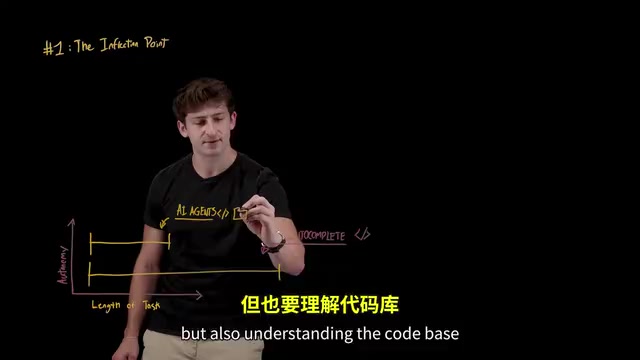
IBM's team observed that over the past year, the efficiency with which AI completes tasks has undergone a qualitative shift—work that once took weeks or even months can now be done in minutes. The essence of this change isn't that AI is "faster," but that the granularity of task delegation has fundamentally shifted.
The early way of using AI was as an autocomplete tool, helping write better functions and tests. But there was an awkward reality: fixing AI output often took longer than writing it from scratch yourself. Now, developers hand entire feature modules to AI coding agents—including understanding the codebase, writing and running tests, and merging changes into the main branch, all completed through a single prompt or a single loop.
Accompanying this is the rise of Spec-Driven Development. Rather than repeatedly "arguing" with AI through prompts to get the right output, you first create a complete specification containing requirements and expected results, then hand it to an AI coding agent to generate the project and all its artifacts. This approach reduces dependence on the model's interpretive ability and makes the development process more predictable.
2. From Implementer to Orchestrator: The Inevitability of Role Transformation

For decades, the bottleneck in software delivery has always been two things: coding speed and code quality. Companies competed to hire the best competitive programmers, seeing who could complete the most complex programming tasks.
This premise is crumbling. Most AI models have already mastered programming languages like Java, Python, and Rust, and can autonomously handle tickets from teams, pushing them through pre-release, production, QA, and other stages. When "implementation" can be efficiently done by AI, the developer's core value shifts to orchestration and architectural decisions.
IBM compares this new role to a "conductor" or "captain"—not personally writing every function, but defining goals, breaking work down into executable milestones, and delegating them to AI models or agents. More importantly, developers need to make architectural decisions that affect software's development for a year or even longer. This capability will only become scarcer and more valuable as AI coding agents continue to evolve.
3. Context Engineering and Loop Engineering: Letting AI Run Autonomously
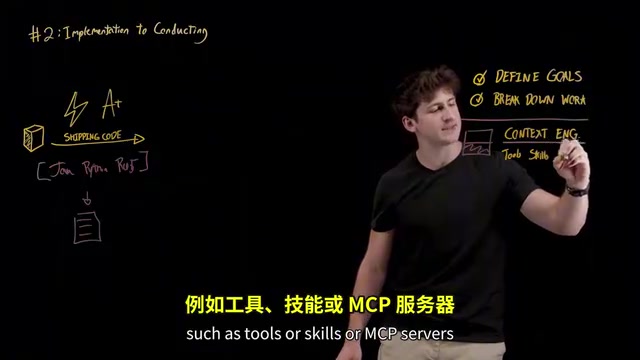
When you hand a codebase to an AI model, the model needs to process not just the code itself, but also external data sources like tools, skills, and MCP servers. Context Engineering is about understanding the resource limits of an AI model's context window and properly managing all these add-on components.
A further practice is Loop Engineering—no longer having humans repeatedly prompt the agent to iterate, but designing a system to automate this process. Loop engineering works like recursive goals: humans define the purpose and completion criteria, and AI keeps iterating until the task is done.
These two engineering practices together point to one trend: the developer's focus shifts from "writing code" to "designing systems that let AI write code." In this system, humans define boundaries and goals, while AI runs autonomously within those boundaries.
MCP (Model Context Protocol) is a communication standard proposed and open-sourced by Anthropic in late 2024, designed to let AI models connect to external tools and data sources in a unified way. Before MCP, every integration with a database, code repository, or third-party API often required writing customized connection code for a specific model, creating a fragmented "N×M" integration problem. By defining standardized client-server interfaces, MCP abstracts tool capabilities into reusable "servers," so models only need to call them according to the protocol to obtain context. This upgrades context engineering from manually assembling prompts to orchestrating a protocol-based tool ecosystem, and also lets agents reuse the same tool integration approach across projects, significantly reducing the marginal cost of building complex AI workflows.
4. Understanding LLM Underlying Mechanisms and Security Risks

IBM gave a thought-provoking example in the video: if you ask an AI model "how long does it take to build a third-person RPG game," it might answer "weeks to months"; but if you use a coding agent to actually build it, it might produce a runnable example in five minutes.
This cognitive bias stems from a fundamental characteristic of LLMs—they don't understand time and memory the way humans do. Understanding how model weights are loaded into GPU memory and how KV cache is generated and stored during inference will give developers a significant advantage when using AI models.
On this basis, if you can layer in skills (reusable project information provided in Markdown files), automation (similar to scheduled tasks and event-triggered operations), and sub-agents (used to independently investigate how a certain library in the codebase is used and return to the main agent), developers can build engineering capabilities far beyond simple prompt interactions.
But with greater capability comes greater risk. Prompt Injection is a security threat as real as SQL injection. AI systems can access sensitive data, connect to networks, and send data—the combination of these three means your AI agent could be tricked into reading an online pull request and then sending your credentials to an attacker, without you even knowing. Therefore, IBM recommends teams run coding agents in disposable sandboxes whenever possible to reduce the attack surface if an agent is compromised.
KV Cache is a key optimization mechanism in the inference stage of large language models. When a Transformer generates each new token, it needs to compute attention over all previous tokens. If it recomputed the key (Key) and value (Value) matrices for all historical tokens at every step, compute overhead would grow quadratically with context length. KV cache works by storing already-computed K and V tensors in GPU memory and directly reusing them when generating the next token, computing only the part corresponding to the new token, thereby reducing single-step inference cost to nearly constant. It is also one of the main sources of GPU memory usage: the longer the context and the larger the batch, the larger the cache size, which directly determines how long a conversation and how much concurrency the model can support. Understanding this helps developers explain why an agent "forgets" or slows down during long tasks, and design strategies such as segmented processing and context compression accordingly.
Prompt Injection refers to attackers using carefully crafted input to hijack the AI system's instruction execution path, making it deviate from the original goal set by the developer. It is divided into direct injection (the user directly inputs malicious instructions) and indirect injection (malicious content hidden in web pages, pull requests, documents, or code comments that the agent reads). Unlike SQL injection, prompt injection is difficult to completely defend against through deterministic means such as parameterized queries, because natural-language instructions and data share the same channel, and the model itself cannot reliably distinguish "commands that should be executed" from "content that should be ignored." When an agent simultaneously possesses the three capabilities of accessing sensitive data, connecting to networks, and sending information externally, a successful indirect injection can lead to credential leakage or data theft. Common mitigation measures include the principle of least privilege, sandbox isolation, manual or rule-based approval of tool calls, and outbound traffic auditing of model outputs.
5. AI as Electricity: The Future Direction of Software Engineering
IBM shared a viewpoint from a conversation with AI pioneer Andrew Ng: AI is becoming the new electricity.
The significance of electricity isn't in itself, but in how it changed everything around it—lighting bulbs, powering phones, warming homes. But behind electricity there is also an entire industry and tens of thousands of practitioners: workers at substations ensuring the grid runs, field technicians repairing streetlights and ensuring household power, and others promoting the spread of electricity.
AI is very likely to follow the same path. We need engineers who can maintain AI systems, ensure the reliability of connections, and safeguard the security, stability, and quality of AI systems. Software engineering will not disappear, but it is shifting from manually writing code to designing and orchestrating systems and AI agents. Developers who excel in architectural design and critical thinking will become more valuable as AI coding agents continue to improve.
For developers who are in or about to enter this field, the key is not competing with AI on coding speed, but improving the meta-capabilities of defining problems, designing systems, and judging quality.
One-line Summary
IBM explains five core concepts of AI agent coding, as developers transform from coders into system orchestrators.
Paragraph Summary
In its official share, IBM proposed that AI coding has evolved from autocomplete to end-to-end delegation, allowing developers to hand complete feature modules to agents and complete codebase understanding, test writing, and change merging in one go. Spec-driven development has risen accordingly, replacing repeated prompting with complete specifications. The developer role therefore shifts from implementer to orchestrator and architectural decision-maker, with core value becoming defining goals, breaking down milestones, and judging quality. In engineering practice, context engineering manages the model context window and external resources such as tools and MCP servers, while loop engineering lets AI iterate autonomously within boundaries defined by humans until completion. At the same time, understanding underlying mechanisms such as model weights and KV cache helps developers use tools better, while prompt injection is a real threat, so running agents in disposable sandboxes is recommended. Andrew Ng proposed that AI is the new electricity; software engineering will not disappear, but will shift toward system design and orchestration.
Related articles

AI Reverse-Engineers Monitor Firmware in 15 Minutes — Has the Hacking Barrier Been Flattened?
A security researcher used AI to reverse-engineer Dell monitor firmware in 15 minutes—entropy analysis, key extraction, MD5 verification—revealing encryption design flaws.

Mistral Voxtral 3: Real-Time Voice at 4 Cents per Minute, Challenging OpenAI
Mistral Voxtral 3 cuts real-time voice agent costs to 4 cents per minute, bundling three speech recognition models, a speech generation model, and a real-time voice toolkit, supporting 50+ languages and self-hosting. This article analyzes its pricing structure, sub-second response performance, and its strategic divergence from OpenAI and Gemini on data privacy versus out-of-the-box convenience.

WebMCP: Every Website as Its Own MCP Server, So AI Agents No Longer Rely on Screenshots
WebMCP lets websites expose tools via the document.modelcontext API, becoming directly callable MCP servers. This article explains its architecture, the Claude Code remote-debugging demo, Chrome's current support stage, and its impact on the agent ecosystem.