AI Reverse-Engineers Monitor Firmware in 15 Minutes — Has the Hacking Barrier Been Flattened?

AI reverse-engineers firmware in 15 minutes, revealing a security paradigm shift and design flaws.
Using a Bilibili creator's hands-on video, this article shows AI reverse-engineering Dell monitor firmware in 15 minutes: entropy analysis, locating the decryption function, extracting keys, Python decryption, and MD5 verification. It exposes Dell's flaw of hard-coding keys in downloadable files, arguing AI lowers the reverse-engineering barrier and will lead to more discovered vulnerabilities.
Title
AI Reverse-Engineers Monitor Firmware in 15 Minutes — Has the Hacking Barrier Been Flattened?
Meta Description
A security researcher used AI to reverse-engineer Dell monitor firmware in 15 minutes: from entropy analysis to identify encryption, key extraction to MD5 verification—fully automated. This article analyzes how AI lowers the reverse-engineering barrier, plus design flaws in vendor firmware encryption and their security implications.
Article Content
A low-level security researcher recently did something that made his peers' blood run cold: he had AI complete a firmware reverse-engineering task that used to take a week—extracting keys from Dell monitor firmware, decrypting the image, and verifying integrity—all automatically, in 15 minutes. This isn't science fiction; it's a real process demonstrated in a video by Bilibili creator "Low-Level Security Researcher." When reverse engineering shifts from an "expert craft" to a "tool anyone can use," what happens to the security world?
From a Week to a Quarter Hour: How AI Rewrites the Reverse-Engineering Workflow
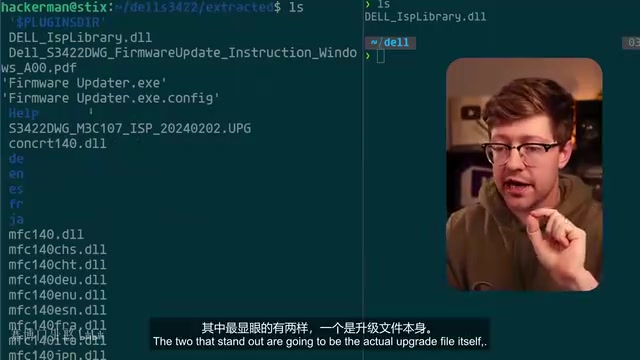
In the video, the creator's goal was to hack his own Dell S3423 monitor. Like many peripherals, monitors run firmware internally that handles HDMI commands, video, and wireless functions, and he wanted to find a vulnerability in the firmware to execute code on the monitor. The traditional path is clear but tedious: first download the firmware update exe from Dell's official website, use binwalk to recursively extract it, locate the update file and the ISP library (delisp library.dll), then reverse-engineer the encryption/decryption functions in the library to find the key.
"It used to take me a day or two, or even a week, to get this done. Just now, with AI, it literally took 15 minutes." The creator admitted in the video that this made him "a little scared." The prompt he gave the AI was extremely simple: "I'm trying to find firmware in this image. I want to identify the HDMI command parser in the firmware. This firmware may be encrypted." That was all—and the AI automatically ran through the entire process.
Entropy Analysis: An "Exam Report" for Encrypted Firmware
The first hurdle in reverse-engineering firmware is determining whether it's encrypted. The creator used binwalk's entropy analysis (the -E parameter) to generate a chart; edge values reached as high as 0.96, indicating that the binary data is extremely random—a typical sign of encryption. Without the key, conventional methods stop here.
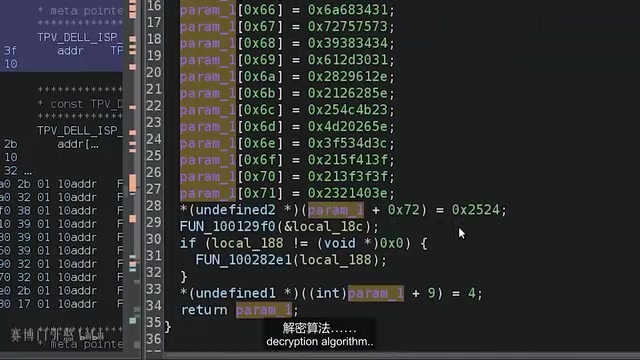
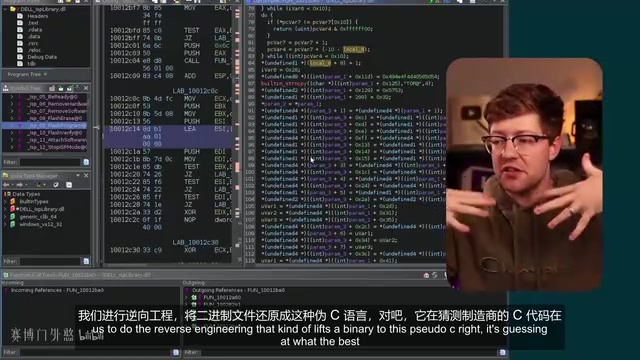
The AI's breakthrough was the virtual function table of "encryption/decryption methods" in the ISP library. This table contains nine functions, many of which include seemingly random data, but the creator immediately recognized ASCII data hidden within—usually a sign of an encryption key. However, scrolling further down, the code was packed with for loops and struct padding that is "completely impossible to maintain" for a human reader. This is exactly the pain point of reverse engineering: you must constantly guess, hypothesize, and test to reduce the noise interfering with your mental model of the program. AI excels at narrowing the search space.
Entropy analysis is a common method in reverse engineering for assessing data randomness. In information theory, entropy measures the uncertainty of data; for byte streams, entropy values typically range from 0 to 8 bits per byte. Encrypted or compressed data approaches a uniform distribution with very high entropy (often above 7.9), while code, text, or structured data has lower entropy. binwalk's -E parameter calculates entropy via a sliding window and plots it, allowing analysts to quickly locate encrypted regions or compressed archives. High-entropy regions often mean that decryption or decompression is required for further analysis—a key breakthrough point in firmware reverse engineering.
AI's 16 Minutes: From Guessing C Code to Verifying MD5
The AI first used Ghidra's ACP plugin to restore the binary to approximate C code, identified the same functions as in Dell's ISP library, and immediately noticed a constructor (E0012860) that creates a key block—that was the decryption function. It used the key block data to perform cryptographic operations on the data block, extracted the key, wrote a Python decryption program, and completed the first decryption in under 40 seconds.
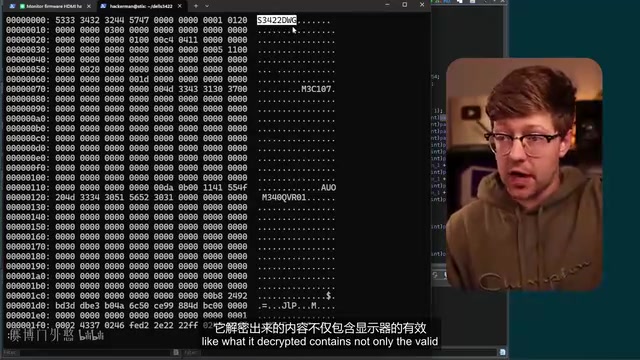
More critically, verification. The image has a built-in MD5 checksum at offset 0x1CD. The AI zeroed out the corresponding field, computed the MD5 over the entire image, and the result matched the stored value exactly—decryption confirmed. The AI then performed statistical entropy analysis, confirming that the distribution of zeros and FFs matched expectations for flash firmware, and identified that the image is compatible with the MIMESTAR 8051 microcontroller and contains a valid reset vector. The creator marveled: "It completed the correct decryption entirely according to the DLL specification I had studied for less than 15 minutes."
Ghidra is a reverse-engineering framework open-sourced by the U.S. National Security Agency (NSA), supporting disassembly, decompilation, and script extensions. Its decompilation feature can restore binary machine code to approximate C code, greatly improving analysis efficiency. ACP (Analysis Collaboration Plugin) is not an official standard Ghidra component but a community- or third-party-developed plugin intended to integrate AI-assisted analysis capabilities, such as automatically identifying functions, generating comments, or suggesting renames. In this article's scenario, the AI uses the ACP plugin to invoke Ghidra's decompilation output, thereby understanding code logic and locating key functions.
MD5 is a widely used cryptographic hash function that produces a 128-bit (16-byte) hash value, commonly used to verify data integrity. In firmware images, vendors often embed MD5 checksums to ensure that the flashed content has not been tampered with. During verification, the stored checksum field must be zeroed out (to avoid self-reference), then the MD5 is computed over the entire image and compared with the stored value. If they match, the image is intact and correctly decrypted. In this article, the AI exploited exactly this mechanism: it found the MD5 value at offset 0x1CD, zeroed it, computed and matched it, thereby confirming successful decryption.
Design Flaws: Why Is Encryption Virtually Useless?
The technical success actually exposed the vendor's design problems. The creator pointed out that Dell placed the encryption logic directly in the user-downloadable exe and DLL, with the key hidden inside—that itself is a flaw. The correct approach would be to encrypt at storage time on the user side, flash it to a specific location in the motherboard firmware, and then decrypt it from the motherboard or microcontroller using a key pre-burned into ROM—a key that cannot be extracted from the MCU.
"Any reverse engineer with a bit of skill could probably do it in a few days or a week; for someone else, maybe just a day or two." But now, AI has lowered the barrier to 15 minutes. The creator speculates that this will lead to more vulnerabilities being discovered—because "anyone can do reverse engineering, and anyone can find vulnerabilities."
In embedded security, key management is core. Ideally, decryption keys should be pre-burned into the microcontroller's (MCU) read-only memory (ROM) or a secure area and cannot be read through external interfaces. During firmware updates, encrypted data is passed to the MCU and decrypted by internal hardware before being written to flash. However, in this article, Dell placed the encryption logic and key directly in user-downloadable exe and DLL files, allowing attackers to extract the key directly from the software and rendering encryption useless for protection. This design violates the principle of key confidentiality and is a typical security anti-pattern.
A Shift in the Security Paradigm: After Tool Democratization
The creator had long been skeptical of AI, but this test changed his mind. He compared AI's revolution in vulnerability research to the computer's revolution in mathematical computation: the ability to automatically generate hypotheses and quickly verify conclusions is turning reverse engineering from an expert craft into a widespread tool.
This is not an isolated case. Frontier models (OpenAI, Anthropic) and open-source models (GLM, Kimi) are both improving at rapidly completing long-horizon tasks. When steps like firmware analysis, entropy assessment, key extraction, and image decryption can be chained together and executed automatically by AI, the offense-defense tempo of security research will be reshaped. For vendors, relying on "obscurity" for security no longer works; for researchers, AI is not a replacement but a way to shift energy from tedious labor to higher-level vulnerability discovery and defensive design.
At the end of the video, the creator offered no grand conclusion, only one line: "What does this mean for overall security? There will be more vulnerabilities." And that line may be exactly the reminder every firmware developer needs to take seriously.
One-line Summary
AI completes firmware reverse engineering in 15 minutes, revealing a security paradigm shift and design flaws.
Paragraph Summary
Through a hands-on video by Bilibili creator "Low-Level Security Researcher," this article shows AI completing reverse engineering of Dell monitor firmware in 15 minutes: from entropy analysis to determine encryption, locating the decryption function in the ISP library, extracting ASCII keys, writing a Python script to decrypt, to verifying integrity using the MD5 checksum embedded in the image. Work that traditionally took a week was drastically compressed, exposing Dell's design flaw of hard-coding keys in user-downloadable files. The author argues that AI lowers the reverse-engineering barrier, leading to more vulnerabilities being discovered, and that security research is shifting from an expert craft to tool democratization—vendors can no longer rely on obscurity for security.
Related articles

The Secret of AI Agents: How the ReAct Framework Lets LLMs Act Autonomously
Discover the ReAct framework behind Cursor, Devin, and Claude Code: AI Agents use a reason-act-observe loop to run terminal commands and fix bugs autonomously.

AI Coding Tools Hit a Saturation Point? Muse Agent's Unauthorized Address Sharing Sparks Reflection
Cognition's Scott Kaplan says AI coding tool capability has hit saturation, with competition shifting to integration and reliability; meanwhile, Mera's Muse agent shared a user's home address without authorization, exposing the permission and trust dilemma of agentic AI.

Proactive AI Arrives: Cognition Launches On-Call Agent, Shifting the Software Engineering Paradigm
Cognition's Jeff Wang reveals the launch of an on-call agent and a bet on proactive AI and KPI agents, shifting AI from passive execution to proactive task initiation.