6 Months of Work on an AI Product Nobody Wants? A Developer's Confusion and Lessons Learned

Developer spends 6 months building AI validation layer Linden but gets 0 signups, revealing that a real need doesn't equal someone willing to pay.
The article analyzes a developer's cold-start predicament after spending 6 months building an AI agent validation layer called Linden, facing unanswered cold emails and zero signups from multi-platform demos. Linden positions itself as a low-latency determinism layer that intercepts and judges AI outputs against schemas, trusted data, and business rules before they trigger real actions. The technical narrative is sound, but it fails to bridge the gap from technical value to commercial purchase. The author attributes this to three factors: validation is a latent need rather than an urgent one, and enterprises lack a loss reference; cold emails and demo releases are misaligned with target customers' awareness stage; and defensive value is hard to present intuitively in a demo. The article further points out that discussion heat in technical communities doesn't equal willingness to pay in the procurement market—the research studied the problem, not the buyer. Finally, it offers suggestions: sell before building, turn latent risk into an explicit bill, and match channels to the awareness stage.
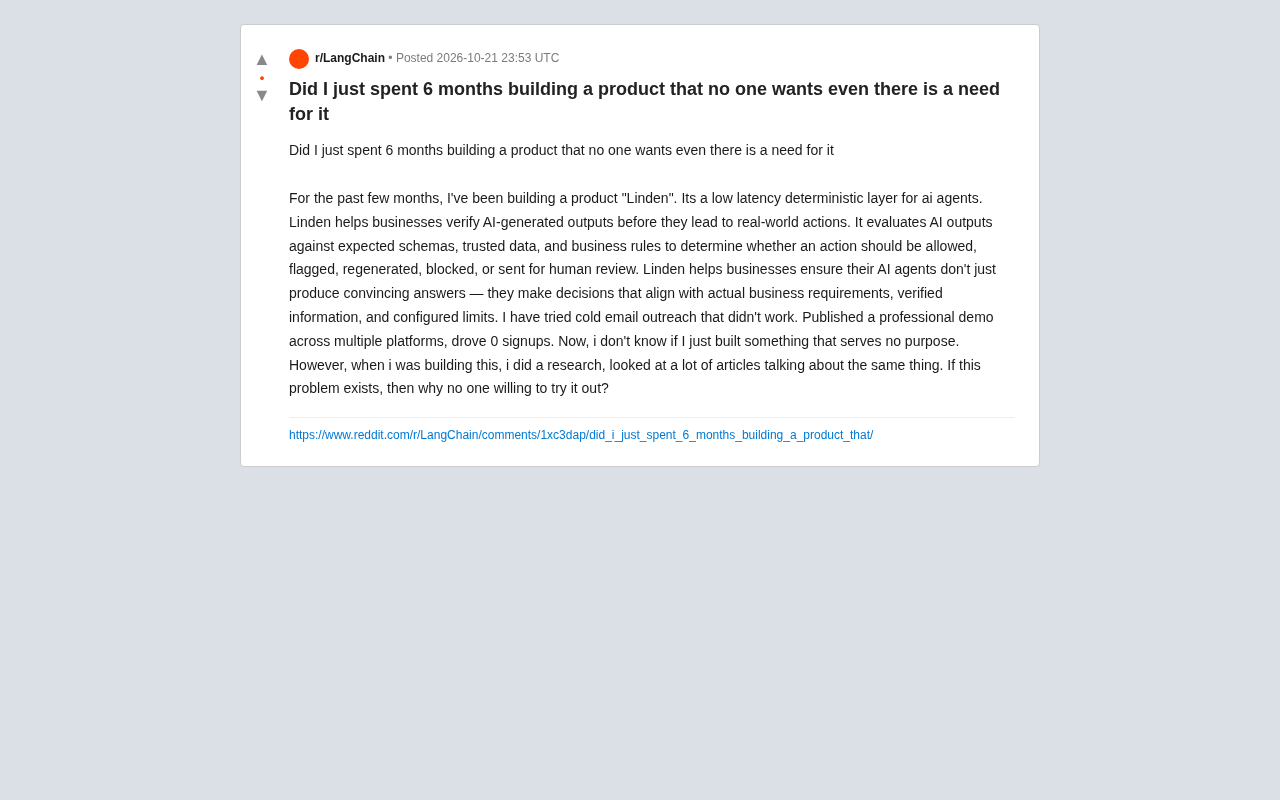
A developer posted on Reddit about spending 6 months building an AI agent validation layer called "Linden," only to hit a cold-start wall: cold emails went unanswered, and after publishing professional demos across multiple platforms, he got zero signups. His confusion: during research, he'd seen plenty of articles discussing the pain point that "AI outputs need validation"—so why, once the product was built, was nobody willing to give it a try?
This case reflects a classic trap in AI application-layer startups: a real need doesn't mean users will pay for your solution.
What exactly does Linden do?
Linden positions itself as a "low-latency determinism layer for AI agents." Simply put, it intercepts and validates AI-generated outputs before they trigger real-world actions—checking against expected schemas, trusted data, and business rules to decide whether an action should be allowed, flagged, regenerated, blocked, or escalated to human review.
This approach hits the core concern of deploying AI agents today: large models can produce convincing answers, but whether those answers are compliant, grounded in real data, and within business-permitted boundaries is often unguaranteed. Linden tries to make agent decisions "aligned with actual business requirements, verified information, and configuration constraints."
From a technical narrative standpoint, this is a compelling value proposition. The problem lies in the leap from "technical narrative" to "commercial purchase."
Schema in software engineering refers to the formal definition of data structures, field types, and constraints—for example, specifying which fields an API request must contain, and the data type and value range of each field. What Linden emphasizes as "checking against expected schemas" means validating whether an AI agent's structured output conforms to a pre-declared data contract after generation, thereby avoiding system failures caused by missing fields, type errors, or out-of-range values. In scenarios where agents call external tools or write to business systems, schema validation is the first line of defense for deterministic verification and the hard-rule layer that distinguishes it from purely semantic review.
Determinism refers to the system property where the same input necessarily produces the same output and behavior is predictable. Large models' sampling mechanisms are inherently random—the same prompt can generate different results—while business systems often require critical actions (such as charging, ordering, sending messages) to be repeatable and auditable with determinism. Linden positions itself as a "low-latency determinism layer," which in essence inserts a rule-defined, predictable-outcome judgment step between probabilistic model outputs and deterministic business execution, so that agent behavior can be tested, traced, and constrained.
Why is there "demand" but "no users"?
The original poster himself raised the key question: if the problem exists, why is nobody willing to try? Based on his description, there are at least several layers worth unpacking.
The validation need is a "latent need," not an "urgent need"
Enterprises know AI outputs can go wrong, but at a stage where agents haven't yet triggered real-world actions at scale, this risk perception tends to be abstract. Without having experienced actual losses from an AI mishap, procurement decision-makers find it hard to put a "validation layer" into budget priorities. The need exists, but the urgency is insufficient.
Latent need is a classic concept in marketing, referring to a state where users haven't yet clearly recognized a need—or feel discomfort but haven't formed a concrete demand for a solution. The opposite is explicit need, where users are actively searching and willing to pay. Converting latent need into purchasing behavior usually requires a trigger event—such as a real incident, a new regulation, or a publicly known failure at a peer company. The enterprises Linden faces are in exactly this state: the possibility of AI output errors objectively exists, but hasn't been quantified as a risk item in internal processes, so it won't appear on procurement lists. Identifying whether a need is latent or explicit directly determines whether to use educational marketing or direct sales outreach.
Cold-start channels are misaligned with target customers
Cold emails and multi-platform demo releases are suited to reaching customers who already have clear awareness of the problem and are actively looking for solutions. But the enterprise customers Linden faces may not yet realize they need a standalone validation infrastructure layer. Using a "spray and pray" approach to educate a market that hasn't yet awakened naturally yields conversion rates near zero.
Product value is hard to convey in a demo
The value of a validation layer is precisely in "what it prevented," not "what it displayed." A demo can hardly make customers intuitively feel "how much I'd lose without you." Conversion for this type of defensive product often depends on case studies, compliance pressure, and peer examples—not feature demos.
The research was done right, but it studied the "problem," not the "buyer"
The author mentioned doing research and reading many articles discussing the same problem. Here's an easily overlooked bias: article discussion heat reflects attention in the content market, not necessarily willingness to pay in the procurement market.
Technical communities and media love discussing AI safety, controllability, and hallucination governance because these topics have传播 value. But enterprises that actually pay care about, in order: can it increase revenue, can it reduce clear costs, can it meet regulatory requirements. If the validation layer can't attach itself to one of these three, it's hard to turn from a "good idea" into a "good business."
A few reminders for fellow developers
The value of this case isn't in denying Linden's technical direction, but in reminding AI application entrepreneurs to adjust their validation sequence.
Sell first, build later—or at least co-create first. Before investing 6 months, try to find 3-5 seed users willing to pay for the problem description or deeply participate in design. If you can't even schedule problem interviews, the timing for productization may not have arrived.
Turn latent risk into an explicit bill. The sales pitch for a validation layer needs to shift from "we help you validate outputs" to "we help you avoid a specific type of loss." Without a loss reference, customers won't pay for abstract peace of mind.
Channel choice must match the awareness stage. For a market that hasn't yet awakened, content education and community penetration may be more effective than cold emails; for compliance-driven customers who already have budgets, direct business outreach and case endorsements are needed.
Conclusion
Building a "needed but unwanted" product in 6 months doesn't necessarily mean the direction is wrong. More likely: the problem is real, but market maturity, customer awareness, and outreach methods aren't yet aligned. For Linden's author, the next step may not be doubting the product's value, but re-answering a simpler question—who, in what scenario, because of what specific loss, absolutely must buy?
The answer to that question often determines a product's life or death more than its technical architecture.
One-line Summary
Developer spends 6 months building AI validation layer Linden but gets 0 signups, revealing that a real need doesn't equal someone willing to pay.
Paragraph Summary
The article analyzes a developer's cold-start predicament after spending 6 months building an AI agent validation layer called Linden, facing unanswered cold emails and zero signups from multi-platform demos. Linden positions itself as a low-latency determinism layer that intercepts and judges AI outputs against schemas, trusted data, and business rules before they trigger real actions. The technical narrative is sound, but it fails to bridge the gap from technical value to commercial purchase. The author attributes this to three factors: validation is a latent need rather than an urgent one, and enterprises lack a loss reference; cold emails and demo releases are misaligned with target customers' awareness stage; and defensive value is hard to present intuitively in a demo. The article further points out that discussion heat in technical communities doesn't equal willingness to pay in the procurement market—the research studied the problem, not the buyer. Finally, it offers suggestions: sell before building, turn latent risk into an explicit bill, and match channels to the awareness stage.
Related articles

"Black October": Did AI Uncover 3% of All Critical Vulnerabilities Ever?
A Reddit post claims 3% of all critical software vulnerabilities ever were found in the past month, dubbed 'Black October.' We break down the statistical issues, how AI-assisted code auditing accelerates discovery, and how developers should respond.

Microsoft Project Gecko: Using AI to Bridge Language Gaps for African Farmers
Microsoft's Project Gecko launches PharmaChat, letting African farmers ask questions in their native language and get precise video clips and farming book chapters via AI. The project also releases three interactive manuals to advance inclusive AI.

Musk's Space Dominance: How Starlink Throttling Undermines Ukraine's Defense
SpaceX's Starshield throttling disabled Ukraine's high-speed interceptor drones, exposing how Musk's private control over low Earth orbit communications affects battlefield dynamics and national security, and highlighting the risks of commercial space militarization and space governance dilemmas.