$60 Billion to Acquire Cursor? Unpacking the Industry Logic Behind Musk's AI Coding Gamble

Analyzing the industry logic behind the rumored $60B acquisition of Cursor by Musk's AI empire.
A rumored $60 billion acquisition of AI coding tool Cursor by SpaceX has stirred the tech world. While the deal's authenticity is questionable, it reflects real industry trends: AI coding has become a critical battleground for tech giants, offering verifiable outputs and high willingness to pay. The article examines the competitive dynamics between Musk's AI ventures, OpenAI, and Anthropic, the evolution from conversational models to AI agents, and how compute infrastructure and commercialization strategies are shaping the future of AI-powered development.
A Massive Acquisition That Shook the Industry
Recently, a bombshell rumor has been circulating in tech circles: SpaceX has reportedly completed a $60 billion acquisition of AI coding startup Cursor. According to regulatory documents cited in the reports, the deal officially took effect that day, with both parties having announced the acquisition agreement two months prior.
It's important to note that this news primarily originates from platforms like Bilibili (a Chinese video platform), and the entities involved (e.g., "SpaceX acquires Cursor," "SpaceX AI") diverge significantly from public market understanding. Musk's AI business is actually xAI, while SpaceX is an aerospace company. xAI was founded in July 2023, headquartered in San Francisco, with its core product being the Grok series of large language models — legally a completely separate entity from SpaceX (Space Exploration Technologies Corp.). However, Musk's various companies share complex resource relationships — for example, xAI once leveraged Tesla's GPU clusters for model training, sparking corporate governance controversies. Understanding this organizational structure helps identify the logical inconsistencies in the claim that "SpaceX acquired Cursor." Therefore, this article treats the news more as an interpretation of Musk's AI empire expansion logic rather than confirmed commercial fact. Regardless of whether it's true, the industry trends reflected behind this rumor are worth serious analysis.

Whether or not the acquisition is real, the $60 billion figure itself tells us one thing: in the eyes of capital, AI coding tools have transformed from "nice to have" into "must-have strategic territory." As one of the most popular AI code editors among developers today, Cursor's valuation has skyrocketed, and intervention by any tech giant would come as no surprise.
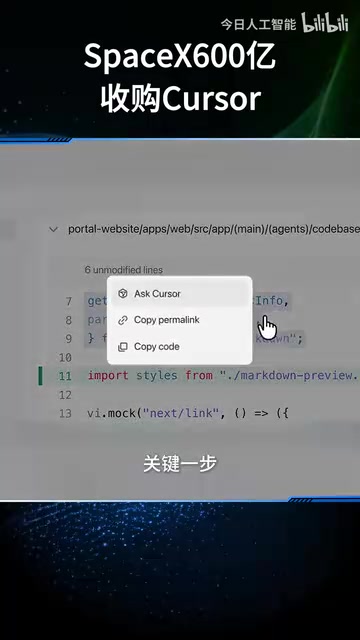
Cursor is an AI-native code editor developed by Anysphere, built on deep modifications to Microsoft's open-source VS Code architecture. Unlike traditional IDE plugins that bolt on AI assistance, Cursor deeply integrates large language model capabilities into every interaction within the editor — from code completion and multi-line editing to cross-file refactoring, allowing users to manipulate codebases directly through natural language commands. Cursor supports multiple underlying models (including GPT-4, Claude, etc.), with its core competitive advantage lying in the depth of code context understanding and the fluidity of the editing experience. Since 2024, Cursor's user base and revenue have grown exponentially, with ARR (Annual Recurring Revenue) reportedly surpassing several hundred million dollars, making it one of the fastest-growing products in the AI coding space.
Why AI Coding Has Become the New Battleground for Tech Giants
Coding Is Where AI First Delivers Commercial Value
The reports repeatedly emphasize one judgment: "Coding is becoming a highly profitable market in AI." This is virtually an industry consensus. Compared to image and video generation tasks, code generation has natural advantages — outputs are verifiable, demand is rigid, and willingness to pay is strong.
The reason AI coding tools became the first scenario where large models achieved commercial viability is closely tied to the unique properties of code generation tasks. First, code correctness can be objectively verified through compilation, testing, and execution, making quality assessment of AI outputs far more deterministic than text or image generation. Second, software developers are among the professional groups with the strongest willingness and ability to pay globally — GitHub Copilot surpassed 1.8 million paid subscribers within two years of launch, proving the rigid demand in this market. Furthermore, enterprise-level procurement provides a scalable revenue path for AI coding tools: a technology company with a thousand engineers might spend millions of dollars annually on coding tools alone. These factors combined make AI coding the vertical market with the highest gross margins and most certain growth in the current large model landscape.
From GitHub Copilot to Cursor, and on to Claude Code, Codex, and a series of other products, the AI coding track has rapidly commercialized over the past two years. Developers are willing to pay for efficiency, and enterprises are willing to make scaled purchases for engineering teams — this creates a high-margin, high-stickiness market. For any company looking to build a moat in AI, capturing the coding entry point means gaining access to a cohort of the most active, highest-value users who are most willing to pay.
A Critical Move to Catch Up with OpenAI and Anthropic
The reports mention that for Musk, this represents "a critical step in catching up with Anthropic and OpenAI." This logic holds. In the arms race of general-purpose large models, competing purely on parameters and benchmarks has reached diminishing returns. What truly creates differentiation is productization and scenario deployment capability.
Anthropic has built its reputation through Claude's coding capabilities, while OpenAI continues to penetrate the developer community through Codex, Canvas, and other products. If Musk's AI business has limited enterprise penetration and has undergone multiple rounds of layoffs and restructuring, then acquiring a ready-made, top-tier product with a massive user base to "take a shortcut" is indeed the fastest way to break through.
From Models to Agents: The Product Evolution Path of AI Coding
Grok Series' Pivot Toward Coding
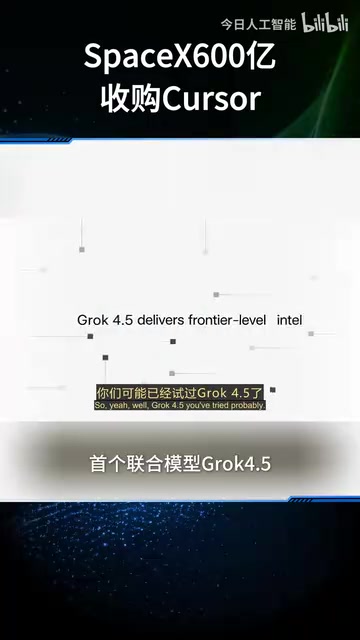
The reports also reveal that before the deal closed, both parties had already launched their first joint model, Grok 4.5, in July, targeting coding, finance, and legal tasks, with a key selling point of "usage costs lower than comparable competitors." This was followed by the release of Grok Bolt, an AI agent-driven product, and the upgraded Grok 4.6.

The evolution path of this product line is clear: from conversational model → vertical domain model → AI agent. Grok 4.5's positioning explicitly targets high-value vertical scenarios like coding, finance, and law, while Grok Bolt as an agent product signifies an upgrade from "answering questions" to "autonomously completing tasks."
AI Agents represent the next evolutionary stage of large model applications. Traditional conversational AI follows a "question and answer" pattern — users ask questions, models return results, and the interaction ends there. AI agents, however, possess capabilities for autonomous planning, tool invocation, and multi-step execution: they can decompose complex tasks into multiple sub-steps, autonomously decide which tools to call (such as code executors, browsers, file systems), dynamically adjust strategies based on intermediate results during execution, and ultimately deliver complete task outcomes. In the coding domain, this means AI is no longer just "helping you write a few lines of code" but can independently complete the entire development workflow of "understanding requirements → designing solutions → writing code → running tests → fixing bugs." OpenAI's Codex, Anthropic's Claude Code, and the Grok Bolt mentioned in the reports are all evolving in this direction.
If Cursor's product interaction is combined with Grok's model capabilities, it could theoretically create an end-to-end AI coding workflow.
The Competitive Intent Behind the Low-Cost Strategy
One detail worth noting: the claim that "usage costs are lower than comparable competitors." In the AI coding track, inference cost is the key factor determining whether a business model can work. Whoever can provide equivalent or even superior capabilities at lower unit cost gains the upper hand in a price war.
In AI coding products, every code completion and every conversational coding session involves large model inference computation, meaning every use of the product generates real compute costs (i.e., inference costs). Taking GPT-4-level models as an example, a single complex code generation task might cost anywhere from a few cents to dozens of cents in inference, and an active developer might trigger hundreds of calls per day. If inference costs are too high, subscription revenue may fail to cover underlying compute expenses, leading to a "the more it's used, the more money is lost" dilemma. Therefore, reducing inference costs has become one of the core competitive dimensions in the AI coding track. Implementation paths include: model distillation (compressing large model capabilities into smaller models), inference optimization (such as KV Cache, speculative decoding, and other techniques), and custom chips to reduce per-unit compute costs.
Low cost + strong capabilities + existing user base — this trifecta is the standard playbook for a latecomer attempting to leapfrog the competition. Of course, whether "low cost" can truly be achieved depends on underlying compute supply and model efficiency, which is another key point mentioned in the reports.
The Dual Ambition of Compute and Commercialization
The reports mention that the company has also signed multiple multi-billion-dollar agreements to provide compute access to Anthropic, Google, and others. This detail is quite interesting — being competitors on one hand while serving as compute suppliers on the other. This "compete yet cooperate" relationship is the true picture of today's AI infrastructure landscape.
The current AI infrastructure landscape exhibits a unique "coopetition" dynamic. Companies with large-scale GPU clusters both use this compute to train and deploy their own models, and sell idle capacity as cloud services to competitors. This model is not uncommon in the industry: Microsoft is both OpenAI's largest investor and compute supplier, while Azure also provides cloud computing services to competitors like Anthropic and Meta. The underlying logic of this coopetition relationship is that GPU clusters have extremely high fixed costs (a 10,000-GPU cluster can cost billions of dollars to build), and only by maximizing utilization can costs be amortized. Therefore, renting compute to external customers is an economically rational choice.
Even more striking is the bold prediction: "By September this year, AI revenue is expected to surpass all other businesses combined." If placed within Musk's overall commercial landscape, this means AI has transformed from a cash-burning R&D project into a potential core revenue engine. This also explains why such heavy bets are being placed on the high-margin coding track — for AI to be profitable, it must find scenarios that can be monetized at scale, and coding is currently one of the most certain answers.
Conclusion: Beyond Truth or Fiction, Industry Trends Are Irreversible
Returning to the original question, this "$60 billion Cursor acquisition" news has questionable details, and readers should remain cautious. But peeling away the shell of rumor, the industry logic reflected at its core is real and clear:
First, AI coding has become the focal battleground for large model vendors. Second, acquiring mature products to fill scenario gaps is a common strategy for giants chasing market leaders. Third, from models to agents, from technology to commercialization, the entire industry is accelerating value realization.
Regardless of whether this deal actually happened, one thing is certain — on the AI coding track, a true gamble of capital and technology has already begun.
Related articles

Why Does the Tesla Roadster Need to Fly? A Deep Dive into Musk's Wild Demo
Tesla's Roadster launch showed wall-climbing, upside-down driving, and flying stunts—but The Vergecast notes the demo car may lack a battery, the Rocket version is invite-only and not street-legal, and the website terms don't guarantee delivery. After nine years of delays, why does this car still need to exist?

AI Is Not a Replacement: Human-AI Collaboration Through the Lens of Factory Root Cause Analysis
Starting from factory root cause analysis, this article explains how AI accelerates evidence chain construction rather than replacing human experts, exploring the pragmatic implementation logic and business value of 'AI supporting people rather than replacing them.'

AI Agent Decision Auditing: Building an Evidence Chain in Regulated Workflows
Starting from a Reddit discussion, this article analyzes three core issues in AI agent decision auditing within regulated workflows: what fields audit records should contain, how to handle feedback latency for erroneous decisions, and how to continuously calibrate LLM judge consistency with human judgment.