The Fascinating Real-World Counterparts of OpenAI Gym Reinforcement Learning Environments
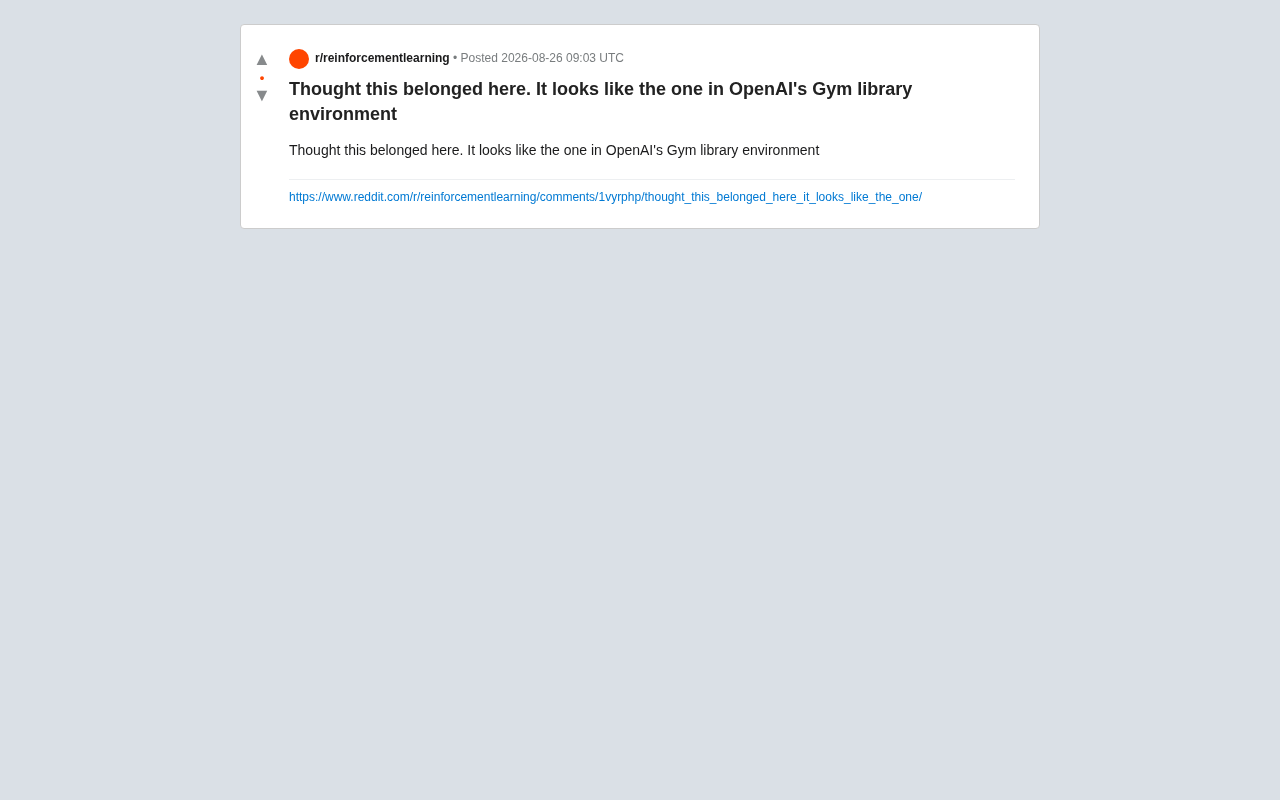
A Reddit photo reveals how OpenAI Gym's RL environments are rooted in real-world physics.
Inspired by a Reddit post comparing a real-world scene to an OpenAI Gym environment, this article explores how classic RL environments like CartPole and MountainCar originate from real physics problems. It covers Gym's role as a standardized benchmark, the importance of simulation for safe RL training, the Sim-to-Real Gap challenge, and how embodied AI is pushing environments toward greater realism.
A Photo That Sparked Reinforcement Learning Associations
Recently, a Reddit user shared a photo of a real-world scene, marveling at how it looks identical to a classic reinforcement learning environment from the OpenAI Gym library. This seemingly lighthearted post reflects an interesting phenomenon in the Reinforcement Learning (RL) field: the simulation environments abstracted as algorithm testing benchmarks often have their origins in the real world around us.
For developers familiar with RL, OpenAI Gym is almost invariably the first stop when getting started. It provides a series of standardized testing environments—from the classic CartPole and MountainCar to Atari games and robot control tasks—helping researchers compare different algorithms under a unified interface. When someone discovers a physical scene in everyday life that closely resembles one of these environments, that knowing smile of "the model comes from reality" naturally emerges.
Reinforcement learning is one of the three major paradigms of machine learning (alongside supervised learning and unsupervised learning), with its core idea originating from operant conditioning theory in behavioral psychology. In the RL framework, an Agent learns optimal policies through interaction with an Environment: at each step, the agent observes the current State, selects an Action, and the environment returns a new state and a Reward signal. The agent's goal is to maximize long-term cumulative reward. This process is typically modeled as a Markov Decision Process (MDP), defined by a five-tuple of state space, action space, transition probabilities, reward function, and discount factor. It is precisely this elegant yet powerful mathematical framework that enables RL to be applied across a wide range of scenarios, from games to robot control.
What is OpenAI Gym: A Standardized Benchmark for Reinforcement Learning
A Unified Interface That Lowers the Research Barrier
OpenAI Gym (now community-maintained and renamed Gymnasium) is an open-source toolkit released in 2016. Its core value lies in providing a unified environment interface for reinforcement learning. Regardless of the task type, developers can interact with environments through standard methods like env.reset(), env.step(action), and env.render().
Gym was released by OpenAI in April 2016, created against the backdrop of a lack of unified experimental benchmarks in the reinforcement learning field, which made it difficult to reproduce and compare results across different research teams. In 2022, as OpenAI shifted its research focus to large language models, Gym's maintenance was transferred to the Farama Foundation and renamed Gymnasium. The Farama Foundation also maintains a series of related projects, including PettingZoo (multi-agent environments), MiniGrid (grid world environments), and more, forming a complete reinforcement learning experimental ecosystem. Gymnasium maintains backward compatibility while fixing numerous known issues from the original Gym and introducing stricter type checking and API specifications.
This standardization dramatically lowered the barrier to research. Before Gym, different papers used wildly different experimental environments, making it nearly impossible to compare algorithms horizontally. Gym made "getting your first agent running on CartPole" a milestone for many learners and established a common foundation for fair algorithm comparison.
Real-World Physical Prototypes Behind Classic Environments
Many environments in Gym are directly derived from classic control theory problems:
- CartPole (Inverted Pendulum): Control a cart moving left and right to keep a pole balanced upright—a classic case study in automatic control courses.
- MountainCar: An underpowered car needs to swing back and forth to build momentum before it can reach the hilltop.
- Pendulum: Apply torque to swing a pendulum to the vertically upward position and maintain balance.
These environments have deep roots in classical control theory. The CartPole problem can be traced back to control theory research in the 1960s and serves as a classic test platform for verifying control algorithm stability. Traditional methods like PID control and LQR (Linear Quadratic Regulator) can precisely solve the linearized inverted pendulum problem, but the advantage of reinforcement learning is that it requires no pre-established precise system dynamics model—the agent discovers the optimal control policy entirely through interaction with the environment. The MountainCar problem was proposed by Andrew Moore in his 1990 doctoral thesis to demonstrate the effectiveness of value function approximation methods in continuous state spaces. Although these problems are low-dimensional and physically simple, they contain core RL challenges such as Credit Assignment and the Exploration-Exploitation Tradeoff—the sparse rewards in MountainCar particularly test an algorithm's exploration capability.
These environments have endured because they are simple enough to understand yet contain core reinforcement learning challenges such as nonlinear dynamics and delayed rewards. When someone sees a similar physical device in real life and immediately thinks of the corresponding simulation environment, it demonstrates that these abstract models were well-designed—they precisely capture the essential features of real-world problems.
Why Simulation Environments Are Critical for Reinforcement Learning
A Safe and Inexpensive Space for Trial and Error
Reinforcement learning training often requires massive trial-and-error iterations. Having robots repeatedly fall over or autonomous vehicles constantly crash in the real world is both expensive and risky. Simulation environments provide a safe, inexpensive, and infinitely repeatable testing ground where agents can rapidly complete policy learning.
The development of modern high-fidelity physics simulation platforms has greatly expanded the capability boundaries of simulation training. MuJoCo (Multi-Joint dynamics with Contact) is a physics simulation engine developed by Emo Todorov, specifically designed for robot control and biomechanics research, capable of efficiently simulating complex physical phenomena such as contact forces, friction, and tendons. In 2021, DeepMind acquired MuJoCo and open-sourced it, greatly advancing robot reinforcement learning. NVIDIA's Isaac Gym leverages GPU parallel computing capabilities to run thousands of simulation instances simultaneously, improving training speed by several orders of magnitude. Additionally, platforms like PyBullet, Drake, and Habitat serve different application scenarios. The common trend among these platforms is pursuing higher physical fidelity and faster simulation speed—from the simple 2D physics of the Gym era to today's realistic 3D contact dynamics, the leap in simulation capabilities has directly driven RL algorithms from toy problems to real-world applications.
Sim-to-Real Gap: The Transfer Challenge from Simulation to Reality
However, there is always a "Sim-to-Real Gap" between simulation and reality. No matter how realistic a simulation environment is, it cannot fully replicate the complex factors in the real world such as friction variations, sensor noise, and lighting interference. How to successfully transfer policies trained in simulation to real scenarios has been a core research topic in robot learning.
Mainstream approaches to addressing the Sim-to-Real Gap include Domain Randomization, Domain Adaptation, and System Identification. The core idea of Domain Randomization is to heavily randomize the physical parameters of the simulation environment during training (such as mass, friction coefficients, delays, etc.), forcing the agent to learn policies that are robust to environmental variations. OpenAI used this method in 2019 to train a robotic hand to solve a Rubik's Cube, becoming a landmark case—policies from simulation were directly deployed to a real robotic hand without additional adjustment and successfully completed the task. Domain Adaptation borrows from transfer learning, aligning feature distributions between simulation and reality through adversarial training and other methods. In recent years, the maturation of Digital Twin technology has also provided new pathways for closing this gap, maintaining synchronization between simulation models and real systems through continuous calibration.
Real-World Scenarios Informing Simulation Design
The Reddit user's observation also reminds us from a different angle: excellent simulation environment design is fundamentally a high-quality mathematical abstraction of the real world. Researchers need to extract key principles from everyday physical phenomena and transform them into trainable environments to build valuable learning benchmarks.
With the rise of Embodied AI, an increasing amount of research emphasizes the realism and diversity of environments. Embodied AI emphasizes that agents must acquire knowledge through physical interaction with their environment rather than learning solely from static data. This direction experienced explosive growth in 2023-2024 as large language models were combined with robotics. Representative works include Google's RT-2 (applying vision-language models to robot control), humanoid robots from Figure AI and 1X Technologies, and Stanford's Mobile ALOHA low-cost bimanual manipulation system. These systems typically combine large-scale simulation pre-training with small amounts of real-world fine-tuning, reflecting the evolution from the simple environments of the Gym era to complex real-world tasks. From Gym to MuJoCo, Isaac Gym, and various high-fidelity physics simulation platforms, reinforcement learning training environments continue evolving toward greater realism.
The AI Community Culture Behind a Small Post
This post doesn't contain particularly deep technical content, but it reflects a unique cultural atmosphere in the AI community: practitioners and enthusiasts have internalized the reinforcement learning mindset into their everyday observations of the world. Seeing a physical scene and immediately thinking "which RL environment does this resemble?"—this mental habit embodies the unique appeal of this field.
For beginners, this is also a valuable insight: reinforcement learning isn't distant—it's hidden in the physical world we experience every day. Understanding CartPole means understanding how to make continuous decisions under uncertainty; understanding MountainCar means understanding why sometimes you need to "take a step back to move forward" to achieve a goal. The mathematical principles behind these intuitions—the optimal substructure described by the Bellman equation, the optimization of long-term returns through policy gradient methods—are precisely the bridge that transforms human intuition into computable algorithms.
Conclusion
An ordinary real-world photo evoked the community's collective memory of OpenAI Gym's classic environments. Behind this is a sign of reinforcement learning maturing as a discipline—its abstract models have become deeply rooted in reality, serving as a universal language for researchers to understand the world and build intelligent agents. Regardless of how technology evolves, the cycle of distilling problems from reality, iteratively refining in simulation, and returning to reality for validation remains the inevitable path for AI toward practical application.
Related articles

M&M's Spent Millions Replacing Artificial Blue Dye — Why Is It So Hard?
Mars spent millions trying to replace artificial blue dye in M&M's with spirulina, but thick material clogs pipes and residue risks mold, forcing a full production-line rebuild. Here's the engineering behind the reformulation.
Teammate Wanted for Meta Global AI Developer Hackathon: Computer Vision & Medical AI
A Reddit developer seeks teammates for the Meta Global AI Developer Hackathon, focusing on computer vision and medical AI. This article analyzes the track logic, skills-complementarity needs, and topic selection strategy behind this teaming signal.
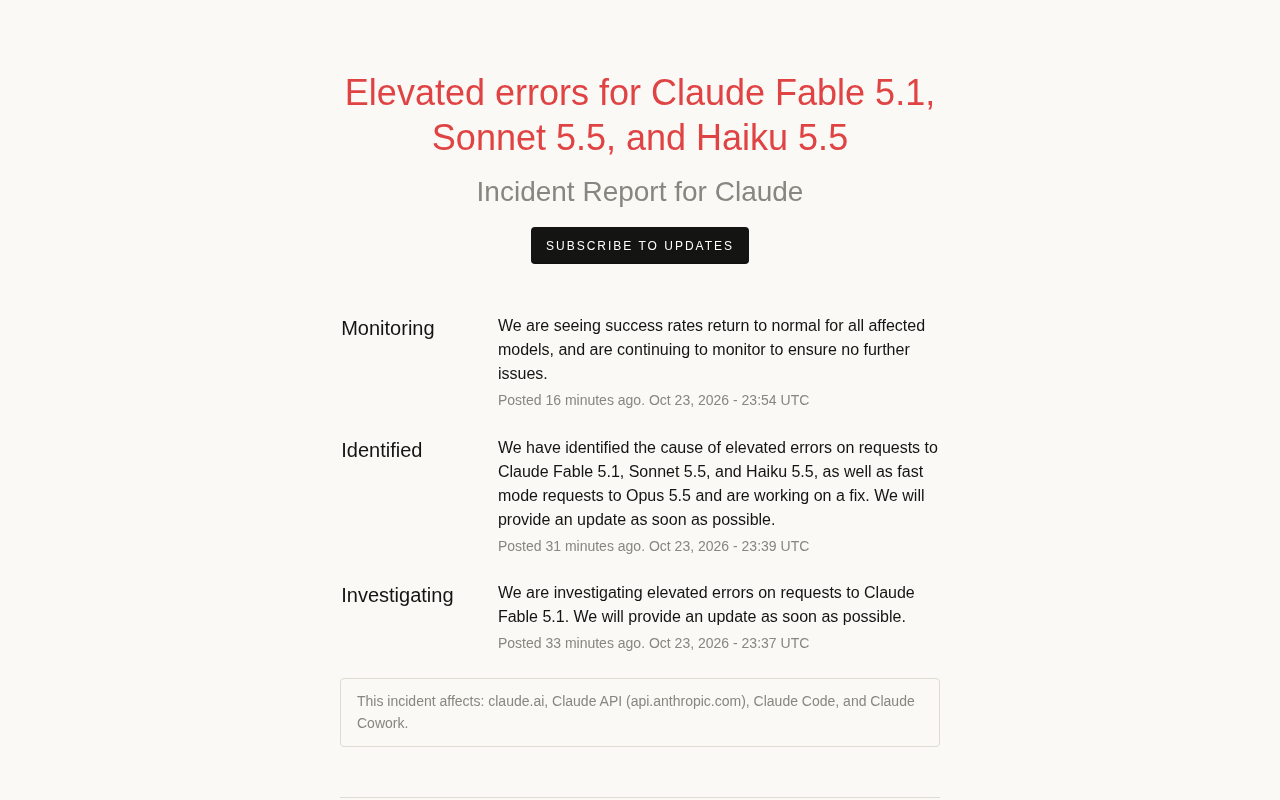
Multiple Claude Models Hit by Errors: A Postmortem of Fable 5.1, Sonnet 5.5, and Haiku 5.5
Claude Fable 5.1, Sonnet 5.5, Haiku 5.5, and Opus 5.5 fast mode saw elevated errors; Anthropic identified and resolved the issue in 17 minutes. This postmortem covers the timeline, the technical reasons for the multi-model cascading failure, and practical lessons for retry and degradation strategies.