Vois 2.0 Review: Unlimited Voice Synthesis for $10/Month — Can It Replace ElevenLabs?
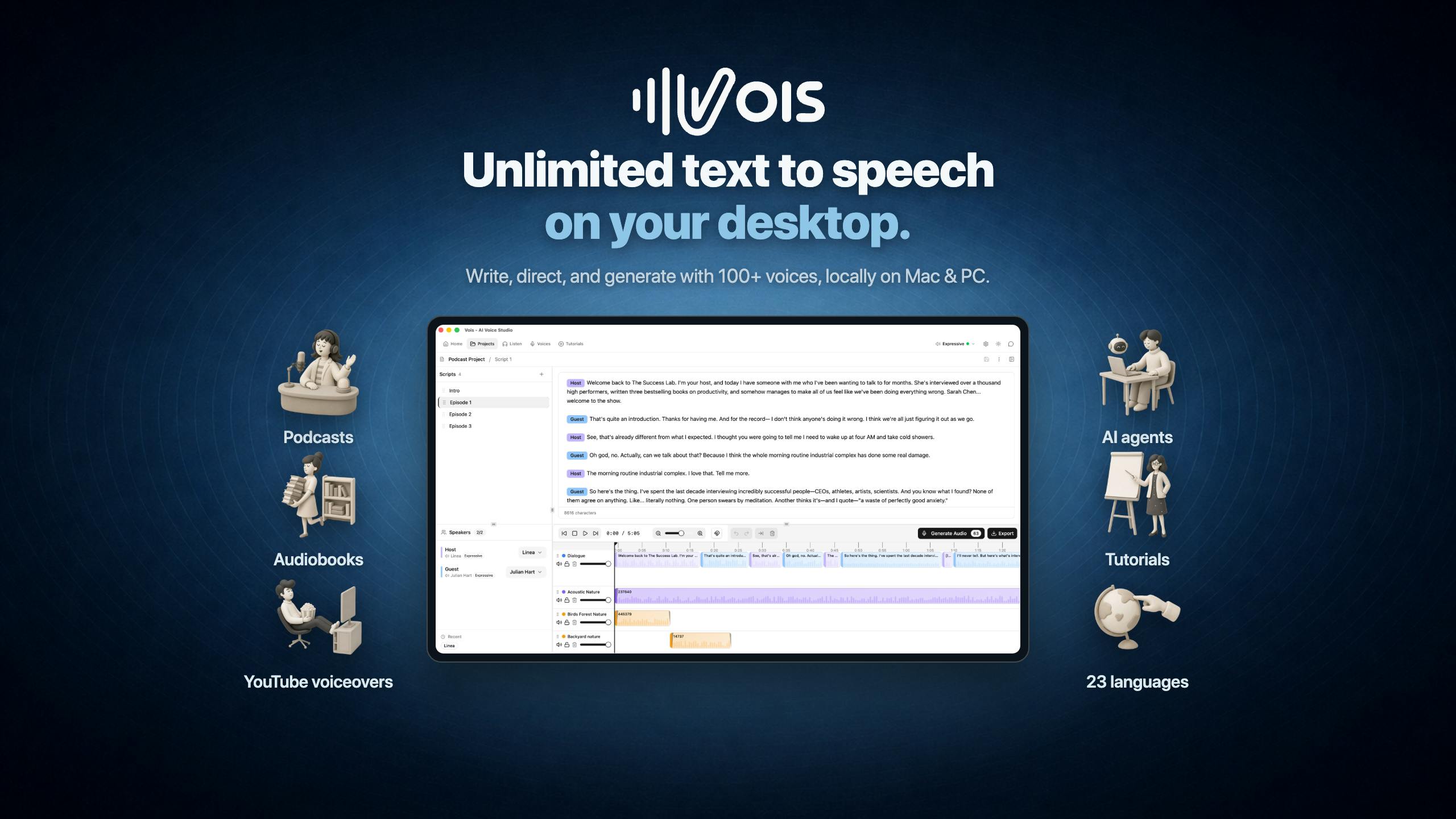
Vois 2.0 offers unlimited AI voice synthesis at $10/month, positioning itself as a budget ElevenLabs alternative.
Vois 2.0 is a desktop AI text-to-speech tool that eliminates per-character billing with unlimited generation for $10/month. It features 100+ voices, ethical voice cloning, a multi-speaker timeline, mastering tools, CLI for AI Agents, and support for up to 600+ languages. While its fixed pricing model appeals to high-volume creators, questions remain about voice quality compared to cloud-based competitors like ElevenLabs.
A New Competitor in Desktop Voice Synthesis
In the AI voice synthesis space, ElevenLabs has long been considered the gold standard — but its per-character billing and token-consumption business model has always been a pain point for creators. Founded in 2022 by former Google and Palantir engineers, ElevenLabs quickly became an industry benchmark with its highly realistic neural network voice synthesis technology. Its core technology is based on large-scale Transformer models capable of generating speech nearly indistinguishable from real humans. However, free users get roughly 10,000 characters per month, while paid plans range from $5 to hundreds of dollars. For users who need high-volume generation, a 100,000-word audiobook could consume tens of dollars in credits — a significant cost burden.
Recently launched on Product Hunt, Vois 2.0 has entered the market positioning itself as an "ElevenLabs alternative," with one highly attractive selling point — unlimited generation.
According to its Product Hunt page, Vois 2.0 received 78 upvotes after launch, ranking #15 for the day, and was categorized under Productivity, Artificial Intelligence, and Audio. Its creator is Praney Behl.
Core Selling Point: Unlimited Generation Without Usage-Based Billing
Vois 2.0's most direct differentiator lies in its pricing logic. Unlike mainstream cloud-based TTS services, Vois is a desktop application where subscribers enjoy unlimited text-to-speech: no tokens, no usage meter, and no per-character fees.
The technical foundation of this model is worth understanding in depth. Cloud-based TTS services run speech synthesis inference on servers, with users accessing results via API calls. The advantage is freedom from user device limitations and access to the most advanced large models; the downside is network latency and ongoing operational costs. Desktop TTS downloads models locally for inference, leveraging the user's own CPU/GPU computing power. Once the model is deployed, there's no need for ongoing server expenses. This is precisely the technical basis enabling Vois to offer "unlimited generation" — the marginal cost is transferred to the user's hardware resources. However, local models typically need to compromise on parameter scale and generation quality to accommodate consumer-grade devices.
For creators who need to generate voice content in large volumes, this model means cost predictability. With traditional per-character billing services, costs can quickly accumulate to prohibitive levels when producing long-form audiobooks or podcast series. Vois fundamentally changes this cost structure by covering all generation needs under a fixed subscription price.
Feature Matrix: More Than Just a Simple TTS Tool
Vois 2.0 isn't a single-function voice generator — it has built a relatively complete audio creation toolchain.
Voice Library and Voice Cloning
The product offers over 100 preset voices covering various timbres and styles to meet narration needs across different scenarios. It also includes a built-in voice cloning feature, emphasizing "consent built in" — a particularly meaningful detail given the current frequent controversies around AI voice ethics, indicating the developers are attempting to balance technical capability with compliant usage.
AI voice cloning technology allows replicating a person's vocal characteristics from just a few seconds to a few minutes of audio samples, which creates serious ethical and legal risks. In 2024, the U.S. FTC issued warnings about AI voice cloning being used for fraud, and multiple states have enacted targeted legislation. "Built-in consent mechanism" means the product requires users to prove they've obtained explicit authorization from the person being cloned during the cloning process, typically through recording specific confirmation statements or uploading written consent forms. Competitors like ElevenLabs and Resemble AI also strengthened similar compliance measures during 2023-2024, making this an industry baseline requirement.
Multi-Speaker Timeline and Audio Post-Processing
Vois features a multi-speaker timeline that allows users to arrange dialogue between multiple characters within the same project — particularly useful for producing podcast interviews, game NPC dialogue, or audio dramas. A multi-speaker timeline is a visual editing interface that allows users to arrange voice segments from different characters on a timeline, controlling the start/end times, spacing rhythm, and overlap of each segment. This feature is common in professional audio production software like Adobe Audition and Descript, but is uncommon in TTS tools. Its core value lies in enabling non-professional users to arrange multi-character dialogue without learning a DAW (Digital Audio Workstation), significantly lowering the production barrier for audio dramas and podcast interview content.
Additionally, it provides mastering and export functionality, creating a closed-loop workflow from generation to finished product. Mastering originates from the music production industry and is the final processing stage before audio publication, including EQ adjustments, dynamic compression, loudness normalization, and stereo optimization. In TTS voice scenarios, mastering primarily addresses unifying volume levels across different voice segments, eliminating frequency irregularities that AI generation may introduce, and ensuring output meets the loudness standards of various platforms (such as Spotify podcasts, YouTube) — typically -14 to -16 LUFS. Built-in mastering means users don't need to additionally use professional plugins like iZotope Ozone, further simplifying the workflow.
CLI Interface for AI Agents
A noteworthy technical feature is that Vois provides a command-line interface (CLI) that can be directly called by AI Agents. CLI (Command Line Interface) is a way of operating software through text commands rather than a graphical interface, with its core advantage being programmability and automation capability. In the AI Agent ecosystem, a CLI interface means automation frameworks like AutoGPT, LangChain, or custom scripts can directly invoke Vois for speech synthesis without manual intervention through a graphical interface.
This design aligns with current AI automation workflow trends, enabling voice generation to be integrated into larger automation pipelines. Typical use cases include: an AI Agent automatically converting LLM-generated scripts into voice and uploading them to podcast platforms, or a game engine synthesizing NPC voices in real-time based on dynamically generated dialogue text. This design philosophy is highly aligned with the 2024-2025 "Agentic AI" industry trend — increasingly, tools no longer serve only human users but simultaneously exist as callable nodes within AI Agent toolchains.
Multilingual Support: Up to 600+ Languages
Language Coverage
The standard version supports 23 languages, while the Pro version's Omni engine claims support for over 600 languages. TTS systems supporting 600+ languages are typically trained on multilingual foundation models. Representative technologies include Meta's MMS (Massively Multilingual Speech) project, which covers 1,100+ languages. These models achieve broad coverage through self-supervised pretraining on massive multilingual data, followed by fine-tuning for individual languages.
However, it's important to note that voice quality for minority languages is often far below that of resource-rich languages like English. The 600+ figure represents more of a technical feasibility than commercial maturity across all languages. For users who truly need high-quality multilingual output, it's advisable to focus on evaluating actual performance in target languages rather than being attracted by the total number. Nevertheless, such extensive language coverage gives Vois the potential to serve globalized content creation, particularly suited for educational and media projects requiring multilingual localization.
Typical Use Cases
According to official descriptions, Vois has been applied across multiple content creation fields:
- Audiobook production
- Podcast production
- Faceless YouTube video voiceovers
- Game NPC voices
- Tutorial and online course narration
The official site also mentions that creators from well-known companies are among its users, attempting to establish trust through social proof.
Pricing Strategy: $10/Month with Lifetime Price Lock
Vois 2.0 has launched with aggressive pricing: $10 per month, with the price locked for the lifetime of the subscription. This "lifetime price lock" promotional tactic is a common strategy for startup products to rapidly acquire early users, with obvious appeal to price-sensitive independent creators.
However, the unlimited generation business model also carries potential concerns. TTS inference itself incurs computing costs. If using cloud-based generation, long-term unlimited supply creates significant cost pressure on the service provider; if using local computing, it places certain requirements on user device performance. Taking current mainstream neural network TTS models as an example, real-time high-quality voice generation typically requires at least 8GB of RAM and a CUDA-capable discrete GPU, while pure CPU inference may require several times real-time processing time. Whether the product can find a balance between low pricing and sustainable operations remains to be proven over time.
Conclusion: Can Vois 2.0 Challenge ElevenLabs' Position?
From a product positioning perspective, Vois 2.0 precisely targets the soft spot of mainstream services like ElevenLabs — billing anxiety. Through its combination of desktop delivery, unlimited generation, CLI integration, and multilingual support, it offers high-volume content creators a more cost-predictable option.
For podcasters, YouTubers, and indie developers struggling with voice generation costs, Vois 2.0 is at least worth trying. But as with all startup tools, the actual voice quality performance, naturalness of cloning, and long-term service stability are what will ultimately determine whether it can truly challenge ElevenLabs' position. In the fiercely competitive AI voice synthesis space, a sincere disruptor is always good news for creators.
Related articles

Build an AI Super Employee System at Zero Cost: A Full Breakdown of Automated Agent Workflows
A deep breakdown of the AI super employee system demoed on Bilibili: agent orchestration, digital human voiceovers, map and enterprise lead generation, 24/7 customer service, and legal modules. We analyze the business logic and compliance risks behind zero-cost signup to help entrepreneurs judge the real ROI of this AI digital employee system.

The Essential Difference Between Chatbots and AI Agents: Crossing from Conversation to Execution
What's the difference between a chatbot and an AI agent? Based on the MCP series on the Learn Tech channel, this article uses examples like booking flights and summarizing notes to explain: a chatbot only gives answers, while an agent actually completes tasks through a think-act-observe loop. It breaks down the four core components—model, tools, memory, and goal—as well as MCP's role as a bridge, and discusses agents' applicable boundaries and permission risks.

Free GitHub Repo: 342 Hours of AI Courses, from Math to MCP Servers
A free GitHub repo offers 342 hours of AI courses: 523 lessons across 20 phases, from math fundamentals to agent building and MCP servers. Nearly 100,000 learners have started.