64-Microphone Acoustic Camera Hands-On: Seeing Sound for $800

The $800 TD2E acoustic camera uses a 64-mic array to visualize sound in real time—accurate localization, but weak software ecosystem.
The author bought the $800 TD2E acoustic imaging camera for a hands-on test. Its 64 rear-facing microphones localize sound sources via array algorithms and overlay the results on the camera feed as a color heatmap, accurately pinpointing speech at the mouth and a 9000 Hz pure tone from a single phone speaker. With a 2000–100000 Hz range covering ultrasound, it suits gas leak and mechanical noise inspection, and includes a bright fill light. The trigger shutter feels good, but photos are only 0.3 MP and the labeled HDMI port is missing. Good for maintenance and teaching, not casual buyers; hardware is solid but software and data analysis need work.
Unboxing: A Camera That Can "See" Sound
While browsing Amazon, a device priced at $800 caught my eye—the TD2E Acoustic Imaging Camera. It claims to visualize sound sources in real time, which sounds like a prop from a sci-fi movie, yet the price falls within the consumer-grade range. Out of curiosity, I ordered one to find out whether it's real technology or just marketing hype.
After unboxing, I found a 5000 mAh rechargeable battery included, which clicks directly into the bottom of the body. The build quality is more solid than expected, and the dense perforations on the back cover are the core of the device—an array of 64 microphones. When powered on, the screen lights up with a clean interface and no unnecessary bells and whistles.
How It Works: Sound Source Localization and Visual Overlay
The logic behind this camera isn't complicated: the 64 rear-facing microphones pick up sound simultaneously, an acoustic array algorithm calculates the direction of the sound source, and the localization result is overlaid on the camera feed as a color heatmap. Wherever you look, the sound in that direction "lights up" on the screen.
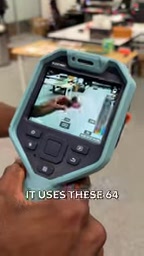
In actual testing, when I spoke toward the camera, the sound source marker landed precisely on my mouth. When I switched to a single phone speaker playing a 9000 Hz pure tone, the corresponding frequency spike was clearly visible on screen—the localization accuracy is sufficient to distinguish a single sound-emitting unit. This "what you see is what you hear" feedback is very intuitive, especially for tracking down abnormal noises that are invisible to the naked eye.
The core of an acoustic array algorithm is beamforming: because sound reaches different microphones at slightly different times (phase differences), the algorithm uses delay-and-sum or frequency-domain processing to make signals from a specific direction add in phase while canceling signals from other directions, thereby "pointing" at the sound source. The more microphones and the larger the array aperture, the higher the spatial resolution. A two-dimensional array of 64 microphones can form multiple beams simultaneously, enabling real-time scanning across a wide field of view. A traditional sound level meter can only give a single sound pressure value, whereas an acoustic camera outputs the spatial distribution of sound sources—that is the most fundamental difference between the two.
Frequency Response: Detection Beyond the Limits of Human Hearing
The TD2E's pickup range extends from 2000 Hz all the way to 100000 Hz. This means it can capture not only sounds within the audible range of human hearing, but also detect the ultrasonic band—acoustic signals that we cannot hear at all but that genuinely exist.
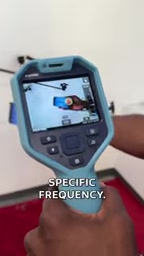
This feature takes it out of the "toy" category. In industrial inspection scenarios, high-pressure gas leaks and mechanical bearing wear often produce high-frequency noise that the human ear can barely detect, but an acoustic camera can locate them quickly. The bright fill light it comes with also confirms this positioning—it's not for taking atmospheric photos, but for seeing equipment details clearly in dim machine rooms and pipe galleries.

The ultrasonic band generally refers to sound waves above 20 kHz, which the human ear cannot perceive; however, high-frequency sound waves attenuate quickly in air and are highly directional, making them ideal for precise localization. In industrial settings, compressed air leaks, electrical discharges (such as corona), and early-stage bearing wear all produce significant energy in the 20–100 kHz range. By detecting this band, an acoustic camera essentially turns "inaudible faults" into hot spots on the screen. Note that ambient high-frequency noise will also be picked up, so in practice you often need to combine frequency-band filtering and threshold settings to eliminate interference.
Operational Details: Shutter, Storage, and One Small Regret
There's a trigger-style shutter on the side of the body, and the feel of pulling it is unexpectedly satisfying. However, its photo specs are rather restrained: single 0.3-megapixel photos saved to a Micro SD card. The top flap is printed with three labels—Micro SD, USB, and HDMI—but when I opened it, I only found the first two ports. The HDMI port doesn't exist—possibly a batch difference or a leftover from a shared mold design.
This omission doesn't affect core functionality, but if you plan to connect an external monitor for live demonstrations, you'll need to find another solution. As for battery life, the 5000 mAh battery is more than adequate for routine inspection work; the exact duration depends on screen brightness and how often the fill light is used.
Who Should Buy This Device?
$800 is no small sum, and the TD2E is clearly not intended for ordinary consumers to try out. Its value is concentrated in two scenarios: first, equipment maintenance and industrial inspection, quickly locating leak points or abnormal noise sources and saving the time of checking one by one; second, acoustic research and teaching demonstrations, turning abstract sound wave distributions into visual images to help students understand acoustic concepts.
If you just want to "see what sound looks like," renting one or watching demo videos is enough. But if you need a high-frequency, on-site sound source localization tool, this 64-microphone array camera's portability and real-time capability genuinely provide spatial information that a traditional sound level meter cannot.
Its shortcomings are equally obvious: low photo resolution, ports that don't match the labels, and a lack of a software ecosystem for analyzing exported data. As an early consumer-grade acoustic imaging product, the hardware foundation is decent, but the software experience still needs polish.
The commercialization background of acoustic imaging is worth mentioning: such devices were initially brought to the industrial market by manufacturers like Fluke and FLIR, typically priced in the thousands to tens of thousands of dollars. The TD2E enters at $800, essentially "consumer-electronifying" professional instruments—trading a smaller array and simplified software for a lower price. The cost is compromises in resolution, sensitivity, and the depth of analysis software. For small maintenance teams or teaching institutions with limited budgets, this trade-off is reasonable; but for professional users who need to issue inspection reports and perform trend analysis, the lack of a supporting software ecosystem is the real barrier.
One-line Summary
800美元的TD2E声学相机用64麦克风阵列实时可视化声源,定位精准但软件生态薄弱。
Paragraph Summary
作者自费800美元购入TD2E声学成像相机进行实测。该设备通过后置64个麦克风组成的阵列拾音,经声学算法计算声源方向,并以彩色热力图叠加在摄像头画面上,实测可精准定位嘴部说话声和单个手机扬声器的9000赫兹纯音。其频响范围达2000至100000赫兹,覆盖超声波频段,适用于气体泄漏、机械异响等工业巡检场景,机身还配有高亮补光灯。操作上一处扳机式快门手感不错,但拍照仅0.3百万像素,顶部标识的HDMI接口实际缺失。作者认为它适合设备维护与声学教学,不适合普通消费者尝鲜,硬件底子不错但软件生态和数据导出分析能力仍需打磨。
Related articles
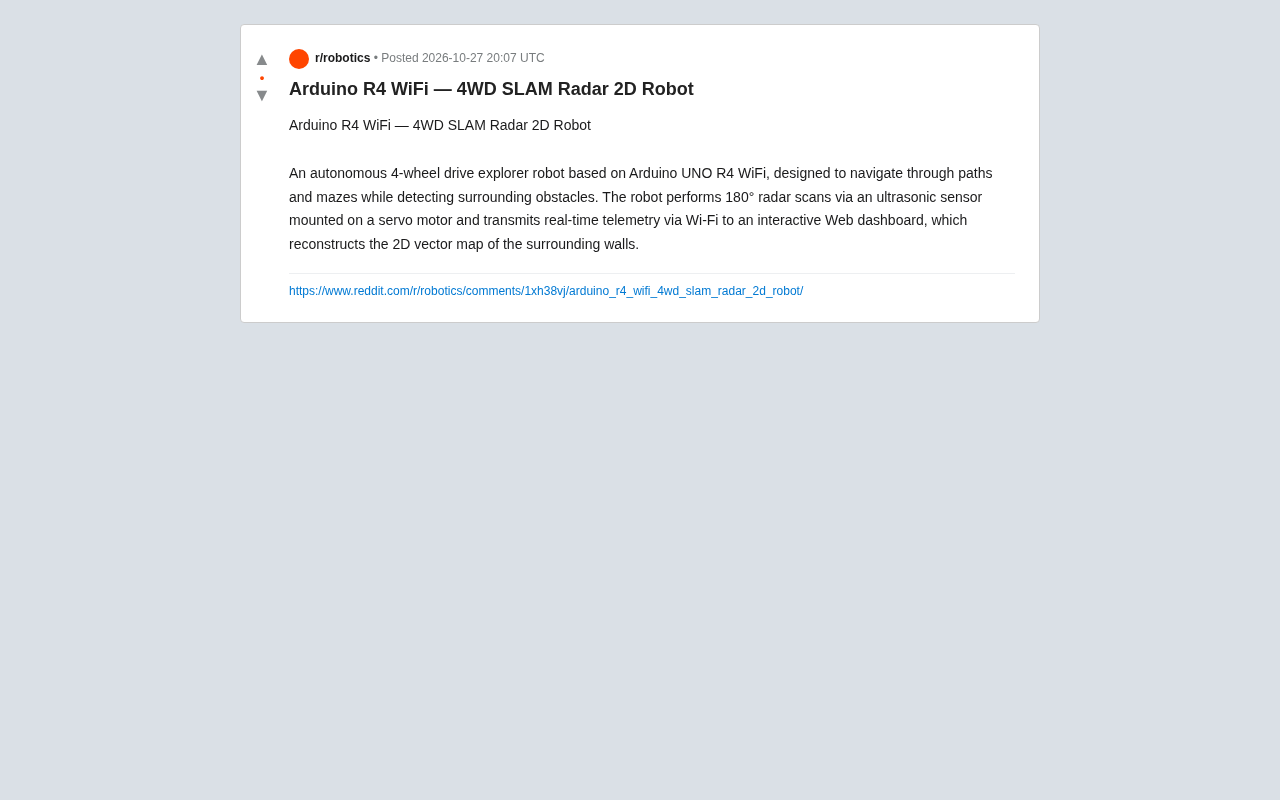
Building a 4WD SLAM Radar Robot with Arduino R4 WiFi
A Reddit maker shares a 4WD SLAM radar robot based on Arduino UNO R4 WiFi: a servo-mounted ultrasonic sensor performs 180° scanning, sends telemetry over Wi-Fi to a web dashboard, and reconstructs a 2D vector wall map in real time—a low-cost entry-level validation of simultaneous localization and mapping.
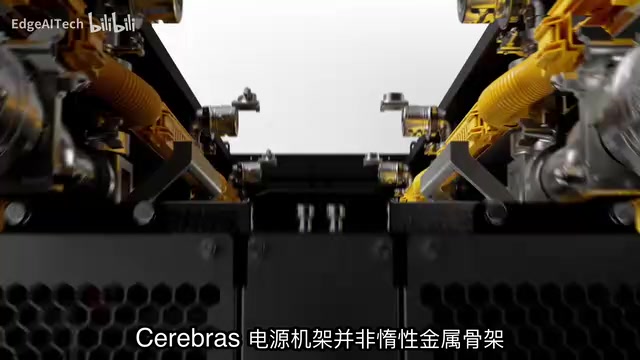
Cerebras CS-4 Stuns with Launch: The 4-Trillion-Transistor Wafer Monster That Crushes GPUs in Inference Speed
Cerebras CS-4 wafer-scale engine launched: 4 trillion transistors, 900,000 AI cores, inference an order of magnitude faster than GPUs. Modular power rack plus compute backpack design, 3D vertical stacking, and half-millimeter power delivery—online in minutes.

Apple's M6 Chip Lands in iMac: A Week in Review of Performance Upgrades and AI Controversy
Apple launches new iMac and MacBook Pro with M6 chip, N1 wireless chip brings speed gains; OpenAI claims three major discoveries but faces academic skepticism; data centers become a U.S. midterm election issue; Anduril teams up with Qualcomm for all-American laptops.