67K GitHub Stars: A Closer Look at byoungd's "Life Advancement Guide" Repository

GitHub's byoungd/up hits 67K Stars by aggregating AI learning, English, and personal growth resources.
The GitHub repository `byoungd/up` has surged to 67,402 Stars with nearly 2,800 new Stars in a single week, blending life advancement, AI learning, and English learning into one structured guide. The article explains that high Star counts primarily reflect visibility rather than depth of use, and that weekly growth and Fork counts are better indicators of real momentum. Readers are advised to evaluate such repositories by update frequency, originality, and community discussion quality — and to treat any guide as a map rather than a destination, validating content through hands-on practice.
A GitHub Repo That Went Viral
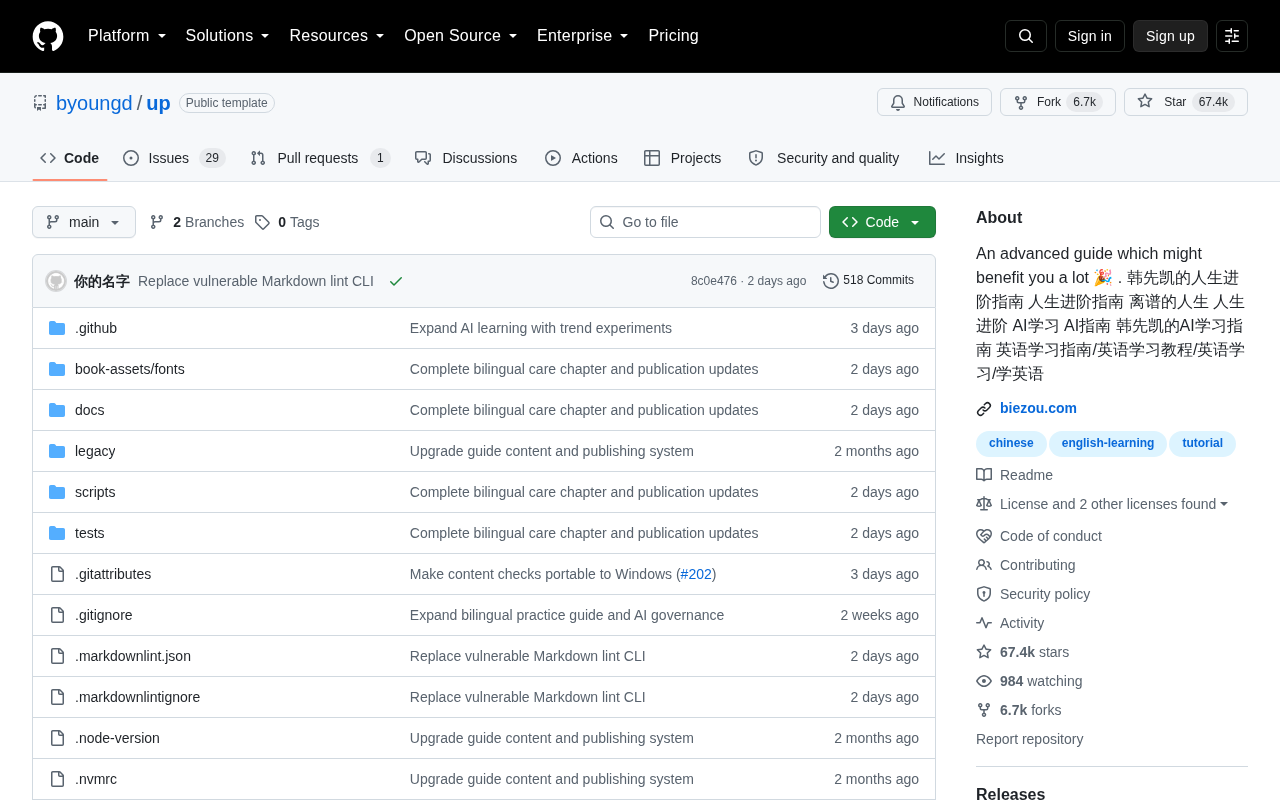
A GitHub repository called byoungd/up has been turning heads lately. Its description is intriguing — "An advanced guide which might benefit you a lot 🎉" — accompanied by a collection of Chinese-language tags spanning topics like "Life Advancement Guide," "AI Learning," "AI Guide," and "English Learning Tutorial."
The numbers speak for themselves: the project has accumulated 67,402 Stars, 6,687 Forks, and gained 2,827 new Stars in a single week during the tracking period. That kind of growth puts it firmly in the top tier of the open-source community, signaling that it has resonated with a remarkably broad audience. The primary language is listed as JavaScript.
What It Is: A Learning Resource Aggregator
Based on its title and tags, this repository tries to bring together several distinct learning needs under one roof: personal growth ("life advancement," "unconventional life paths"), AI-related learning paths ("AI learning guide"), and language acquisition ("English learning tutorial," "learn English").
This "broad and comprehensive" approach to content aggregation is far from unusual in GitHub's Chinese-speaking tech community. Repositories like awesome-xxx series and various "learning roadmap" projects have long dominated the high-Star charts, reflecting a strong demand among developers and self-learners for structured knowledge indexes. Compared to scattering searches across the web, a community-validated, actively maintained guide repository can dramatically reduce the cost of filtering information.

The awesome-xxx series is a specific naming convention on GitHub, originating from the awesome repository created by Sindre Sorhus in 2014. It was designed to curate high-quality resource links within a given technical domain. Today, this pattern has spawned thousands of sub-repositories covering everything from programming languages and frameworks to niche industry tools. Its core value lies in "community-sourced curation" — contributors submit resources via Pull Requests, and maintainers act as quality gatekeepers, forming a decentralized knowledge-filtering process. byoungd/up follows a similar aggregation philosophy, but its cross-domain design (technology × language × personal development) casts a wider net, giving it reach beyond any single technical community.
What 67K Stars Actually Signals
67,000 Stars is no small number — it means the project was widely bookmarked and shared at some point. But readers should interpret this data with a clear head:
- Stars represent awareness, not necessarily depth of use. Many users Star a project first and decide whether to read it later, so Star count is more a measure of visibility than engagement.
- Weekly growth is a better indicator of current momentum. A single-week gain of 2,827 Stars suggests the project is in an active viral cycle, likely fueled by social media, tech newsletters, or recommendation algorithms.
- Fork count reflects collaboration intent. With 6,687 Forks, a significant portion of users wanted to personalize or contribute to the repository.
It's also worth noting that GitHub's Star mechanism has a built-in "Matthew effect": high-Star projects are more likely to appear on GitHub Trending, in tech newsletters, and in social media feeds — which generates even more Stars in a compounding cycle. GitHub Trending is the platform's official leaderboard, ranking projects by daily, weekly, and monthly Star growth and surfacing them to users worldwide. Once a project lands on the Trending list, it typically receives many times its usual exposure in a short window. This means a spike in weekly Stars doesn't always reflect a breakthrough in content quality — it may simply be an algorithmic or viral peak. Understanding this mechanism helps readers assess a project's lasting influence more soberly.
How to Evaluate "Learning Guide" Repositories
When faced with a high-profile "learning guide" repository, consider evaluating it along a few key dimensions:
Update Frequency
A guide's longevity depends on whether it's actively maintained. This is especially true in the AI space — technologies, tools, and models evolve rapidly, and a guide left untouched for six months may contain substantial outdated content. Checking the commit history is the most direct way to assess this.
Commit history is the record of every code or document change logged by Git's version control system, including timestamps, author information, and change descriptions. On a GitHub repository page, you can click the "X commits" link above the file list to view the full commit log, or visit "Insights → Contributors" to see contribution activity over time. For content repositories, focus on whether there have been substantive additions or removals in the past three to six months — not just README formatting tweaks or spelling corrections. Frequent but trivial commits can create the illusion of active maintenance, so reading the actual commit messages matters more than counting the number of commits.
Originality and Depth
Some aggregation repositories are little more than lists of external links, with no curation or personal insight from the author. A genuinely valuable guide typically prioritizes resources by quality, suggests a learning sequence, or includes the author's own practical experience.
Quality of Community Feedback
The discussions in Issues and Discussions sections often reveal more about a project's real-world usefulness than its Star count. An active, welcoming community is a hallmark of a quality open-source project.
What This Means for Self-Learners
The viral success of this project reflects a broader trend: the needs for AI learning, English learning, and personal development are converging. More and more learners want a single, systematic path that simultaneously builds their technical skills, language abilities, and cognitive frameworks.
For readers looking to make the most of resources like this, the most practical approach is: treat the guide as a map, not a destination. Absorb it selectively based on your own foundation, and validate what you learn through hands-on practice. The greatest value of open-source repositories lies precisely in lowering the barrier to high-quality learning resources — letting more people build on community consensus and get up to speed faster.
Conclusion
byoungd/up has earned its place as a notable learning resource aggregator on GitHub, with over 67,000 Stars. It weaves together threads of life advancement, AI learning, and English acquisition — meeting self-learners' appetite for structured knowledge. That said, popularity is just a starting point. Whether the content stays current and whether it offers genuine original depth are the real determinants of long-term value. Beyond bookmarking it, readers should engage with it critically and put it to use based on their actual needs.
Related articles

Amphibious Transforming Drone: Beyond 100x Power Savings, What Are the Real Needs?
Is the amphibious transforming drone just a gimmick? Starting from the 100x power difference of the M4 Morphobot, explore real application scenarios and thesis topic ideas, analyzing boundary conditions where pure drones and pure ground robots both fail.

Warhound Raises $200 Million: Genetically Engineered "War Dogs" Paired with Anduril Gear
Warhound raises $200M, backed by Ben Lamm and Palmer Luckey, to genetically engineer dogs for military and law enforcement use and equip them with Anduril gear. This article analyzes its technology direction, funding logic, and ethical controversy.

Claude API Comes to Google Cloud: IAM Integration and SDK Access Guide
Anthropic hosts the full Claude API on Google Cloud with IAM-controlled permissions and unified billing. This guide covers the Vertex AI and Anthropic-hosted entry points, IAM role configuration, and SDK access.