68% of Americans Support Pausing AI Development; Superintelligence Ban Sparks Debate

Poll shows 68% of Americans support pausing AI development and banning superintelligence, reflecting public anxiety and the expert-public perception gap.
A survey shows 68% of Americans support pausing AI development and banning superintelligence, sparking heated debate on Reddit. Commenters clash: some joke about redefining intelligence benchmarks, others criticize AI companies for fueling opposition with risk narratives, and some compare US-China AI safety discourse, noting the lack of RSI and threat narratives in Chinese public discussion. Rational voices acknowledge public vigilance is reasonable but argue a pause is unwise and that the public doesn't understand actual risks. The article notes that experts disagree on risk definitions, making clear information even harder for the public to obtain; the 68% figure mirrors anxiety about AI losing control, distrust of tech giants, and expectations for regulation, calling for an effective dialogue mechanism between innovation and risk.
Poll Reveals AI Anxiety: Majority Support Pause and Ban
A recent Reddit post sparked widespread discussion: a survey shows that 68% of Americans support pausing artificial intelligence research and development, and favor banning the development of superintelligence. This figure quickly became a focal point of debate in the tech community, reflecting deep-seated public unease about the rapid advancement of AI.
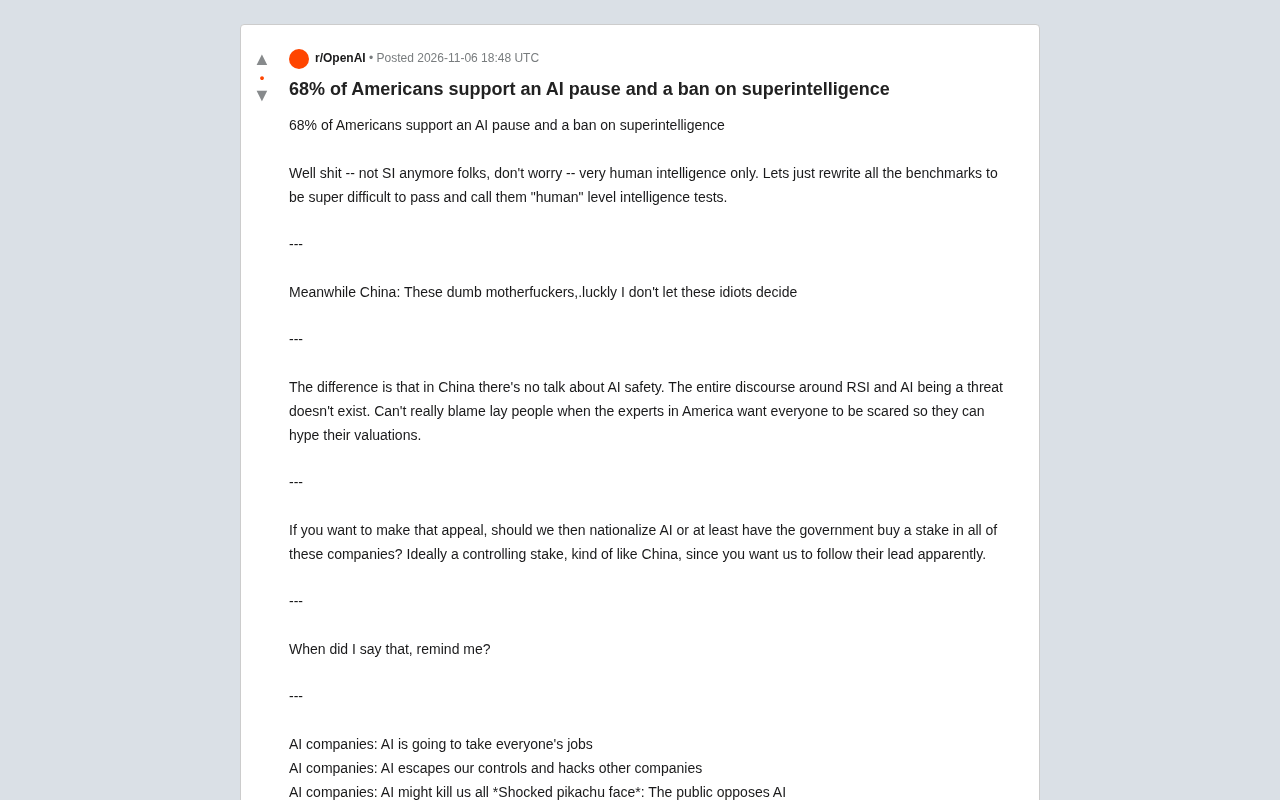
The post title stated its position bluntly, while the comment section revealed a clash of sharply contrasting viewpoints. Some joked, "Let's never mention superintelligence again, just talk about human intelligence," advocating for redefining benchmarks and calling impossibly difficult tests "human-level intelligence tests." Others pointed the finger at AI companies' marketing strategies, arguing that it is precisely these companies' relentless narratives about "AI stealing jobs," "AI going out of control," and "AI possibly killing everyone" that have fueled public opposition—as one comment put it: "AI companies: AI will take everyone's jobs; AI will escape control and attack other companies; AI might kill us all. Shocked Pikachu face: public opposes AI."
Superintelligence is a hypothetical concept in the field of artificial intelligence, referring to an agent that vastly exceeds the smartest humans in almost all cognitive domains (including scientific innovation, social planning, strategic decision-making, etc.). The term was popularized by philosopher Nick Bostrom and others, and its core concern is that once superintelligence emerges, humans may lose control over it. Unlike current "narrow AI" such as large language models, superintelligence has not yet been achieved, but it has become a key anchor in AI safety discussions. The debate surrounding it involves not only technical feasibility but also deeper issues such as human existential risk and value alignment—this is the context that makes the "ban superintelligence" option in the poll resonate.
Cross-Cultural Perspective: Differences in AI Safety Discourse Between China and the US
One noteworthy point in the discussion came from a comparative perspective. A commenter pointed out that in China, public discussion about AI safety is virtually nonexistent, and narratives around recursive self-improvement (RSI) and AI threats have not formed mainstream discourse. This difference was used by some to criticize US experts for "manufacturing fear to inflate valuations," and some even suggested that if AI safety were truly to be prioritized, the government should consider taking equity stakes in or nationalizing AI companies, similar to the Chinese model, to gain control.
While this comparison is somewhat crude, it highlights a key issue: public discussion of AI safety is highly dependent on regional context and industry ecosystem. In the US, AI companies are both technology drivers and producers of risk narratives, and this dual identity easily breeds public distrust; in China, AI development is more embedded in a national strategic framework, and safety issues are absorbed in different ways.
Recursive Self-Improvement (RSI) refers to the hypothetical process by which an AI system can modify its own code or architecture, thereby becoming more powerful with each iteration, potentially triggering an intelligence explosion. This concept is widely discussed in the AI safety field because it implies that once a system crosses a certain capability threshold, its rate of evolution could far exceed the pace of human oversight. In Western AI safety discourse, RSI is often linked to "loss of control risk" and is an important argument for advocating pauses or strict regulation; in Chinese public discussion, however, this concept is rarely emphasized separately, and safety issues revolve more around content compliance, data security, and controllable development—a technical footnote to the discourse differences from a cross-cultural perspective.
The Gap Between Public Sentiment and Expert Understanding
There were also rational voices in the comments. One user argued that public vigilance is reasonable, but "pausing" is not a wise solution. "The public doesn't know what they're talking about. Their feelings are based on what they hear, and they don't understand the actual risks or how to address them." This view represents the attitude of some technology optimists: acknowledging that risks exist but opposing a one-size-fits-all pause.
However, when pressed on "what are the actual risks," the discussion often becomes vague. This precisely exposes the dilemma of AI safety discussions: experts themselves disagree on the definition and prioritization of risks, making it even harder for the public to obtain clear, credible information. Thus, behind the poll numbers lies a complex picture woven from emotion, narrative, and interests.
AI Safety is an interdisciplinary field focused on ensuring that AI systems' behavior aligns with human intentions and values and avoids accidental or malicious harm. Its core sub-problems include value alignment (making AI understand and internalize human preferences), interpretability (understanding the basis for model decisions), robustness (resisting adversarial attacks), and governance mechanisms (regulation, auditing, and responsibility allocation). Disagreements among experts often lie not in "whether there is risk" but in the prioritization and timeline of risks: one camp focuses on long-term existential risks, while another emphasizes near-term harms such as bias, privacy, and employment. This internal division makes it difficult for the public to obtain a unified risk picture and explains why behind the poll numbers lies vague anxiety rather than clear demands.
Conclusion: Public Opinion Should Not Be Interpreted Simplistically
The 68% support rate is a striking number, but it is more like a mirror reflecting public anxiety about AI going out of control, distrust of tech giants, and expectations for regulatory gaps to be filled. Simply viewing public opinion as "right" or "wrong" is biased. The real question is: how to establish an effective dialogue mechanism between encouraging innovation and preventing risks, so that public concerns are heard and the possibilities of technology are not stifled by fear. After all, behind the call to pause research lies a longing for a more responsible and transparent AI governance framework.
Related articles
 Tech Frontiers
The AI Industry Doesn't Lack Marketing—It Lacks Good Products
AI faces market selloffs and public skepticism—is marketing really the problem? This analysis of market signals and product experience argues the core困境 is incomplete products and a gap between promises and experience; the only way to change perceptions is to ship better products.
 Tech Frontiers
Generative UI Streaming in Chat SDK Agents: A Deep Dive into json-render
A deep dive into json-render and Chat SDK's generative UI streaming capabilities: typed component catalogs, streamCard incremental updates, toCard spec validation with platform-limit fallbacks, and real-world deployment on Slack, Teams, and more.
 Tech Frontiers
How Do You Stop AI Agent Emails From Sounding Like AI? One Developer's Solution
AI agent emails always sound like AI? A developer shares reright: a rewrite step that validates numbers, names, and links, preventing humanizers from tampering with key info. Test data and integration details inside.