6GB Delivers Opus-Level Performance: Bonsai 2.5 27B Hands-On Test

27B ternary-quantized model squeezed to 5.9GB, nearly matching full precision, but game dev remains a weak spot
Prism ML's Ternary Bonsai 2.5 27B is compressed from Qwen 3.8 27B using -1/0/+1 ternary weights at about 1.76 bits per weight, with a file size of only 5.9GB that fits on a consumer GPU while retaining vision, tool calling, chain-of-thought, and 262k context under Apache 2.0. Compared with the previous generation, it fixes overthinking and long-task loops: it averages 77.2 across five agentic tool-calling benchmarks, close to full precision's 77.7, with AppWorld jumping from 51.2 to 90.5 and about 90% of agentic coding capability retained. A built-in draft head delivers 1.5–2x decoding speedup, measured at about 158 tokens/s on a 4090. Frontend and dashboard generation quality stands out, but long game-related tasks still require substantial manual fixes, and on hard tasks it consumes about 53% more tokens than full precision.
A 27B Model Fits into 6GB of VRAM
Prism ML's newly released Ternary Bonsai 2.5 27B may be the most noteworthy update this year for local deployment enthusiasts. According to a hands-on video from the YouTube channel World of AI, this 27B-parameter model has a file size of only 5.9GB, can fit onto a single consumer-grade GPU, and retains visual input, native tool calling, chain-of-thought, and a 262k-token context window, under the Apache 2.0 license.
It is compressed from Qwen 3.8 27B, with each weight constrained to three values: -1, 0, and +1—this is what "Ternary" means. That works out to roughly 1.76 bits per weight, about 9 times smaller than the original full-precision model.
This is not the Bonsai series' first appearance. The previous generation, Bonsai 2, was already impressive at the same size, but had two fatal flaws: overthinking and getting stuck in repetitive loops on long tasks. Prism ML's own explanation is that small errors accumulate layer by layer across long workflows, and a single early mistake can derail an entire task. Version 2.5 addresses exactly this problem.
Ternary Quantization is an extremely low-bit weight quantization scheme: each floating-point weight is mapped to one of three discrete values {-1, 0, +1}. Since only three states need to be distinguished, each weight theoretically requires about log₂(3) ≈ 1.585 bits; in practice, after adding metadata such as scaling factors and group statistics, it comes to about 1.76 bits per weight. Compared with 4-bit quantization (about 4.25 bits per weight), ternary quantization improves the compression ratio by roughly another 2.4 times—which is why a 27B-parameter model can be squeezed down to 5.9GB. The cost is extremely low weight representation precision: the model relies on per-group scale factors to recover the numerical range, making it highly sensitive to the quality of post-training quantization (PTQ) or quantization-aware training (QAT). Whether a ternary model can retain full-precision capabilities depends largely on how carefully the compression pipeline is tuned.
Qwen 3.8 27B is a dense 27B-scale model from Alibaba's Tongyi Qianwen series, featuring visual input, tool calling, and long-context capabilities, and is often used by the community as a baseline for local deployment and quantization. All "full-precision comparisons" in this article use this model as the reference point.
Benchmarks: Approaching Full Precision, Even Surpassing It in Some Cases
According to data cited in the video, Bonsai 2.5 averages 77.2 across five agentic tool-calling benchmarks, while full-precision Qwen 3.8 scores 77.7—a nearly negligible gap, and a marked jump from Bonsai 2's 67. The most striking result is AppWorld: a leap from 51.2 straight to 90.5.
On agentic coding, it scores 75.6 on SWE-bench Verified, 60.1 on Terminal Bench, and Deep SWE rises from Bonsai 2's 0 to 27. Overall it retains about 90% of the full-precision model's agentic coding score, compared with 63% for the previous generation. Averaged across general knowledge, math, coding, and instruction following, it scores 82.12 versus 84.32 for full precision.
In other words, it retains almost all the capability at a fraction of the size.
SWE-bench Verified, Terminal Bench, AppWorld, and Deep SWE are several representative benchmarks for measuring agentic capability today. SWE-bench Verified consists of manually curated real GitHub issues, requiring the model to locate and fix bugs in code repositories, scored by test pass rate—it is the most frequently cited metric for coding agents. Terminal Bench assesses a model's ability to execute multi-step command-line tasks in a real terminal environment. AppWorld simulates an application ecosystem (email, calendar, payment APIs, etc.), requiring the model to complete cross-application multi-step operations through tool calls, with extremely high demands on long-chain planning and state tracking—which is why Bonsai 2.5's jump from 51.2 to 90.5 on this item stands out so much. Deep SWE focuses on more complex, longer software engineering tasks and is the litmus test distinguishing "can fix small bugs" from "can complete full feature development." Together, these benchmarks characterize the model's reliability as an agent rather than mere knowledge Q&A proficiency.
Speed: Free Acceleration from the Draft Head
Every Bonsai 2.5 file has a built-in draft head for multi-token prediction, which is said to boost decoding speed by about 1.5 to nearly 2 times, with output identical to normal decoding.
Official figures are 291 tokens/s on a single H100 and 204 tokens/s on a consumer-grade RTX 4090. The video author measured an average of about 158 tokens/s on his 4090, slightly below the official number, which he attributes to very long generated content and continuously growing context.
Community tests cover more varied hardware: someone ran the full 262k context on a 12GB RTX 3060 at about 74 tokens/s with the draft head enabled, versus only 26 tokens/s for Bonsai 2 on the same card; on a 10GB RTX 3080, output speed rose from 48 to 79 tokens/s and the test score went from 76.3% to 85.7%. On an M5 Pro Mac Mini it runs at about 30 tokens/s, 1.77 times faster than 4-bit Qwen 3.8 on the same machine, with model sizes of 7.67GB versus 16GB.
In one tester's own benchmark, Bonsai scored 93.3 versus 93.4 for 4-bit Qwen 3.8 27B—a tenth-of-a-point difference, while the former uses only 8GB of VRAM.
Draft head and multi-token prediction are a variant of the speculative decoding approach. Traditional autoregressive decoding generates only one token per step, leaving much of the GPU's compute idle waiting on memory bandwidth; the draft head is a small prediction module attached to the main model that "guesses" several subsequent tokens at once, which the main model then verifies in parallel—correct guesses are accepted directly, incorrect ones are rolled back and recomputed. Since verification is parallel, the higher the acceptance rate, the more pronounced the speedup, and the output distribution remains consistent with normal decoding, hence the emphasis that "results are identical to normal decoding." This is also the key to Bonsai 2.5 reaching 158–204 tokens/s on consumer-grade GPUs. Note that the draft head's speedup ratio fluctuates with task type: structured, predictable output (such as code templates, JSON) has a high acceptance rate, while creative text has a low one.
Frontend and Design: Aesthetics Beyond What the Size Suggests
The video author ran multiple hands-on tests on a 4090 using Prism ML's Llama CPP fork. The frontend direction was his biggest surprise—four different frontend demos all demonstrated quite mature visual taste.
A landing page for Nvidia's next-generation GPU: the model conceived of an "RTX 6090" on its own and drew the entire graphics card in SVG, complete with three spinning fans, a neon green glow, and a bottom reflection; scrolling reveals spec cards, a cursor-following ray-tracing demo, a benchmark section, and a layered cutaway view. It took about 7.6 minutes and 67k tokens.
Chromaform, a color-scheme website built on React 18, has 5 color systems, large-type typography that morphs on scroll, and staggered sliding color blocks—but it didn't load a compiler when writing the code, leaving an unclosed function that required a re-prompt to fix the syntax error.
A data analytics dashboard, by contrast, was a one-shot success: KPI cards with mini trend charts, a revenue curve, a traffic-source donut chart, every chart regenerating when the data range switches, and a sortable transactions table. The author calls it one of the cleanest works he has seen from an open-source model.

Weaknesses: Games and Long Tasks Remain the Achilles' Heel
The weaknesses are equally clear. Asked to draw a giraffe riding a bicycle with a rhino on its back, the bicycle, road, and countryside scenery all looked good, but the rhino became a small gray blob.
The Minecraft clone test is the most telling: at the default ultra-high reasoning level, the model thought for 16 minutes and consumed about 120k tokens without writing a single word—all of it was mental simulation. After switching to the medium level recommended by Prism ML, it wrote 1,300 lines of code, but needed several fixes to run, ultimately producing a procedural world with hills, trees, and an inventory, with flat lighting and the promised shader pack entirely unimplemented.
In the turn-based zombie survival shooter test, the medium level likewise exhausted its tokens during the thinking phase, forcing the author to cap thinking at 60k, after which the entire game was written in 6.5 minutes and, after manual bug fixes, ran successfully. Feature-wise it checked out: turn-based rounds, hit scoring, flashlight beams, zombies breaking windows. The author's conclusion is blunt: he wouldn't use this model for game development.

Reasoning Effort and thinking token budget are important usage parameters for models with chain-of-thought like this. The model performs internal reasoning before outputting the final code, and the length of that reasoning is controlled by the level (such as low/medium/high or "ultra-high"). The higher the level, the more thorough the planning, but the tokens and time consumed grow multiplicatively, and there is a risk of "overthinking"—exhausting the context or output budget during the thinking phase, resulting in not a single word of actual output. The "16 minutes of thinking, 120k tokens consumed, zero output" in the Minecraft clone test is a typical manifestation of this failure mode. A practical approach is to cap thinking at around 60k and choose the medium level, striking a balance between planning quality and deliverability; for interactive tasks requiring multiple rounds of iteration, a low level combined with manual error correction is often more efficient than pursuing a one-shot success.
Trade-offs vs. Full Precision: More Tokens for a Smaller Size
A head-to-head comparison with full-precision Qwen 3.8 27B makes its positioning clearer. Given the same voxel lighthouse prompt, Bonsai generated 53% more tokens (382k vs. 250k), taking 123 minutes on a single RTX 5070, while Qwen completed it in about 49 minutes in the cloud. In a four-model comparison that also included Haiku 5.5 and Inkling 2 Mini, the latter two both finished within 20 minutes—but the key point is that Bonsai ran entirely locally on a 16GB graphics card.
A more practical test is a US mortgage calculator: on a 4090, Bonsai reaches 231 to 255 tokens/s, while 4-bit Qwen 3.8 on the same card manages only 54 tokens/s; over 5 runs each, Bonsai's page gave the correct monthly payment figure 4 times, versus 3 for Qwen.
How to Get Started
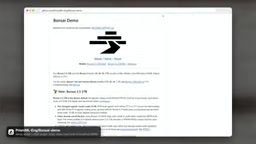
The weights have been released on Hugging Face in GGUF and MLX formats. The minimal package requires Prism ML's own maintained Llama CPP fork, and the fastest path to get started is their Bonsai demo repository. On Windows, run a setup script, then start the server, and you get chat, vision, and tool-calling capabilities locally.
The video author's final judgment is worth repeating: Bonsai 2.5 will not replace full-precision Qwen 3.8 27B—on hard tasks it genuinely consumes more tokens; but the fact that a 5.9GB file can produce frontends of this caliber, run a real coding agent, and sit right next to 4-bit quantized models on benchmarks is itself significant. It makes private, localized AI practical for the first time.
Related articles

ChatGPT Plus Top-Up in China: Third-Party Website Recharge That Supports WeChat Pay and Alipay, No Overseas Card Needed
A Bilibili creator tests ChatGPT Plus top-up methods in China: comparing third-party website recharge, direct credit card, and mobile in-app purchase, with a full walkthrough of password-free WeChat/Alipay recharge and an analysis of Session credential and payment risk-control risks.

System Exchange Spawns an Offbeat Journey to the West: Why This Comedy Series Works
A Bilibili comedy short series reimagines Journey to the West with a system-exchange premise, as the protagonist challenges Sun Wukong, Erlang Shen, and other classics.

HN Warning: Don't Use AI to Write Comments, or They'll Be Auto-Deleted
Hacker News warns that AI-written comments will be automatically deleted. This article analyzes HN's automated enforcement mechanism, the community's attitude toward AI-generated content, and what it means for creators using AI tools responsibly.