ChatGPT Plus Top-Up in China: Third-Party Website Recharge That Supports WeChat Pay and Alipay, No Overseas Card Needed
A Bilibili creator compares three ChatGPT Plus top-up methods, demonstrates the third-party recharge process, and warns of its permission-transfer risks.
The article summarizes a Bilibili creator's tutorial on topping up ChatGPT Plus in China, comparing third-party website recharge, direct credit card payment, and mobile in-app purchase. The creator considers third-party recharge the most hassle-free due to low price, low barrier, and no password required—only pasting a Session code. The article notes that while this avoids password leakage, the Session credential is still account access permission, and handing it to a third party is a permission transfer, not zero risk. It also analyzes credit card pain points (hard-to-get overseas cards, hidden fees) and mobile in-app purchase issues (payment risk control). The advantage of third-party recharge is outsourcing payment to an equipped environment; stability depends on the third party's channels, not user control. Finally, it reminds users about credential scope, service continuity, customer-service reliance, and price fluctuations.
Many people have recently been discussing how to top up ChatGPT Plus from within China. A Bilibili creator made a tutorial comparing the three mainstream ChatGPT Plus top-up methods currently available, and gave a detailed walkthrough of the full process of recharging through a third-party website. The core information in this video is worth breaking down: it offers an actionable recharge path, but it also exposes the risk boundaries of the third-party recharge model itself.
A Practical Comparison of the Three Top-Up Methods
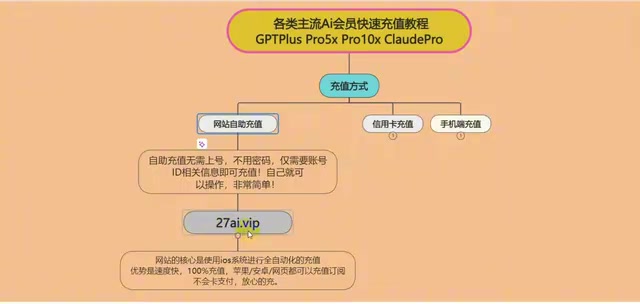
According to the creator, users in China currently subscribe to ChatGPT Plus and other mainstream AI memberships mainly through three routes: third-party website recharge, direct credit card payment, and in-app purchase on mobile.
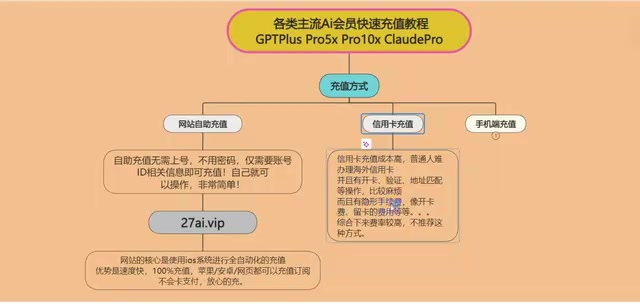
The creator's assessment is that third-party website recharge is the most hassle-free, based on three dimensions: price, ease of use, and account security. The problem with direct credit card payment is cost—the creator notes that overseas credit cards are difficult for ordinary people to obtain and come with hidden fees, making the overall rate relatively high. The pain point of mobile in-app purchase is that the steps are cumbersome and it doesn't support local payment methods; most critically, if your network environment isn't ideal, you can easily get stuck at the payment risk-control stage, and the money may be lost for nothing.
The shortcomings of these two methods are described fairly specifically by the creator, but they are experience-based observations rather than a rigorous side-by-side review.
The Third-Party Website Recharge Process
Using 27ai.vip, the site demonstrated by the creator, as an example, the entire process does not require providing an account password—only account ID-related information. This is a selling point the creator repeatedly emphasizes: no need to log in on the site, no password required, directly avoiding the risks of privacy leakage and account theft.
The specific steps are roughly as follows: after opening the website, browse all products, where you can see packages such as ChatGPT Plus, ChatGPT Pro 5x, ChatGPT Pro 10x, ChatGPT Go, and Claude Pro, all labeled with monthly prices. After selecting the package you need, log in, return to the recharge website and click "Get Session," and the page will display a string of code. Copy the code in full (including the brackets) and paste it back into the recharge website, confirm that it is the account you want to recharge, choose a payment method, and submit the order.
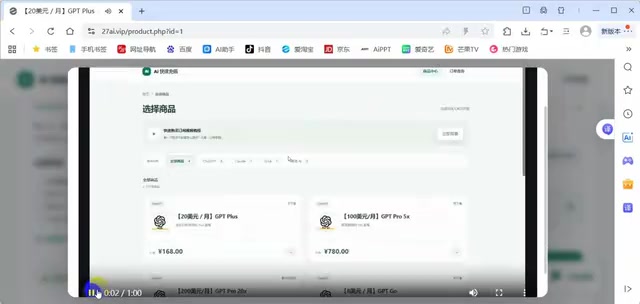
The creator skipped the actual payment step in the video and only showed the order-processing and recharge-success states. After the recharge is complete, return to the ChatGPT website and refresh the page to see the Plus badge; if it doesn't appear, just refresh a couple more times.
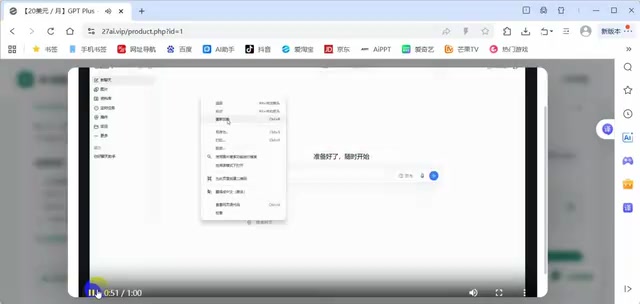
The website provides online customer service. The creator mentions that if the recharge fails or you need an invoice, you can contact customer service to handle it.
What Is a Session
In web applications, a Session is a mechanism used by the server to identify a user. After a user logs in, the server generates a unique session identifier, usually stored in the browser as a Cookie or token. Subsequent requests carrying that identifier can access the account without a password. "Getting the Session" mentioned in the article generally refers to extracting this credential code.
Unlike an account password, a Session credential usually has an expiration time, and its scope of permissions may be limited by the context in which it was generated (for example, web-only). However, within its validity period it can be used directly to simulate login, so it is essentially still a form of account access permission. Handing it to a third party means that party can perform operations as the user during the credential's validity period—this is the technical reason why "no password needed" does not equal "zero risk."
The Security Boundaries of the Third-Party Recharge Model
The most noteworthy aspect of this tutorial is that it uses "not giving out the password" as a security argument. From a technical perspective, the authorization scope of Session-type credentials is usually smaller than that of a full account password, which does indeed reduce the probability of the account being directly taken over. But this does not equal zero risk—the Session credential itself is still part of account access permissions, and handing it to a third-party platform is essentially still a transfer of permissions.
In other words, the third-party recharge solution addresses the specific problem of "password leakage," not the overall problem of "account security." When deciding whether to use it, users need to be clear about what exactly they are giving up.
Payment Risk Control Is the Real Dividing Line
Among the three methods, the pain points of credit cards and mobile in-app purchases actually point to the same thing: risk control at the payment stage. The creator mentions that mobile top-ups can easily get stuck at payment when the environment isn't good, with money going down the drain—this describes the typical scenario where a transaction fails after risk control is triggered but fund processing lags behind.
Third-party recharge websites have an advantage here because they shift the payment action to an environment they are equipped to handle, leaving the user to complete only a single local payment. This is an experience improvement brought about by process outsourcing, not that payment itself has become easier. Understanding this helps assess the stability of such services at different times—it depends on whether the third party's own payment channels are smooth, not on factors the user can control.
Common Triggers of Payment Risk Control
Payment risk control is a mechanism by which payment institutions or card issuers assess transaction risk based on multi-dimensional information and decide whether to block a transaction. Common triggers include: IP address inconsistent with billing address, multiple attempts within a short period, abnormal device fingerprints, use of proxies or data-center IPs, cross-border transactions, and so on.
When a transaction is blocked by risk control, the common symptoms are an error on the payment page or an order status that remains "processing" for a long time. At this point the funds may have been pre-authorized or deducted, but the merchant has not received a success notification, creating a lag where "money has been deducted but the service has not arrived"—the scenario referred to in the article as "money going down the drain." Such issues usually require intervention from the card issuer or payment platform and take a long time to resolve, which is the core reason why mobile in-app purchases and direct credit card payments are unstable.
A Few Things to Keep in Mind When Using It
Based on the video information, if you are considering the third-party website recharge route, there are several practical issues you need to weigh for yourself:
- Scope of credential authorization: The validity period and permission boundaries of the Session information are determined by the platform, and you should understand them clearly before use.
- Service continuity: The payment channels and operational status of such websites are not controllable by users, so long-term subscriptions carry uncertainty.
- After-sales reliance on customer service: Resolution of issues such as failed recharges and invoices depends entirely on the other party's customer service response, with no platform-level guarantee.
- Prices vary by package: The creator mentions that the website's prices are advantageous, but the monthly price of each package should be based on what the website actually displays; the video does not give specific figures.
The creator finally suggests that users who need to top up should check out the website, emphasizing that it works on Apple, Android, and web, and does not rely on overseas cards. The information in this tutorial is concentrated on the process demonstration; the video says little about the risks of the third-party recharge model, so users would do well to fill in that gap themselves before using it.
One-line Summary
A Bilibili creator compares three ChatGPT Plus top-up methods, demonstrates the third-party recharge process, and warns of the permission-transfer risks.
Paragraph Summary
The article reviews a Bilibili creator's tutorial on topping up ChatGPT Plus from within China, comparing third-party website recharge, direct credit card payment, and mobile in-app purchase. The creator considers third-party website recharge the most hassle-free because of its low price, low barrier to use, and no need to provide an account password—simply pasting a Session code completes the recharge. The article points out that while third-party recharge avoids password leakage, the Session credential is still part of account access permissions, and handing it to a third party is essentially a transfer of permissions, not zero risk. It also analyzes that the pain point of direct credit card payment is the difficulty of obtaining overseas cards and hidden fees, while mobile in-app purchases easily get stuck at payment risk control. The advantage of third-party recharge lies in outsourcing the payment action to an environment equipped to handle it; its stability depends on the third party's payment channels and is not controllable by users. Finally, it reminds users to pay attention to the scope of credential authorization, service continuity, reliance on customer service for after-sales support, and price fluctuations.
Related articles
6GB Delivers Opus-Level Performance: Bonsai 2.5 27B Hands-On Test
Prism ML releases Ternary Bonsai 2.5 27B: ternary quantization brings it to just 5.9GB, runnable on a single consumer GPU while retaining 262k context and vision. Hands-on agentic benchmarks approach full-precision Qwen 3.8 27B, exceeding 150 tokens/s on a 4090, with impressive frontend and dashboard results, though game development and long tasks remain weak spots.

System Exchange Spawns an Offbeat Journey to the West: Why This Comedy Series Works
A Bilibili comedy short series reimagines Journey to the West with a system-exchange premise, as the protagonist challenges Sun Wukong, Erlang Shen, and other classics.
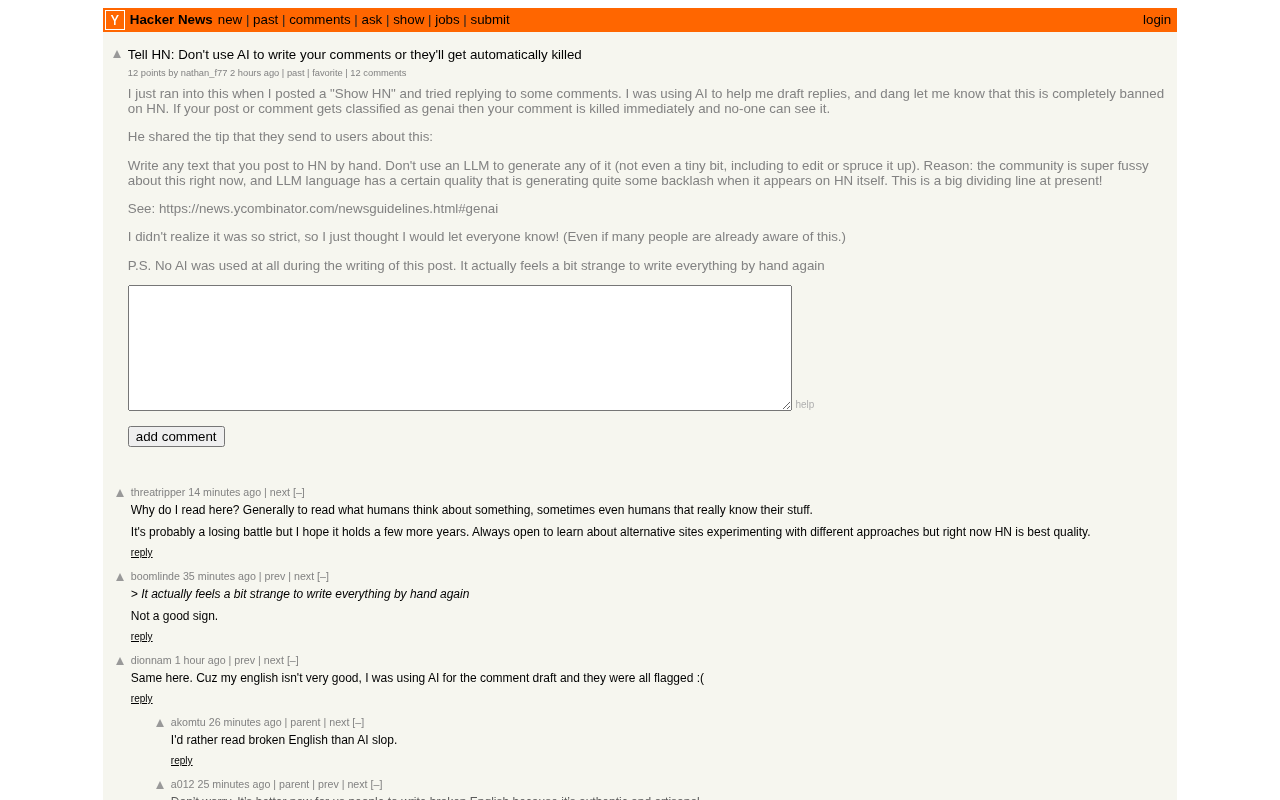
HN Warning: Don't Use AI to Write Comments, or They'll Be Auto-Deleted
Hacker News warns that AI-written comments will be automatically deleted. This article analyzes HN's automated enforcement mechanism, the community's attitude toward AI-generated content, and what it means for creators using AI tools responsibly.