7 Anima Model Combinations Tested: The Optimal Config Guide for Anime Image Generation

A rigorous test of all 7 Anima model combos: pick aesthetic, add Turbo LoRA for anime style.
A Reddit user rigorously tested all 7 Anima combinations (base, aesthetic, turbo LoRA, turbo baked) using controlled variables. The verdict: prioritize the aesthetic version, and stack Turbo LoRA for a richer anime-girl style. The article covers four test scenarios, prompt structures, and ComfyUI parameter configs.
Article
In the world of AI art, model selection directly determines the quality and stylistic direction of the final work. As a mainstream model dedicated to anime-style generation, Anima offers multiple variants including base, aesthetic (aesthetically optimized), turbo LoRA (acceleration LoRA), and turbo baked (built-in acceleration). Faced with the abundance of combination options, creators often find themselves paralyzed by choice.
The Evolutionary Logic of the Anima Model Family: Anima's multi-variant design reflects the Stable Diffusion community's dual pursuit of "specialization" and "efficiency." In the diffusion model ecosystem, a so-called "Diffusion Model" is a class of deep learning architectures that generate images through progressive denoising—during training, Gaussian noise is gradually added to images, and during inference, the model learns the reverse denoising path. This process naturally supports multi-step iteration and provides compression room for subsequent distillation-based acceleration. The evolutionary path of model variants generally follows an established paradigm: base pretraining (establishing stylistic foundations on large-scale anime datasets) → aesthetic fine-tuning (secondary alignment via human preference or aesthetic scoring models) → distillation acceleration (compressing multi-step inference into few-step high-quality output). Anima's three-tier base/aesthetic/turbo system is a textbook implementation of this paradigm, with each tier addressing different dimensions of creative needs. Understanding this evolutionary logic helps creators make more informed decisions when selecting models.
Recently, a Reddit user systematically compared all 7 Anima combinations through a rigorous controlled-variable experiment, providing the community with highly valuable empirical data. This article distills the core methodology and conclusions of that test to help you make smarter configuration decisions in anime image generation.
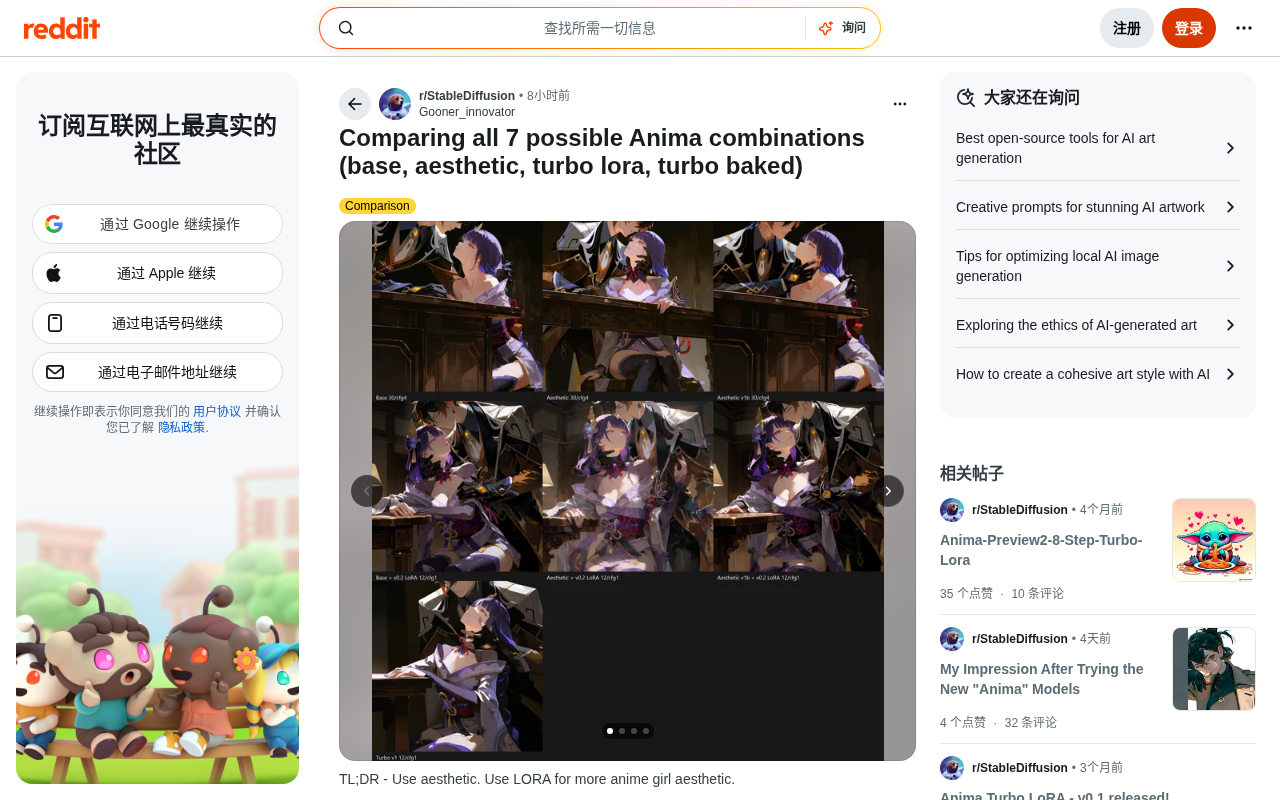
Experimental Design: A Rigorous Controlled-Variable Approach
The core value of this test lies in its scientific experimental framework. The tester employed a standard controlled-variable method to ensure the comparison results are genuinely reliable:
- Fixed seed (Seed: 42): All images use the same seed, eliminating interference from randomness
- Unified negative prompt:
worst quality, low quality, score_1, score_2, score_3, artist name, blurry, jpeg artifacts, chromatic aberration - Unified workflow: All generated through ComfyUI, with RTX Video Super Resolution used to upscale the longest edge to 2048px
- Same prompt used within the same comparison table
This methodology guarantees that the differences between models genuinely stem from the models themselves, rather than external variables—which is also a key criterion for judging whether an AI art evaluation is reliable.
Why Controlled Variables Are Especially Critical in AI Evaluation: The generation process of diffusion models is essentially random sampling. Even with the same model and the same prompt, different random seeds can produce vastly different results. The reason so many informal community comparison tests are hard to reproduce or contradict one another is often not the difference between models themselves, but the presence of multiple confounding variables such as seed, sampler, and workflow between comparison groups. A fixed seed ensures the sampling starting point is identical, a unified workflow eliminates toolchain interference, and a unified prompt rules out content variables—all three are indispensable to truly isolate "model differences" from the complex generation system. The credibility of this test comes precisely from its strict control over these details.
The ComfyUI Workflow Ecosystem: ComfyUI is currently the most mainstream node-based graphical workflow tool in the Stable Diffusion ecosystem. Compared to the earlier WebUI (AUTOMATIC1111), it breaks the generation pipeline down into a visual directed acyclic graph (DAG), where each node represents an independent operation (such as model loading, sampling, VAE decoding, LoRA stacking, etc.). The VAE (Variational Autoencoder) plays the role of a "translation layer" in this process: the diffusion process operates in a low-dimensional latent space, and the VAE is responsible for decoding latent vectors back into pixel-level images. Its quality directly affects the sharpness of details and color accuracy of the final output. The core advantage of ComfyUI's architecture lies in reproducibility: a complete workflow can be exported and shared as a JSON file, and the recipient only needs to import it to precisely reproduce the exact same generation configuration. This test uniformly used ComfyUI precisely to ensure this reproducibility—the only variable between different model combinations is the model itself, not toolchain differences.
Specific Breakdown of the Three-Row Configuration
The test divided the 7 combinations into three rows for horizontal comparison:
Row 1 — Base Models (no LoRA):
anima-base-v1.0anima-aesthetic-v1.0anima-aesthetic-v1.0b- Parameter settings: 30 steps, CFG 4, er_sde sampler, simple scheduler
Row 2 — Base Models + Turbo v0.2 LoRA:
- The above three models each stacked with
anima-turbo-lora-v0.2(strength 1.0) - Parameter settings: 12 steps, CFG 1, euler sampler, simple scheduler
Row 3 — Built-in Turbo v1:
anima-turbo-v1.0(acceleration capability already baked into the model weights)- Parameter settings: 12 steps, CFG 1, euler sampler, simple scheduler
Notably, the Turbo accelerated versions can produce images with just 12 steps and CFG 1, a substantial reduction in compute cost compared to the base version's 30 steps and CFG 4—which is highly significant for local deployment and batch generation scenarios.
CFG Parameters, Sampler Principles, and Model Distillation Techniques: CFG (Classifier-Free Guidance) is the core parameter controlling the strength of prompt influence. The higher the value, the more strictly the model follows the prompt, but excessively high values lead to over-saturated images and distorted details; lower values produce more free output but may deviate from the prompt's intent. The base model uses CFG 4, while the Turbo version needs only CFG 1, because the accelerated training process recalibrates how the model responds to guidance signals. The leap from 30 steps at CFG 4 to 12 steps at CFG 1 is essentially the fruit of applying Knowledge Distillation: distillation training has a "student model" mimic the complete multi-step output distribution of a "teacher model," compressing an inference process that originally required dozens of iterative steps into very few steps, while recalibrating the CFG response curve so that good prompt adherence can still be maintained at low CFG values. This technical approach shares a similar underlying philosophy with industry acceleration solutions such as Consistency Models, SDXL-Turbo, and LCM (Latent Consistency Model), all of which strive to break the traditional constraint of "trading steps for quality." The er_sde (stochastic differential equation sampling) method performs more stably during multi-step inference; its mathematical foundation comes from continuous-time stochastic process theory, enabling finer control over the denoising trajectory. Meanwhile, euler, as the most basic Euler numerical integration method, offers higher computational efficiency and is suited for few-step rapid generation scenarios. The choice between the two reflects the optimal trade-off between "precision" and "speed" under different step budgets.
Core Conclusion: Aesthetic Is the Optimal Base Model
Compared to the base version, the aesthetic version underwent targeted aesthetic-oriented optimization during the training phase, producing compositions, lighting, and character depictions that better conform to anime aesthetics—without requiring complex prompts.
The Training Logic of Aesthetically Optimized Models: The advantage of the aesthetic version stems from the differentiated design of its training data and objective function. A common practice is to introduce an "aesthetic scoring model" (such as the LAION aesthetic predictor) during the fine-tuning phase to filter or weight training samples, steering the model in parameter space toward the distribution of high-aesthetic-score images. The LAION aesthetic predictor itself is a linear classifier trained on millions of human-rated images, capable of outputting an aesthetic assessment on a 0-9 scale for any image; this external signal provides fine-tuning with supervision at a higher dimension beyond pixel reconstruction error. This means the aesthetic version, when faced with the same prompt, tends to generate results with more complete compositions, more harmonious character proportions, and color schemes more in line with anime aesthetics—without creators having to manually pile on numerous style-modifying words in the prompt. This training strategy has been widely validated in early anime models such as Waifu Diffusion and NovelAI. It's worth noting that aesthetic optimization is not simply a "beauty filter" but rather adjusts the gradient direction of the loss function so that the model's probability mass at inference time concentrates more on image regions preferred by humans—which bears a deep resemblance to how RLHF (Reinforcement Learning from Human Feedback) works in large language models: both convert human preference signals into training objectives, guiding model parameters to converge toward a "more human-acceptable output distribution." The difference lies only in the feedback form (image aesthetic scores vs. text answer preferences) and the specific implementation of the optimization method.
The tester's configuration recommendation is clear and straightforward: prioritize the aesthetic version; and if you want a richer anime-girl aesthetic style, stack Turbo LoRA on top. Turbo LoRA, while preserving the art style, further amplifies the expressiveness of the specific "anime girl" style, and the combined effect is significant.
Trade-offs in Acceleration Approaches
On the acceleration path, the test compared two approaches:
- Turbo LoRA (add-on): High flexibility, can be stacked on different base models, with adjustable strength
- Turbo baked (built-in):
anima-turbo-v1.0bakes the acceleration capability directly into the model weights
LoRA Technical Background and the Flexibility Trade-off of the Baked Approach: LoRA (Low-Rank Adaptation) is a parameter-efficient fine-tuning technique, originally proposed by Microsoft Research in 2021 for lightweight customization of large language models. Its core idea is: instead of modifying all the weights of the original model, it inserts low-rank matrices (typically rank 4-64) beside key layers and only trains these additional parameters. The mathematical basis of low-rank decomposition is that the parameter changes a model needs to adapt to a specific task can often be approximated by a low-dimensional subspace—that is, the weight update matrix ΔW can be decomposed into the product of two small matrices (ΔW = BA, where B∈R^{d×r}, A∈R^{r×k}, with r far smaller than d and k), thereby compressing the number of trainable parameters from d×k to r×(d+k). In the AI art field, LoRA files are typically only tens to hundreds of MB, far smaller than a full model's several GB. What's special about Turbo LoRA is that it is not used for style transfer but is specifically trained to "teach" the model to complete high-quality inference in very few steps, thereby drastically compressing computation time. The core advantage of the add-on LoRA approach is composability: the same Turbo LoRA can be stacked on any compatible base model, and the balance between acceleration effect and style preservation can be finely controlled by adjusting the strength coefficient (0.0-1.0). The "baked" approach, on the other hand, merges the LoRA weights into the base model (directly modifying the original weights via matrix addition), eliminating the overhead of dynamic runtime loading and requiring no additional matrix multiplication during inference—trading flexibility for inference purity and slightly faster loading speed.
Both can achieve fast 12-step generation, but the add-on LoRA approach has an edge in style control—you can freely choose the base model and then decide whether to stack acceleration. This is precisely why the tester recommends the "aesthetic + Turbo LoRA" combination: it balances image quality, style, and generation efficiency simultaneously.
Four Prompt Sets Covering Diverse Scenarios
To thoroughly test the model's performance across different subject matters, the tester designed four prompt scenarios with distinctly different styles:
Scenario 1: Character Interaction (1:1 ratio)
A two-character composition themed around Raiden Shogun and Zhongli from Genshin Impact, testing the model's performance under character interaction, intimate atmosphere, and dark-toned lighting. This type of composition places higher demands on the model's understanding of spatial relationships and character poses.
The Challenge of IP Character Generation and the Model's Concept-Binding Mechanism: Using well-known IP characters (such as Genshin Impact characters) as test prompts has unique evaluation value—whether the model can strike a balance between "character recognition" (Raiden Shogun's specific attire, hair color, and demeanor features) and "scene creation" (interactive composition, lighting atmosphere) reflects the combined level of the model's training data coverage and concept understanding capability. From a technical standpoint, this tests the quality of the semantic binding established by the text encoder (typically CLIP) between character names and visual features: the more numerous and accurately labeled the "Raiden Shogun"-related image-text pairs in the training data, the more stable the model's text-visual concept binding, and the more accurately it can "recall" the corresponding character's visual features during inference. The differences in anime models' performance in such scenarios often reveal their capability boundaries in the dimension of "character consistency"—which is also the fundamental motivation behind the community developing numerous character-specific LoRAs.
Scenario 2: Hot Spring Scene (9:16 vertical)
A male-female interaction in a nighttime hot spring, using a high-angle overhead POV, showing only the torsos above the water surface. The focus is on examining the model's handling of water surface occlusion, viewpoint composition, and lighting atmosphere.
Scenario 3: Shrine Maiden / Eclipse (16:9 horizontal)
Blending Junji Ito's eerie aesthetics, Yoshitaka Amano's surrealism, and Gothic oil painting style, this is the most complex of the seven test scenarios. The focus is on testing the model's performance limits in highly abstract scenes and atmospheric rendering.
Artist Style Referencing in Prompt Engineering and the CLIP Semantic Space: Referencing specific artist names in prompts (such as "Junji Ito," "Yoshitaka Amano," "WLOP") is an efficient style-directing technique, provided these artists' works have sufficient coverage in the model's training data. Mechanistically, an artist's name is mapped by the text encoder (CLIP) to a high-dimensional semantic vector, which during training has already developed a statistically strong correlation with that artist's visual style features (line texture, color palette preferences, compositional habits). Different models respond with markedly different intensity to the same artist name, depending on the quantity and quality of that artist's related text-image pairs in the training corpus. Scenario 3 selects multiple artists with vastly different styles for mixed referencing precisely to test the model's comprehensive orchestration ability when handling "stylistic tension"—style vectors far apart in the CLIP semantic space are forcibly superimposed, and the model must find a "compromise trajectory" in the latent space. This is an important dimension for distinguishing high-capability models from ordinary fine-tuned models.
Scenario 4: Dark Fantasy Giant (9:16 vertical)
A dark fantasy scene based on WLOP's art style, featuring a colossal titan, a decaying armored knight, and tiny figures viewed from an insect's-eye perspective. The focus is on examining the ability to create scale contrast, glowing runes, and a gloomy atmosphere.
The four scenarios span from character interaction to atmospheric rendering, from realistic to abstract, comprehensively covering the mainstream needs of anime image generation and making the test conclusions more universally applicable.
Practical Advice for Creators
This test provides several directly actionable configuration takeaways:
Model selection: Start directly with the aesthetic version. There's no need to repeatedly tweak the base version—the aesthetic version's out-of-the-box aesthetic performance already has a clear advantage.
Efficiency first: Adopt the Turbo LoRA approach. The 12-step, CFG 1 parameter configuration boosts generation speed by several times, and combined with the flexibility of LoRA, it is the ideal choice for local batch generation.
The prompt structure is worth learning from. The prompts used in the test contain a complete layered structure of quality tags (masterpiece, best quality, score_9, etc.), composition descriptions, lighting atmosphere, and artist style references. This organizational approach can more precisely guide the model to output the target style.
The Model Dependency of Quality Tags and the Conditional Sampling Mechanism: Quality tags like score_9 and score_8_up are not universal prompts but are specific to particular training frameworks (especially AuraFlow/SDXL-family models based on the Danbooru dataset). During training, such tags are explicitly encoded as discrete classifications of image quality—each image in the training dataset is labeled with a corresponding quality grade, and during learning the model associates these text tags with the image features of the corresponding quality tier. Referencing high-score tags at inference time is equivalent to performing conditional sampling in the latent space toward the distribution region of "high-quality images"—essentially using the "text tag → image quality region" mapping established during training to bias the sampling trajectory. Using them on models that don't support such tags will produce invalid output or even interfere with normal generation—because these models' CLIP vocabulary hasn't established corresponding semantic bindings, and the input tag text will merely be mapped to irrelevant semantic vectors, introducing noise instead. Therefore, understanding the target model's training framework is a prerequisite for using quality tags sensibly; before use, you can consult the recommended prompt format in the Model Card, which is usually the most reliable reference source.
Don't overlook post-processing. The test uniformly used RTX Video Super Resolution for super-resolution upscaling; high-quality finished works often require the coordination of generation and post-processing.
RTX VSR and the Differentiated Handling of Anime Image Super-Resolution: RTX VSR is an AI super-resolution technology developed by NVIDIA for RTX 30/40 series GPUs, performing pixel-level reconstruction of low-resolution images based on convolutional neural networks. Unlike traditional bilinear interpolation, AI super-resolution can "fill in" plausible high-frequency details during upscaling, such as hair textures, fabric fibers, and pupil reflections, rather than simply tiling existing pixels. Notably, super-resolution for anime images differs significantly from that for real photos: anime style emphasizes absolute line clarity, flat and uniform color blocks, and exaggerated highlight reflections, while photo super-resolution focuses on the realism of natural textures. In response to this difference, anime-specific super-resolution models (such as Real-ESRGAN's anime variant, and Waifu2x) use large amounts of anime images as high-resolution references during training, and the features learned by their convolutional kernels lean more toward sharpening edges and preserving flat color regions rather than simulating the random perturbations of natural textures—which makes their performance on anime images often clearly superior to general super-resolution models trained on photo datasets. In AI art post-processing workflows, generating at a lower resolution first (saving VRAM and time), then restoring to the target size via super-resolution (2048px), is a mainstream efficiency optimization strategy in the industry: generating at 768px then super-resolving to 2048px can save roughly 70% of VRAM usage compared to directly generating at 2048px, while the super-resolution network can repair details lost during low-resolution generation, with overall quality being no worse. Creators can flexibly choose among RTX VSR, Real-ESRGAN anime, and Waifu2x based on their hardware configuration and stylistic needs.
Conclusion
This full-combination comparison test of Anima provides a solid reference for model selection in anime image generation, using a rigorous controlled-variable method. The core recommendation is concise and practical: aesthetic as the mainstay, with Turbo LoRA stacked on top if you pursue a rich anime style.
AI art tools iterate rapidly, and community-driven empirical tests are often closer to real usage experience than official marketing. For creators seeking a balance between efficiency and image quality, understanding the positioning and trade-offs of different model variants is far more valuable than blindly chasing the latest version. The essence of model selection is making trade-offs between different distribution regions in parameter space—and this test is precisely what helps you clearly see where each path leads before you make those trade-offs.
Related articles

The Truth Behind Codex 'Build a Website in 5 Minutes': AI Isn't Creating Sites—It's Helping You Copy Them
Exposing the truth behind viral Codex 5-minute website videos: creators aren't building original sites with AI—they're copying shared prompts or scraping others' work. Learn AI coding tools' real limits.

Getting Started with AI Agent Development: A Complete Guide from Concept to Practice
A comprehensive guide to AI Agent architecture and development, covering automated marketing, intelligent customer service, and investment analysis scenarios with single and multi-agent collaboration.

The Truth Behind Codex 'Build a Website in 5 Minutes': AI Isn't Creating Sites — It's Helping You Copy Them
Exposing the truth behind viral Codex 5-minute website videos: creators aren't building original sites with AI — they're copying shared prompts or scraping others' work.