72 Hours to OpenAI DevDay: What Developers Should Watch For

OpenAI kicks off a 72-hour countdown to DevDay, hinting at major model, API, and ecosystem announcements.
OpenAI posted a countdown announcement revealing its annual DevDay developer conference is less than 72 hours away, teasing that the team is ready to "show our work." DevDay is OpenAI's primary venue for communicating its technical roadmap, and past editions have consistently delivered impactful releases including model upgrades, API expansions, and pricing changes. This year, key areas to watch include advances in reasoning and multimodal capabilities, updates to the API toolchain, and deeper third-party integrations. Developers and companies building on OpenAI's platform are advised to monitor official channels and begin evaluating upgrade and migration strategies ahead of the announcements.
OpenAI DevDay Countdown Is On
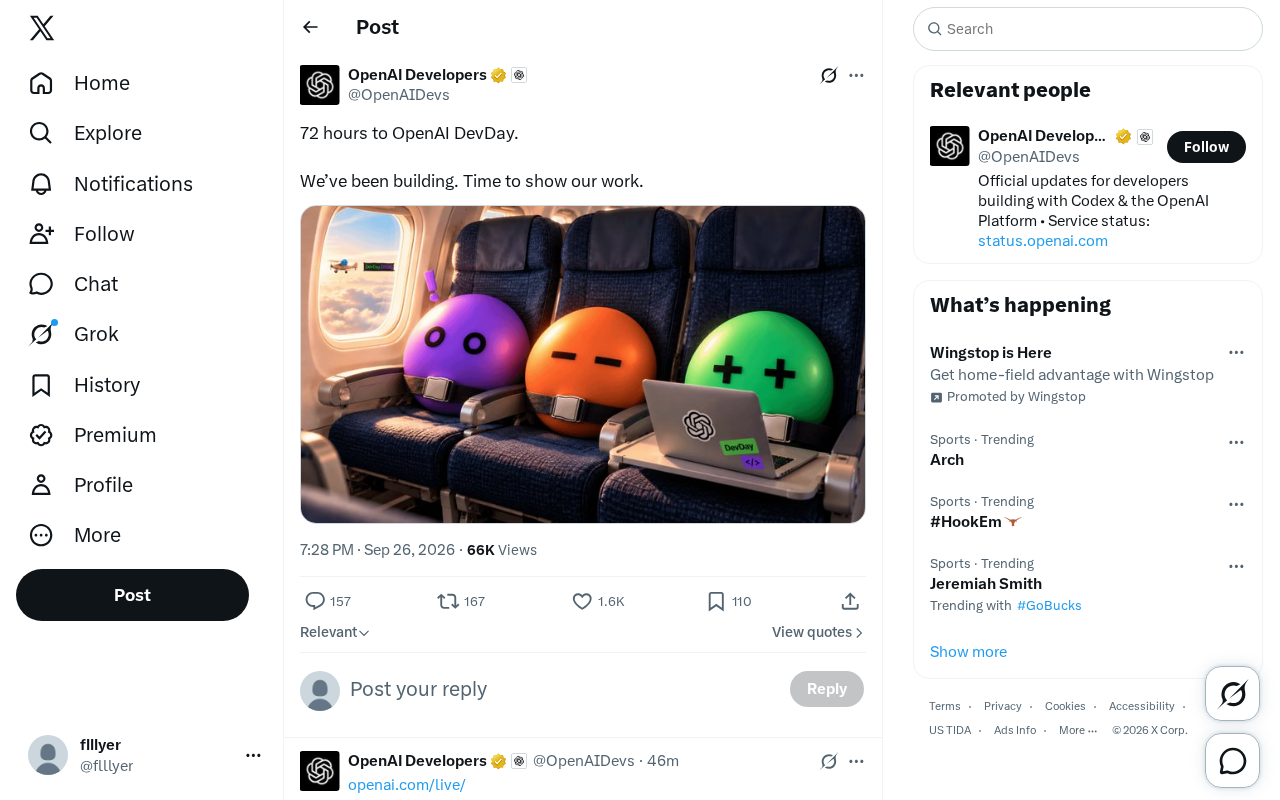
OpenAI posted on social media announcing that its DevDay developer conference is just 72 hours away. The teaser was short but loaded with implication: "We've been building. Time to show our work."
That single tweet says a lot. It signals that OpenAI has been quietly accumulating a wave of announcements ready to go public. For the global AI developer community, DevDay has always been a key window into OpenAI's technical roadmap, API updates, and product strategy.
What DevDay Actually Means
DevDay is OpenAI's annual event aimed at developers. Past editions have consistently featured heavyweight releases — new model capabilities, API feature expansions, and upgrades to developer tooling. These events aren't just tech showcases; they're the primary channel through which OpenAI signals its direction to ecosystem partners and third-party developers.
The phrase "show our work" in this year's teaser suggests that months of behind-closed-doors development are about to become publicly available products or features. For companies and independent developers building on OpenAI's platform, this could mean new capabilities and fresh commercial opportunities.
Looking back, the inaugural OpenAI DevDay in 2023 launched GPT-4 Turbo, customizable GPTs, and significantly reduced API pricing — all in one shot, dramatically lowering the barrier to entry for the developer ecosystem. The 2024 DevDay shifted to a multi-city touring format and introduced capabilities like the Realtime API and Vision Fine-tuning. These precedents show that DevDay announcements tend to have immediate, practical business value rather than being purely technical demonstrations — teams building on OpenAI's platform typically feel the impact right away.
Key Areas Worth Watching
While OpenAI hasn't revealed specifics, industry patterns and recent signals suggest a few areas developers should pay attention to:
Model Capability Upgrades
Nearly every major OpenAI event centers on model improvements — whether that's reasoning ability, multimodal handling, or response speed. These are the metrics developers care about most.
API and Developer Tools
API feature expansions, pricing adjustments, and new developer tooling are typically the centerpiece of DevDay. These updates directly affect the cost and experience of building applications.
OpenAI's API ecosystem currently operates via REST interfaces, spanning product lines including text generation (Chat Completions), embeddings, image generation (DALL·E), and speech-to-text (Whisper). Developers access these capabilities via API keys and pay per token usage. Historically, API-level changes at DevDay have included: new model versions (such as the gpt-4o series), expanded context windows (affecting how much text can be processed in a single call), support for Structured Outputs to reduce parsing overhead, and cost-reduction options like the Batch API. These shifts directly influence developers' technical choices and budget planning, which is why they draw so much attention.
Ecosystem and Integrations
OpenAI may also announce deeper integrations with third-party platforms, further expanding its footprint in the enterprise market.
Advice for Developers
With only three days until the event, developers who rely on the OpenAI ecosystem should start preparing now: monitor official release channels, assess how your existing projects could leverage potential new features, and think through any migration or upgrade strategies. Any changes at the API level can affect live applications, so planning ahead will help ensure a smooth transition.
One important note: this article is based on a single teaser post from OpenAI, and actual announcements should be treated as official only when formally released. Until the conference opens, any speculation about specific details is purely conjecture.
Closing Thoughts
The countdown to OpenAI DevDay has begun, and this event will be an important lens through which to read the direction of AI development. Whether it's model upgrades, API changes, or ecosystem moves, developers and industry observers alike have good reason to pay close attention. In three days, OpenAI will reveal what it's "been building."
Related articles

Gaussian Process Bandit Optimization: Exploration Strategies and Inference Regret Guarantees
Cumulative regret guarantees in Bayesian optimization fail to reflect final recommendation quality. This article examines a new study that provides inference regret guarantees for Gaussian process bandit optimization through exploration query strategies and fill distance analysis, validated on hyperparameter optimization and control tasks.

The Most Detailed Codex Guide on Bilibili: From Installation to Real-World Practice
The most detailed Codex guide on Bilibili: from app store installation to daily work mode configuration, with a real coffee shop project demonstrating file organization, data extraction, dashboard creation, and other practical tasks. Learn to use Plan Mode and desktop pets to leverage Codex efficiently.

Appearance Compensation in Volume Rendering: Why RGB Accuracy Cannot Guarantee Density Correctness
Volume rendering research reveals that volumetric data perfectly reproducing external RGB views may still contain density errors: appearance compensation can double central density and keep external rays unchanged even when L2 error exceeds 14.52%. Density recovery depends on appearance capacity, spatial resolution, and measurement design.