8K Stars on GitHub: Deep Dive into the Most Comprehensive LLM Learning Resource Repository

awesome-LLM-resources on GitHub is a high-quality resource hub covering the full LLM technology stack.
awesome-LLM-resources is a GitHub project with 8,200+ Stars maintained by WangRongsheng. It systematically covers over a dozen core directions including multimodal generation, AI Agents, MCP protocol, AI-assisted programming, model training and inference optimization, o1 reasoning models, and small language models, providing AI practitioners at all levels with a complete knowledge map from foundational theory to cutting-edge applications.
Project Overview
The pace of innovation in Large Language Model (LLM) technology is staggering, and systematically accessing high-quality learning resources remains a persistent challenge for every AI practitioner and researcher. Large Language Models are deep learning models based on the Transformer architecture, pre-trained on massive text corpora, with parameter counts typically ranging from billions to trillions. Since ChatGPT ignited global attention in late 2022, the LLM field has experienced an unprecedented technological explosion: OpenAI's GPT series, Meta's LLaMA series, Google's Gemini series, Anthropic's Claude series, and Chinese models like Qwen, DeepSeekAd, and GLM have been alternately pushing performance benchmarks forward. The knowledge update cycle in this field has shrunk from months to weeks or even days, with a flood of new papers, models, and tools released every week — making systematic resource curation more important than ever.
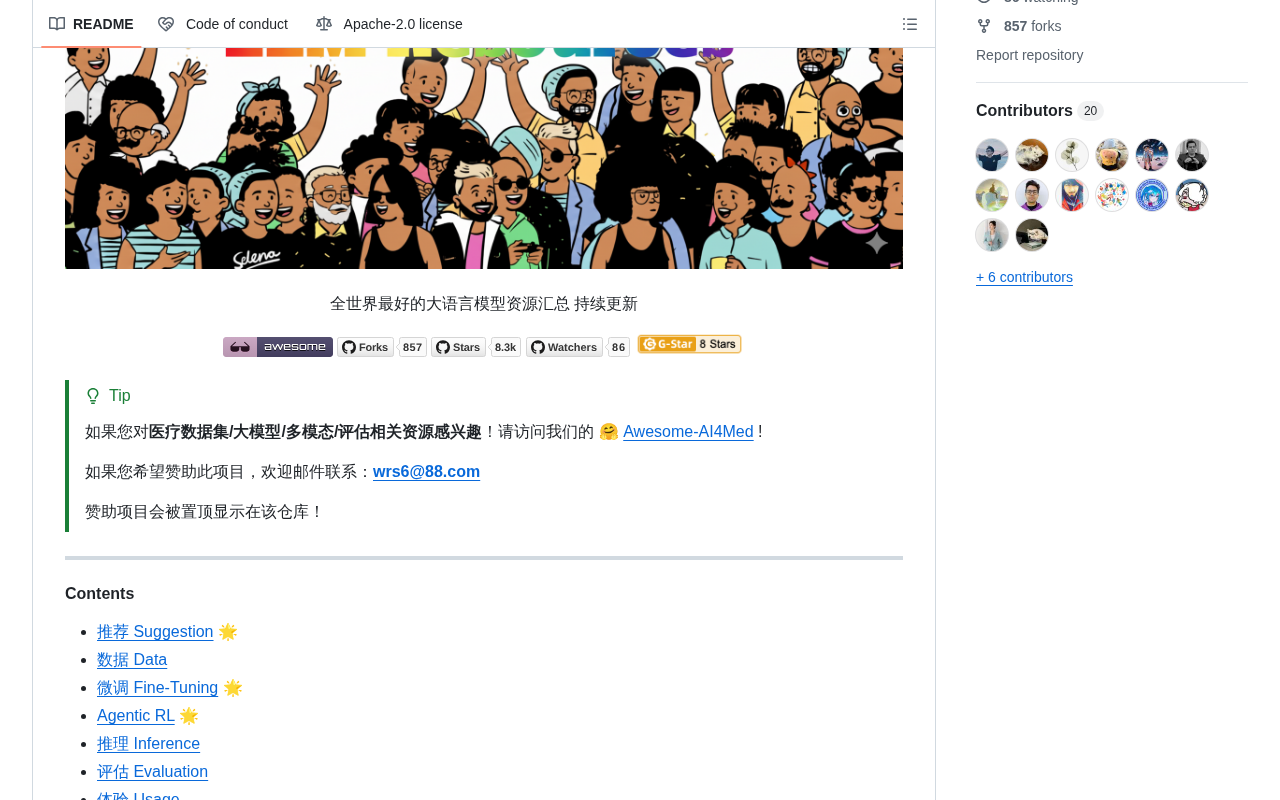
The awesome-LLM-resources project, maintained by WangRongsheng on GitHub, has become one of the most popular LLM resource aggregation repositories, boasting over 8,200 Stars and 844 Forks.
The project bills itself as "the best LLM resource collection in the world," covering a complete knowledge graph from foundational theory to cutting-edge applications, including multimodal generation, Agents, AI-assisted programming, AI paper review, data processing, model training and inference, o1 models, MCP, small language models, vision-language models, and over a dozen other core directions.
Core Content Sections Analyzed
Multimodal Generation and Vision-Language Models
Multimodal AI is the dominant theme in today's technological development. Multimodal AI refers to artificial intelligence systems capable of simultaneously processing and understanding multiple information modalities (such as text, images, audio, and video). Traditional AI models typically excel at only a single modality — for example, BERT for text and ResNet for images. The core challenge of multimodal models lies in achieving cross-modal semantic alignment — enabling models to understand that a picture of a cat and the word "cat" refer to the same concept. CLIP (Contrastive Language-Image Pre-training) was a milestone in this field, mapping images and text into a shared semantic space through contrastive learning, laying the technical foundation for subsequent multimodal large models.
This project systematically curates key papers, open-source projects, and practical guides in the multimodal generation field, covering sub-directions including text-to-image, text-to-video, and image understanding. In text-to-image generation, models like Stable Diffusion, DALL-E, and Midjourney have achieved commercially viable quality levels; text-to-video generation, represented by Sora, Kling, and others, is rapidly breaking through technical bottlenecks. Vision-Language Models (VLMs) are highlighted as a standalone section — driven by models like GPT-4V, LLaVA (which gives open-source models multimodal conversational capabilities through visual instruction tuning), and Qwen-VL (which excels in Chinese multimodal scenarios), reflecting the industry-wide trend of deep integration between visual understanding and language capabilities.
Developers looking to go deep in the multimodal direction can find a complete path from theory to practice in this section.
AI Agent and MCP Protocol
AI Agent is one of the hottest technical directions in 2024-2025. An AI Agent refers to an AI system capable of perceiving its environment, making autonomous decisions, and executing actions to accomplish specific goals. Unlike traditional single-turn Q&A-style LLM interactions, Agents possess core capabilities including Planning, Memory, Tool Use, and Reflection. Typical architectures include: the ReAct framework (alternating between reasoning and action), the Plan-and-Execute framework (formulating a plan first, then executing step by step), and multi-Agent collaboration frameworks (multiple specialized Agents cooperating to complete complex tasks). Open-source frameworks like LangChain, AutoGPT, MetaGPT, and CrewAI provide the infrastructure for Agent development. Since 2024, Agents have moved from the proof-of-concept stage into practical deployment, demonstrating enormous potential in office automation, software development, data analysis, and scientific research.
The project curates core resources around Agent architecture design, tool invocation, and multi-Agent collaboration. Notably, MCP (Model Context Protocol) is listed as a standalone section — this is the model context protocol officially open-sourced by Anthropic in November 2024. Its design philosophy is similar to the USB protocol in computing or the HTTP protocol on the internet, aiming to provide a unified standard interface that allows any LLM to connect to any external tool and data source in a consistent manner.
Before MCP, every AI application needed to write custom integration code for each tool, creating an M×N complexity problem (M models connecting to N tools requiring M×N adapters). MCP simplifies this to an M+N problem: models only need to implement an MCP client, and tools only need to implement an MCP server. The protocol uses JSON-RPC 2.0 as its communication format and supports three core primitives: Resources, Tools, and Prompts. Currently, mainstream AI applications like Cursor, Claude Desktop, and Cline have been among the first to support MCP, and commonly used services such as GitHub, Slack, and databases have already released official MCP servers, with the ecosystem expanding rapidly.
The decision to feature MCP as a standalone section shows the maintainer's sharp instinct for technology trends. MCP is rapidly gaining industry recognition and is poised to become the "USB interface" of the AI Agent space.
AI-Assisted Programming and AI Paper Review
The AI-assisted programming section focuses on tools like Cursor, GitHub Copilot, and Codeium, along with their underlying technologies, while also curating training methods and evaluation benchmarks for code generation models. AI paper review is a relatively niche but highly practical direction, targeting scenarios like automated paper review, rewriting, and polishing for academic publications, providing researchers with useful tool references.
The inclusion of these two sections demonstrates that the project doesn't just track technological frontiers — it also seriously covers real-world productivity scenarios.
Model Training and Inference Optimization
From pre-training to fine-tuning (SFT/RLHF/DPO) to quantized deployment, the project systematically organizes the full lifecycle technology stack for LLMs. LLM training typically consists of two stages: pre-training and alignment. The pre-training stage learns fundamental language capabilities from massive amounts of unlabeled text, while the alignment stage teaches the model to follow human instructions and produce helpful, safe responses. SFT (Supervised Fine-Tuning) is the first step of alignment, using human-annotated instruction-response pairs to train the model to understand and execute instructions. RLHF (Reinforcement Learning from Human Feedback) is the core technique OpenAI used in ChatGPT — its pipeline involves first training a Reward Model to simulate human preference judgments, then optimizing the LLM's output policy using the PPO (Proximal Policy Optimization) algorithm. DPO (Direct Preference Optimization), proposed in 2023, is a more streamlined alternative that skips the explicit reward model training step and directly optimizes the model policy using human preference data. It has been mathematically proven equivalent to RLHF but is simpler to implement and more stable to train, leading to its rapid widespread adoption.
The data processing section covers data cleaning, data synthesis, and data annotation — often the "invisible deciding factors" that determine model quality.
The inference optimization section focuses on inference acceleration frameworks like vLLM, TensorRT-LLM, and llama.cpp, as well as model compression techniques including quantization, pruning, and distillation — directly addressing the core pain points of enterprise-grade deployment. vLLM is a high-performance inference engine developed by the UC Berkeley team, with PagedAttention as its core innovation — borrowing the paged memory management concept from operating system virtual memory to manage KV Cache (Key-Value Cache, the memory area storing historical token attention information during Transformer inference) in pages, dramatically reducing memory waste and enabling a single GPU to serve more concurrent requests. TensorRT-LLM is NVIDIA's inference optimization library that deeply leverages NVIDIA GPU hardware features (such as Tensor Cores and FP8 precision), achieving peak performance through operator fusion, quantization, and parallelism strategies. llama.cpp takes an entirely different approach — it's a pure C/C++ inference framework that supports CPU inference and ultra-low-bit quantization (such as 4-bit and 2-bit), making it possible to run LLMs on laptops or even Raspberry Pis. Quantization techniques (such as GPTQ, AWQ, GGUF) reduce memory footprint and computation by lowering the numerical precision of model weights; pruning removes unimportant parameter connections; and knowledge distillation lets small models learn from larger models' behavior — together forming the model compression toolkit.
o1 Models and Small Language Models
The o1 model section focuses on OpenAI's reasoning-enhanced model series, curating research resources on core techniques like Chain-of-Thought and test-time compute scaling. OpenAI's o1 model, released in September 2024, marked an important turning point in LLM development. Traditional LLMs employ "System 1"-style fast intuitive reasoning — the model performs only a single forward pass when generating each token, which often falls short when handling complex math, logic, and programming problems. The o1 model introduces a "System 2"-style slow thinking mechanism: before outputting its final answer, the model engages in extended internal Chain-of-Thought reasoning, decomposing complex problems into multiple steps and solving them one by one.
The core technology behind this is Test-time Compute Scaling: unlike traditional training-time scaling (increasing parameter count and training data), test-time scaling improves model performance by investing more computational resources during inference (longer thinking time, more reasoning steps). Research shows that increasing computation during inference also yields predictable performance improvements, and for certain tasks, this approach is more efficient than simply scaling up model parameters. The o1 model achieved significant breakthroughs on math competitions (AIME), programming contests (Codeforces), and scientific reasoning benchmarks. Subsequently, Google's Gemini 2.0 Flash Thinking, DeepSeek-R1, and other models have followed this technical path. This direction represents an important paradigm shift in LLMs evolving from "fast thinking" to "slow thinking."
The Small Language Model (SLM) section focuses on lightweight models with parameters in the low billions or less, such as Phi, Gemma, and smaller versions of Qwen. The rise of SLMs stems from several key technical breakthroughs: first, high-quality training data selection and synthesis techniques — Microsoft's Phi series research demonstrated that carefully curated "textbook-quality" data can enable small models to achieve performance far exceeding expectations for their parameter count; second, advances in knowledge distillation and model architecture optimization that allow small models to more efficiently utilize their limited parameter capacity.
In scenarios like on-device deployment, privacy computing, and low-cost inference, small language models are demonstrating undeniable application potential. Specifically, SLMs have irreplaceable advantages in: on-device deployment (running locally on phones, PCs, and IoT devices without internet connectivity), privacy-sensitive scenarios (data stays local to meet compliance requirements), low-latency requirements (response speeds typically several to dozens of times faster than large models), and cost-sensitive enterprise applications (inference costs can be reduced by one to two orders of magnitude). Product strategies like Apple Intelligence and Google on-device AI are heavily pushing SLM edge applications, and this trend is expected to accelerate further in 2025.
Project Value and Usage Recommendations
Why It Deserves Your Attention
- Broad coverage with clear structure: Unlike scattered blog bookmarks, this project is systematically categorized by technical direction, making it easy to search by need
- Stays current with the frontier: Timely inclusion of the latest directions like MCP, o1, and SLM indicates an active update cadence
- Community endorsement: Over 8,200 Stars of community recognition means resource quality has been vetted by a large developer base
Target Audience
- AI beginners: Quickly build a cognitive framework of the full LLM technology landscape through the project's classification system
- Mid-to-senior developers: Fill gaps in specific technical directions and discover new tools and methods
- Technical managers: Understand the complete LLM technology stack to support technology selection and team capability building
Usage Recommendations
Don't try to digest everything at once. A better approach is to focus on 1-2 sections for deep learning based on your current work needs. You can also Watch the repository to receive update notifications and continuously track newly added resources.
Conclusion
The value of awesome-LLM-resources lies not just in resource aggregation, but in providing a clear "knowledge map" for the LLM field. In an era of information overload, this kind of structured curation is itself a scarce capability. Regardless of what stage you're at in your LLM learning journey, this repository is worth bookmarking.
Project link: github.com/WangRongsheng/awesome-LLM-resources
Related articles
 Product Reviews
The Programmer's Desk Setup Guide: Building a Workspace That Feels Like Home
Discover how programmers build productive, comfortable workspaces. From multi-monitor setups to ergonomic design, explore the desk philosophy that drives focus and flow.
 Product Reviews
Qoder vs Cursor Real-World Comparison: Which $20/Month AI IDE Is Better?
Hands-on comparison of Qoder vs Cursor AI IDEs: Agent autonomy, human interaction count, and architecture decisions. Qoder needed only 2 interactions vs Cursor's 8.
 Product Reviews
Cursor Cloud Agent Demo: Eliminating Bottlenecks Across the Entire Software Development Lifecycle
Deep analysis of Cursor's Cloud Agent demo showing how cloud VMs, automated test artifacts, and a full-chain control plane systematically eliminate human bottlenecks across the software development lifecycle.