8K Stars on GitHub: Deep Dive into the Most Comprehensive LLM Resource Repository

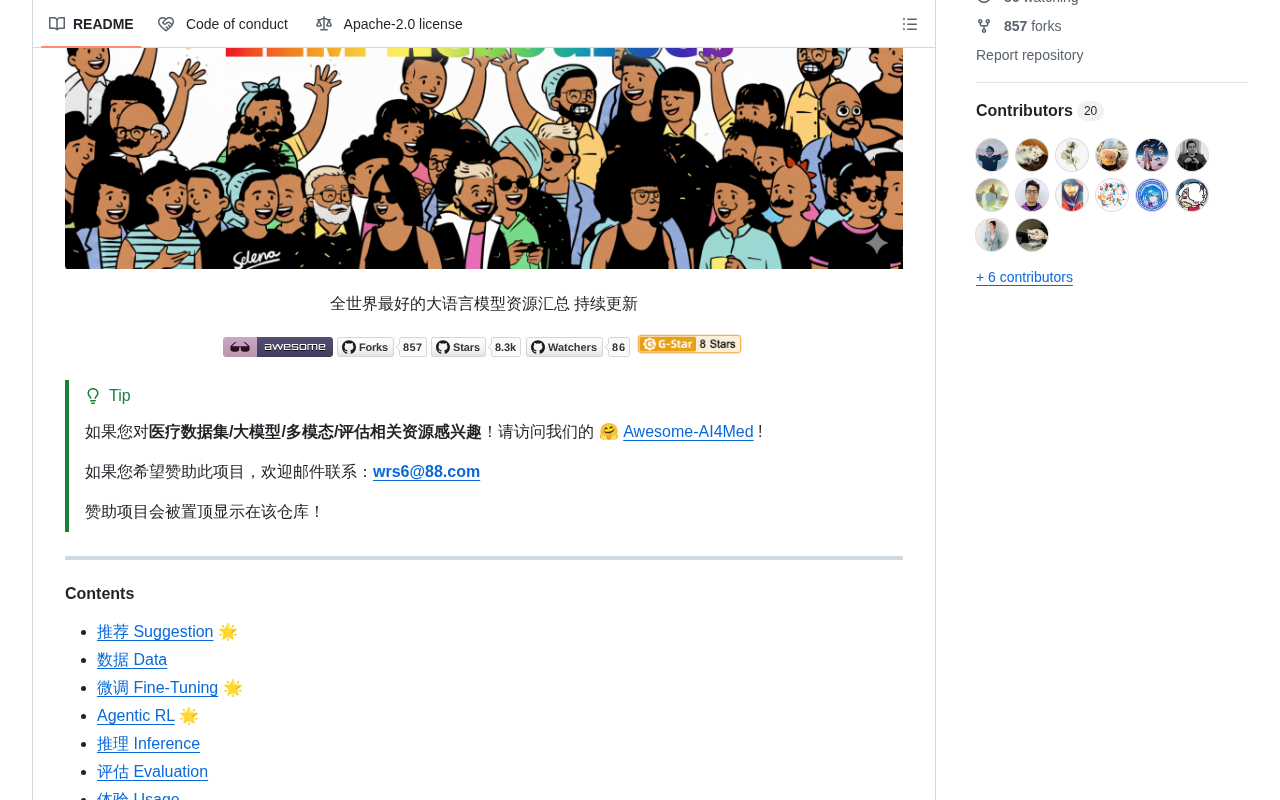
awesome-LLM-resources is GitHub's most comprehensive Chinese LLM resource hub covering the full LLM ecosystem.
The GitHub project awesome-LLM-resources (8200+ Stars) systematically aggregates high-quality resources across the LLM domain, covering multimodal generation, AI Agents and MCP protocol, AI-assisted programming, model fine-tuning (SFT/RLHF/DPO/LoRA), inference optimization (vLLM/TGI), o1 reasoning models, small language models, and over ten other core areas. Chinese-friendly, frontier-focused, and practice-oriented, it serves as an excellent learning and technology tracking index for everyone from beginners to senior practitioners.
Project Overview
In today's rapidly evolving landscape of Large Language Models (LLMs), practitioners and researchers face a core pain point: high-quality resources are too scattered, making it difficult to plan a learning path. An open-source project on GitHub called awesome-LLM-resources is systematically addressing this problem. Maintained by developer WangRongsheng, the project has earned over 8,200 Stars and 844 Forks, making it arguably the most comprehensive LLM resource aggregation in the Chinese-speaking community.
Positioned as "the world's best LLM resource compilation," the project covers a complete knowledge graph from foundational theory to cutting-edge applications, spanning multimodal generation, Agents, AI-assisted programming, AI paper review, data processing, model training and inference, o1 models, MCP, small language models, vision-language models, and more than ten other core domains.
Background on LLM Technology Development
Large Language Models are deep learning models based on the Transformer architecture, pre-trained on massive text datasets, with parameter scales typically ranging from billions to trillions. Since ChatGPT's release in 2022, LLM technology has experienced explosive growth, expanding from initial text generation to code writing, logical reasoning, multimodal understanding, and many other dimensions. Major players in the current LLM landscape include OpenAI (GPT series), Anthropic (Claude series), Google (Gemini series), Meta (LLaMA series), and Chinese companies like Baidu, Alibaba, and DeepSeekAd. The pace of technological iteration is extremely fast, with new models, frameworks, or methodologies released almost every week—which is precisely the core value proposition of resource aggregation projects.
Deep Dive into Ten Core Resource Sections
Multimodal Generation and Vision-Language Models
Multimodality is the dominant theme in current LLM development. This project systematically organizes the technological evolution from GPT-4V to open-source Vision-Language Models (VLMs), including papers, code, and practical tutorials for mainstream models like LLaVA, Qwen-VL, and InternVL. For developers looking to expand from pure-text LLMs into the multimodal domain, this section provides a clear entry path.
Multimodal AI refers to artificial intelligence systems capable of simultaneously processing and understanding multiple forms of information (text, images, audio, video). The technical core lies in cross-modal alignment—enabling models to understand semantic relationships between information from different modalities. GPT-4V is OpenAI's large model with visual understanding capabilities, pioneering a new paradigm of "visual comprehension." LLaVA (Large Language and Vision Assistant) is one of the most influential open-source vision-language models in academia, achieving multimodal understanding through bridging visual encoders with language models. Qwen-VL and InternVL come from Alibaba and Shanghai AI Lab respectively, representing China's cutting-edge work in the multimodal domain. These models share a common technical pipeline: using pre-trained visual encoders (such as CLIP's ViT) to extract image features, then mapping visual features to the language model's embedding space through projection layers or adapters, thereby enabling unified multimodal reasoning.
Agents and MCP Protocol
AI Agents are considered the key form factor for LLM deployment. The project includes cutting-edge materials on Agent architecture design, tool calling, memory mechanisms, and more.
An AI Agent is an AI system capable of autonomously perceiving its environment, making plans, executing actions, and learning from feedback. Unlike simple Q&A-style LLMs, Agents can decompose complex tasks, invoke external tools, maintain long-term memory, and accomplish goals through multi-step reasoning. A typical Agent architecture contains four core modules: the Planning module handles task decomposition and strategy formulation, commonly using Chain of Thought (CoT) or Tree of Thought (ToT) methods; the Memory module is divided into short-term working memory and long-term vector database storage; the Tool Use module interacts with external APIs, databases, code executors, etc. through function calling interfaces; and the Action module executes specific operations and observes results. Representative frameworks include LangChain, AutoGPT, MetaGPT, and others.
Notably, the project has established a dedicated MCP (Model Context Protocol) section—this is a model context protocol proposed by Anthropic that is becoming the new standard for Agent-tool interaction. Including MCP as a standalone section reflects the maintainer's keen judgment of technological trends.
MCP is a standardized protocol open-sourced by Anthropic in late 2024, designed to solve the fragmentation problem in connecting LLMs with external data sources and tools. Before MCP, every AI application needed custom integration code for different data sources and tools, resulting in massive duplication of effort and compatibility issues. MCP adopts a client-server architecture: MCP Hosts (such as Claude Desktop, IDE plugins) act as clients initiating requests, while MCP Servers serve as lightweight services exposing specific data source or tool capabilities. The protocol defines three core primitives: Resources (data exposure similar to GET requests), Tools (action execution similar to POST requests), and Prompts (prompt templates). MCP's significance lies in its attempt to become the "USB-C port" of the AI world—a universal connection standard that allows any LLM to access any external system through a unified protocol.
AI-Assisted Programming and AI Paper Review
These two sections focus on practical LLM applications in professional scenarios. The assisted programming section covers usage tips and underlying principles of tools like Cursor, GitHub Copilot, and Devin; the AI paper review section targets academic researchers, organizing methodologies for using LLMs to assist with paper writing, reviewing, and literature surveys. This integration of vertical-domain resources makes the project's practical value far exceed that of a typical awesome list.
Model Training and Inference Optimization
From pre-training and fine-tuning (SFT/RLHF/DPO) to efficient inference deployment, the project provides complete tech stack resources. This includes parameter-efficient fine-tuning methods like LoRA/QLoRA, inference frameworks like vLLM/TGI, quantization and compression techniques, and more. For teams that need to train and deploy models with limited compute, this section offers extremely valuable references.
Fine-Tuning Methods Explained: SFT, RLHF, and DPO
These three methods represent the evolution of LLM alignment technology. SFT (Supervised Fine-Tuning) is the most fundamental approach, directly fine-tuning models with high-quality instruction-response pair data to teach them to follow human instructions. RLHF (Reinforcement Learning from Human Feedback) is the key technology behind ChatGPT's success, conducted in three steps: first SFT, then training a Reward Model to learn human preferences, and finally using the PPO algorithm to optimize the policy model to produce outputs that receive higher rewards. RLHF achieves excellent results but is complex and unstable to train. DPO (Direct Preference Optimization) is a simplified approach proposed in 2023 that mathematically proves it's possible to skip reward model training and directly optimize the policy model from human preference data, significantly reducing training complexity and computational cost. It has now become one of the mainstream alignment methods.
Parameter-Efficient Fine-Tuning: LoRA and QLoRA
LoRA (Low-Rank Adaptation) is a parameter-efficient fine-tuning method proposed by Microsoft in 2021. Its core insight is that the weight change matrix during fine-tuning exhibits low-rank properties, so full fine-tuning can be decomposed into a product of two small matrices. Specifically, for a d×d weight matrix, LoRA freezes the original weights and only trains two matrices of rank r (typically r=8 or 16, much smaller than d): A (d×r) and B (r×d), reducing parameters from d² to 2dr—typically over 99% fewer trainable parameters. QLoRA further introduces 4-bit quantization: storing frozen base model weights in 4-bit NormalFloat format, dequantizing to BFloat16 only during forward passes, combined with paged optimizers to manage peak memory usage. This makes it possible to fine-tune 65B parameter models on a single consumer GPU (such as a 24GB RTX 4090).
Inference Frameworks: vLLM and TGI
vLLM is a high-performance LLM inference engine developed at UC Berkeley. Its core innovation is the PagedAttention mechanism—borrowing the paging concept from operating system virtual memory to manage KV Cache. In traditional inference, each request's KV Cache requires pre-allocated contiguous GPU memory, leading to significant memory fragmentation and waste (measured waste rates can reach 60-80%). PagedAttention divides the KV Cache into fixed-size blocks, allowing non-contiguous storage and dynamic allocation, bringing memory utilization close to the theoretical optimum. Additionally, vLLM supports Continuous Batching, which can insert new requests immediately as different requests complete, dramatically improving throughput. TGI (Text Generation Inference) is an inference framework developed by Hugging Face, characterized by deep integration with the Hugging Face ecosystem, tensor parallelism support, built-in watermarking mechanisms, and suitability for rapid production deployment. Comparing the two, vLLM typically leads in throughput, while TGI excels in ease of use and ecosystem compatibility.
o1 Model and Reasoning Capabilities
OpenAI's o1 model pioneered a new paradigm of "chain-of-thought reasoning." The project has dedicated a section to this, including technical analyses of o1, open-source reproduction attempts (such as Open-o1, DeepSeek-R1, etc.), and academic research on enhancing LLM reasoning capabilities. This reflects the community's intense interest in "slow thinking" abilities.
OpenAI's o1 model, released in September 2024, marks a paradigm shift for LLMs from "fast thinking" (System 1) to "slow thinking" (System 2)—a concept borrowed from Nobel laureate Daniel Kahneman's dual-system theory. Traditional LLMs have a fixed amount of computation per token generated, making them prone to errors on complex reasoning problems. The o1 model introduces the concept of test-time compute scaling: before answering a question, the model engages in extended internal deliberation (Chain of Thought), decomposing complex problems into multiple reasoning steps while performing self-verification and error correction. This approach has achieved breakthrough results on math competitions (AIME), programming (Codeforces), and scientific reasoning tasks. Among open-source reproduction attempts, DeepSeek-R1 achieved similar reasoning capabilities through large-scale reinforcement learning training, with its technical report revealing an "Aha Moment"—the model spontaneously learning to reflect and self-correct during RL training. This direction is considered one of the important paths toward AGI.
Small Language Models (SLMs)
Beyond the large model arms race, small language models are becoming another important track. The project compiles resources on small-parameter models like Phi, Gemma, and Qwen2.5, along with related technologies such as on-device deployment and model distillation. For developers focused on edge computing and cost control, this is an invaluable resource collection.
Small language models typically refer to models with 0.5B to 7B parameters, representing a pragmatic "good enough" approach. Microsoft's Phi series pioneered this field—Phi-3 Mini has only 3.8B parameters yet approaches GPT-3.5 performance on multiple benchmarks, with the secret being high-quality "textbook-level" training data. Google's Gemma 2B/7B and Alibaba's Qwen2.5 series similarly demonstrate impressive capabilities at small parameter counts. The core value of small language models lies in: (1) On-device deployment—can run locally on phones, laptops, and other devices, protecting data privacy without requiring network connectivity; (2) Cost control—inference costs scale approximately linearly with parameter count, allowing small models to reduce API costs by 10-100x; (3) Low latency—fewer computations mean faster response times. Knowledge Distillation is the key technique for obtaining high-quality small models, "compressing" knowledge by having the small model learn the output distribution of a larger model.
Project Value and Usage Recommendations
Why It's Worth Your Attention
Compared to other awesome lists, this project has several notable advantages:
- Extremely broad coverage: From theory to practice, training to deployment, large models to small models—it covers virtually the entire LLM ecosystem
- Stays current with the frontier: Latest hot topics like MCP, o1 reasoning, and small language models are all included, with relatively frequent updates
- Chinese-friendly: The project primarily uses Chinese, lowering the reading barrier for Chinese-speaking developers
- Practice-oriented: Beyond just papers, it includes extensive engineering practices, tool recommendations, and tutorial resources
Recommended Usage Approaches
- Beginners: Start with the data processing and model training sections to build foundational understanding before expanding into Agents and multimodal directions
- Researchers: Focus on cutting-edge sections like o1 models and vision-language models, tracking the latest papers and open-source implementations
- Engineers: The assisted programming, model inference, and MCP sections can directly improve daily development efficiency
- Team Leads: Use this project as an index for team technical learning to develop systematic study plans
Conclusion
In today's rapidly changing LLM landscape, the value of a high-quality resource aggregation project cannot be underestimated. awesome-LLM-resources has proven its content quality with 8,000+ Stars of community recognition. Whether you're an AI enthusiast just getting started or a seasoned practitioner with years of experience, this project deserves a place in your bookmarks as an important reference for continuous learning and technology tracking.
Related articles
 Product Reviews
The Programmer's Desk Setup Guide: Building a Workspace That Feels Like Home
Discover how programmers build productive, comfortable workspaces. From multi-monitor setups to ergonomic design, explore the desk philosophy that drives focus and flow.
 Product Reviews
Qoder vs Cursor Real-World Comparison: Which $20/Month AI IDE Is Better?
Hands-on comparison of Qoder vs Cursor AI IDEs: Agent autonomy, human interaction count, and architecture decisions. Qoder needed only 2 interactions vs Cursor's 8.
 Product Reviews
Cursor Cloud Agent Demo: Eliminating Bottlenecks Across the Entire Software Development Lifecycle
Deep analysis of Cursor's Cloud Agent demo showing how cloud VMs, automated test artifacts, and a full-chain control plane systematically eliminate human bottlenecks across the software development lifecycle.