90DaysOfDevOps: A DevOps Learning Roadmap with 30k Stars

90DaysOfDevOps evolved from a personal public learning project into a community learning map covering the full DevOps landscape.
This article introduces the GitHub repository MichaelCade/90DaysOfDevOps. Originally a personal public learning record, after three years it has evolved into a structured learning map covering DevOps principles, processes, tools, and use cases. With over 30k stars and 6,700+ forks, and 156 new stars today, it remains highly attractive. The year-by-year expansion ensures coherence and depth, helping beginners and experienced practitioners alike. High forks reflect deep community participation, embodying DevOps knowledge-sharing culture and showing how public learning and community co-creation turn personal growth into a sustainable community asset.
From a Personal Learning Project to a Community Learning Map
MichaelCade/90DaysOfDevOps started as the author's personal "learn in public" project and has now become a structured learning map used by many in the community. The project has accumulated three years of content covering DevOps principles, processes, tools, and use cases. The repository currently has over 30,000 stars and more than 6,700 forks, with 156 new stars today, indicating its continued popularity.
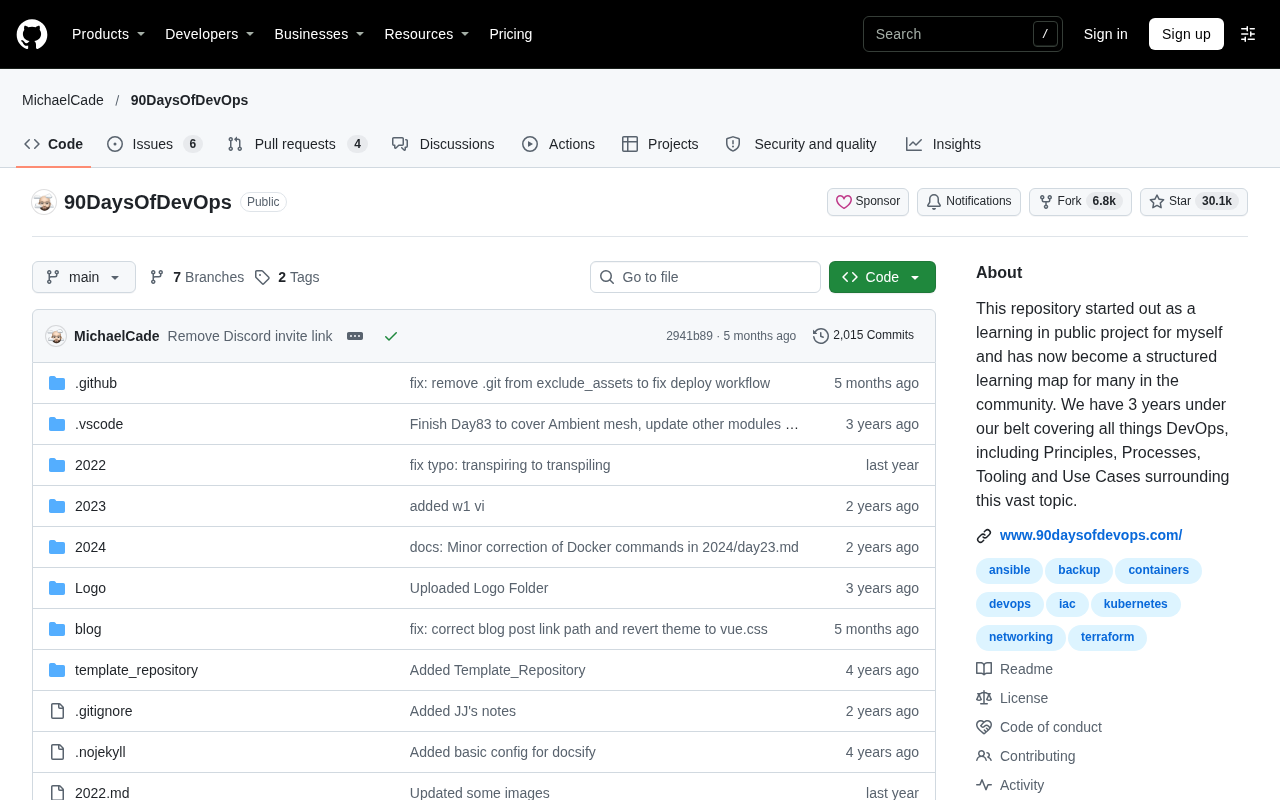
The value of this project lies in the fact that it is not a crash course but a time-tested learning roadmap. By publicly documenting his learning process, the author inadvertently paved a reusable path for others.
Learn in Public is a learning methodology: learners continuously share their learning process, notes, code, and insights publicly rather than completing their learning privately and then showcasing the results. This approach was first promoted by the developer community (e.g., the "Learn in Public" concept proposed by Shawn Wang). Its core assumption is that public output brings feedback, corrections, and connections, thereby accelerating personal growth while producing valuable byproducts for others. 90DaysOfDevOps is a typical practice of this model—the author did not set out to create a complete tutorial but gradually accumulated content while publicly documenting daily learning, eventually crystallizing into a structured roadmap.
Three Years of Accumulation: Covering the Full DevOps Landscape
The repository has gradually expanded its content over three years, from fundamental principles to specific tools and then to real-world use cases. This "year-by-year iteration" approach keeps the content coherent and deep rather than a random pile of knowledge points.
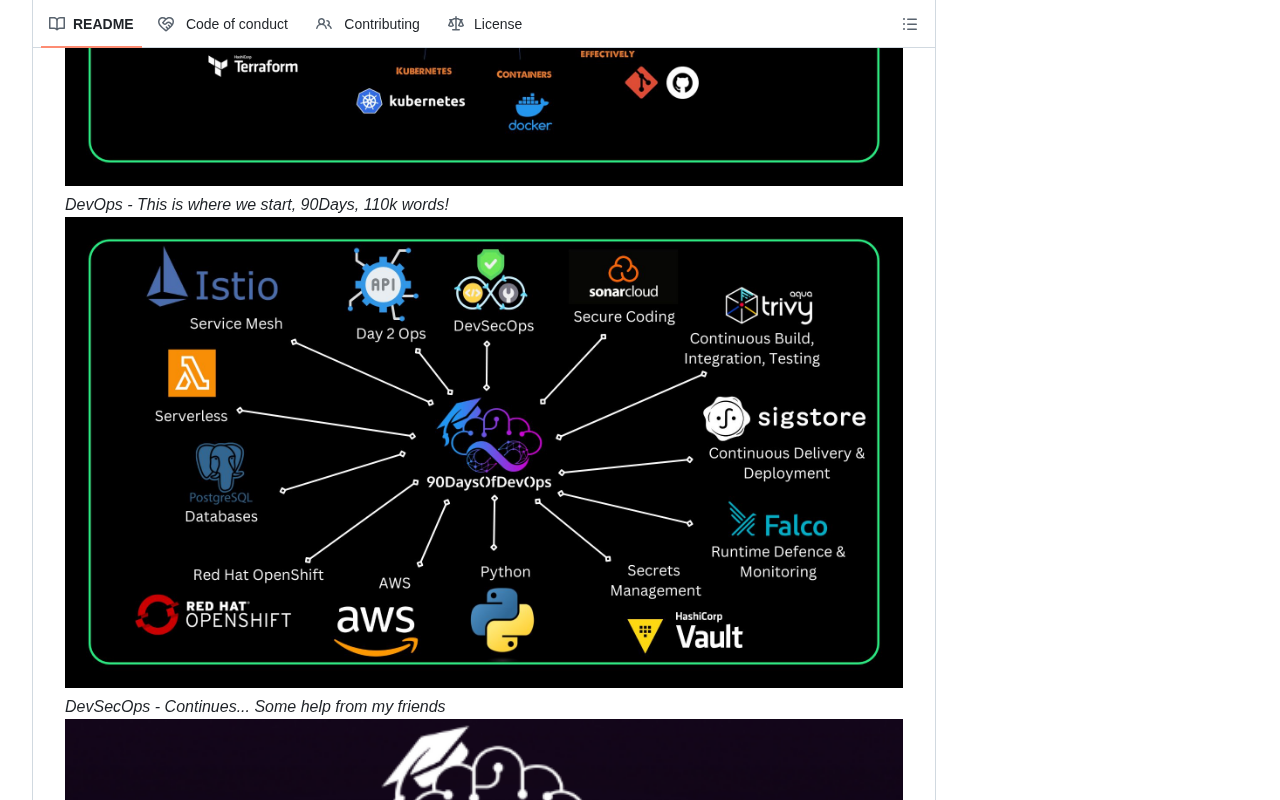
For beginners, this structured learning map can reduce the confusion of "not knowing what to learn." For experienced practitioners, it can also serve as a reference for filling gaps.
DevOps principles, processes, tools, and use cases form a commonly used layered framework for understanding the field. Principles refer to core cultural concepts such as collaboration, automation, continuous improvement, and measurement feedback; processes refer to ways of working in the software delivery lifecycle, such as continuous integration, continuous delivery, infrastructure as code, and agile practices; tools are the specific technologies that support these processes, such as containers, orchestration systems, CI/CD platforms, and monitoring systems; use cases apply principles and tools to real scenarios, such as microservice deployment, fault injection, or cost optimization. Organizing learning content according to this layering can prevent beginners from falling into the fragmented trap of "learning only tools without understanding principles" and also help experienced practitioners fill gaps layer by layer.
Community-Driven Learning Model
More than 6,700 forks indicate that many users not only read but also copy and possibly modify or localize the content. This level of participation is a key indicator of the success of an open-source learning project. The project's evolution from a personal project to a community resource also reflects the knowledge-sharing culture in the DevOps field.
Fork is an operation on Git hosting platforms (such as GitHub): a user completely copies another person's repository to their own account, thereby obtaining an independently modifiable copy. The number of forks is therefore often used as a measure of "depth of participation"—it means users are not just browsing or bookmarking but may be localizing translations, adding notes, adjusting learning paths, or suggesting improvements. Compared with stars (which indicate interest or bookmarking), forks better reflect whether users intend to use or adapt the content. For open-source learning projects, a large number of forks also means the content may be translated into multiple languages or redistributed in local communities, thereby expanding the project's influence.
Key Takeaways
- The project evolved from a personal public learning project into a community structured learning map and has been ongoing for three years.
- The content covers DevOps principles, processes, tools, and use cases, suitable for learners at different stages.
- High star and fork counts reflect community recognition, and daily new stars show continued appeal.
- The open-source collaboration model provides a sustainable path for iterating learning resources.
Conclusion
90DaysOfDevOps demonstrates the power of learning in public and community co-creation. It is not just a collection of technical resources but also a demonstration of a learning method: through continuous recording and sharing, personal growth can be transformed into a community asset. For those who want to systematically learn DevOps, this is a starting point worth following.
One-line Summary
90DaysOfDevOps evolved from a personal public learning project into a community learning map covering the full DevOps landscape.
Paragraph Summary
This article introduces the development history and value of the GitHub repository MichaelCade/90DaysOfDevOps. The project started as the author's personal public learning record and, after three years of iteration, has evolved into a structured learning map covering DevOps principles, processes, tools, and use cases. The repository has over 30,000 stars and more than 6,700 forks, with 156 new stars today, showing its continued appeal. The article points out that this year-by-year expansion ensures coherence and depth of content, reducing confusion for beginners and helping experienced practitioners fill gaps. The high fork count reflects deep community participation—not just reading but also copying and adapting—mirroring the knowledge-sharing culture in the DevOps field. Overall, the project shows how learning in public and community co-creation can transform personal growth into a sustainable community asset.
Related articles

AI Coding Enters the Team Collaboration Era: Interpreting Three Major Moves from Meta, GitHub, and Mistral
Meta acquires Conductor, GitHub Copilot Fusion becomes available, Mistral opens Large 4 weights—three moves show AI coding shifting from code generation to organizing development workflows. This article explains task orchestration, model collaboration, and cost control for developers.

Building a RAG Assistant with Dify: A Practical Guide to Knowledge Bases, Workflows, and Agent Nodes
How should knowledge bases, workflows, and Agent nodes connect in a Dify RAG assistant? We break down the division of labor and wiring logic for a shippable app.
 Tech Frontiers
The AI Industry Doesn't Lack Marketing—It Lacks Good Products
AI faces market selloffs and public skepticism—is marketing really the problem? This analysis of market signals and product experience argues the core困境 is incomplete products and a gap between promises and experience; the only way to change perceptions is to ship better products.