A 22k-Star Ebook Treasury: How One GitHub Repo Aggregates Resources from Four Major Reading Apps
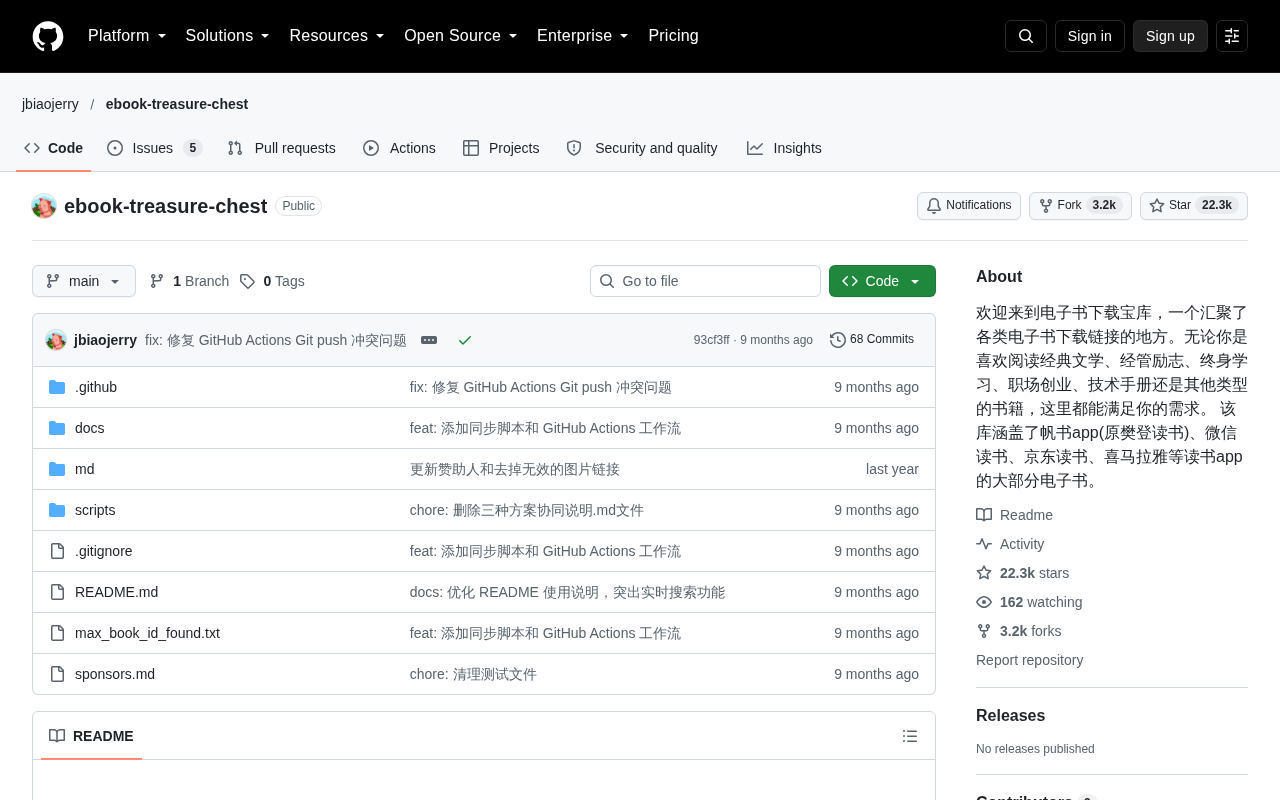
A 22k-star open-source ebook link index repository reflecting the aggregation value and concerns of Chinese digital reading.
This article introduces the GitHub project ebook-treasure-chest, which uses Python to maintain a cross-platform ebook download link index covering mainstream reading apps such as FanShu, WeChat Read, JD Read, and Himalaya, and has received over 22k stars. It analyzes why it became popular: Chinese ebook platforms are numerous and content is not interconnected, making user search costly, while this repository provides the aggregation value of "one entry point, multi-source index" with an extremely low usage barrier; the roughly 7:1 ratio of stars to forks indicates that users are mostly consumers rather than contributors. It also points out two concerns: poor stability of external links and unclear copyright authorization boundaries, as well as the common dilemma that index-type projects gain popularity quickly but struggle to sustain maintenance. Finally, it emphasizes that ordinary readers should view it as a clue map rather than a guarantee list.
In today's world of increasingly widespread digital reading, access to ebook resources remains fragmented—FanShu, WeChat Read, JD Read, and Himalaya each have their own libraries, and users often have to switch back and forth between multiple apps. A project on GitHub called jbiaojerry/ebook-treasure-chest attempts to solve this pain point with an open-source index.
Project Overview: The Demand Signal Behind Twenty Thousand Stars
ebook-treasure-chest has accumulated over 22,253 stars and 3,166 forks on GitHub, with daily new stars once reaching 220. For a resource-aggregation repository maintained by a single person, these numbers are quite impressive. It uses Python as its primary language and is essentially not a complex software system but a structured index of download links.
According to the project description, it covers book categories spanning classic literature, business and inspiration, lifelong learning, workplace entrepreneurship, and technical manuals, and claims to include most ebooks from mainstream reading apps such as FanShu (formerly Fan Deng Reading), WeChat Read, JD Read, and Himalaya.
This design philosophy of "one entry point, multi-source index" precisely addresses the long-standing information silo problem in the Chinese ebook ecosystem.
Why a Link Repository Can Earn Twenty Thousand Stars
Fragmented Reading Platforms and Broken Search Experience
A notable feature of the Chinese ebook market is the proliferation of platforms with content that is not interconnected. FanShu focuses on audiobooks and book commentary, WeChat Read emphasizes social reading, JD Read is tied to the e-commerce ecosystem, and Himalaya is a major hub for audio content. If users want to find a particular book, they often need to search on multiple platforms separately, and may not even be sure whether the target book exists on a given platform.
ebook-treasure-chest aggregates ebook resource links from these major platforms into a single index, reducing search costs. Its value lies not in "providing new content" but in "reducing discovery costs"—a classic aggregator value proposition.
The "aggregator value proposition" originates from a classic concept in internet platform economics: an aggregator itself does not produce content but creates value by integrating fragmented supply and reducing users' discovery and comparison costs. In the ebook scenario, each reading platform constitutes a closed content silo, and users searching for a book must jump repeatedly between multiple apps. The aggregator's role is precisely to compress this "multi-point search" into a "single-point lookup." The magnitude of its value depends on two factors: the breadth of sources aggregated and the accuracy and timeliness of the index information. This also explains why such projects often exist as "link lists" rather than "content libraries"—they sell the map, not the destination.
Extremely Low Technical Barrier, Extremely Low Usage Barrier
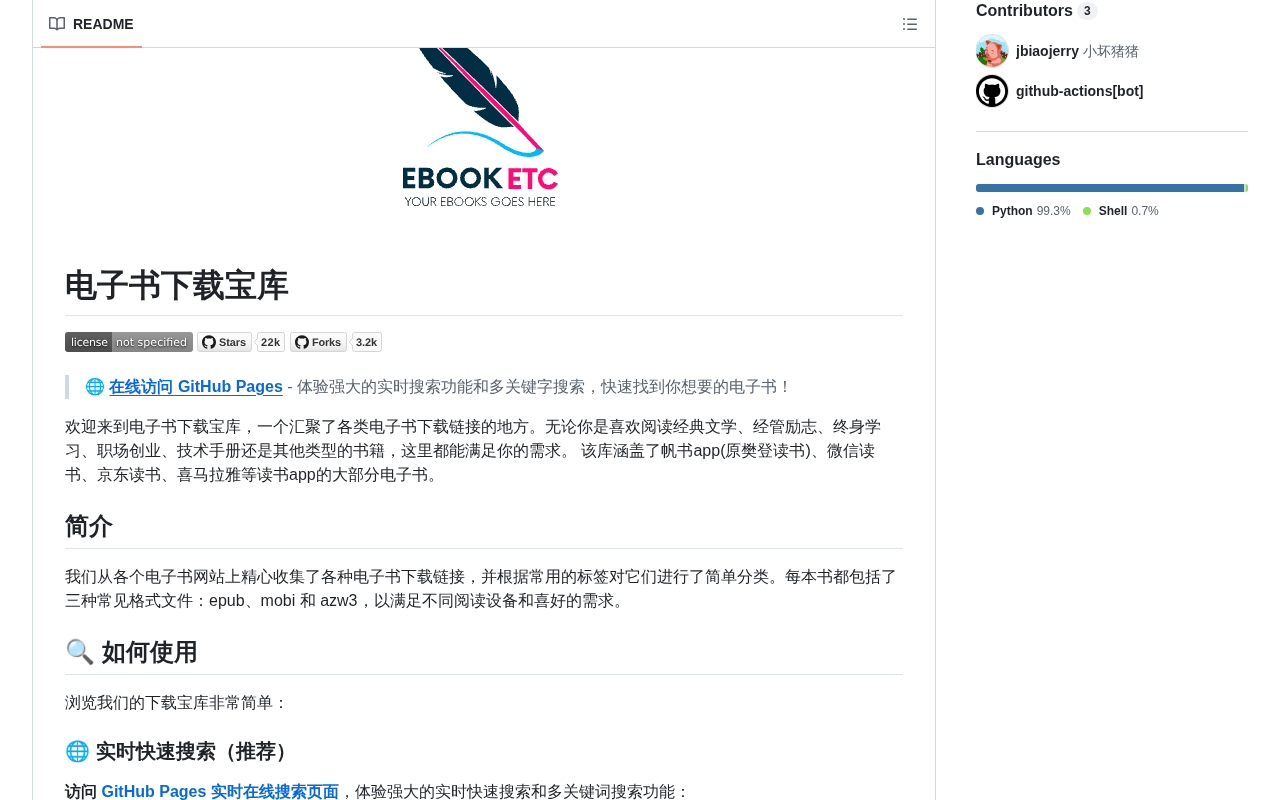
The project uses Python as its primary language, and its star count far exceeds its fork count (about 7:1), indicating that the vast majority of users are "consumers" rather than "contributors." This fits the typical user profile of resource-index projects: open the repository, find the book, click the link, done.
Compared with complex open-source projects that require deployment, configuration, and debugging, these "open-and-use" repositories have a natural advantage in spreading.
Concerns About Resource-Aggregation Open-Source Projects
Link Validity and Copyright Boundaries
The core asset of such projects is external links, not self-hosted content. Link stability therefore becomes the biggest variable: changes to resource paths by target platforms, removal of specific books, or changes in access policies will invalidate entries in the index. Repository maintainers need to continuously inspect and update, which explains why the project chose Python rather than pure Markdown maintenance—scripted link validation is a predictable engineering direction.
More worthy of discussion is the copyright dimension. The project states that it aggregates ebook download links from major reading apps, but whether the resources these links point to have legal authorization is not determined by the repository itself. For users, understanding the boundary between "index" and "content" is a basic judgment they should possess when using such resource libraries.
Sustainability of Index-Type Projects
22k stars is an impressive number, but resource-aggregation projects generally face the same problem: popularity comes quickly, but maintenance sustainability is hard to guarantee. Once links become largely invalid and maintenance cannot keep up, the star count instead becomes a burden—it means a batch of users whose expectations are dashed.
From an engineering perspective, for such projects to survive long-term, they need to upgrade from a "manually maintained link list" to a "resource index system that can automatically detect, be collaboratively validated by the community, and mark invalid status." The choice of Python gives room for this evolution, but whether it can truly be achieved depends on the maintainer's willingness to invest.
"Link invalidation detection" is a key part of engineering for resource-index projects. Common approaches include: using HTTP status codes to batch-probe link reachability, performing keyword or page-structure validation on returned content to identify "soft 404s" (where the page still returns 200 but the content has changed), and writing detection results into status fields with dynamic annotations in the README. A more advanced approach is to use CI tools such as GitHub Actions to run detection scripts periodically, automatically generate invalidation reports, and submit issues, thereby transforming maintenance from "manual inspection" into a "community-participatory automated process." Such mechanisms are low-cost but can significantly extend the effective lifecycle of index-type projects.
Practical Significance for Ordinary Readers
Setting aside the halo of star counts, the value of this project to ordinary users can be summarized in three points: first, it provides a cross-platform bibliography map that helps readers quickly determine on which platform a book can be obtained; second, it reduces the time cost of repeatedly searching across multiple apps; third, as an open-source index, its structure itself has reference value for developers who want to build their own personal library indexes.
It is important to recognize clearly that links in the repository are not permanently valid, and book availability changes dynamically with platform policies. Treating it as a "clue map" rather than a "guarantee list" is a more reasonable mindset for use.
Final Thoughts
The popularity of ebook-treasure-chest reflects a real structural problem in the Chinese digital reading ecosystem: content is growing, but the path to discovering content remains fragmented. A 22k-star link repository cannot cure this problem, but it at least proves that in a landscape where platforms each fight their own battles, the open-source community still has room to fill information gaps in a lightweight way. For developers, it is also a reminder—sometimes, organizing and indexing is itself a valuable product.
One-line Summary
A 22k-star open-source ebook link index repository reflects the aggregation value and concerns of Chinese digital reading.
Paragraph Summary
This article introduces the GitHub project ebook-treasure-chest, which uses Python to maintain a cross-platform index of ebook download links covering mainstream reading apps such as FanShu, WeChat Read, JD Read, and Himalaya, and has received over 22k stars. The article analyzes why it became popular: Chinese ebook platforms are numerous and content is not interconnected, making user search costly, while this repository provides the aggregation value of "one entry point, multi-source index" with an extremely low usage barrier. The roughly 7:1 ratio of stars to forks indicates that users are mostly consumers rather than contributors. It also points out two concerns: poor stability of external links and unclear copyright authorization boundaries, as well as the common dilemma that index-type projects gain popularity quickly but struggle to sustain maintenance. Finally, it emphasizes that ordinary readers should view it as a clue map rather than a guarantee list.
Related articles

zCAD AI: Generating Editable Parametric 3D Parts with Natural Language
zCAD AI tops Product Hunt with natural-language generation of editable parametric 3D parts and assemblies, browser CAD editing, and STEP export. We break down its boundaries and use cases.

myPip: Building Monetizable Games with AI Vibe Coding
myPip is an AI game creation tool that generates playable games from natural language descriptions, with built-in in-app purchases and ads for monetization. This article covers its features, use cases, and challenges.

AI Code Documentation Isn't Just Boring Text: The Practice of Visual Interactive Docs
AI-generated code is outpacing static docs. Learn how visual, dynamic, interactive documentation—with Linear/Jira integration and interactive PR review—keeps engineers in sync.