A 5-Level Roadmap for Learning AI Agents: Don't Rush Into Frameworks

A 5-level hands-on roadmap to learn AI Agents from the ground up, before touching any framework.
This article breaks AI Agent development into five progressive levels, each paired with a concrete project. Start by understanding how LLMs work (tokens, context windows, temperature), then master production-grade API patterns like retries and idempotency. Level 3 shifts focus to context management over prompt engineering, Level 4 covers building a reliable RAG pipeline, and Level 5 wires everything into a complete tool-calling Agent. The core argument: learning order determines success — build from the ground up before reaching for frameworks.
A lot of people want to get into AI Agent development. They've bookmarked piles of resources, watched dozens of tutorials — and then when it comes time to actually build something, they realize all they can do is call an API and chat with a model. That's not a talent problem. It's a sequencing problem. 90% of people dive straight into LangChain or multi-agent frameworks before filling in any of the foundational gaps, and end up feeling more lost the more they learn.
This article breaks the learning path into five levels, each tied to a small, concrete project you can actually ship and verify. Follow this order, and it'll do more for you than blindly watching a hundred tutorials.
Level 1: Understand How Large Language Models Actually Work
Most people think calling an API is just sending a request and getting a response back. That's the biggest misconception. If you want to build Agents, you need to understand how models work under the hood first.
Tokens are the model's atomic unit — and Chinese, English, and code all consume tokens at very different rates, which directly affects your costs. The context window is the model's working memory, but bigger isn't always better. Stuff too much into it and you get "lost in the middle" — the model remembers what was at the start and end just fine, but ignores the information buried in between.
Temperature controls randomness in the output, not "intelligence." If you want consistent results, just turn it down. If you can't pass this level, everything else you build will be standing on sand.
Checkpoint project: Build a working Q&A system with parameter tuning, and experience firsthand how token consumption and temperature affect outputs.
The "lost in the middle" phenomenon is academically documented in research from Stanford and others: when a large amount of information is packed into the context window, the model pays the most attention to content at the beginning and end, while key information in the middle tends to get overlooked — with recall accuracy dropping by more than 20% in some cases. This explains why simply expanding the context window doesn't linearly improve performance — structure and position matter just as much. In practice, important instructions should go at the start of the system prompt or the end of the user message, not buried in the middle of a wall of background material.
Level 2: Don't Just Call APIs — Make Them Production-Ready
Knowing how to call an API is table stakes. Making a system run reliably in a real production environment is where the real skill is.
A single model call involves an entire network chain — retries, rate limiting, idempotency, timeouts, streaming responses, logging — and none of these are optional. Retries in particular must be paired with idempotency design. Without it, a single network hiccup could cause duplicate charges or tools executing twice, and that's a serious mess.
Don't expect structured output to work just because you said "please return JSON." That's a natural language request, not an engineering guarantee — you need validation to back it up. Function calling, at its core, is the model expressing "I want to invoke this tool" — but the execution authority always stays in your hands.
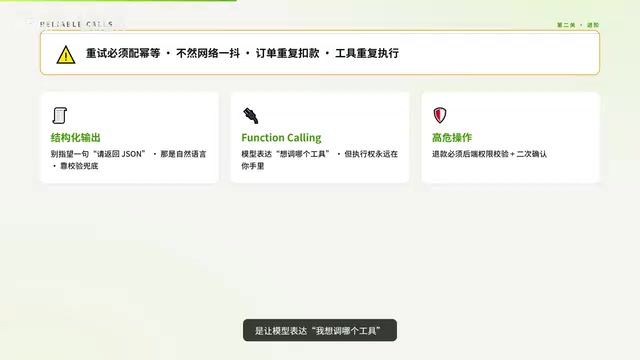
For high-risk operations like refunds, the backend must enforce full-chain validation and secondary confirmation. The model can suggest; it doesn't get to decide.
Checkpoint project: Add retry logic and idempotency checks to an existing API endpoint.
Idempotency is a foundational engineering principle in production systems: the same operation should produce the same result whether it's executed once or ten times. In AI Agent scenarios, this is especially tricky — a network timeout triggers a retry, and the Agent might invoke the same tool twice. The standard approach is to generate a globally unique request ID (e.g., a UUID) for each request, which the server uses for deduplication so the operation only executes once per ID. Streaming responses are another production detail worth understanding: pushing model tokens incrementally to the client via Server-Sent Events or WebSocket significantly improves perceived latency — but it also requires handling reconnection on dropped streams and validating the integrity of partial results.
Level 3: Context Management Matters More Than Prompt Writing
When an Agent misbehaves, most people's first instinct is to blame the prompt and make it longer. In reality, most problems come from a messy context.
System rules, conversation history, tool outputs, and retrieved documents all get crammed together, and the critical instructions get buried. Here's a key distinction: prompts determine what the model "hears"; context determines what the model "sees." These are not the same thing, and conflating them causes a lot of grief.
For long-running tasks, you need context compression. Don't hesitate to break subtasks apart — don't force one Agent to carry the entire load. The quality of how you organize your context usually matters far more than the exact wording of your prompts.
Checkpoint project: Implement a context compression mechanism to handle very long conversations or tasks.
Level 4: RAG — Feed the Model the Right Information, Not Hallucinations
Nine out of ten enterprise use cases involve RAG (Retrieval-Augmented Generation), but it's absolutely not as simple as "chunk, embed, store."
Dirty document parsing and chunks that are too small will both cause poor retrieval, and any weak link in the chain can collapse the entire system. So when performance is bad, don't immediately go rewriting prompts. Trace the pipeline first: did the right documents make it into the candidate pool? Are they ranked near the top? Was the evidence truncated?
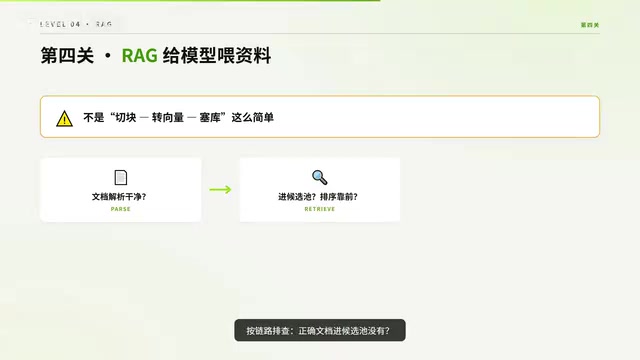
Only after you've ruled out those basics should you bring in advanced techniques like hybrid retrieval, reranking, and query rewriting. The value of RAG comes down to one sentence: reliably putting the right information in front of the model, rather than letting it make things up.
Checkpoint project: Build a complete RAG system from scratch.
The RAG pipeline has two core phases — indexing and retrieval. In the indexing phase, documents are chunked, converted to vectors, and stored in a vector database. In the retrieval phase, the user's question is also vectorized, and the most relevant chunks are found using cosine similarity or approximate nearest neighbor algorithms, then assembled into the prompt for the model. Hybrid retrieval combines vector search (semantic similarity) with keyword search (e.g., BM25), with a reranking model scoring both result sets; query rewriting has the model expand or rephrase the user's question into a form that's more retrieval-friendly before the search runs. All of these advanced techniques assume your baseline pipeline is solid — clean document parsing, sensible chunk sizes, and embedding models that fit your domain. Otherwise you'll be optimizing in the wrong direction entirely.
Level 5: An Agent Is Just Everything Above, Wired Together
This is when you finally start touching real Agents — and it's not mysterious at all. At its core, it's a large language model plus planning, memory, and tools, running on a "reason → act → observe → revise" loop.
Memory needs to be layered: short-term memory holds task state, long-term memory accumulates user preferences. Don't treat raw chat history as memory. For tool integration, you need to understand MCP; for accumulating task experience, you need Skills — and these are not the same thing. MCP answers "how do tools plug in," while Skills answer "what's the process for doing this kind of work."
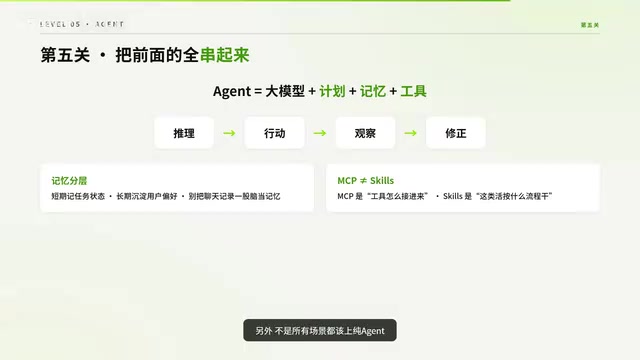
There's also an important judgment call here: not every scenario calls for a pure Agent. For tasks with clear, defined flows, a Workflow is far more controllable. Pure Agents are flexible but expensive, hard to debug, and produce unpredictable traces. Every system that actually works in production shares one trait: let the model handle what the model should judge, and lock down in code what code should lock down.
Checkpoint project: Wire the previous four levels together into a complete, tool-calling Agent.
MCP (Model Context Protocol) is an open protocol introduced by Anthropic in 2024, designed to standardize the interface between large language models and external tools and data sources — think of it like USB for hardware peripherals, so tools don't need to be individually adapted for each model. The choice between Workflow and pure Agent is fundamentally a trade-off between determinism and flexibility: a Workflow fixes the execution path through a predefined directed graph, where each step is predictable and reversible — ideal for structured scenarios like approval flows or report generation. A pure Agent relies on the model to dynamically plan its next action at runtime, which suits open-ended tasks with ambiguous or variable paths, but at the cost of higher debugging complexity, greater token consumption, and behavior that's hard to reproduce. Real systems typically mix both: stable subprocesses get fixed into Workflows, while decision-heavy nodes are handed off to the Agent.
Learning to Build Agents Is Learning an Engineering Collaboration Method
Learning to build Agents isn't about learning a specific framework. It's about learning how to engineer a collaboration with a colleague who is confidently capable of making things up.
Work through these five levels in order, ship a small project at each step, and don't rush into frameworks. Hand-crank the minimal end-to-end loop yourself first — only then will you truly understand what the framework is actually saving you from. This bottom-up learning path is slower, yes, but every step is solid. That beats collecting tutorials you never act on by a mile.
Related articles

LynnReal-Omni: 32B Unified Video Diffusion Model Goes Open Source with Multi-Task Coverage in Four Steps
LynnReal-Omni is a 32B unified video diffusion model on MiniMax H3, covering text-to-video, pose guidance, style transfer, restoration in 4 steps. Flash version generates 540p video in 377ms on one H100.

Anthropic Co-Founder: AI 'Kill Switch' May Need to Be Mandatory by Law
Anthropic's co-founder tells the BBC that AI 'kill switches' may need to be legally mandated. We analyze the industry logic, technical challenges, and the tension between regulation and innovation.

The AI Data Center Boom Is Colliding With Cities Scarred by Heavy Industry
The AI data center boom is clashing with post-industrial communities. Philadelphia's case reveals structural conflicts between AI growth, energy use, water, and environmental justice.