A Beginner's Guide to AI Agents: Core Principles and Learning Paths Explained

A beginner-friendly guide to AI Agent principles, LLM differences, and learning paths for developers and non-coders.
This article explains AI Agents from scratch using intuitive analogies. It clarifies how Agents differ from LLMs — Agents decompose tasks into sub-tasks and repeatedly call LLMs to execute them. It highlights the critical role of human-designed rules (prompts) in ensuring reliable Agent behavior, and provides two distinct learning paths: a deep technical route for programmers and a practical tool-based approach for non-technical users.
Introduction: Why Agents Are So Hot in AI
Over the past two years, AI Agents have become one of the hottest topics in artificial intelligence. From various frameworks and open-source projects to industry talks, Agents are everywhere. But for absolute beginners, a core question remains: What exactly is an Agent? How does it relate to large language models? And how should I start learning from scratch?
This article is based on a beginner-friendly explanation of AI Agents by B-site creator Tang Yudi. Unlike typical concept-heavy overviews, the author deliberately avoided opening slides to recite definitions. Instead, the explanation starts from practical experience to help readers truly understand the essence of Agents. As he emphasizes: There is no single, perfect definition of an Agent — it's a very "fluid" concept.
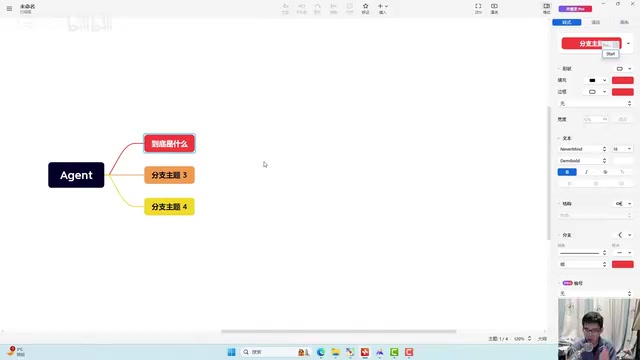
What Is an AI Agent: Explained with a "Go to Class for Me" Example
A Vivid Analogy to Help You Get It Instantly
The word "Agent" is often translated as "proxy" or "intelligent agent." Here's a very down-to-earth example: Imagine one morning you can't get out of bed, so you tell your roommate, "Hey buddy, go to class for me."
This seemingly simple command actually needs to be broken down into many steps:
- When the teacher takes attendance, your roommate needs to raise their hand and say "here" for you
- When the teacher assigns homework, your roommate needs to submit it on your behalf
- When the teacher covers key points, your roommate needs to take notes for you
- By lunchtime, your roommate might even infer that you're still sleeping or playing games, and bring food back for you
This is the core logic of an Agent: You give it a request or command, but that request can't be accomplished in a single step — it needs to be broken down into multiple processes, each completed individually.
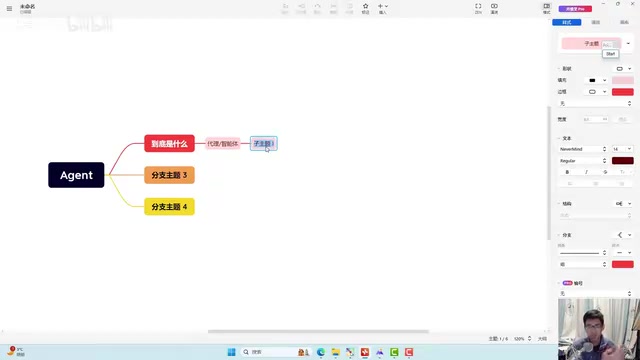
The Essential Difference Between Agents and Large Language Models
Many people confuse Agents with large language models. To understand the difference, you first need to know what a large language model is. A Large Language Model (LLM) is a large-scale neural network model trained on the Transformer architecture, such as GPT-4, Claude, Llama, etc. They learn statistical patterns and knowledge representations by pre-training on massive text datasets. The core capabilities of LLMs include text generation, reasoning, code writing, and more, but at their heart, they're still predicting the next token based on probability. Understanding this is crucial for understanding Agents — every decision an Agent makes is essentially leveraging the probabilistic reasoning capability of the LLM.
The key differences between the two are:
LLMs operate in a "question-and-answer" mode — you ask a question, it answers; you ask again, it answers again. This is a passive, single-turn interaction.
Agents follow a complete "understand → decompose → execute" pipeline:
- Step one: understand your command
- Step two: break the task down into multiple sub-tasks based on that understanding (what to do first, second, third)
- Step three: execute each sub-task one by one, ultimately completing the overall goal
In other words, the LLM is the Agent's "brain," while the Agent is the complete "action system" built around that brain — a combination of capabilities including perceiving the environment, making plans, invoking tools, remembering history, and more.
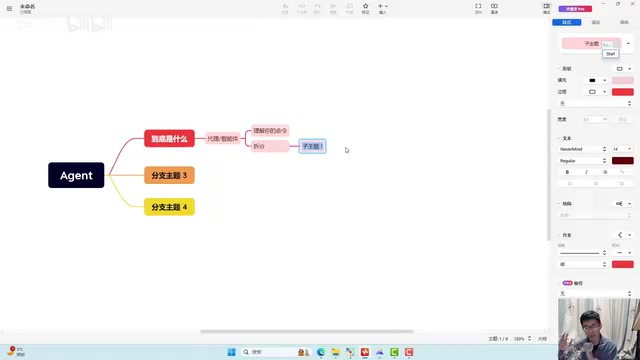
How Agents Work: Everything Is Powered by the LLM
How an Agent Breaks Down Tasks
Many people assume an Agent "has a mind of its own" and can truly understand and think. But the reality is: Inside an Agent, everything is accomplished using the LLM.
Taking "go to class for me" as an example, here's how an Agent actually works:
- First, it takes the command along with the user's contextual information (e.g., "Tang Yudi doesn't like going to class, but he likes reviewing notes before exams") as a prompt
- It feeds this to the LLM, asking it to break the entire task into several sub-commands
- The LLM returns: do A, do B, do C
After completing each sub-task, the Agent queries the LLM again: "What's my current situation? What commands have I received? What should I do next?"
So the essence of an Agent is that it engages in extensive interaction with the LLM. For every decision it makes and every task it performs, it asks the LLM, "What should I do?" This is a critical point — an Agent isn't something entirely new and separate from LLMs; it's a better way of utilizing them.
This pattern of making multiple calls to the LLM is known in academia as the "Reasoning-Action" (ReAct) paradigm or the "Plan-and-Execute" paradigm. The ReAct pattern has the model alternate between Thought and Action, with each step deciding the next operation based on the observation from the previous step. This design enables Agents to handle complex tasks requiring multi-step reasoning, rather than just generating a one-shot answer.
The Importance of Rule Design: Why Agents Still Need Human-Crafted Prompts
This is one of the most valuable insights for understanding Agents:
As of now, Agents still can't truly understand every human behavior. This is because LLMs can hallucinate, producing outputs that are unstable or even "divergent."
LLM hallucination refers to the model generating content that seems plausible but is actually incorrect or entirely fabricated. This is inherent to the generation mechanism — LLMs sample text based on probability distributions and don't possess true fact-verification capabilities. In Agent scenarios, hallucination is particularly problematic because an incorrect output from one sub-task can be amplified by subsequent steps, causing the entire task chain to go off track. This is one of the fundamental reasons why Agents need human-defined rules as constraints.
So how does an Agent ensure stable execution? The answer is — rules.
Rules are essentially human-written prompts. In Agent architectures, prompts are not just the user's raw input — they include system instructions (System Prompt), contextual information, conversation history, tool invocation results, and other multi-layered information concatenated together. Well-designed prompts can significantly improve an Agent's task completion quality. For example, "For going to class, you must sign in for me, you must do this, you must do that" — hardcoding the key processes to ensure the Agent can smoothly and perfectly complete the task.
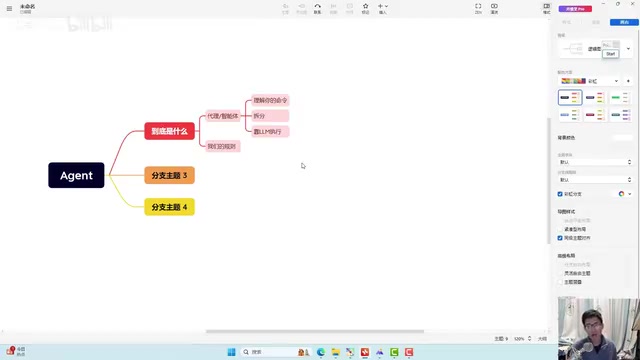
Many frameworks, projects, and talks today over-mythologize Agents, as if they can analyze and understand everything on their own. But virtually all truly successful cases today are the result of carefully human-designed rules.
Take software development as an example: first, a product manager (PM) defines every step of the process, then the corresponding developers implement each step. The whole thing relies on thorough process design. Agents themselves still struggle to possess genuine self-directed thinking — it's not that they absolutely can't, but if you don't design proper rules, the results will be poor.
This reality has also given rise to an emerging engineering role — Agent engineers or Prompt engineers. Their core work involves designing reasonable task decomposition workflows, writing high-quality system prompts, defining tool invocation specifications, and building error handling and fallback mechanisms to ensure Agents run stably across various edge cases.
Learning Paths for Beginners: Different Routes for Different People
Depending on your learning goals, beginners can be divided into two groups, each with a distinctly different recommended path.
Type 1: Programmers Who Want to Build and Develop Agents
If you want to go deep into the underlying technology and do development, here's the recommended systematic learning path:
- Build a solid programming foundation: Master Python, frameworks, data analysis, and other foundational skills first
- Go straight to LLMs: You can skip the tedious NLP basics and jump directly to large language models, with a focus on learning the Transformers library. Transformers is an open-source library developed by Hugging Face that provides a unified interface for thousands of pre-trained models, supporting tasks like text classification, generation, and question answering. It's currently the most mainstream toolkit in LLM development.
- Model deployment: Learn how to fine-tune, quantize, and deploy LLMs. Fine-tuning means continuing to train a pre-trained model on domain-specific data to adapt it to specific tasks. Quantization compresses model parameters from high precision (e.g., FP32) to low precision (e.g., INT4/INT8) to reduce memory usage and speed up inference. Common tools include GPTQ, AWQ, bitsandbytes, etc.
- Knowledge base construction: Learn RAG (Retrieval-Augmented Generation) related technologies. RAG is a key technique for addressing the timeliness and accuracy limitations of LLM knowledge. The core idea is: before generating an answer, retrieve relevant document fragments from an external knowledge base, inject them into the prompt as context, and then have the LLM generate the final answer. RAG involves document chunking, vector embeddings, vector databases (such as Pinecone, Milvus, FAISS), similarity search, and other components, making it a foundational capability for building enterprise-grade Agent applications.
- Choose an Agent framework: Pick an open-source framework to study in depth — LangChain is recommended. LangChain is one of the most popular LLM application development frameworks, created by Harrison Chase in 2022. It provides core abstractions like Chain, Agent, Memory, and Tool, helping developers quickly build complex applications based on LLMs. LangChain's Agent module supports multiple reasoning paradigms including ReAct and Plan-and-Execute, allowing models to dynamically select tools and execute multi-step operations. Similar frameworks include LlamaIndex (focused on data indexing and retrieval), AutoGen (Microsoft's multi-Agent collaboration framework), CrewAI (a role-playing multi-Agent framework), and others, each with different strengths. Learners can choose based on their needs.
For developers, there's an important piece of advice: Don't just learn how to use frameworks — learn to read the source code. Understand which algorithms the framework uses, what those algorithms do, which modules are involved, and what each module does. Aim for source-code-level understanding. While this takes significant time, for those who want to evolve from "users" to "developers," it's absolutely worth the effort.
Type 2: Non-Technical Background, Just Want to Use Agents for Applications
If you simply want to build applications and create things for yourself, the advice is straightforward:
Just choose between Claude Code and Codex.
Claude Code is a programming Agent tool from Anthropic built on the Claude model. It can understand codebases, write code, and execute commands in a terminal environment to complete complex software development tasks. Codex is OpenAI's programming Agent product with similar autonomous coding and task execution capabilities. These two tools represent the latest application of Agents in software development — users simply describe their needs in natural language, and the tool autonomously handles code writing, debugging, deployment, and more, dramatically lowering the barrier for non-technical people to build applications.
Both tools work great and can help you with development, office tasks, image editing, and more. Which one to choose depends on your specific needs and use case.
Summary: How to Properly Understand AI Agents
Returning to the original question, we can summarize Agents clearly:
An Agent is designed to help us accomplish a task, but to do so, it breaks it down — decomposing the overall task into many sub-tasks, then combining each sub-task with your "game rules" (i.e., prompts) to call the LLM, ultimately producing the desired output.
From a technical architecture perspective, a complete Agent system typically contains these core components: the LLM (responsible for reasoning and decision-making), a memory system (short-term memory for current conversation context, long-term memory for historical interaction data), a toolset (external capabilities like search engines, code executors, database queries, etc.), and a planning module (responsible for task decomposition and execution strategy). These components work together to enable Agents to handle complex tasks far beyond what a single LLM call can achieve.
The design philosophy of Agents can be summed up in one sentence: Make the Agent mimic human behavior — whatever a human would do, have the Agent follow the same logic.
The value of this understanding framework is that it reveals both the Agent's real capabilities (essentially orchestrating and calling LLMs) and its current limitations (still dependent on human-designed rules). For every learner looking to get started with Agents, building this pragmatic and clear-eyed understanding is far more important than chasing over-hyped concepts.
It's worth noting that Agent technology is evolving rapidly. From the earliest single-Agent systems to today's multi-Agent collaboration architectures, to advanced Agents with self-reflection and self-improvement capabilities, this field sees major breakthroughs every few months. But no matter how the technology iterates, the core principles outlined in this article — LLM-driven, task decomposition, rule constraints — will remain the fundamental paradigm of Agent systems for the foreseeable future.
Related articles

ml-pipes: Building Software Engineering Best Practices Into ML Inference Pipelines
ml-pipes is an open-source framework that builds pre-run validation, pipeline inspection, tracing, and benchmarking into ML inference pipelines, bridging the MLOps engineering gap.

Aquifer Open Source: A Traffic Smoothing Solution for Peak Shaving Bursty GPU Inference Workloads
Aquifer is an open-source traffic smoothing runtime that uses durable queue buffering and backend backpressure to solve burst traffic challenges in GPU inference services, enabling peak shaving and cost reduction.

AI Mass-Producing Sales Videos: The Horse Racing Revolution in Content Commerce
Breaking down an explosive overseas AI content commerce strategy: batch-generating sales videos via AI workflows and horse-race testing them on TikTok and Instagram with CLI + Codex automation.